
WYCKOFF · C / D
Wyckoff spring and test: how to read it
A brief move below support does not establish that a range has recovered. This guide separates the observations to compare with a schematic, the current confirmed phase and the later outcome that cannot already be known when an event appears.
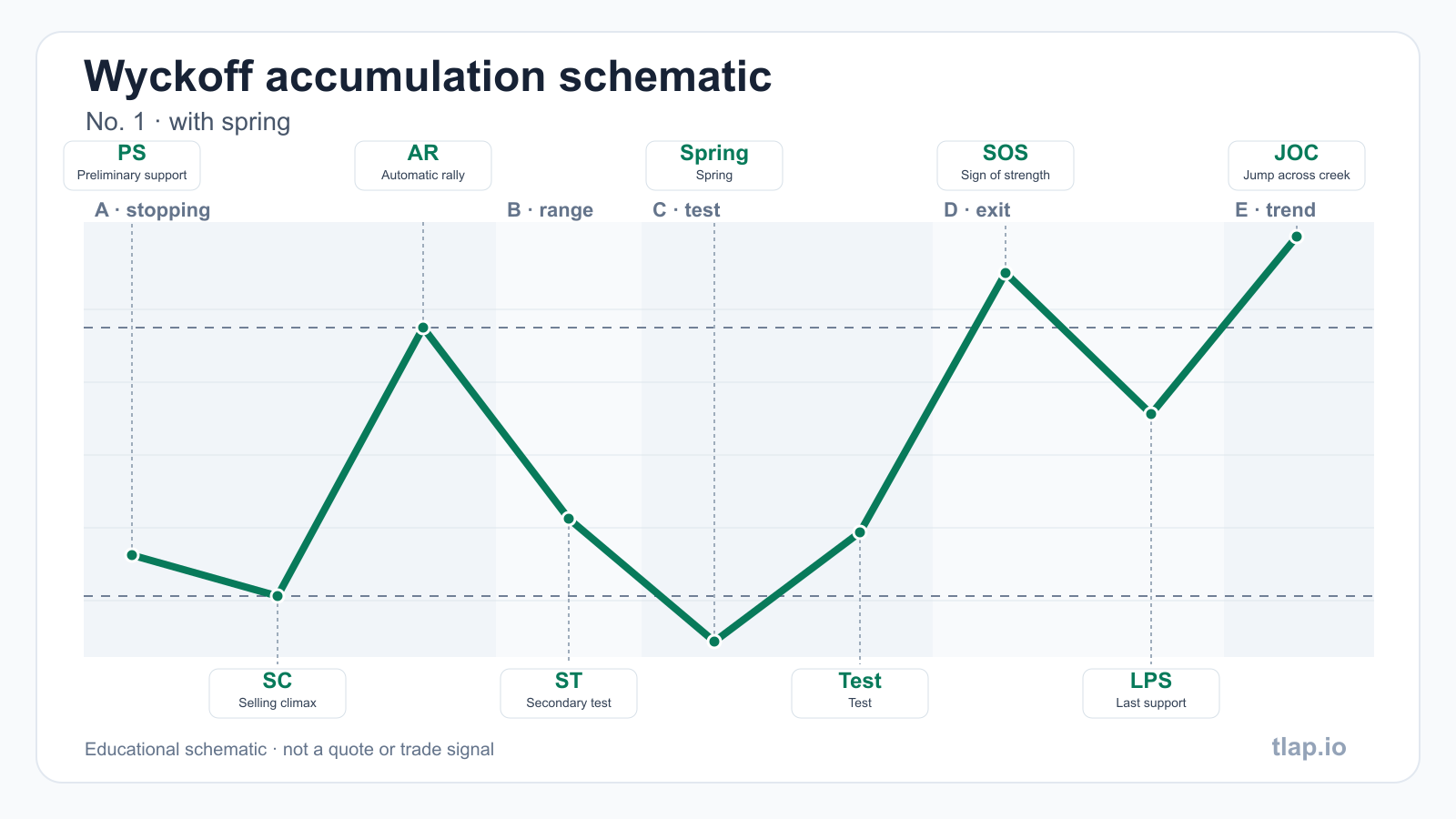
What a spring and its test describe
A spring moves below support and returns; a subsequent test examines that recovery. The classical account compares the test with the spring using price spread and volume. This is an observation sequence, not a name for every lower wick.
Begin with one structure and one timeframe. Record its lower boundary and the candle closing times, then locate the excursion and return. Boundaries from a different range make the comparison unreliable: the same candle can lie inside a new structure and outside the old one.
Reading the current TLAP block
The block below selects active accumulation in phases C and D from a complete, fresh scanner response. A phase C entry does not establish that a spring occurred: the range may be testing without a late false break. Open the scanner and inspect the actual event label, time and subsequent closes.
The snapshot time belongs to the summary, not to a forecast. The same instrument on 1H and 4H represents two separate observations. If the response is incomplete or stale, the current list is unknown; unavailable data does not mean that no matching ranges exist.
A comparison you can repeat
Record the ticker, timeframe, boundary and event time. Inspect the close after the return, then the later test separately. If an update recalculates the boundary, compare the new markup with your recorded time rather than a remembered chart shape. A proxy-volume label does not represent consolidated exchange volume.
An educational drawing supplies no price scale for a real instrument. Its purpose is to preserve label order. Compare schematics No. 1 and No. 2 in the atlas: the absence of a spring does not make the observed phase invalid and does not alone confirm the alternative variant.
Confirmation and outcome are separate
A confirmed event can later be invalidated or finish without reaching its target. Check the separate outcome in scanner history. Do not substitute the next candle's colour or append an unclosed bar to a completed observation. The diagram example and the current row are different objects with different dates.
FAQ
Is every move below support a spring?
No. The specific range boundaries, a return and subsequent closes must be checked. A candle wick does not establish the sequence.
Why does the block show C and D only?
They concern the decisive test and subsequent confirmation. Earlier A/B phases and the E phase remain available in the scanner.
Does an empty list mean a failure?
Not when a complete fresh response contains no matching active ranges. An unavailable response is shown separately, without a numeric zero.