
WYCKOFF · A / B / C / D / E
Wyckoff method for crypto
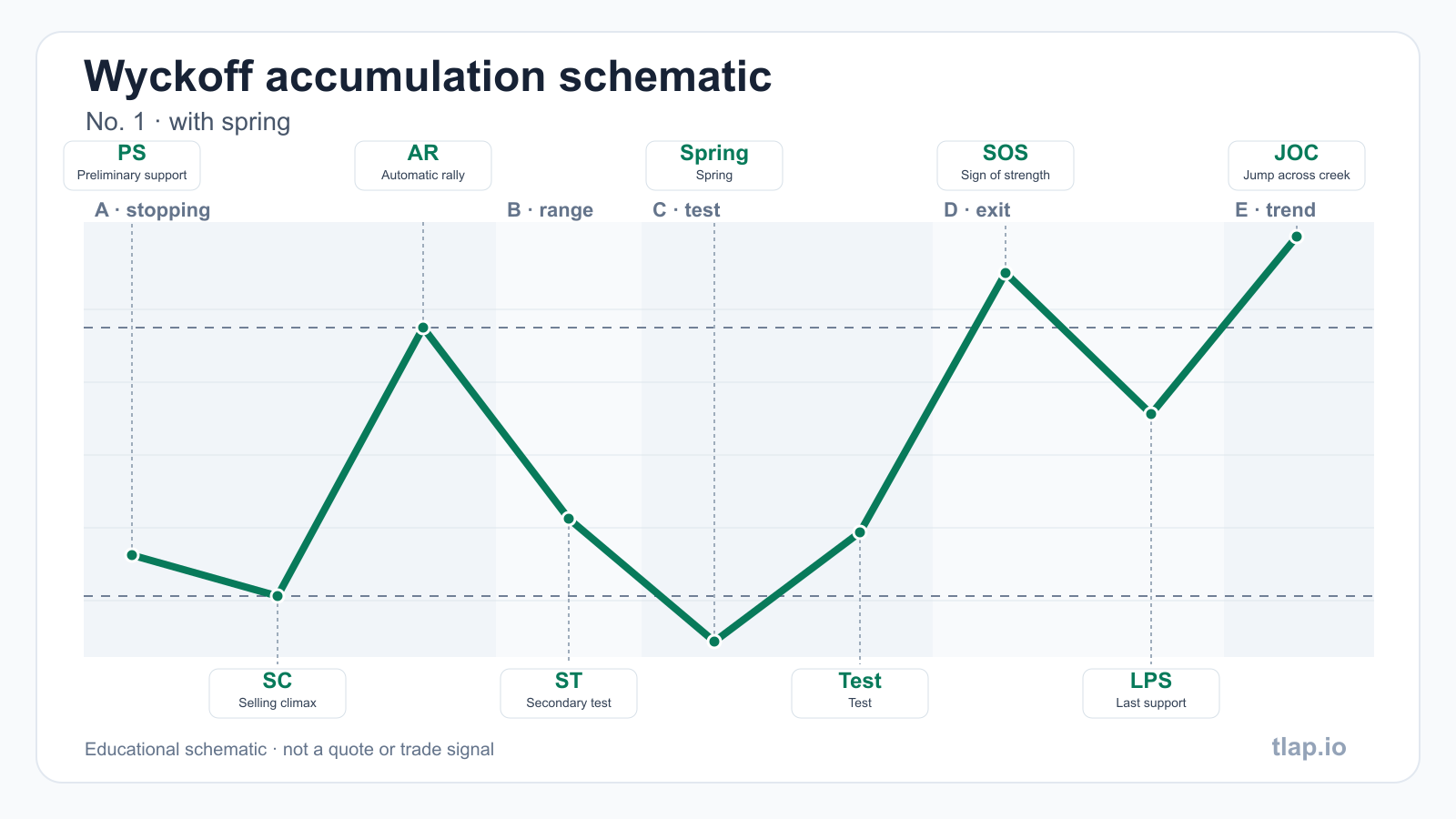
A crypto ticker does not define one chart shared by every venue. Repeatable markup requires the candle source, timeframe and closing time. The educational schematic remains the same, but current values belong to a specific series whose provenance and missing observations must be preserved.
From a ticker to an inspectable observation
Open a crypto instrument in the scanner and select one timeframe. Record the snapshot time and last closed candle. Do not compare an unclosed 1H candle with a completed 4H candle as simultaneous events. Identical tickers across venues do not guarantee identical extremes or volumes either.
This article's live list is restricted to crypto instruments in the same configuration catalog used by the scanner. It adds no assets because of popularity or a page title. Accumulation and distribution remain observations on an individual timeframe for each instrument.
Volume belongs to its source
Check whether volume comes from the exchange series or is labelled as a proxy. Even exchange observations belong to the selected source; the number does not reveal total turnover across venues. When combining series, define units and an aggregation rule first rather than adding unrelated bars.
A sustained price move and high volume do not identify a participant. Record the actual event, boundary and closed candle in the scanner. Those details can be checked after an update; a story about an unknown large participant's intention does not replace observable conditions.
Current structure and history
The block includes active accumulation and distribution in A–E. Zero in a phase means a complete fresh response contains no matching rows; an unavailable response is shown separately. Phase B need not immediately produce a C event, and C does not confirm the same schematic variant for every asset.
Open both accumulation and distribution in the atlas, then the actual instrument. Educational drawings contain neither execution prices nor current volume. Compare event order rather than mapping the drawn rally's height to a future return. Preserve the date in history because new closes can change boundaries.
Preserve gaps and keep outcomes separate
When a candle series is missing, do not fill it from another venue without an explicit source decision. A missing interval is not zero volume. A measured event outcome is separate from phase: a confirmed structure can be cancelled or finish without reaching its target. A continuously traded market does not make that result known in advance.
FAQ
Why can one ticker have different phases?
Different timeframes contain different sequences of closed candles. The source must also match when comparing observations.
Does the block include every cryptocurrency?
No. It selects the current scanner's crypto catalog and verified active structures only.
Can the diagram be read as current BTC?
No. It is an educational schematic without a current price scale. The actual observation is in the instrument's live row.