
Funding Rate — Crypto Perpetual Funding Across 5 Exchanges
Funding Rate is a periodic payment exchanged between traders holding long and short positions in perpetual futures contracts. The mechanism helps keep the price of a perpetual contract aligned with the underlying spot or index price.
When the Funding Rate is positive, long position holders pay short position holders. When the rate is negative, short position holders pay longs. Funding is exchanged between traders rather than being a conventional trading fee charged by the exchange.
The TLAP Funding Rate Tool displays current funding rates for popular cryptocurrencies across Binance, Bybit, OKX, Bitget, and Deribit. It allows traders to compare funding across exchanges and evaluate the derivatives market environment.
Funding Rate Tool Features
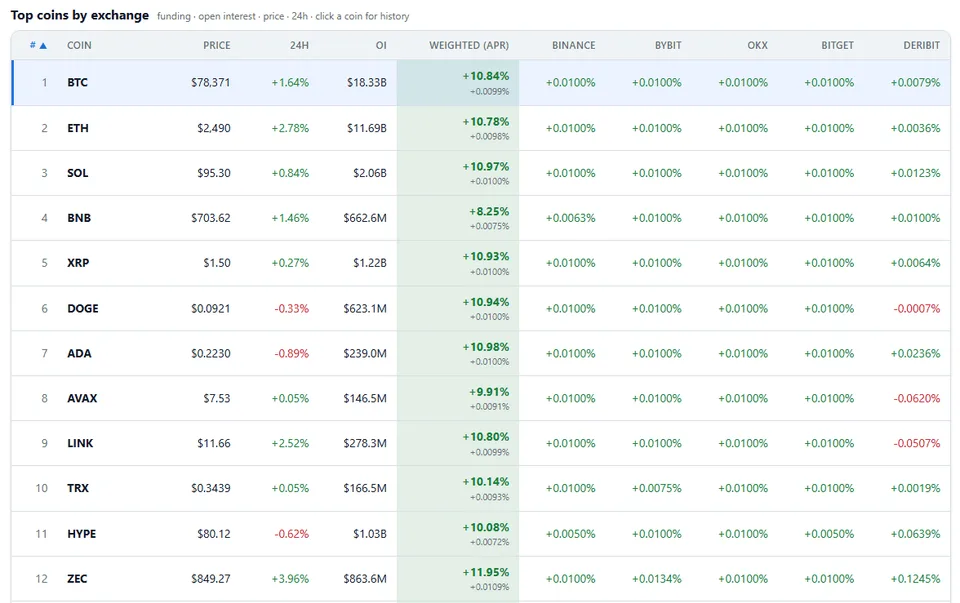
For each cryptocurrency, the tool provides:
current price and 24-hour price change;
Open Interest (OI) in USD;
current Funding Rate across five exchanges;
annualized Funding Rate.
The annualized figure extrapolates the current funding rate over a year. It is a reference value, not a forecast of future funding costs or a guaranteed return.
You can search for a specific cryptocurrency and filter the table by:
market capitalization;
high or low Funding Rate;
Open Interest.
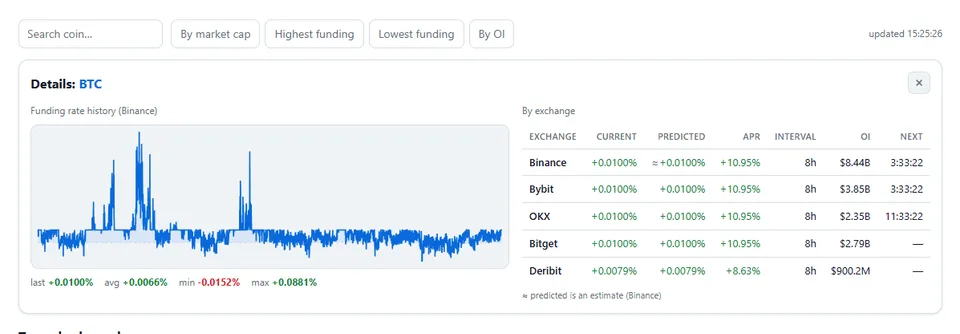
Clicking an asset opens its Funding Rate history, allowing you to track how funding has changed over time.
Four summary metrics are shown below the chart:
Current Funding Rate
Average Funding Rate
Minimum Funding Rate
Maximum Funding Rate
The exchange-level table shows:
current Funding Rate;
Predicted / Estimated Funding Rate, where available;
annualized Funding Rate;
funding interval;
next funding time;
Open Interest.
Funding data is updated automatically using public cryptocurrency exchange APIs. Funding intervals and calculation methods can vary between exchanges, so cross-exchange comparisons should take the relevant funding schedule into account.
How to Analyze Funding Rate
Funding Rate provides context on the cost of holding perpetual futures positions, the premium or discount of the perpetual contract, and the balance of demand between long and short exposure.
It can also provide useful information about derivatives market sentiment and positioning, but it is not a direct measure of the number of long or short positions.
Funding does not predict price direction on its own. It becomes more useful when analyzed together with price, Open Interest, volume, and liquidation data.
Identifying an Overheated Market
A high positive Funding Rate means that long position holders are paying shorts to maintain long exposure. It can accompany strong bullish sentiment and increasingly crowded long positioning, particularly when Open Interest is also rising.
When price, OI, and Funding Rate all rise, the market may be seeing growing long demand and expanding leveraged exposure. If funding reaches extreme levels relative to the asset's own history, the market may become more vulnerable to a sharp pullback or long squeeze.
A deeply negative Funding Rate means that short position holders are paying longs. It can reflect strong bearish sentiment or increasingly crowded short exposure. If the short side becomes heavily crowded and price reverses sharply, a short squeeze may develop.
Always compare extreme funding readings with the historical range of the specific asset. A rate that is unusually high for one cryptocurrency may be normal for another.
Combining Price, Open Interest and Funding
The most useful approach is to analyze the three metrics together.
Price Rising + OI Rising + Funding Increasing
Price is moving higher while Open Interest expands and funding becomes increasingly positive.
This can indicate growing long demand and potentially crowded positioning, especially when funding reaches historically elevated levels.
However, OI does not reveal whether newly opened exposure is predominantly long or short, so this combination should be interpreted together with price action and other derivatives data.
Price Falling + OI Rising + Negative Funding
Price is declining while Open Interest expands and funding becomes increasingly negative.
This can indicate growing demand for short exposure and potentially crowded bearish positioning.
If the market reverses sharply, crowded short positions may be forced to close, potentially contributing to a short squeeze.
Price Rising + OI Falling
Price is rising while Open Interest declines.
The move may be driven partly by short covering or the closing of existing positions rather than by broad expansion in open futures exposure.
Funding can provide additional context by showing whether the cost of maintaining long or short exposure is changing during the move.
Price Falling + OI Falling
Price is declining while Open Interest decreases.
This can reflect position closing, deleveraging, or long liquidation.
A sharp reduction in OI after a large price move may indicate that leveraged positions are being removed from the market. However, declining OI alone does not distinguish ordinary position closing from forced liquidation.
These combinations provide market context rather than standalone trading signals.
Cross-Exchange Funding Analysis
Funding Rates can differ significantly between exchanges.
Comparing funding across Binance, Bybit, OKX, Bitget, and Deribit can help identify assets with unusually high or low funding on a particular venue.
Differences may reflect variations in local positioning, liquidity, contract specifications, or the premium of the perpetual contract relative to its underlying market.
For traders exploring funding arbitrage, funding is only one part of the calculation. Also consider:
spot price;
perpetual futures price;
futures basis;
trading fees;
liquidity;
transfer costs;
execution costs.
The potential funding income must be weighed against basis risk, transaction costs, execution risk, and the possibility that the Funding Rate changes before the position is closed.
Funding Costs for Perpetual Positions
Funding Rate is particularly important for traders holding perpetual futures positions for extended periods.
Even a relatively small Funding Rate can have a significant effect on PnL when:
position size is large;
leverage is high;
the position is held through many funding periods;
funding remains consistently positive or negative.
The annualized Funding Rate provides a quick reference for the potential carrying cost if the current rate were maintained for a full year. Actual funding paid or received depends on future rates, the funding interval, and the position's notional value.
It is important to distinguish between:
Funding Rate — the applicable percentage rate;
Funding Fee — the actual amount paid or received for a funding period.
Funding intervals can vary by exchange and contract, so the actual funding cost should always be calculated using the conditions of the specific perpetual contract.
For this reason, traders holding perpetual positions should monitor Funding Rate throughout the life of the trade rather than relying only on the rate available at entry.
Important Notice
Funding Rate data is provided for informational and analytical purposes only and does not constitute investment advice or a standalone trading signal.
Funding rates can change rapidly. Extreme positive or negative readings do not guarantee a reversal or continuation of the prevailing trend.
Trading leveraged cryptocurrency derivatives involves substantial risk, including liquidation and the potential loss of the entire trading capital. Before trading, make sure you understand perpetual futures, funding mechanics, leverage, liquidation risk, and the rules applicable to the exchange and contract you trade.