
TLAP Forex Economic Calendar: Track Market-Moving Economic Events
Loading calendar...
No events match the current filters.
What Is the TLAP Economic Calendar?
The TLAP Forex Economic Calendar helps traders monitor important macroeconomic releases and assess their potential impact on the FX market.
The calendar combines scheduled economic events, advanced filters, detailed release data, historical statistics, and additional information about each economic indicator. This makes it easier to identify market-moving events, compare actual results with market expectations, and prepare for periods of potentially elevated volatility.
Economic Release Calendar Overview
The calendar interface is divided into several sections.
Summary and Search

The top section provides a quick overview of market activity, including:
the total number of available economic releases;
the number of releases scheduled for today;
the number of high-impact events;
the time remaining until the next release;
the number of currencies covered by the calendar.
This gives traders a quick view of the upcoming news flow and how active the current trading period may be.
You can search by economic release (economic indicator), currency, or country. Additional filters allow you to select:
High, Medium, or Low impact (importance);
All, Upcoming, or Released events;
individual currencies.
Date navigation lets you view today, tomorrow, or any specific date. This makes the economic release calendar useful for both monitoring upcoming releases and reviewing historical economic data.
Economic Events List
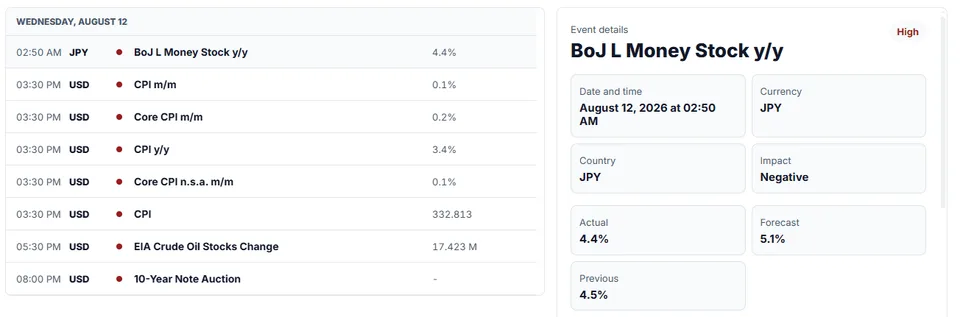
The main section lists economic releases grouped by date. Each release includes:
release time;
affected currency;
impact level;
economic indicator;
available release values.
This makes it easy to identify which releases may affect a particular currency pair and when market volatility may increase.
Release Details
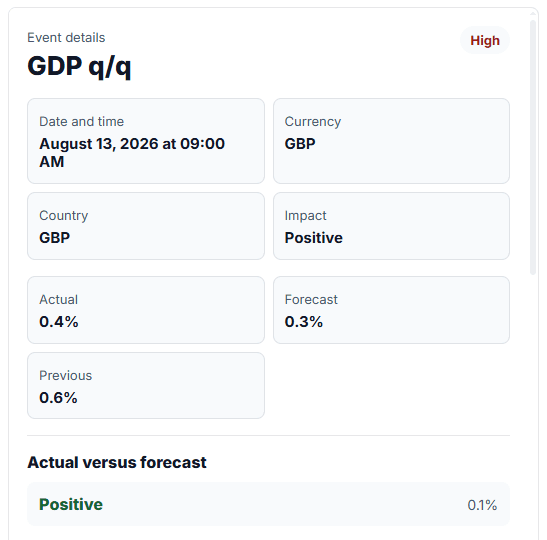
Selecting an individual release opens a detailed information panel.
It shows the release date and time, affected currency, country, and the potential market impact of the release.
For released data, three key values are displayed:
Actual — the reported value;
Forecast — the market consensus estimate;
Previous — the previous reported value.
The panel also highlights the difference between the Actual and Forecast values, helping traders quickly assess whether the release came in above or below expectations.
A significant surprise versus market consensus can trigger a sharp market reaction. The direction and magnitude of that reaction depend on the economic indicator, the size of the surprise, and the broader macroeconomic environment.
The market does not simply react to whether a number is "high" or "low" in absolute terms. What often matters most is how the result compares with market expectations and what it implies for the broader economic and monetary-policy outlook.
Economic Indicator Description
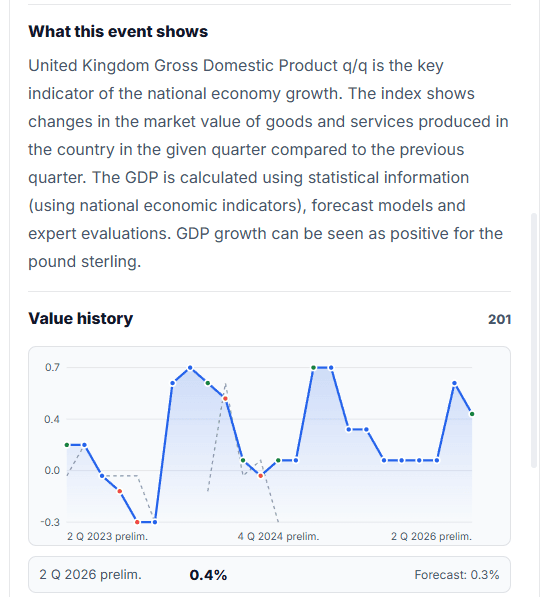
Each release includes an explanation of the economic indicator itself: what it measures, how the data is calculated, why it matters for the economy, and how the publication may affect financial markets.
For example, a UK GDP (Gross Domestic Product) release describes changes in the total output of goods and services produced by the UK economy and provides insight into the pace of economic growth.
The calendar also provides a historical data chart for supported indicators.
The chart helps traders:
track the indicator's historical trend;
identify accelerating or slowing economic conditions;
compare current readings with previous releases;
evaluate whether the latest result fits the broader macro trend.
Where available, forecast values are also displayed, allowing traders to compare market expectations with the eventual release.
Recent releases below the chart show the period, Actual value, and Forecast, making it easier to track how economic data and expectations have evolved over time.
Additional Release Information
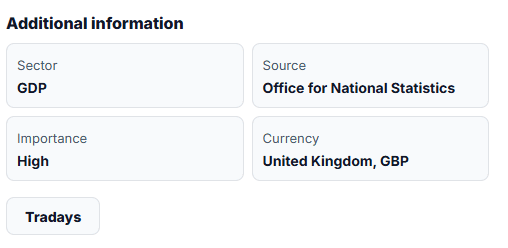
A separate information block provides key characteristics of the selected release:
Sector — the economic category, such as GDP, inflation, employment, or interest rates;
Source — the organization or government agency publishing the data;
Importance — the expected market significance of the release;
Currency — the currency most directly affected by the release.
How to Use the Economic Calendar in Trading
The TLAP Economic Calendar is most useful as a macro filter and risk-management tool, rather than as a standalone trading signal.
Track High-Impact Events
Major economic releases can trigger sharp moves and volatility spikes in FX markets.
Pay particular attention to inflation data, employment reports, GDP releases, interest rate decisions, central bank announcements, and other high-impact events.
Compare Actual vs. Forecast
The difference between the Actual result and the Forecast is often more important than the headline number itself.
A significant positive or negative surprise versus market consensus can rapidly change expectations and trigger a strong price reaction.
The impact depends on the release. A higher-than-expected inflation reading, for example, may have a very different market effect from a stronger-than-expected GDP figure.
Review Previous Data
Comparing the latest result with previous releases helps identify whether economic conditions are improving, deteriorating, accelerating, or slowing.
Revisions to previous data can also change how the market interprets the latest release.
Analyze Historical Data
Use historical charts to understand the broader trend of an economic indicator rather than focusing on a single release.
This is particularly useful for identifying persistent changes in inflation, growth, employment, monetary policy, etc .
Focus on the Affected Currency
A release affecting the USD, EUR, GBP, JPY, or another major currency can influence multiple related currency pairs.
When analyzing an event, consider the currency directly affected by the release as well as the broader FX market context.
Plan Trades Around Major Releases
The calendar helps identify periods when volatility may increase.
Ahead of high-impact events, traders may adjust position size, stop-loss placement, and overall market exposure. Some strategies may also avoid opening new positions immediately before major releases.
After the announcement, traders can monitor the initial market reaction and look for confirmation from price action before entering a position.
Combine Fundamental and Technical Analysis
Economic releases provide macroeconomic context but do not guarantee a specific price response.
For example, a stronger-than-expected economic release may support a currency, but the initial reaction can be limited if the result was already priced into the market.
Use the economic calendar together with price action, market structure, support and resistance, and your trading strategy.
Typical Workflow
A practical approach is:
Economic Calendar → Event Impact → Market Expectations → Actual vs. Forecast → Market Reaction → Technical Confirmation → Trade and Risk Management
This workflow helps traders prepare for major releases without treating economic news as a standalone entry signal.
Important Notice
The TLAP Economic Calendar provides informational data about scheduled and released economic events. It is not an investment recommendation or a standalone trading signal.
Market reactions can differ from expectations, and high-impact releases may cause sharp price movements, wider spreads, slippage, and increased trading risk.
Before entering a trade, consider the broader fundamental and technical context, your risk-management rules, position size, and individual risk tolerance.