
Tokenized US Stocks and How to Buy Them on Bybit
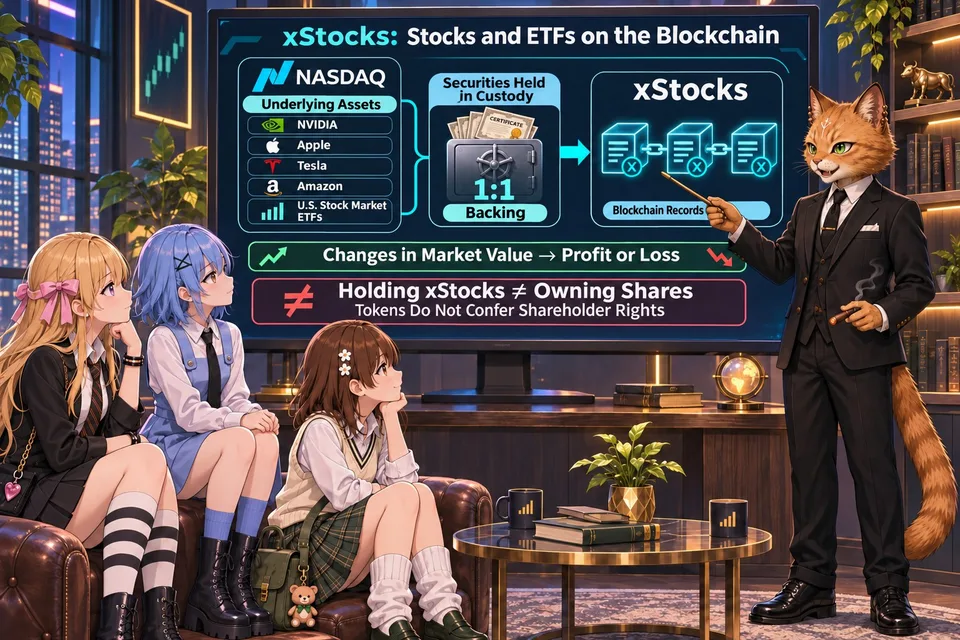
xStocks is a range of tokenized stocks and ETFs from Backed, available on cryptocurrency platforms including Bybit. The project launched in May 2025. The underlying assets include NVIDIA, Apple, Tesla and Amazon shares, as well as ETFs tracking the US stock market.
The tokens are backed by the corresponding underlying securities at a 1:1 ratio and allow holders to profit or incur losses from changes in their market value. However, holding xStocks does not mean owning the shares themselves and does not grant shareholder rights.
Let's look at how tokenized stocks work, how they differ from regular securities and CFDs, where to buy them and how to trade them, using the NVIDIA token on the Bybit exchange as an example.
What tokenized stocks are in simple terms
Tokenized stocks are digital assets issued on a blockchain and linked to shares of publicly traded companies. They allow investors to benefit financially from changes in the value of securities without having to open a traditional brokerage account.
For example, NVIDIA stock trades on the US Nasdaq exchange under the ticker NVDA. Its tokenized version may trade on a cryptocurrency platform under a different symbol, such as NVDAX on Bybit.
If NVIDIA's stock price rises, the token's price should also increase. If the underlying stock falls in price, the token generally loses value. This gives an investor the opportunity to trade the price movements of an American company's stock through cryptocurrency infrastructure.
Tokenization is based on blockchain technology. Instead of a traditional record of asset ownership in a centralized recordkeeping system, a digital token is created that may contain information about the holder's rights or refer to the relevant legal documents.
It is also necessary to distinguish between three concepts:
Underlying asset — a company's stock, such as NVIDIA, Apple or Tesla.
Token — a digital instrument whose value or rights are linked to the underlying share.
Issuer — an organization that issues tokens and is responsible for their legal and economic structure.
How tokenized stocks differ from regular stocks and CFDs
All three instruments allow you to profit from changes in the value of securities, but they are structured differently.
Criterion | Traditional stocks | Tokenized stocks | CFD |
|---|---|---|---|
What the investor buys | A security | A digital token | A contract with a broker |
Backing | The company's equity itself | Depends on the issuance model | The broker's contractual obligations |
Voting rights | Yes, under the terms of the share class | Depends on the token's design | No |
Dividends | Under the terms of the stock | Under the terms of the token issuance | A cash adjustment is possible |
Trading venue | Stock exchange | Crypto exchange or blockchain platform | Brokerage platform |
Trading hours | During stock exchange hours | Can be 24/7 | Depends on the broker and instrument |
Withdrawal to a personal wallet | No | Available for supported tokens | No |
The main difference from regular stocks lies in the legal nature of ownership. The buyer of a security becomes a shareholder, while the buyer of a token may receive only the right to financial exposure to changes in its value.
The difference from CFDs lies in the transaction mechanism. A CFD is a contract between a trader and a broker, with settlement based on changes in the price of the underlying asset. A tokenized stock is a digital asset that can circulate on a blockchain and be transferred between compatible wallets.
Both instruments are available on some cryptocurrency exchanges. For example, Bybit offers xStocks on the spot market, as well as separate TradFi perpetual contracts and CFDs. These are different products, even if their value is tied to shares of the same company.
Stock tokenization models
The tokenization mechanism depends on who issues the digital asset, how investor rights are recorded and how the token is linked to the underlying stock.
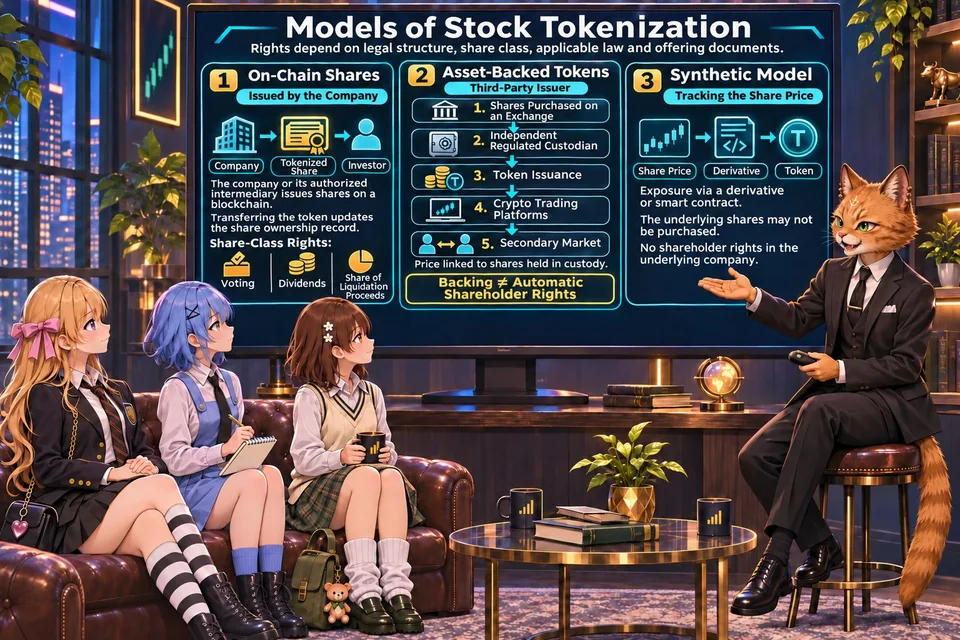
Broadly speaking, three main models can be identified.
1. Issuance of tokenized shares by the company itself
In this case, the company or an intermediary authorized by it issues securities directly on the blockchain.
The record of share ownership is maintained using a distributed ledger. Transferring a token to another investor means changing the record of the owner of the security.
In terms of its economic and legal nature, this model is closest to ordinary shares. If the token represents the same class of shares, the holder may receive the corresponding rights: to participate in voting, receive dividends, and claim a share of the assets upon the company's liquidation in accordance with the law.
2. Issuance of tokens backed by real shares
A model more common on cryptocurrency platforms involves a third-party issuer.
It buys actual shares on the stock market and transfers them to an independent custodian for safekeeping. Digital tokens are then issued, with their value tied to the securities held in custody.
A simplified outline is as follows:
The issuer buys shares in a company on a traditional stock exchange.
The securities are transferred to a regulated custodian.
The issuer issues a corresponding number of tokens.
The tokens are listed on cryptocurrency platforms.
Investors buy and sell them on the secondary market.
For example, Backed issues the xStocks range of tokenized assets. According to Bybit's documentation, these tokens are backed by the corresponding underlying shares at a 1:1 ratio, and the securities are held by an independent custodian.
However, the existence of backing does not mean that a token holder automatically becomes a shareholder in the company. Their rights are determined by the terms of issuance of the digital instrument.
3. Synthetic tokenized assets
In the third model, the issuer issues a digital instrument whose value is tied to a stock's price, but the securities themselves may not be purchased.
In economic terms, such an asset resembles a derivative financial instrument. The investor gains the opportunity to profit from changes in the underlying stock's price but does not acquire rights to it.
For example, if a token tracks the value of Tesla shares, its price will depend on TSLA's performance. However, the investor does not become an owner of Tesla shares and does not receive the rights associated with them.
Therefore, before buying, it is important to find out not only which stock the token is tied to, but also exactly what backs it and what legal rights it provides.
Dividends on tokenized stocks: does the investor receive payouts
Dividends are one of the important features of investing in stocks. If a public company decides to distribute part of its profits among shareholders, holders of the relevant securities may receive a cash payment.
However, the situation with tokenized stocks is more complex.
Dividend payments depend on the token's legal structure and the terms of its issuance. Several options can be identified:
The issuer passes on to token holders the cash payments received from the underlying shares.
Dividends are reinvested, and their economic value is reflected in the token's value.
The issuer adjusts a special multiplier that determines the proportion of the underlying asset represented by one token.
The terms of issuance do not provide for token holders to participate in dividend distributions at all.
Therefore, linking a token to the stock of a dividend-paying company does not in itself mean that the investor will receive payments.
In the case of xStocks, separate cash dividends are not credited to the token holder's account. For example, Bybit states that certain corporate actions, including dividend distributions, may be reflected through adjustments to the token multiplier or other mechanisms used by the issuer.
The number of tokens held by the investor does not change. The economic interest in the underlying share represented by one token and the corresponding reference value may change.
It is important to understand that such an adjustment is not equivalent to receiving dividends in a brokerage account. An xStocks holder does not acquire a shareholder's right to dividend payments.
Thus, when choosing tokenized stocks, investors need to check the rules for corporate actions separately. This is especially relevant for long-term investors who expect to earn not only profits from rising prices but also dividend income.
Advantages and Disadvantages of Tokenized Stocks
The emergence of tokenized stocks expands investment opportunities, but at the same time introduces new risks associated with cryptocurrency infrastructure.
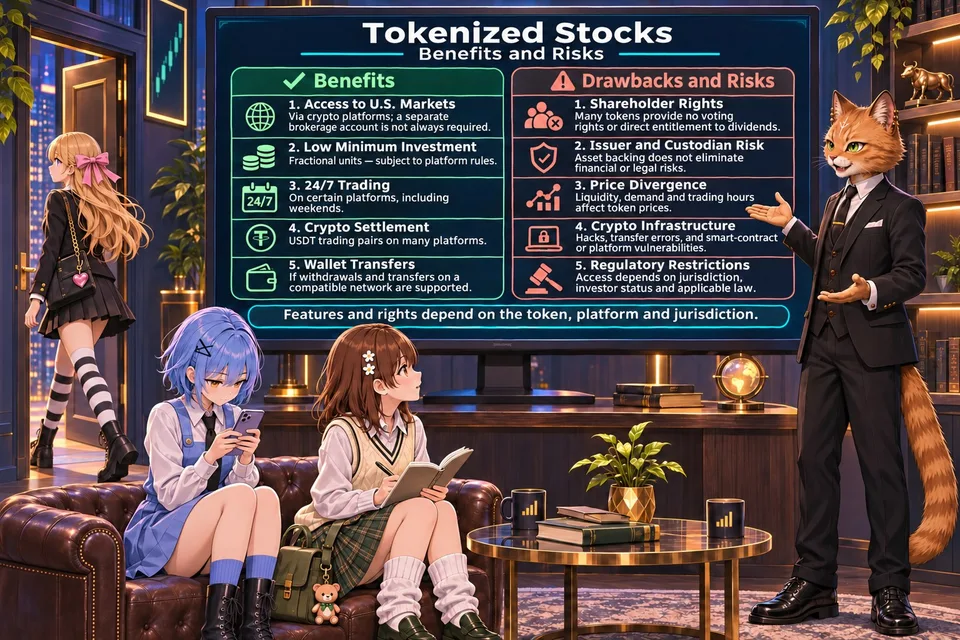
Advantages
1. Access to the U.S. stock market.
Tokenization provides access to shares in major international companies through cryptocurrency platforms. Trading does not always require opening a separate account with a traditional broker.
2. Low barrier to entry.
Depending on the platform's rules, you can buy small fractions of tokenized assets. This makes it possible to invest limited capital in expensive company shares.
3. Round-the-clock trading.
Some cryptocurrency platforms allow tokenized stocks to be traded 24 hours a day, including weekends and public holidays. This differs from traditional stock exchanges, which operate on a fixed schedule.
4. Settlement in cryptocurrency.
On many platforms, tokenized stocks are traded in pairs with USDT. An investor does not have to convert funds into dollars and use traditional banking infrastructure every time.
5. Ability to transfer between wallets.
Some tokens can be withdrawn from an exchange and held in compatible blockchain wallets. This allows them to be used outside a centralized trading platform, if such use is permitted under the terms of issuance.
Disadvantages and risks
1. Lack of shareholder rights.
Most popular tokens traded on exchanges do not grant voting rights or a direct right to receive dividends. An investor acquires a different financial instrument, even if its value is tied to a stock.
2. Issuer and custodian risk.
If the company that issued the tokens faces financial or legal problems, this may affect investors' interests. Holding the underlying shares with a custodian reduces some risks but does not eliminate them entirely.
3. Divergence between token and underlying stock values.
The token's price may differ from the stock's price on the stock exchange. Reasons include a lack of liquidity, changes in demand, pricing mechanisms and trading outside US market hours.
4. Cryptocurrency infrastructure risks.
When using tokens, an investor also faces the risks of wallet hacks, transfer errors, smart contract vulnerabilities and trading platform problems.
5. Regulatory restrictions.
Access to tokenized stocks depends on the country of residence, investor status and legislation. Some platforms restrict trading in these instruments in certain jurisdictions.
Where to Buy Tokenized U.S. Stocks
Tokenized shares of American companies can be purchased on centralized cryptocurrency exchanges and through certain blockchain protocols.
When choosing a platform, it is important to consider not only the availability of the desired ticker, but also the token's legal model, its backing, fees and withdrawal options.
Among the platforms offering tokenized stocks are:
Bybit — lists xStocks tokens on the spot market. Available instruments include NVIDIA, Apple and Coinbase tokens.
KuCoin — added xStocks tokens, including NVDAX, to the spot market in November 2026.
Kraken — offers its own access to the xStocks lineup, including the NVIDIA token with the ticker NVDAx.
The range of assets and trading conditions differ. For example, Kraken sets separate requirements for clients from the European Economic Area, while KuCoin restricts access to xStocks in a number of countries.
How to choose an exchange for trading tokenized stocks
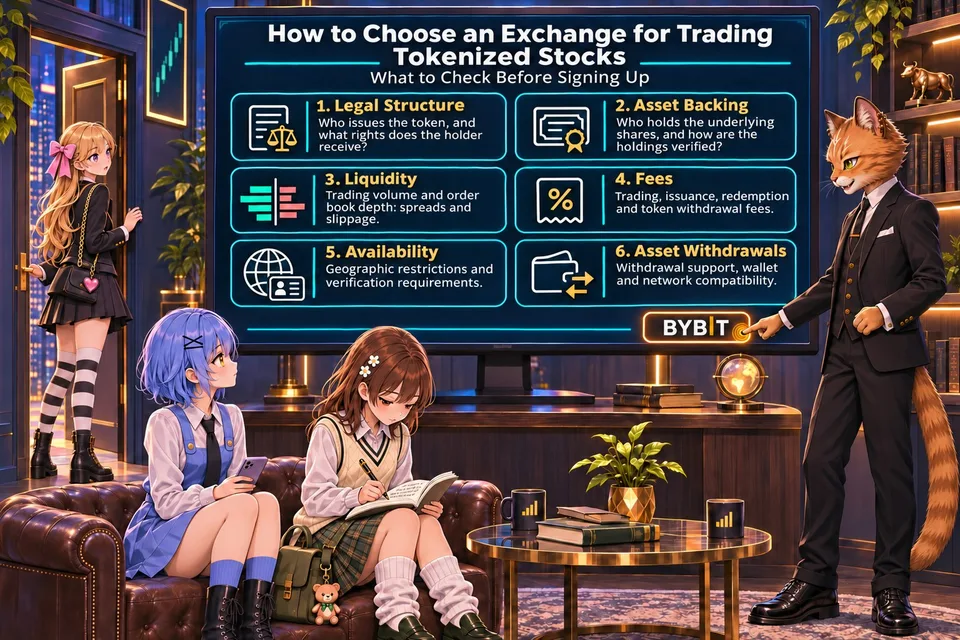
Before registering, it is worth checking several features.
Legal model. You need to determine who issues the token and what rights its holder receives.
Backing. If backing by real shares is claimed, you should find out who holds them and how the existence of the underlying assets is verified.
Liquidity. The lower the trading volume and order book depth, the higher the likelihood of slippage and a significant spread.
Fees. You need to account for buying and selling fees, as well as potential costs for issuing, redeeming and withdrawing tokens.
Availability. You need to check geographical restrictions and verification requirements.
Asset withdrawals. If you plan to hold tokens yourself, make sure the platform supports withdrawals and that your chosen wallet is compatible with the relevant network.
Tokenized stocks on Bybit: how trading works
Bybit offers tokenized U.S. stocks as part of the xStocks product line created by Backed.
Backed is an issuer of digital financial instruments linked to traditional securities. The company issues tokens backed by underlying stocks and ETFs, while Bybit provides a secondary market for buying and selling them.
This means that the cryptocurrency exchange does not issue the shares themselves or become an owner of NVIDIA, Anthropic, or Apple. Its role is to organize trading in tokens issued by a third-party company.
Which tokenized stocks are available on Bybit
Bybit's xStocks lineup includes digital instruments linked to shares of well-known public companies.
Examples include:
Company | Token ticker |
|---|---|
NVIDIA | NVDAX |
Apple | AAPLX |
Coinbase | COINX |
Alphabet | GOOGLX |
Amazon | AMZNX |
Anthropic | ANTUSDT |
This is not a complete list of assets. Listings and the availability of individual trading pairs may change.
Features of Trading xStocks on Bybit
Tokenized stocks are available on the spot market. Trades in these pairs are settled in USDT, and leverage is not used for a regular spot purchase of xStocks.
Trading takes place around the clock, independently of US stock exchange schedules.
However, there is an important feature: during regular trading hours, the token's price follows the underlying stock price, while outside the main trading sessions it may depend more heavily on supply and demand on the cryptocurrency platform itself.
For example, if news about NVIDIA's or Anthropic's financial results emerges after Nasdaq closes, investors may start buying or selling NVDAX or ANTUSDT even before the US market opens. As a result, the token's price can change on weekends or at night, even though the underlying stock is not trading at that time.
One more detail: Bybit does not redeem xStocks directly on the exchange. The platform serves as a secondary market. Redeeming tokens directly with Backed requires separate registration and completion of the required verification procedures.
It is important to consider geographical restrictions. According to Bybit, xStocks trading is unavailable to users from the European Economic Area, including the Netherlands, as well as a number of other jurisdictions. Therefore, the instructions below are intended only for users for whom the product is available in their place of residence. Before publishing and using these instructions, it is worth checking the exchange's current terms.
How to buy tokenized stocks on Bybit
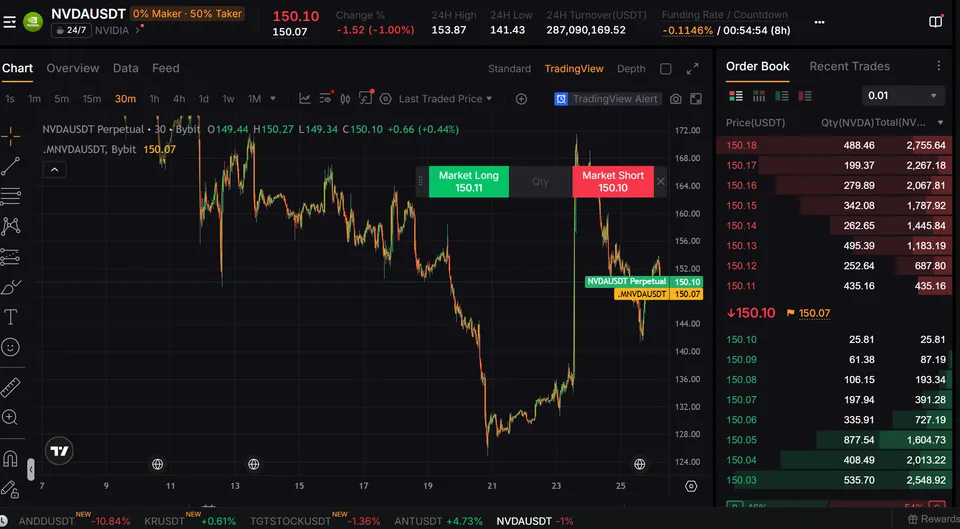
For users in permitted regions, the process of buying xStocks resembles regular spot cryptocurrency trading.
Register on Bybit and complete the required identity verification.
Fund your account or transfer USDT to the Unified Trading Account (Unified Trading Account).
Open the spot trading section.
Use the search bar to find the ticker of the token you need, such as NVDAX or Anthropic.
Select the NVDAX/USDT or ANTUSDT trading pair.
Specify the order type — market or limit.
Enter the number of tokens and confirm the purchase.
A market order is executed at the available prices in the order book. A limit order lets you set the maximum purchase price or minimum sale price, but does not guarantee execution.
Trading fees should be taken into account. According to Bybit's published fee schedule, the maker and taker fees for xStocks at the basic VIP level are 0.20% per trade. It is best to check the current terms immediately before placing an order.
Tokenized Nvidia shares: an example of trading NVDAX on Bybit
Let's look at a practical example of how you can profit from changes in the value of NVIDIA shares through the tokenized instrument NVDAX on Bybit.
Regular NVIDIA shares are traded on Nasdaq under the ticker NVDA. The tokenized version, offered in the xStocks range, is designated as NVDAX.
In this case, Backed issues a digital instrument linked to NVIDIA shares. According to the issuer's documentation, NVDAx is a tracker certificate issued in the form of tokens on blockchains. Its purpose is to track the value of the underlying NVIDIA Corporation share.
On Bybit, investors can trade NVDAX on the spot market in exchange for USDT.
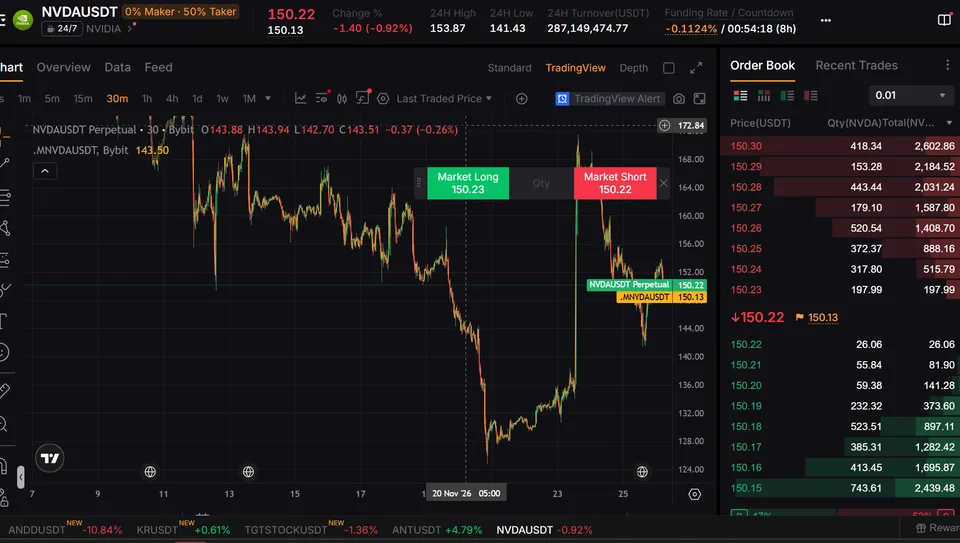
How the price of NVDAX is determined
The value of the token is based on the price of the underlying NVIDIA share. If the company's shares rise in price on the stock market, NVDAX should also become more expensive.
Backing with underlying assets, the work of market makers and arbitrage mechanisms are used to maintain the link between the prices.
Suppose that a share of NVIDIA is trading at $100, while the value of NVDAX is close to this level. An investor buys 10 tokens for 1,000 USDT.
If the price of the underlying share increases by 5%, the value of the token may also increase by approximately 5%.
Hypothetical result of the trade:
Metric | Value |
|---|---|
Number of tokens | 10 NVDAX |
Purchase price | 100 USDT |
Total purchase amount | 1,000 USDT |
Price after a 5% increase | 105 USDT |
Position value | 1,050 USDT |
Gross profit | 50 USDT |
Return | 5% |
Thus, the trader earns a profit from the increase in the value of NVIDIA shares without directly buying securities on Nasdaq.
If the token price decreases by 5%, the value of the position will be 950 USDT, and the loss will be 50 USDT. Therefore, tokenized stocks do not protect investors from market risk.
The calculations do not account for trading fees, the spread or possible deviations of the token's value from the underlying stock price.
What happens to NVDAX after Nasdaq closes
One of the main differences between tokenized stocks and traditional securities is the ability to trade outside regular exchange sessions.
For example, Nasdaq closes, but NVDAX trading continues on Bybit. If important news about NVIDIA emerges during this time, cryptocurrency market participants can react to it immediately.
This creates additional opportunities for traders, but also increases risks. During hours when there is no trading on the main stock exchange, the token's liquidity may change, and its price may temporarily deviate from the calculated value of the underlying stock.
Therefore, trading around the clock does not mean that a token can be bought or sold at any time at a price that fully matches the Nasdaq quote.
Disclaimer
This material is for informational purposes only and does not constitute personalized investment advice or an offer to buy or sell tokenized stocks or other financial instruments.
This article does not provide trading instruction and is not an educational program. The information provided is intended as a general introduction to how tokenized assets work, the specifics of purchasing them and the associated risks. No trading instruction is provided on the basis of this material.
Readers make all decisions about buying, selling and holding tokenized stocks independently and at their own risk. Before making trades, they must review the token issuance terms, the backing mechanism, how dividends are accounted for, the trading platform's fees and applicable restrictions.
Trading tokenized stocks involves the risk of losing some or all of the funds invested. The token's price may deviate from the value of the underlying stock, and additional risks are associated with the issuer, custodian, cryptocurrency exchange and blockchain infrastructure.
Mentioning platforms, instruments and trading strategies does not constitute a recommendation to use them. Materials related to trading education and financial market analysis do not guarantee a profit. The author is not responsible for the financial outcomes of decisions readers make based on the information presented.