
How the Media "Ousted" Jensen Huang and Who Really Runs Nvidia
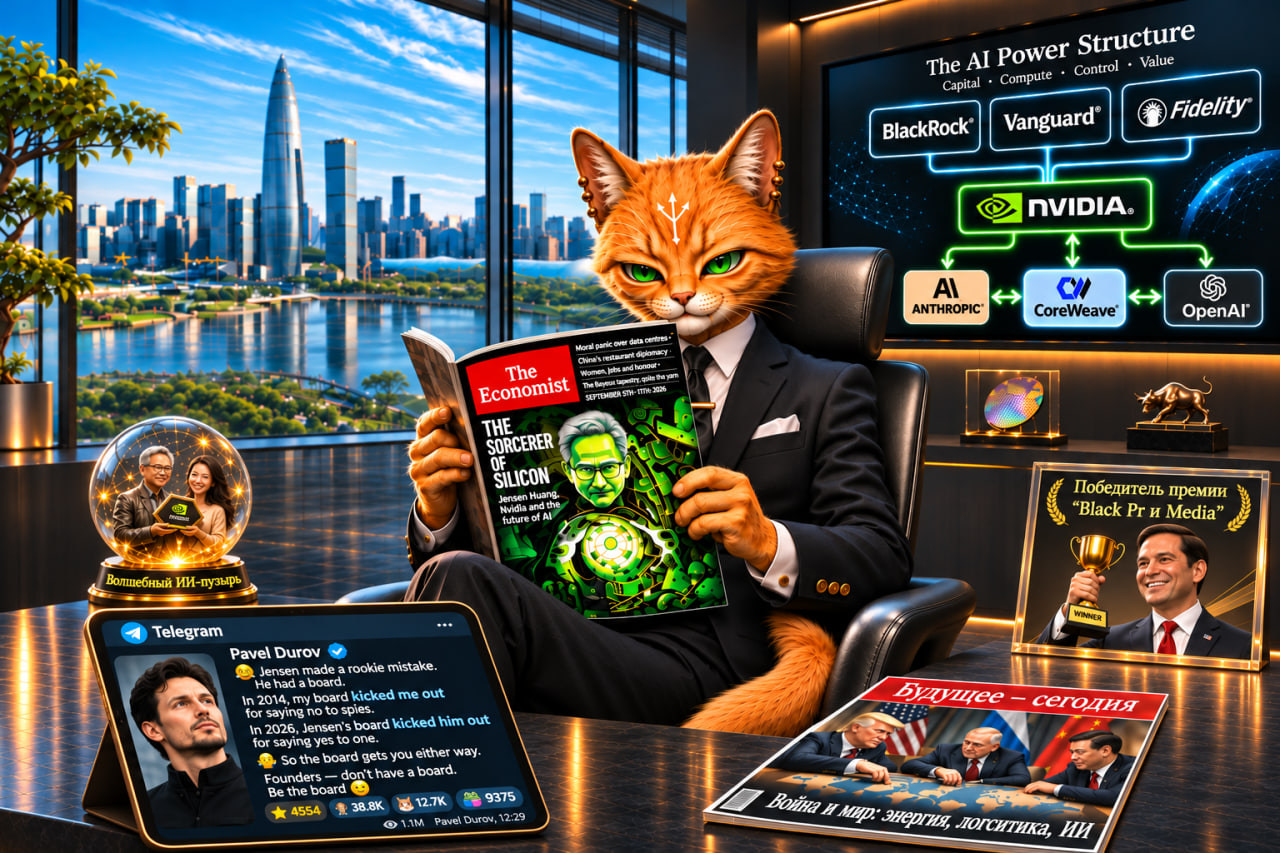
Last week's main media story was the virility of Nvidia's 64-year-old founder, Jensen Huang, who had led the company continuously until November 11, 2026. Allegedly, it was his romantic relationships with several women, one of whom is accused of working for Chinese intelligence, that led to his departure.
Frankly, the sex life of the head of one of the world's largest corporations sounds like a very funny reason for his departure. Especially after Billy Gates's own adventures on Epstein's island. So Huang's amorous nature is a pretext, not the reason: you have to understand that.
Let's note right away that Huang left “voluntarily”: first he submitted his resignation, which the board of directors reviewed and approved on 11/11, and the world was told only the next day — November 12. A small detail, but any bureaucrat will immediately appreciate the subtlety of the situation.
Why did I pay attention to this? Simply because Jensen Huang is an extremely experienced figure on the world stage, so he understands the rules of the game perfectly well. And if the game involves every iron telling him (modern irons are connected to the internet, aren't they?), “Time to go,” then it really is time to go.
How was Huang "ousted"?
Very simple. They launched a media campaign. We all took part in it.
Let's start with the fact that all the negative public allegations now being made against him were already known. They had been written about repeatedly, but no media campaign had been built around them. Still, the very fact that Huang's sexual escapades were written about and brought up again, especially since September, is itself evidence of the audience being primed. Those who get it, get it.
The real story began publicly on September 5, when The Economist reported on NVidia's schemes. The issue featured a whole set of articles on NVIDIA's transformation into the financial hub of the AI industry and the risks of financing demand for its own products.
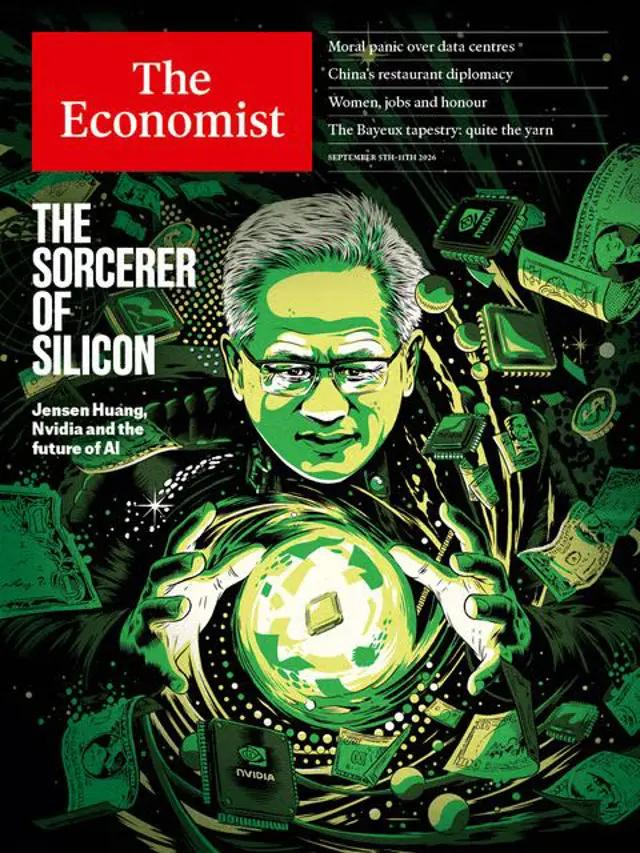
The magazine then analyzed circular financing, guarantees, chip competition, the residual value of GPUs and the threat of insufficient AI monetization in detail. At the same time, the editors in politically correct terms stated their conclusion that the benefits of the technology's accelerated development outweigh the financial risks of the scheme.
Let's go through it in order again: there has certainly been some talk of an AI bubble for about half a year now. The Economist's editors did not even say anything new... Wait, who exactly are The Economist?
As of 2026, the ownership structure is as follows:
Shareholder
Stake
Exor (the Agnelli family)
43.4%
Smith Financial (Stephen Smith)
26.9%
The Economist Group and other shareholders
around 29.7%
In March 2026, Canadian billionaire Stephen Smith (Smith Financial) acquired the stake held by the Rothschilds — 26.9%.
The editorial team's worldview aligns with the interests of:
international financial capital and major institutional investors;
multinational corporations;
global trade and production chains;
the English-speaking business and political establishment;
supporters of the American and European liberal international order.
This does not mean that the editorial team takes instructions from these groups. Rather, its analytical perspective largely coincides with their view of how the global economy should be organized. The Rothschilds, who sold their stake only half a year ago, can vouch for that.
So, a magazine as interesting as The Economist is running a full breakdown of NVidia's schemes. For the serious players who invested in these schemes, the information is generally nothing new. But they did receive a very important signal.
If people start discussing the scheme publicly, it is time to get out of the game. That is as clear as two times two. To us—in hindsight.
We will not examine Huang's scheme now: it is a topic for a separate in-depth study. And it will appear on Tlap soon.
After The Economist, the discussion gradually shifted from the question “Is NVIDIA creating a bubble?” to a more specific question: “Who bears the financial risk if AI demand fails to meet expectations?”
Date | Publication | Main topic |
|---|---|---|
August 10 | Reuters | $500 billion in AI infrastructure funding |
August 10 | Axios | NVIDIA and Wall Street's largest funds |
August 25 | Reuters | Circular financing risks ahead of earnings reports |
August 28 | Reuters | Suspension of certain customer financing programs |
September 5 | The Economist | NVIDIA as the central bank of AI |
October 21 | LSEG | Map of mutual financing among AI companies |
November 12 | WSJ | NVIDIA crisis and consequences for companies in its ecosystem |
November 12 | The Guardian | NVIDIA's financial power and its impact on the AI economy |
November 14 | JPMorgan | Financial risks and potential consequences of a change in leadership |
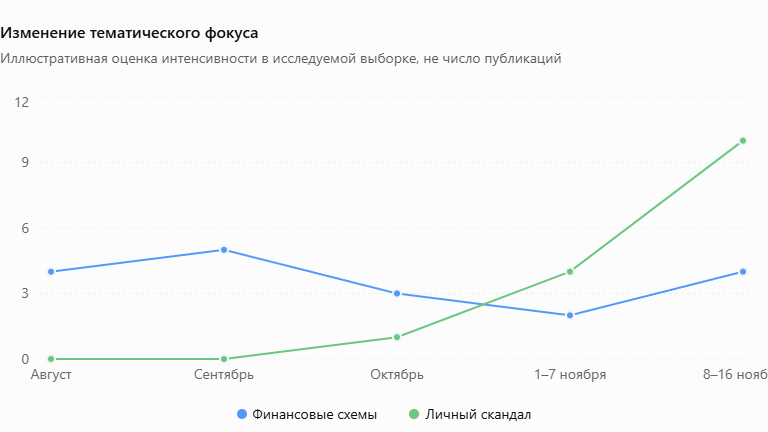
In September, after an article in The Economist, the financial issue gained further legitimacy as a subject of serious economic analysis. In October, it became part of a broader discussion of AI market risks.
In November, the focus became personal: public attention was redirected to Huang, his relationships, corporate control and the possible impact on the security of chip supplies.
October 29: the public scandal begins
The New York Times reports on Huang's close relationship with Alice Huang, who is linked to Megaspeed. This raises the question of possible Chinese espionage and access to information about chip supplies.
November 8: a personal admission
Huang tells employees that he was unfaithful to his wife. NVIDIA announces an independent investigation.
November 9–10: the political dimension
The Guardian, The New Yorker and other publications examine the possible link between personal relationships and national security, export restrictions and US policy toward China.
November 11: the scandal widens
Reports emerge of other alleged relationships, including one with a female NVIDIA employee. The board of directors' response is discussed.
November 12: a leadership crisis
Huang is reported to be stepping down as CEO. Corporate governance, oversight of the chief executive and risks to the entire AI industry become the focus.
November 13–16: financial and political consequences
Reuters reports on Huang's correspondence with NVIDIA management. WSJ analyzes AI companies' dependence on NVIDIA funding. The Guardian links the personal scandal to the stability of the entire AI economy.
And here is a chart of coverage of the topic in major media outlets. A clear shift in focus and a search for someone to blame.
Today, a little more on public communications.
We won't examine the story involving women either — there's nothing interesting about repeating what has been repeated a million times. But we will shed light on a slightly different angle of the problem.
Huang's media image
Huang portrayed himself as a family man. PR professionals say that when you build a reputation as an impeccable family man, a supporter of traditional values and simply a “good guy,” even one mistake can bring down the entire image created in the media.
If you never try to look like a paragon of virtue in the first place, but regularly find yourself at the center of scandals, like Elon Musk or Pavel Durov, then another walk with another woman is unlikely to change public perception significantly. It will simply fit the image that has already taken shape.
Thus, in an era of total digital transparency and intense scrutiny of private lives, a “bad boy” reputation may prove a more reliable safeguard against reputational risks than the image of an exemplary family man. The smaller the gap between your actual behavior and your public image, the fewer opportunities there are to use that gap against you.
And this is where they caught Huang out: how could a family man allow himself to behave like that? Tut-tut.
On the other hand, Jensen Huang's leather jackets themselves told the story of his personal life before he did. At least, that is the view of the American magazine The Cut, which devoted an entire column to the Nvidia chief's wardrobe.
Leather jackets have long been Huang's trademark, just like Steve Jobs's black turtlenecks. He appeared in them on the cover of Time and regularly wears them at Nvidia presentations. He himself claimed that his wife and daughter choose his clothes.
At the same time, his wardrobe is entirely consistent with the image of someone who is a far cry from an exemplary family man. Tight-fitting Tom Ford leather jackets costing around $9K, accentuated biceps and overt sexuality are more the trappings of a divorced millionaire with a Harley-Davidson and a Raya profile than of a typical Silicon Valley executive.
What is the takeaway?
It turned out that tarnishing Huang's image in the eyes of the average person was not so difficult. If there is too much talk about financing schemes and so on, questions may also be asked about the others at the feast, and nobody wants that. Including Huang himself. So it is better to talk about women and spies.
By the way, the Russian-speaking world is discussing more and more of Huang's women, while the real blow to his image is the possible espionage by one of the ladies. It is the outright destruction of his public image, with one more mistress as the cherry or strawberry on the cake.
Now, figures are cropping up here and there suggesting that up to 20% of Nvidia's sales went through the Singaporean company Megaspeed, which is owned by Alice Huang, who is said to be the mistress and spy in question. The goods were then smuggled into China, and perhaps a small amount also reached Russia, although no one is talking about that yet.
Whatever the case, it smells like a serious scandal. And once again, who else was making money from the actual sales? Well, well.
As the story develops, let us repeat: Huang is being cast as a traitor—a betrayer of his family and his country. This is really very aggressive marketing, to put it in sales terms.
Trump and Rubio
Democratic-leaning media outlets were quick to remind readers that it was Huang who funded the demolition and reconstruction of the White House ballroom. And that was very important indeed to Donald Trump.
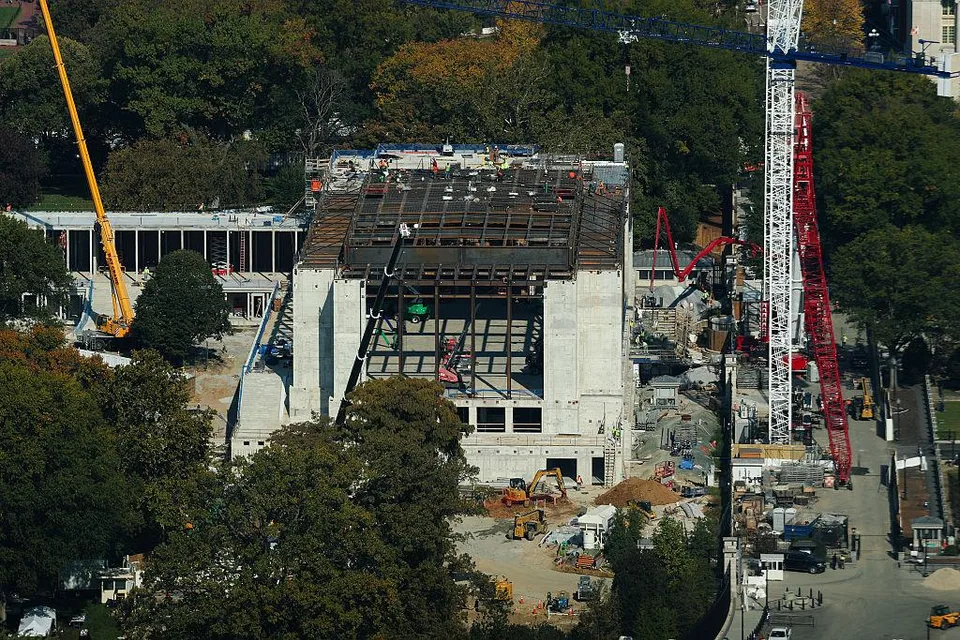
Incidentally, on November 11, Trump said he had called Huang to offer his support.
On November 14, The Washington Post joined the effort to destroy Huang.
Citing former White House officials, WP reported that some members of Trump's national security team were unhappy with Jensen Huang's influence on the president and his attempts to secure approval for AI chip exports to China.
Huang, by contrast, urged Washington to continue supplying chips to the PRC, arguing that this would keep Chinese companies dependent on American technology. His closeness to Trump helped Nvidia secure export permits. According to former Commerce Department employees, the company's applications were processed on an expedited basis, raising concerns about insufficient vetting of end buyers.
According to the newspaper's sources, Marco Rubio passed Trump a memo based on a CIA report about Huang's ties to a woman suspected of working for Chinese intelligence. In doing so, he presented the intelligence in more categorical terms. One of the former officials called the information a “nuclear bomb” and said the aim was to weaken the Nvidia chief's influence on the president.
At the G7 meeting in Paris, Rubio dodged questions about his role in briefing the White House. He only stressed that the US should be guided by its own national interests in relations with China.
Pavel Durov on himself and Jensen Huang
We couldn't let this pass. The narcissistic Pavel Durov seemed to be talking about Huang, but ended up talking about his beloved self.
On November 13, Pavel made the following post.
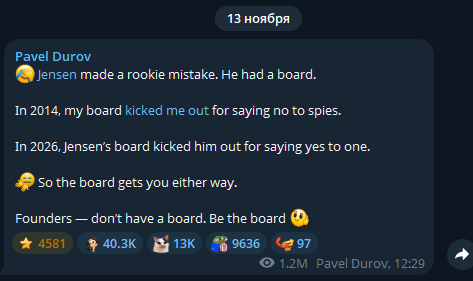
Translation: “Jensen made a rookie mistake. He had a board of directors. In 2014, my board of directors fired me for saying ‘no’ to spies. In 2026, Jensen's board of directors fired him for saying ‘yes’ to one of them. It turns out the board of directors will get you either way. Company founders—don't create a board of directors. Be the board of directors yourselves.”
The message here is simple: “I (Durov) didn't fall for provocations by the Russian intelligence services and later became my own boss.” But for some reason he forgot to explain how he managed to escape the embrace of the French intelligence services in August 2024. Or did he tactfully leave that out because he couldn't say no to the French?
The next day, Durov wrote about Huang again.
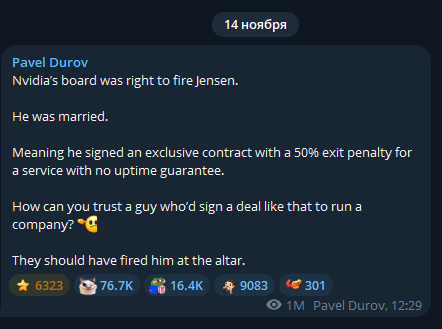
I'll give the floor to ChatGPT, which generated its response on Nvidia chips:
I would read the joke primarily as a provocative declaration of Durov's worldview:
A person who voluntarily entered into a lifelong exclusive contract with high exit costs and no guarantees of reciprocal performance has demonstrated a questionable understanding of risk management.
It is simultaneously:
Mockery of Huang over a family scandal.
Criticism of the institution of monogamous marriage.
Durov presenting himself as someone who prefers freedom to commitments and views relationships through the lens of contracts and incentives.
And in my view, the third meaning is more interesting than the first: Durov turns Huang's personal story into a public advertisement for his own philosophy of life.
I didn't edit the bot's words, as I largely agree with them. Still, why does Durov mock Huang so much?
I don't know, but I suspect that, on a purely personal level, he may resent the fact that the SEC brought him (Durov) to heel in 2019–2020 for innocent shenanigans with the Gram token, while Huang pulled off an absolutely incredible scheme involving the AI industry that neither the SEC nor anyone else noticed at all until the critical moment.
And even Denny’s restaurant
Now everyone is disowning Huang. I love these traditions of disowning people. Just yesterday you were proud that you had shaken someone’s hand once in your life, and then you say you still can’t wash that hand clean. Does everyone know people like that?
And now Denny’s restaurant has removed the commemorative plaque above the table where Huang and his partners came up with the idea for Nvidia.
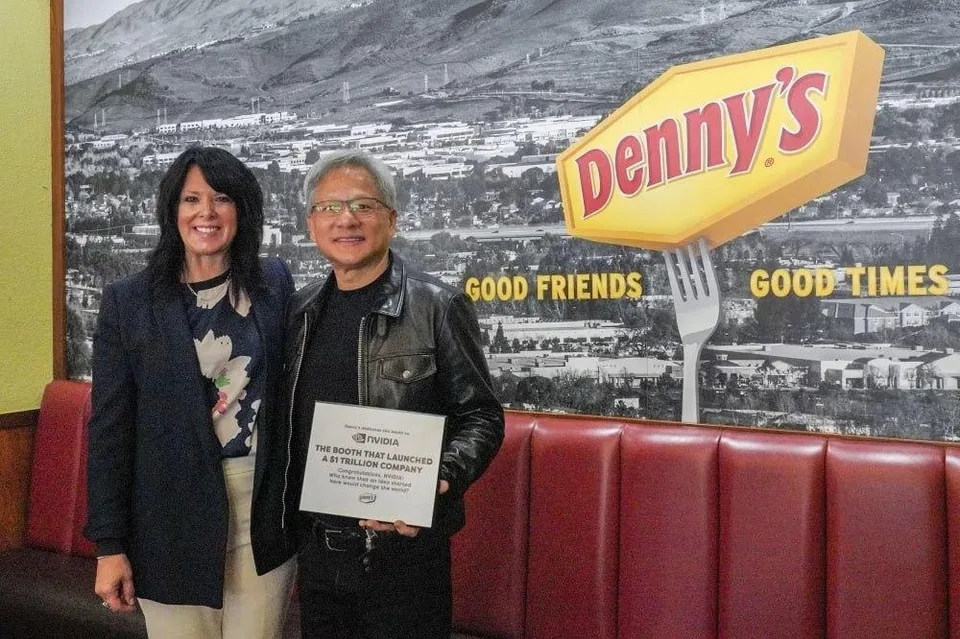
Why was Huang removed?
There are many answers to be found. Both online and in your own head. Here are some of them.
Seizing control of a critical equipment manufacturer for a new technological leap is about geopolitics on a grand scale and control over the world.
Anyone who has read even some of the statements and official documents from Russia, the EU, the US and China on technological development will see that AI is absolutely central.
You might think, so what if someone is writing and discussing some documents: just give us the money. The funny thing is that these projects are used to find ways to get newly created money flowing into the economy.
Basically, if the aim is to control the center of the bubble, which is also the technological core, then it has to be brought under control.
The need to redirect funds into US government debt is about addressing US budget problems.
The US fiscal year began on October 1, and, according to the US Treasury, the budget deficit in October 2026 was -$404 billion. This is a record high for the start of a fiscal year. For example, in October 2025, the deficit was just -$284 billion.
And this comes against a backdrop of rhetoric from Fed officials.
Williams: “At least one more interest rate hike this year would be appropriate; it would be appropriate to consider the size of the move.”
Hammack: “None of us is satisfied with the situation regarding rising consumer prices; the regulator has the full range of tools at its disposal to counter current inflation trends.”
Goolsbee: “The inflation data were ‘concerning’; several more months of high inflation would be unacceptable; if inflation stays at its current level, we will take action.”
Daly and Logan: “It is very likely that there will be NEW RATE HIKES.”
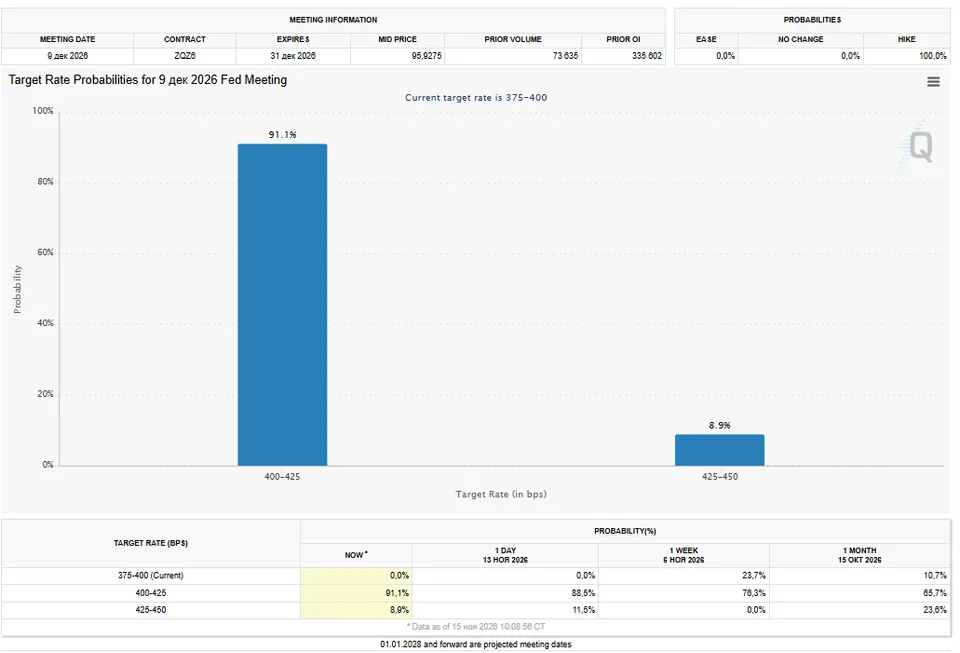
Result: 100% of investors are certain of a rate hike at the very next meeting.
And if money is needed for bonds, right now it can only come from the market: there is no talk at all of starting up the printing press. And there is no spare money in the market. So it is time to draw blood. And who can be put under the knife to let big capital pull its money out?
Work out the rest yourselves.
Deflating the bubble amid high inflation and rising interest rates.
The bubble poses a problem: inflation is already through the roof, meaning you cannot simply print money as in 2008 to solve the problem. So the process has to be controlled.
Right?
And now let's simply examine the volume auction in NVIDIA (NASDAQ: NVDA) shares and look at how the major players.
Nvidia's principal shareholders
BlackRock, Vanguard, and State Street — NVIDIA's largest investors
As of November 13, 2026, approximately 24,150,000,000 shares are outstanding.
According to the latest publicly available data on institutional positions:
Investor | Shares | Stake |
|---|---|---|
BlackRock | 1.94 billion | 8.06% |
Vanguard — Capital Management | 1.54 billion | 6.39% |
State Street | 1.03 billion | 4.25% |
Fidelity | 932.8 million | 3.87% |
Geode Capital Management | 613.7 million | 2.55% |
Vanguard Portfolio Management | 517.8 million | 2.15% |
JPMorgan Chase | 462.2 million | 1.92% |
The two largest asset managers — BlackRock and Vanguard — together account for about 14.45% of the shares, according to these data.
But there is an important caveat: these are mainly asset managers that hold shares through investment funds, ETFs and client portfolios. This entire stake cannot automatically be treated as BlackRock's or Vanguard's own capital.
Jensen Huang also remains a major shareholder. NVIDIA's latest official disclosure, as of March 23, 2026, listed him as holding 870,600,000 shares, or 3.58% of its share capital. Leaving the CEO role does not in itself mean selling shares, although we do not know whether or when he sold his stake.
Some board members have sizable shareholdings of their own. According to disclosures as of March 23, 2026:
Director | Shares | Equity stake |
|---|---|---|
Mark A. Stevens | 34,070,000 | 0.14% |
Tench Coxe | 30,560,000 | 0.13% |
Harvey C. Jones | 7,000,000 | 0.029% |
A. Brooke Seawell | 2,510,000 | 0.010% |
These are SEC figures from before the changes to the board's composition and Huang's resignation.
So, NVIDIA has influential representatives of venture capital. This is especially true of Mark Stevens, Tench Coxe, Brooke Seawell and Harvey Jones. Their professional work involves investments in technology businesses.
The world's largest institutional asset managers—BlackRock, Vanguard, State Street and Fidelity—have stakes in the company. They hold a substantial number of shareholder votes, although actual voting rights do not always match the number of shares under management. For example, Vanguard's disclosure as of March 31, 2026 listed 1,777,000,000 shares under its investment discretion, but only 238,900,000 shares with sole voting power.
A fundamental point
There is one fundamental point that makes these companies particularly interesting in terms of how the financial system is structured. They manage assets that ultimately belong to others.
For example:
A pension fund invests money in a BlackRock ETF.
The ETF buys shares in Apple, Microsoft, Nvidia and other corporations.
The shares are recorded in the fund's name or through depositories' nominee infrastructure.
BlackRock manages the fund and receives certain powers to vote the shares.
As a result, BlackRock can influence companies' corporate decisions without being the ultimate economic owner of the money invested. This raises several questions:
Who actually determines corporations' investment policies?
How independent are the votes cast by the largest asset managers?
In whose interests are decisions made — those of the ultimate investors or the managers?
Can the concentration of votes among a few asset managers create systemic political and economic leverage?
The text above is from that same ChatGPT, running on Nvidia chips that OpenAI received as collateral from Nvidia, which inflated market capitalization to benefit the same BlackRock, Vanguard, State Street and Fidelity.
And my text goes like this: all these corporations are, by definition, well-known global schemers. Their fingerprints are all over most of the world's growth areas (the AI boom) or global problems (the bond market of that same Ukraine, which owes BlackRock for the rest of its days).
So could these guys come up with an AI boom scheme involving NVidia? They certainly could. And Huang is the face of this scheme.
By the way, U.S. Treasury Secretary Scott Bessent said that the new head of American tech giant Nvidia should be someone brought in from outside, rather than one of the company's employees. A very interesting statement, don't you think?
Stock exchange auction
Over the year, average daily turnover measured in shares fell from 177 million to 127,000,000 shares. In monetary terms, however, the decline was less significant.
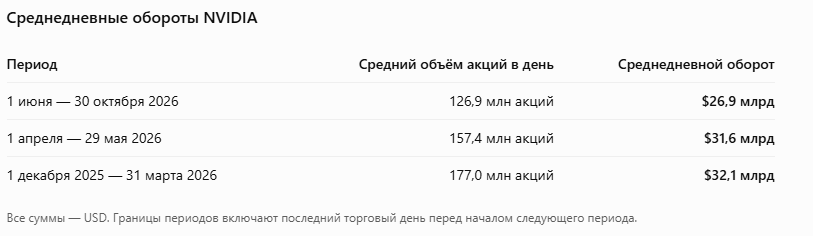
A sharp spike in trading volume can be observed on November 9–13, 2026. On November 12, that is, the day the media announced the news of Huang's departure, trading volume amounted to almost 509,000,000 shares. These trading volumes are extremely rare: they were higher only on January 21, 2025, when just over 566,000,000 shares changed hands on the exchange.
Back then, let me remind you, the story of the tariff wars was beginning. On that day, smart money was buying up shares at an average price of $122–$127. The share price continued to fall, and the bottom was reached at around $88 a couple of weeks later.
It is better to accumulate more shares, even at a higher price, and then average down if you suspect that in just half a year you will be able to unload them at 190, and in a year to a year and a half at 225. Right? Pure DCA as practiced by investment funds.
Where did I get the figure of $225 per share? It is all very simple.
The first distribution by big money (a transfer from strong hands to weak hands) took place back in the spring of 2026. The approximate range was 219–227. By and large, they traded within this same range in August and September. They were buying back a little lower and selling a little higher.
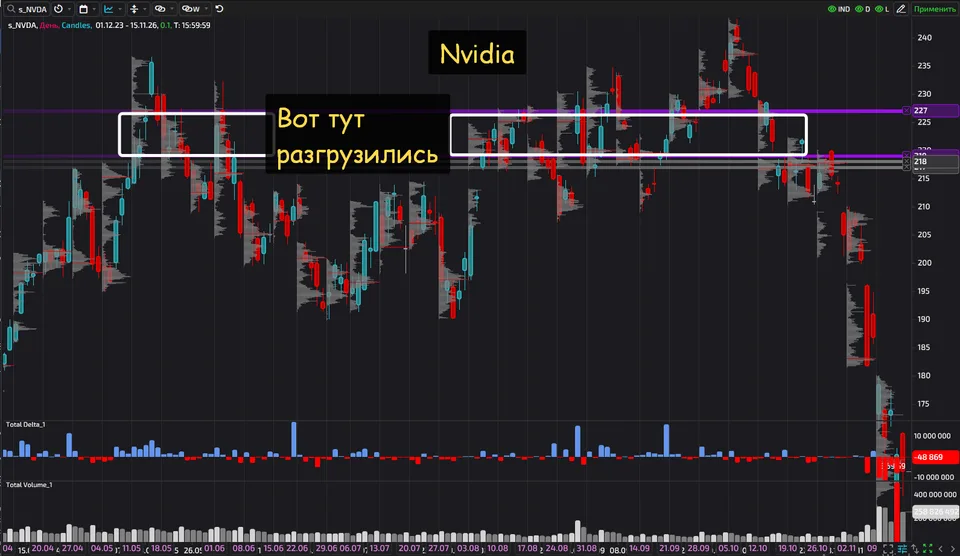
Notice that Nvidia shares fell quite sharply after the previously discussed article in The Economist was published. If retail investors saw something positive, a savvy reader immediately understood that it was time to get out of the stock.
After that, there was one last move north, taking the price to 243.5 on October 6. The share price has been declining ever since.
I would point out that trading was sideways on October 15–29 (in the 212–218 range), which already marked the formation of a bearish pattern. But, of course, the pattern could still have been invalidated if the price had managed to hold at 220, and all the more so at 225. But on October 30, the market opens below 210, that is, below all support levels. And this is a signal to go short.
There was still an opportunity to sell in early November in the 207–209 range.
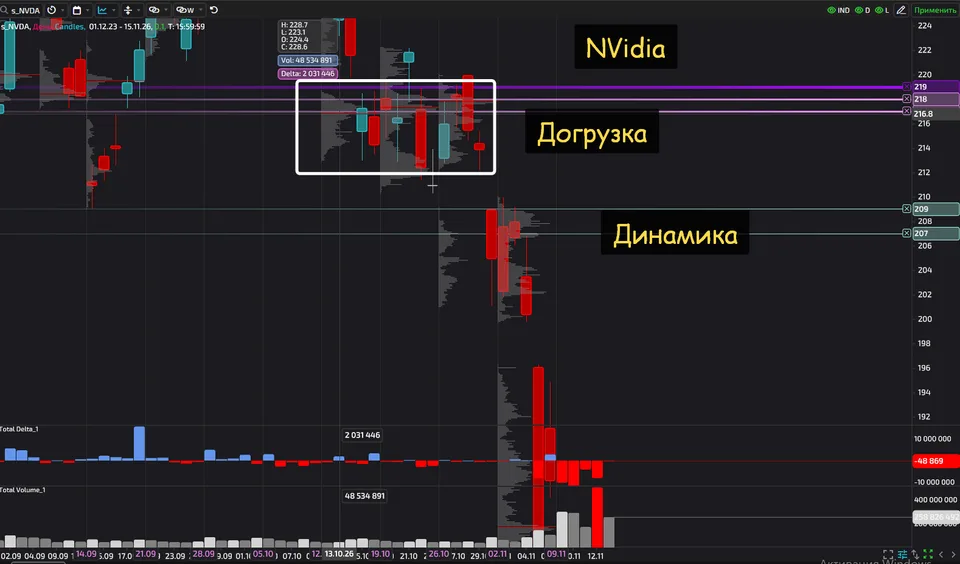
And now comes a classic case: on November 12, the media report that Huang has left. And it is on this very day that we see a potential pause. Once again, the classic principle: “Sell the rumors, buy the facts.” Is it usually phrased differently? Well, what difference does it make?
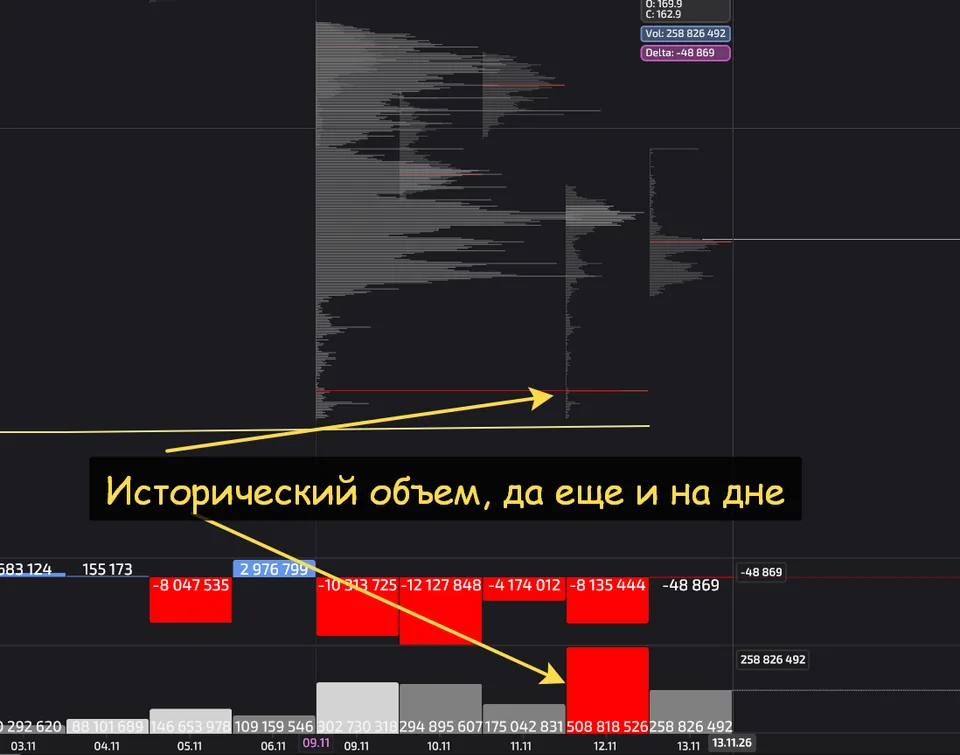
Of these 508,000,000 shares, just under 30 million changed hands in the first minute of trading. Of those, almost 18,000,000 shares traded at 151 over two minutes.
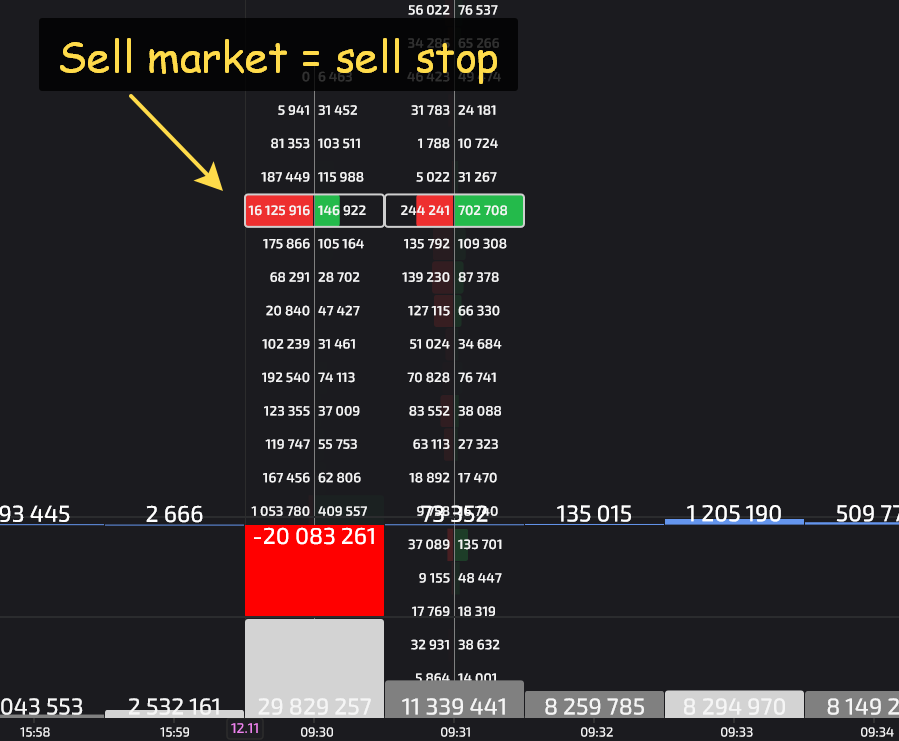
Meanwhile, right from the open, more than 16,000,000 shares went through as market sell orders, also known as sell stops.
This is outright capitulation by leveraged traders. You can use leverage on stocks too, although it is usually no more than 1:2 for regular trading and no more than 1:4 intraday. Of course, this also includes the stops of those who placed them below 160. Any ordinary stop is a market order. And wherever it can be filled, that is where it gets filled. In our example, that is an average of $151 per share.
Such capitulation looks like a pause. Very much like a pause. But a pause does not mean the end. 16,000,000 shares at one price may seem like a lot, but against last week's daily volumes of 300,000,000–500,000,000, it is a mere trifle.
What next? What happens next depends entirely on what happens in the real world. And the auction model suggests spending a little time consolidating between 159.5–161 and 167–168.5. Right around the -1 deviation from November's VWAP.
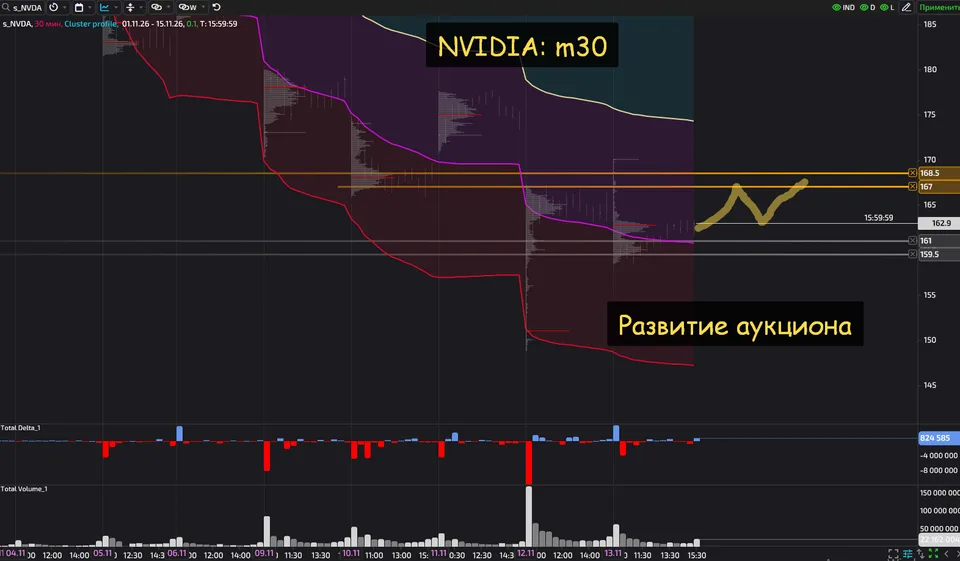
You can view the full stock chart on Bybit. Of course, this is a CFD, not an actual share, but you can study it.
Not interested in M30? Then let's look at the weekly auction. There is a classic pattern there that any conventional technical analysis will also show.
Tactical buying at 151? That is just above 147–148.5, where the highest-priced purchases took place during the 2024 auction. There were hardly any of them there, but you can see them on the chart.
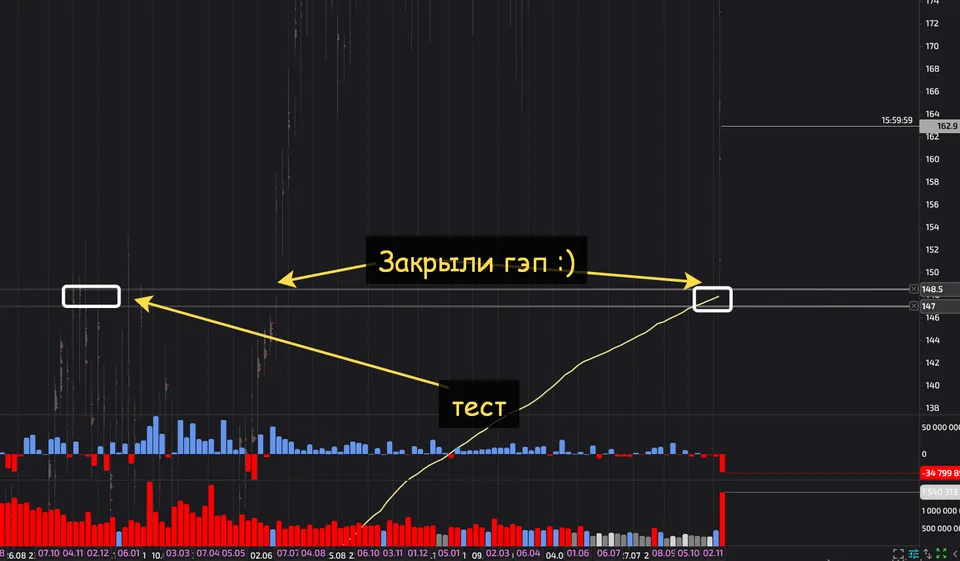
Well, fans of gap trading will see that the gap from June 23, 2025 was filled. And that is precisely why... But gaps are an everyday occurrence in stocks, so it is not even worth talking about.
Closing Remarks
And now let's imagine one more level of the game.
I have already said that Huang is a world-class player. And he sees and understands everything perfectly well. And to exit the game in style, in a way that looks completely different to the public? A proven method is a sex scandal. After that comes a high-profile dismissal. And then...
And then the bubble Huang inflated is deflated without Huang. A brilliant game!
And what if he is sent to prison? After all, a female Chinese spy often lay beneath him, and NVidia chips somehow made their way into China, too. Then he could end up in prison.
Or, once he is in prison, the video cameras will miraculously switch off for one minute, and then events will follow the script of Jeffrey Epstein's "suicide" in 2019. That is if those behind the NVidia phenomenon — BlackRock, Vanguard, State Street and Fidelity — choose the "isn't it time to cover our tracks?" scenario.
Another option. In that same prison, Huang is in honorable exile, staying out of things while a fierce storm rages all around: hiding in plain sight.
Ukrainian oligarch Kolomoisky is an absolutely perfect example of this scheme: he is in custody, and with good reason, but is completely uninvolved in the current bloody affairs. And why would he need that? He will even come out ahead later.
Now let's put Huang into this scenario and suppose that "doing time" for a couple of years — retreating into the shadows — would be better than being in the spotlight when the AI bubble really bursts. And BlackRock, Vanguard, State Street and Fidelity are always in the shadows anyway.