
DCA Strategy: Testing Its Relevance in the Cryptocurrency Market

Dollar-cost averaging (DCA — Dollar-Cost Averaging) is an investment strategy in which an investor regularly invests a fixed amount of money in a specific asset (for example, stocks, ETFs, cryptocurrency), regardless of the current price.
It sounds nice. They say even Warren Buffett recommends this very strategy to beginner investors. He uses it himself too: though only where there is potential for long-term growth, preferably sharp growth.
In this article, we will try to understand what DCA is and whether it is worth applying this method to cryptocurrencies, especially since Buffett himself almost for the first time in his life missed a "fat" opportunity: if he had applied DCA to crypto, he would be richer than Musk and Bezos put together.
What Is DCA in Simple Terms

DCA (Dollar-Cost Averaging / dollar-cost averaging) is a simple idea with strong psychological and mathematical logic. It is as follows:
If an investor buys an asset for a fixed amount at equal intervals of time, then they automatically acquire more shares (volume) of the asset during periods of falling prices and fewer during periods of rising prices. In practice, the DCA strategy solves two main problems of the private investor: attempts to "guess the bottom" and emotional mistakes — panic selling during drawdowns and greedy buying during price growth.
In conditions of high volatility — and cryptocurrencies are a vivid example of such volatility — DCA works as an "anesthetic against emotions": it disciplines and turns the market from a guessing game into a routine operation.
It is important to understand the weak sides of DCA as well.
First, the dollar-cost averaging strategy does not protect against a prolonged bear market: if the market goes down for years, the investor will lose the monetary value of their investments, although they will be buying cheaper as the decline continues.
As an example, let us take Huntsman Corporation stock (ticker HUN: NYSE). The corporation produces specialty chemicals and went public at the beginning of 2005. The price fell from $27,5 per share to $2,50 by mid-2009, then moved back and forth with volatility, reaching 41 bucks per share in January 2022. The price now is $11,9.
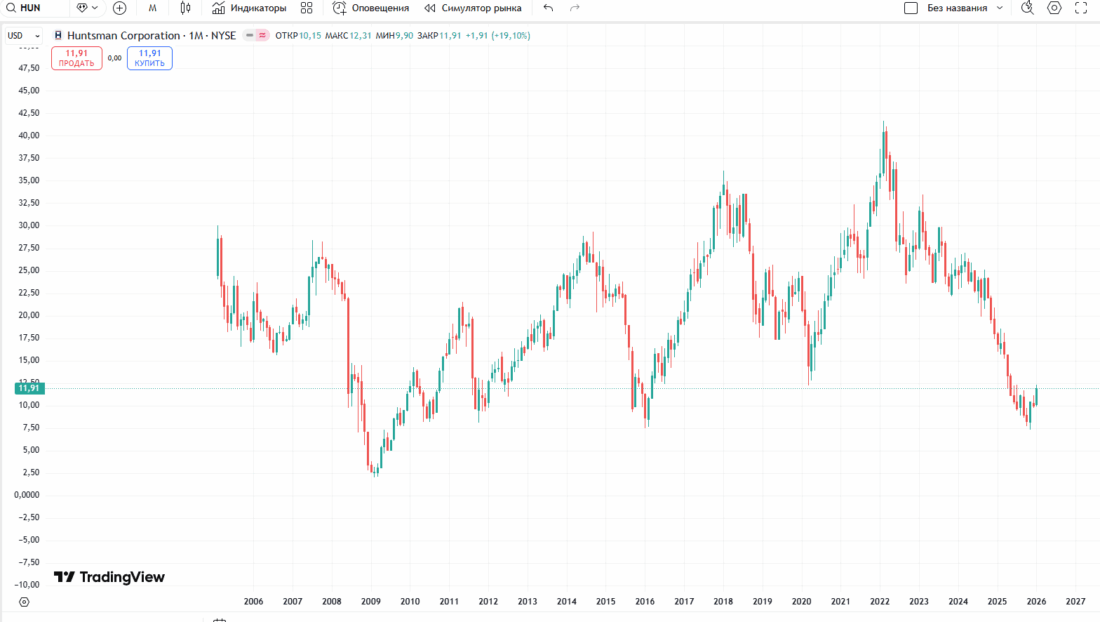
I think everyone understands that the stock is in a multi-year range. If we are talking about long-term investing, then over 20 years only dividends brought solid profit from DCA. But here there is a reliable asset that has intrinsic value.
And yet there are other stories, when an asset keeps declining, it has no real intrinsic value, and applying the DCA strategy only makes the situation worse.
This often happens with cryptocurrencies.
Second, in a strong one-sided bull market, a one-time purchase at the beginning could bring more profit than stretching out the entry. But in the real world, no one knows in advance whether the market will go "only up" or "only down," so DCA is often considered a reasonable approach for most private investors.
Here one can recall the beginning of the crypto era. Buying BTC in 2014 for a notional $200…
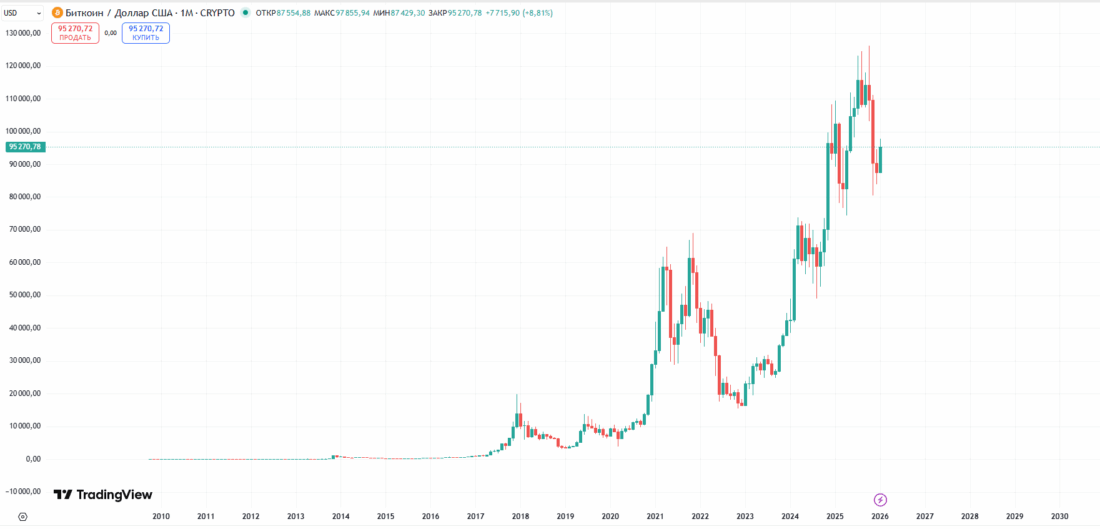
But investing "all in" in bitcoin using the DCA strategy at the end of 2017 led many to ruin: a year later, the price had fallen by 70% or more.
Why Is DCA Suitable for Beginners?
You do not need to be an expert. A beginner investor does not need to predict market movement; they only need discipline.
Minimum stress. When the market falls, the same amount of money can buy more of the asset. This turns a decline from a cause for panic into an opportunity.
You can start with any amount. The main thing is that this amount is enough to buy one unit of the asset. What matters here is not so much the amount as the regularity.
It fights emotions. Fear and greed are the investor's main enemies. DCA forces you to act according to a plan, not under the influence of the news.
How to Apply DCA to Cryptocurrencies?
First, you need to choose a reliable asset. In my opinion, it is very difficult to find reliable assets among cryptocurrencies, especially for beginners. It should be a coin with high capitalization and "official" recognition.
By official recognition, I mean the presence of ETFs (spot exchange-traded funds) for this coin or at least ETF registration applications filed with the SEC. Funds for BTC / ETH already exist. Applications for SOL / XRP / LTC / ADA / AVAX / APT / SUI / MOVE have been filed or discussions about filing them are underway.
In addition, it is necessary to study what policy the key states are pursuing regarding the selected instruments.
In general, you need to remember that DCA does not save you from failure, but it works with quality assets that grow over the long term.
After choosing a cryptocurrency for DCA, it is necessary to determine the monthly / quarterly / annual investment amount. This should be a comfortable amount that will not affect the personal and family budget.
After that, you need to choose a reliable crypto exchange where long-term operations can be carried out. This includes, for example, the Chinese ByBit.
And the most important rule. Under no circumstances should you watch what is happening with the account, let alone do it daily. The task is simply to fund the account on a certain date with the set amount. If something goes wrong, then it will either be a good opportunity to buy more of the asset for the same money, or... Or the chosen cryptocurrency has gone belly up, and there is no point in worrying about it.
And finally. DCA is a marathon, not a sprint. Therefore, you should not expect quick results.
Approximate DCA Calculation for Cryptocurrencies

Let us assess the real potential of applying the DCA strategy to cryptocurrencies. Let us take, for example, BTC/USDT and DOT/USDT.
To assess the potential profitability of DCA, you need to carry out a simple sequence of actions:
- Collect the average annual prices of the asset for each year (for BTC/USDT since 2015, for DOT/USDT since 2021).
- Calculate how many units of the asset would have been bought in each year when investing $10 000 (quantity = 10 000 / the average annual price in that year).
- Sum all purchased units over the entire period.
- Multiply the total quantity by the asset price at the end of the period (for example, by the average annual price of 2025 or by the price at the end of 2025) — this will give the final portfolio value.
- Compare the final value with the total invested amount ($10 000 × number of years) and calculate the growth as a percentage.
The method is simple and transparent: it shows that DCA is just the arithmetic of purchases plus market volatility.
For bitcoin the following approximate results were obtained. I will not attach the cryptocurrency chart: it is above, and everyone has seen it anyway.
- Total purchased: 53.051719 BTC (the sum of all annual purchases at average annual prices).
- Final portfolio value: $5822638.
- Total growth: +5193.31%.
Bitcoin demonstrates extremely high returns in this model — this is a consequence of strong price growth in certain years and the choice of 2015 as the starting point.
But the situation with DOT/USDT is much sadder. The year 2021 was chosen because in that year the pair began trading on the ByBit exchange. However, on many other exchanges as well, exchange trading was launched in that same year.
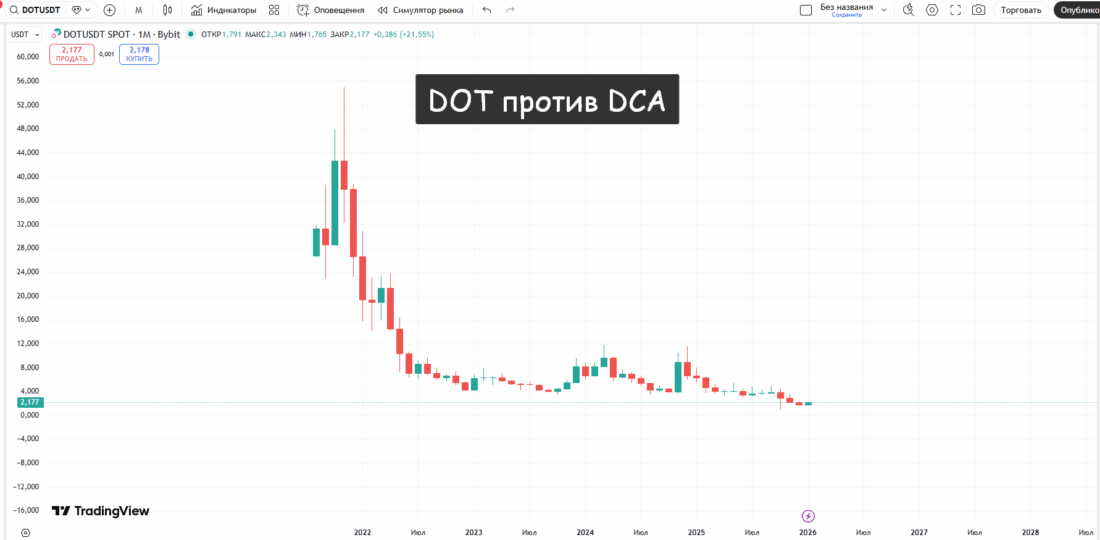
Closing prices on August 1 of each year were used for the calculation.
- 01.08.2021 — DOT ≈ $18,41. Purchased 543,183 DOT.
- 01.08.2022 — DOT ≈ $8,1940. Purchased 1220,405 DOT.
- 01.08.2023 — DOT ≈ $5,1980. Purchased 1923,817 DOT.
- 01.08.2024 — DOT ≈ $5,3429. Purchased 1871,641 DOT.
- 01.08.2025 — DOT ≈ $3,651. Purchased 2739,058 DOT.
The price for valuing the portfolio on 31.12.2025 is $1.79.
Disappointing results for the portfolio: $50 000 invested, total amount of DOT on hand: ≈ 8 298.103 DOT, final portfolio value (8 298.103 × $1.79): ≈ $14 853.61.
The loss is about −70,3%, or a little more than 35 thousand dollars over 5 years of annual investment into this coin using the DCA strategy. I will add that if, when choosing the DCA purchase date for this cryptocurrency, it had not been August 1 but October 1, the situation would have been much, much worse.
How to Launch a DCA Strategy on ByBit
On the ByBit exchange there are two ways to buy crypto using the DCA strategy: Recurring Buy and DCA Bot.
Recurring Buy - automatic regular purchases
This is the official function for automating cryptocurrency purchases through Bybit. It works on the DCA principle - dollar-cost averaging: the bot itself will buy the selected coin on schedule, without human involvement.
The important thing is that there is no need to make each purchase manually: the bot buys on its own according to the set schedule. At the moment of purchase, the balance in the Funding Account must be sufficient, otherwise the transaction will not go through.
No fee is charged for creating the plan, but each transaction has the usual exchange trading commission.
To start Recurring Buy, you need to:
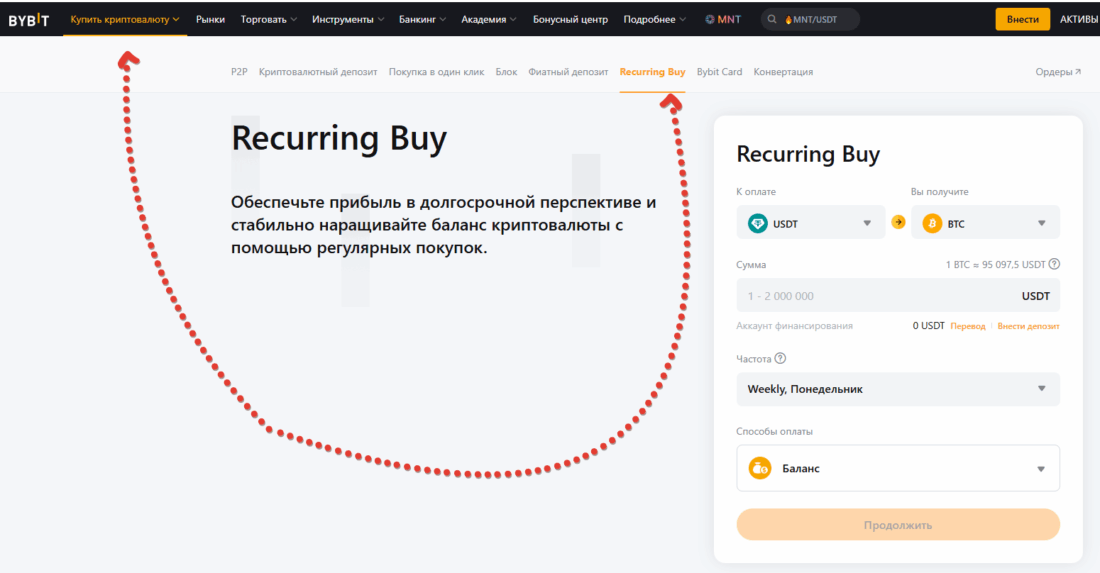
- Log in to the Bybit website.
- In the top menu, go to Buy Crypto -> One-Click Buy.
- On the One-Click Buy page, find the Recurring Buy button.
- Fill in the plan parameters: choose the payment method (fiat or crypto balance) and the cryptocurrency for investment; specify the amount of the one-time investment; choose the frequency: Daily, Weekly, Bi-Weekly, or Monthly.
- Read and confirm the terms by checking the box, then click Confirm.
- The plan is launched - according to the selected schedule, Bybit will automatically make purchases.
- You can track the details, status, and history of your automatic purchases in the View Details section.
DCA bots inside Trading Bot (for Spot)
This is a more advanced tool that can be found in the Trading Bot -> DCA Bot section. It is intended for regular purchases in the spot environment and has more flexible settings (for example, selecting several coins at once).
The main thing: DCA bots are suitable for frequent purchases (once every 10 minutes, once an hour, etc.), and it is possible to buy several coins in one bot. You can buy only with crypto, not with fiat.
The bot works only in Spot mode, so there is no risk of liquidation.
To create a DCA bot on the Bybit exchange, you need to perform the following actions:
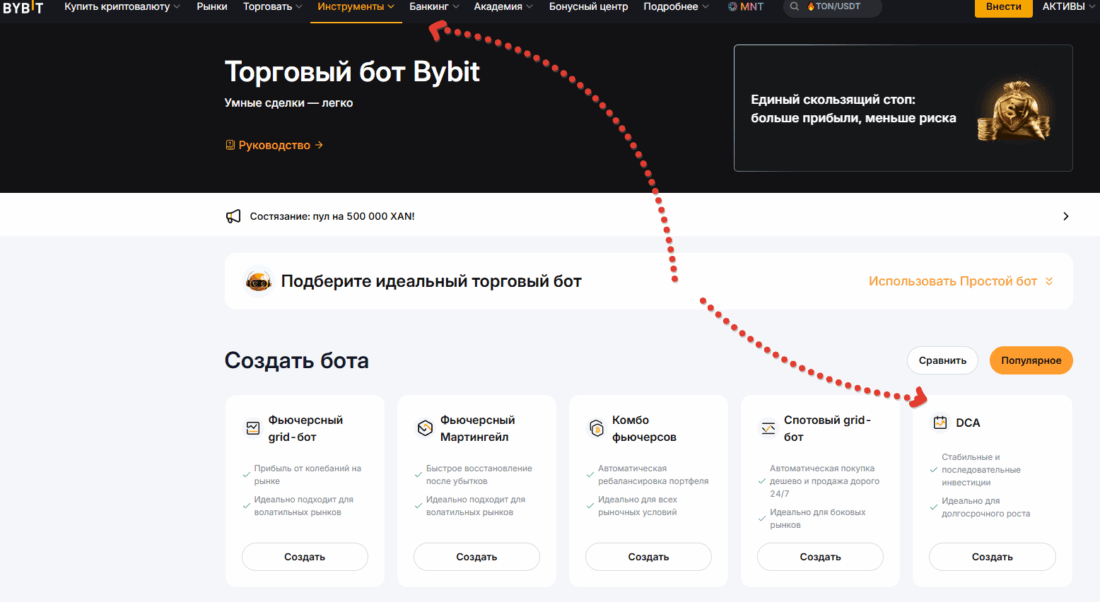
Go to Bybit, and in the menu select Tools -> Trading Bot.
Select DCA and click Create.
Next, you should configure the bot parameters:
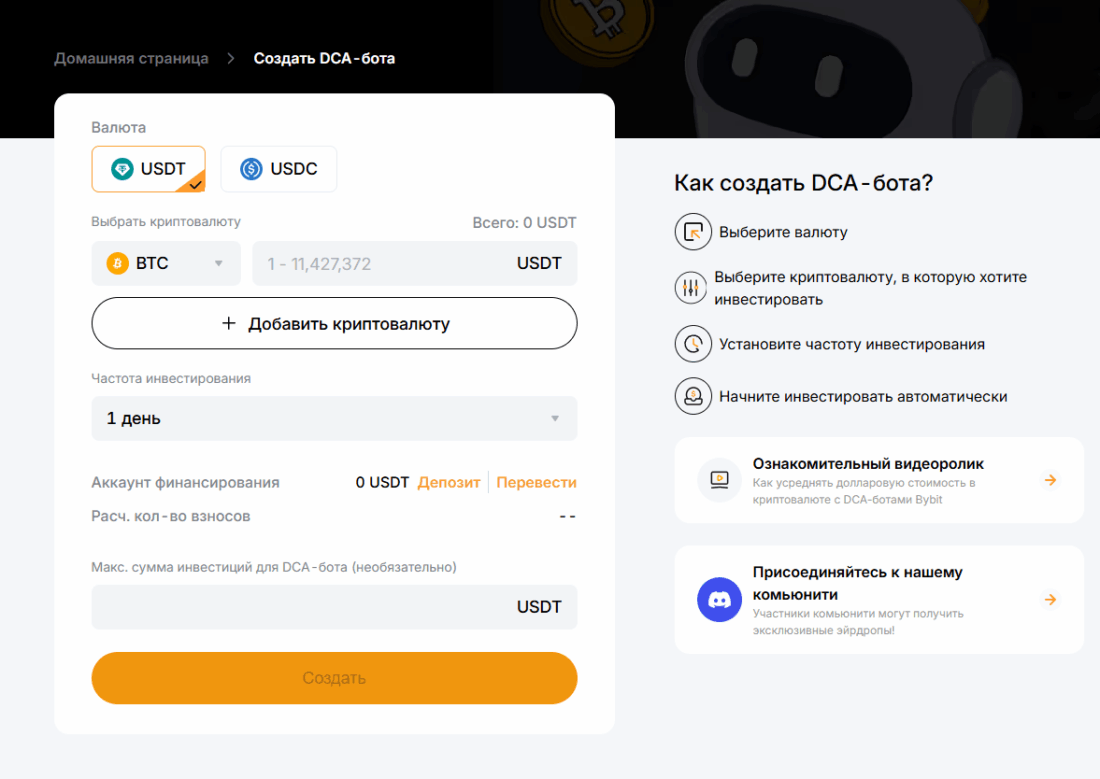
- Payment currency: USDT or USDC.
- Coin/coins to buy: BTC, ETH, MNT, etc. (up to 5 coins in one bot).
- The investment amount per cycle and the purchase frequency (time interval).
- The maximum total investment volume (optional).
- Confirm creation - the bot will appear in the list of active bots.
In the My Bots section, you can view the order history, average price, completed purchases, and current position.
Conclusion
In its classic form, the dollar-cost averaging (DCA) strategy works well on instruments prone to long-term growth. The emergence of cryptocurrencies changed a lot, including the DCA strategy.
DCA bots in crypto help reduce the impact of market volatility and turn a long-term strategy into a short-term one, that is, in essence, they average the position: they create a grid of orders.
And how to use DCA bots—as grid bots or as a tool for medium- and long-term investments—everyone decides for themselves.
Respectfully,
Ivan Rusin