
Diagonal Spread in Options: Combining the Vertical and the Horizontal

A diagonal spread is an options strategy that combines two classic approaches: vertical and horizontal (calendar) spreads. The trader simultaneously buys and sells options of the same type (calls or puts) on the same underlying asset, but with different strikes (as in a vertical spread) and different expiration dates (as in a calendar spread).
The main idea of the strategy is to use the difference in time decay (theta) between the two options while keeping a specific directional bias (bullish or bearish).
A diagonal spread is usually not chosen "at random." It is more suitable for a trader who understands where the price will be, how long they are willing to wait, and how the position will behave when implied volatility rises or falls.
In educational materials, such strategies are presented as limited-risk instruments, but they require an understanding of what exactly happens to each leg over time.
This material is for informational purposes only and cannot and should not be regarded as consultation or advice.
What a Diagonal Spread in Options Is in Very Simple Terms
A diagonal spread is a structure of two options on the same underlying asset, but with different strikes and different expiration dates.
The key thing here is not the term itself, but the logic of building the options structure.
In a vertical spread, the options differ in strike (price) but have one expiration date. Such an options structure depends either on the direction and strength of the market move or on staying within a consolidation zone.
In a calendar spread, the strike is the same while the expirations are different. Here, the profit lies in the lack of price movement and in time. Moreover, time is no less, and often more, important than price.
In turn, a diagonal spread differs in both strikes and lifespan. This makes the diagonal more flexible, but also more difficult to assess in terms of profit and risk, because time, market direction, and volatility changes all work in the position at once.
Diagonal spreads are valued because they make it possible to "assemble" a position for a fairly narrow scenario: not just "the market will rise" or "the market will fall," but, for example, "the asset will stay near a specific level in the coming weeks and then carefully move in the desired direction."
Experts note that a bullish call diagonal spread is suitable for a neutral market or moderate growth, because the strategy benefits from the decay of the short option's time value.
Depending on the market outlook and the options used, there are several main diagonal spread configurations:
| Strategy type | Direction | Form |
|---|---|---|
| Bull Call Diagonal | height | hump up |
| Bear Call Diagonal | fall | downward tilt |
| Bull Put Diagonal | height | mirror call |
| Bear Put Diagonal | fall | mirror call |
| Double Diagonal | outset | two peaks |
Bullish Call Diagonal Spread

Outlook. Moderately bullish.
Structure. Buying a long-term call with a lower strike (usually in the money, ITM) and selling a short-term call with a higher strike (usually out of the money, OTM). This strategy is often called a "Poor Man's Covered Call," because it imitates a covered call strategy but requires significantly less capital.
Result. It is usually created as a debit spread (the trader pays a premium), since the cost of the longer-dated option exceeds the cost of the nearer one.
Bearish Put Diagonal Spread
Outlook. Moderately bearish.
Structure. Buying a long-term put with a higher strike (usually in the money, ITM) and selling a short-term put with a lower strike (usually out of the money, OTM).
Result. It is also usually created as a debit spread.
Other Diagonal Spreads
There are also other, less common types of diagonal spreads.
Bullish put diagonal spread. Usually a credit spread (the trader immediately receives profit when forming the options structure due to the larger premium received for the sold option), in which a near-term put (in the money) is sold and a longer-term put (out of the money) is bought. It is used with a neutral or slightly bullish outlook.
Bearish call diagonal spread. A credit spread in which a near-term call (in the money) is sold and a longer-term call (out of the money) is bought. It is used with a neutral or slightly bearish outlook.
Double diagonal spread (Double Diagonal). A more professional strategy that includes buying a long-term straddle and selling a short-term strangle. This is a neutral strategy aimed at generating income from time decay while the asset price remains within a certain range.
Practical Examples with Calculations
Let us look at two classic examples of debit diagonal spreads.
Example 1: Bullish Call Diagonal Spread
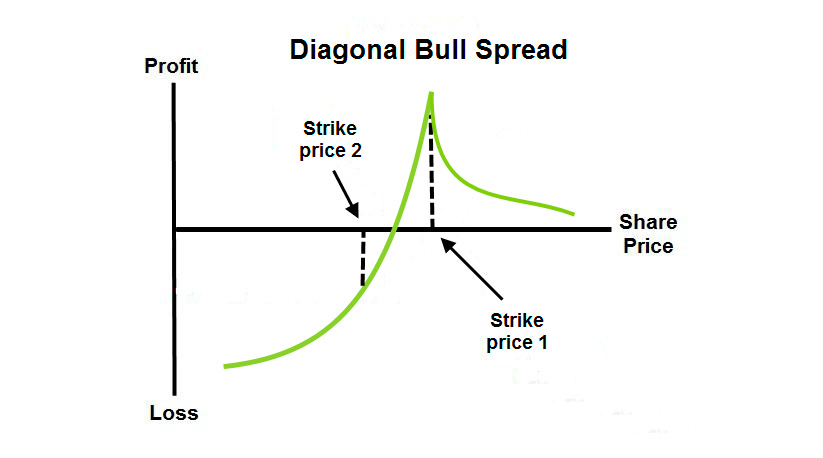
Assume that XYZ company shares are trading at $100. The trader expects a moderately bullish scenario: the price will rise a little over the next month, but there will be no strong rally.
- Action 1 (Buy). The trader buys a long-term call option (for example, expiring in 3 months) with a strike of $98 for a premium of $4.50 per share. For one contract (100 shares), this will be $450.
- Action 2 (Sell). The trader sells a short-term call option (for example, expiring in 1 month) with a strike of $102 for a premium of $2.00 per share. For one contract, this will be $200.
Net result is a debit. Expense = $450 (paid) - $200 (received). The total initial loss before commissions (debit) is -$250.
Scenario Analysis on the Expiration Date of the Short-Term Option
Scenario 1 (Share Price = $101.50)
The short-term call with a strike of $102 expires out of the money (OTM) and is worth nothing. The trader keeps the $200 premium. In turn, the long-term call with a strike of $98 is still in the money (ITM) and is worth about $4.50 (excluding time decay).
This means it can be sold for $450.
Profit. $450 (sale of the long-term option) - $250 (net debit) = $200.
Scenario 2 (Share Price = $105)
The short-term call with a strike of $102 ends up in the money and will be exercised. The loss on it is $2 per share, or $200. This fully cancels out the premium received earlier.
However, the long-term call with a strike of $98 will already be worth at least $7 ($105 - $98). Profit. $700 (value of the long-term option) - $450 (premium of the long-term option) = $450.
It is important to remember that the maximum profit in this strategy is often reached when the asset price at the expiration of the short-term option is exactly at its strike ($102).
Scenario 3 (Share Price = $95)
The short-term call expires out of the money. The long-term call with a strike of $98 is also out of the money and is worth only the remaining time value. The loss is limited by the net debit.
Maximum loss = $250 (net debit).
Example 2: Bearish Put Diagonal Spread
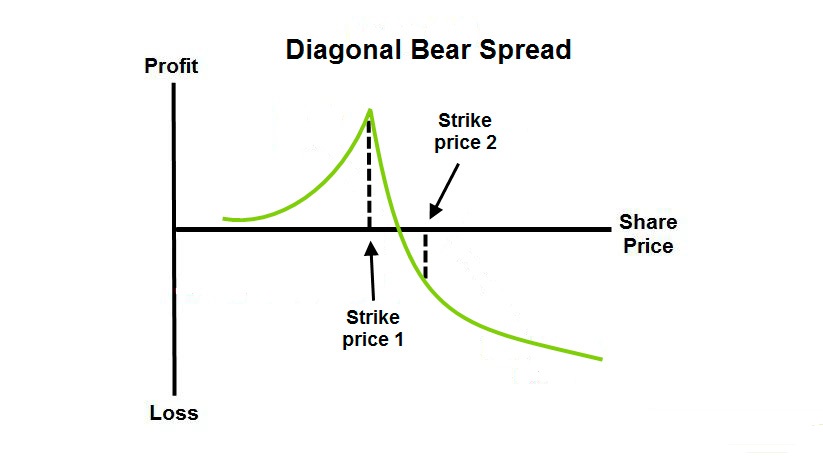
The NASDAQ index is trading at 22,600. The outlook is moderately bearish in the short term.
- Action 1 (Buy). The trader buys a long-term put (expiring in 1.5 months) with a strike of 22,600 (ATM). The premium is $135.
- Action 2 (Sell). The trader sells a near-term put (expiring in 3 weeks) with a strike of 22,500 (OTM). The premium is $90.
Net result is a debit. $135 (paid) - $90 (received) = $45 (per 1 unit of the asset). For a lot of 50 units, the total debit (net expense) will be $2,250.
Scenario Analysis on the Expiration Date of the Near-Term Option (for a Lot of 50)
Scenario 1 (Index = 22,450)
The near-term put (22,500) is in the money (ATM). The trader takes a loss on it: (22,500 - 22,450) * 50 = $2,500. But the long-term put (22,600) is also in the money and brings a profit: (22,600 - 22,450) * 50 = $7,500.
Profit. $7,500 (profit from the long-term option) - $2,500 (loss from the near-term option) - $2,250 (net debit) = $2,750.
Scenario 2 (Index = 22,700)
Both options are out of the money and expire worthless. The trader loses the entire debit paid. The maximum loss is $2,250.
Key Risk Factors and Position Management in a Diagonal Spread
Diagonal spreads require more active management than simple vertical or calendar spreads. The most significant risks of these options structures are the following:
- Early exercise risk. This is perhaps the main risk. A sold short-term American-style option can be exercised by the holder at any time before expiration if it is in the money. This is especially relevant if the asset price moves sharply beyond the strike of the sold option. It is important to monitor this risk and be ready to close the position before expiration. However, Bybit crypto options are European-style, so this risk is absent.
- Theta and Vega. The strategy is initially built on the fact that theta (time decay) will "eat away" the value of the sold option faster than that of the bought option. This is the main source of potential profit. Vega (sensitivity to volatility) also affects the position. Usually the strategy benefits when volatility rises, since the purchased long-term option is more sensitive to its changes.
Professional traders skillfully manage their position through rolling.
After the short-term option expires, the trader is left with the purchased long-term option. To continue generating income, the position can be rolled — sell another short-term option with a later expiration date, collecting the premium.
This procedure can be repeated several times, which makes the strategy resemble regular rent paid for a long-term asset.
Trader Action Table
| Situation | Action |
|---|---|
| Near option expires worthless | Sell the next monthly option (“roll” the position) or close the long-term option with a profit. |
| The price sharply broke the strike of the sold option | Option 1: Close the entire position (spread) and lock in your profit/loss. Option 2: Buy back the sold option and roll it higher (for a call) or lower (for a put) on the same date to get out of the danger zone. |
| Sharp drop in volatility | Bad for debit diagonals. The value of the distant option will fall more. Consider leaving early. |
| The expiration date of the long-range option has arrived | Important! The position ceases to be a diagonal and turns into a regular vertical spread, and the risks increase. |
A Section for Those Who Like Tables
Below are detailed summary tables comparing all the key types of diagonal spreads. The tables will help you quickly understand which structure to choose depending on your market outlook.
Debit Diagonal Spreads (the Trader Pays a Premium When Entering the Position)
| Parameter | Bullish call diagonal | Bearish Put Diagonal | Double diagonal |
|---|---|---|---|
| Market Forecast | Moderately bullish | Moderately bearish | Strictly neutral |
| Position structure | Buying long-distance ITM CallSelling short-range OTM Call | Buying a long-distance ITM Puta Selling a near-term OTM Puta | Buying a far Straddle (ATM)Selling a near Strangle (OTM) |
| Transaction type | Debit | Debit | Debit |
| Maximum profit | BA price = strike price of the sold near option (as of its expiration date) | BA price = strike price of the sold near option (as of its expiration date) | The BA price is between the strikes of the sold options on the near expiration date |
| Maximum loss | Limited to net debit paid | Limited to net debit paid | Limited to net debit paid |
| Time Effect (Theta) | Positive (we make money on the collapse of a nearby option) | Positive (we make money on the collapse of a nearby option) | Strongly positive (decay of two nearby options) |
| Impact of volatility (Vega) | Positive (far option is more sensitive) | Positive (far option is more sensitive) | Positive (protection with long-range options) |
Credit Diagonal Spreads (the Trader Receives a Premium When Entering the Position)
| Parameter | Bullish put diagonal | Bearish call diagonal |
|---|---|---|
| Market Forecast | Neutral / Slightly Bullish | Neutral / Slightly Bearish |
| Position structure | Selling a short-term ATM/ITM Put Buying a long-range OTM Put (protection) | Selling short-range ATM/ITM CallBuying long-range OTM Call (protection) |
| Transaction type | Credit | Credit |
| Maximum profit | Limited to the net premium received (if the near option expires out of the money) | Limited to the net premium received (if the near option expires out of the money) |
| Maximum loss | The difference in strikes minus the loan received (realized when the price drops significantly) | The difference in strikes minus the loan received (realized when the price rises strongly) |
| Time Effect (Theta) | Positive (gain from the collapse of the shorted option) | Positive (gain from the collapse of the shorted option) |
| Impact of volatility (Vega) | Negative (increasing volatility increases the cost of the sold option) | Negative (increasing volatility increases the cost of the sold option) |
Additional Parameters for Analysis (The Greeks)
| Parameter (Greek) | Value for standard Debit Diagonal (ITM/OTM) | Explanation |
|---|---|---|
| Delta (Δ) | Moderately positive (Call) or negative (Put) | The strategy is directional, but less aggressive than simply buying an option. The near option delta is subtracted from the far option delta. |
| Gamma (Γ) | Negative near the strike of the sold option | This means that if the price moves sharply higher (for a call spread), the rate of profit growth will slow and the position may begin to lose value due to exponential growth in the gamma of the sold option. |
| Theta (Θ) | Positive | The main driver of profit. As long as the price does not cross the strike of the sold option, the position makes money daily. |
| Vega (ν) | Positive | The strategy benefits from increased implied volatility (IV), making it a good tool ahead of major news (but after the event). |
Conclusion
Diagonal spreads are a powerful and flexible tool in the options trader's arsenal. They make it possible to implement complex trading ideas by working with price direction, time, and volatility.
Here is a brief table with the key characteristics of diagonal spreads:
| Column 1 | Column 2 |
|---|---|
| Characteristic | Description |
| Forecast | Directional (bullish or bearish) combined with temporary decay |
| Structure | Buying and selling options of the same type with different strikes and expiration dates |
| Max. profit | Usually achieved when the price of the underlying asset is equal to the strike price of the sold option at the time of its expiration |
| Max. lesion | For debit spreads, this is the net premium paid |
| The influence of time | Positive (the strategy benefits from the accelerated decay of the sold option) |
| Impact of volatility | Moderately positive (long-term purchased option is more sensitive to increased volatility) |
| Difficulty level | High |
This strategy is not suitable for passive trading: it requires constant monitoring, an understanding of the Greeks, and a readiness for active action. However, for traders willing to devote time to it, diagonal spreads open up broad opportunities for building effective and risk-controlled positions.
For a beginner, the safest path is to first learn how to read payoff diagrams and calculate debit/credit, and only then move on to rolling, early closing, and position management.