
Butterfly Options: Strategy Types and Calculation Examples

An options butterfly (Butterfly Spread) is a strategy that allows traders to profit from a particular price movement scenario while limiting the maximum loss. It is used when a trader expects the asset price to be near a specific level at expiration or, conversely, anticipates a strong move beyond a specified range.
A butterfly consists of four options and three strike prices. In the classic structure, one option is bought at the lower strike, two are sold at the middle strike, and one is bought at the upper strike. If the trader opens the reverse position, the result is a short butterfly.
There are several variations of the strategy:
Long call or put butterfly — a bet on the price being near the central strike.
Short call or put butterfly — a bet on the price moving beyond the outer strikes.
Iron Butterfly — a combination of calls and puts that allows traders to build a similar profit and loss profile using different types of options.
These structures differ in their composition, risk characteristics, initial costs, and conditions for generating a profit. We will examine each using examples involving stocks and cryptocurrency options.
A long butterfly is used when the price is expected to remain near a target value at expiration. For example, a stock costs $100, and a trader expects it to trade at approximately the same level in a month. By buying a butterfly, the trader limits their costs and gains an opportunity to profit if the forecast proves correct.
A short butterfly suits the opposite scenario. The trader expects a strong move up or down and opens a position that generates a profit if the price ends up beyond the outer strikes.
The expiration date matters for both structures. The forecast may be correct about the direction of the move, but the strategy will still end in a loss if the price does not reach the required level by the time the options expire.
However, a long butterfly is not an unconditionally profitable strategy in a sideways market, nor is a short butterfly guaranteed to be profitable in a volatile market. The outcome depends on the premiums at entry, the time until expiration, and the actual price on the settlement date.
Structure of an options butterfly
Consider three strikes: $90, $100, and $110. The central strike is $100, while the outer strikes form the butterfly's wings.
The distance from the central strike to each wing is the same — $10. This is a classic symmetrical butterfly.
The standard structure uses four options with the same expiration date and the same underlying asset. If the trader uses calls, all four options are calls. If puts — all four are puts.
To calculate the result, you need to distinguish between three quantities:
Opening cash flow — the amount the trader paid for the options or received from selling them.
Options payoff at expiration — the exercise value of the entire combination, excluding the initial premiums.
Final profit or loss — the options payoff adjusted for the initial cash flow and additional trading expenses.
In the examples below, premiums are quoted per one share. All quotes are hypothetical and serve to explain the mechanics of the strategy; commissions and taxes are excluded.
Long Call Butterfly
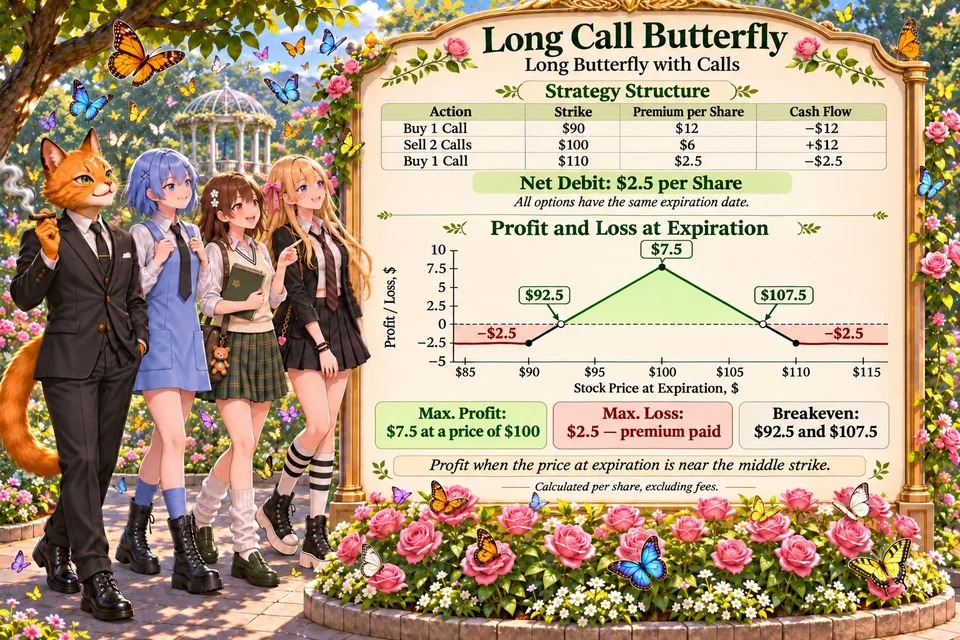
A long call butterfly (Long Call Butterfly) consists of the following transactions:
buying one call with the lower strike;
selling two calls with the central strike;
buying one call with the upper strike.
The trader makes a profit if the price at expiration is near the central strike. Maximum lo
ss is limited to the net premium paid when opening the position.
Suppose a stock costs $100. The trader expects its price to remain around $100 in a month.
Option | Strike | Premium per share | Transaction | Cash flow |
|---|---|---|---|---|
Call | $90 | $12.00 | Buy 1 | −$12.00 |
Call | $100 | $6.00 | Sell 2 | +$12.00 |
Call | $110 | $2.50 | Buy 1 | −$2.50 |
Total | −$2.50 |
To open the position, the trader pays $2.50 per share.
Suppose the price is still $100 at expiration. The purchased call with a $90 strike has $10 of intrinsic value. Both sold calls with a $100 strike and the purchased call with a $110 strike have no intrinsic value.
The options result is +$10 per share. After deducting the initial cost of $2.50, the profit is $7.50 per share.
Profit and Loss at Expiration
Stock price | Options payoff | Cash flow at opening | Net profit/loss |
|---|---|---|---|
$85 | $0 | −$2.50 | −$2.50 |
$92.50 | +$2.50 | −$2.50 | $0 |
$95 | +$5.00 | −$2.50 | +$2.50 |
$100 | +$10.00 | −$2.50 | +$7.50 |
$105 | +$5.00 | −$2.50 | +$2.50 |
$107.50 | +$2.50 | −$2.50 | $0 |
$115 | $0 | −$2.50 | −$2.50 |
The maximum profit is $7.50 per share, and the maximum loss is $2.50. The breakeven points are at $92.50 and $107.50.
For a standard option contract covering 100 shares, this corresponds to a maximum profit of $750 and a maximum loss of $250, excluding commissions.
Long Put Butterfly
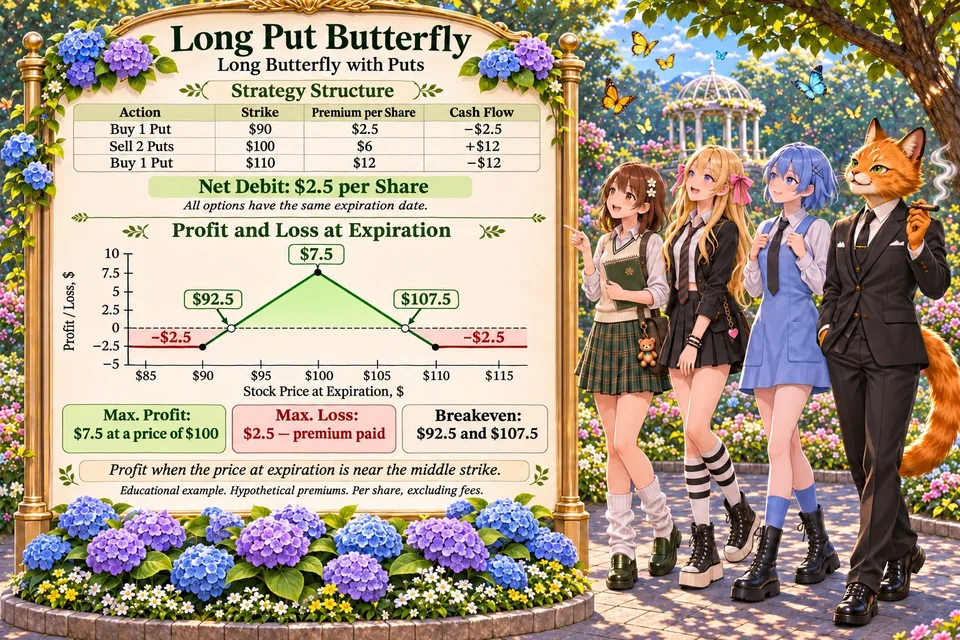
A long put butterfly uses put options instead of calls. It also consists of four options with three strikes, but the order of transactions is reversed:
buying one put at the upper strike;
selling two puts at the central strike;
buying one put at the lower strike.
The economic rationale of the strategy is the same: the trader expects the price to be near the central strike at expiration.
We use the same stock with a current price of $100 and strikes of $90, $100, and $110.
Option | Strike | Premium per share | Transaction | Cash flow |
|---|---|---|---|---|
Put | $110 | $12.50 | Buy 1 | −$12.50 |
Put | $100 | $6.00 | Sell 2 | +$12.00 |
Put | $90 | $2.00 | Buy 1 | −$2.00 |
Total | −$2.50 |
The net cost is $2.50 per share.
If the price at expiration is $100, the purchased put with a $110 strike has $10 of intrinsic value. The other options have no intrinsic value. After deducting the initial cost, the profit is $7.50 per share.
For comparable strikes and expiration dates, call and put butterflies have the same payoff profile when calculated at expiration. However, actual purchase prices may differ due to market conditions, interest rates, dividends, exercise characteristics, and bid–ask spreads.
Short Call Butterfly
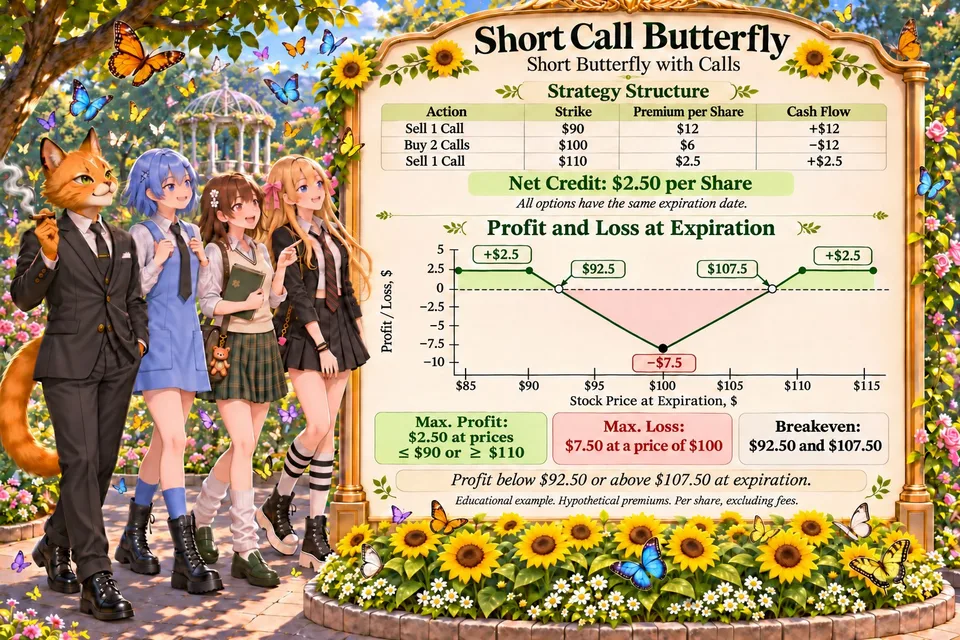
A short call butterfly (Short Call Butterfly) is the reverse position of a long call butterfly:
sell one call at the lower strike;
buy two calls at the central strike;
sell one call at the upper strike.
The trader receives a premium when opening the position and expects the price at expiration to fall outside the outer strikes. The maximum loss occurs near the central strike.
We use the same hypothetical premiums: the $90 call costs $12, the $100 call costs $6, and the $110 call costs $2.50.
Option | Strike | Transaction | Cash flow |
|---|---|---|---|
Call | $90 | Sell 1 | +$12.00 |
Call | $100 | Buy 2 | −$12.00 |
Call | $110 | Sell 1 | +$2.50 |
Total | +$2.50 |
The trader receives a credit of $2.50 per share.
Stock price at expiration | Options payoff | Credit at opening | Net profit/loss |
|---|---|---|---|
$85 | $0 | +$2.50 | +$2.50 |
$92.50 | −$2.50 | +$2.50 | $0 |
$95 | −$5.00 | +$2.50 | −$2.50 |
$100 | −$10.00 | +$2.50 | −$7.50 |
$105 | −$5.00 | +$2.50 | −$2.50 |
$107.50 | −$2.50 | +$2.50 | $0 |
$115 | $0 | +$2.50 | +$2.50 |
The maximum profit is $2.50 per share. It is achieved when the price is at or below the lower strike of $90 or at or above the upper strike of $110.
The maximum loss is $7.50 per share. It occurs at a price of $100, when the value of the short $90 call is $10 and the other options do not offset this loss.
The breakeven points are $92.50 and $107.50.
A short call butterfly is suitable when forecasting a strong move in either direction, but the maximum profit is limited to the premium received.
Short Put Butterfly
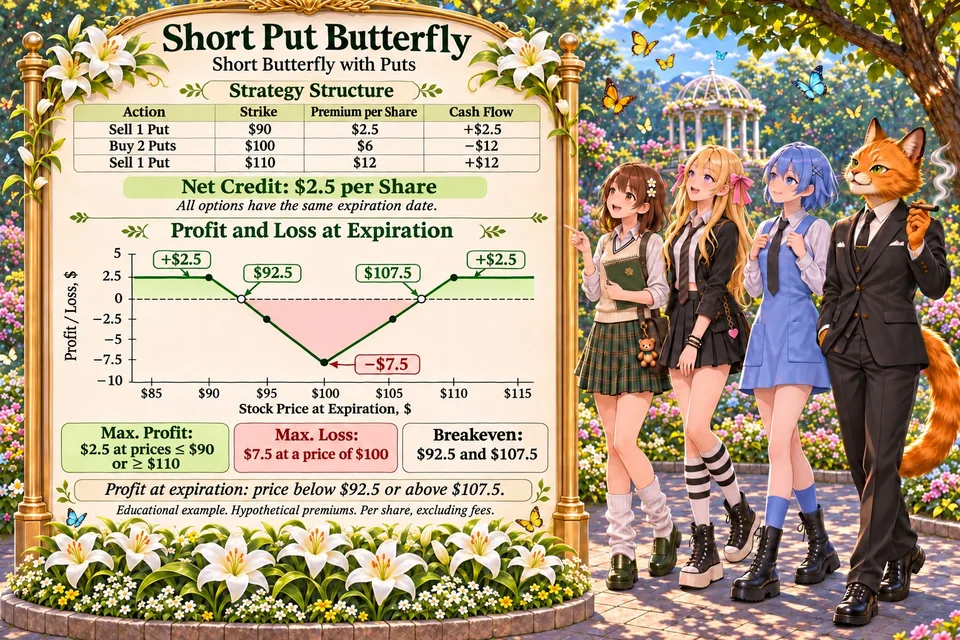
A short put butterfly (Short Put Butterfly) is the reverse position of a long put butterfly:
selling one put with the upper strike;
buying two puts with the central strike;
selling one put with the lower strike.
It also anticipates the price moving beyond the outer strikes by expiration. Maximum profit occurs beyond the wings, while maximum loss occurs near the central strike.
Option | Strike | Premium per share | Transaction | Cash flow |
|---|---|---|---|---|
Put | $110 | $12.50 | Sell 1 | +$12.50 |
Put | $100 | $6.00 | Buy 2 | −$12.00 |
Put | $90 | $2.00 | Sell 1 | +$2.00 |
Total | +$2.50 |
The credit received at opening is $2.50 per share.
If the stock falls to $80, the short $110 put creates a $30 obligation, the two long $100 puts have a combined value of $40, and the short $90 put creates a $10 obligation. The net result on the options is zero. Including the credit received, the trader earns $2.50 per share.
At a price of $100, the loss on the options is $10 per share, and the final loss after accounting for the credit is $7.50.
The key parameters of this structure match those of the short call butterfly at the hypothetical prices given:
maximum profit — $2.50 per share;
maximum loss — $7.50 per share;
breakeven points — $92.50 and $107.50.
The payoff profiles of short call and put butterflies have the same shape with identical strikes and consistent prices. They differ in the type of options and potential exercise characteristics.
Iron Butterfly — Iron Butterfly
An iron butterfly differs from a regular butterfly in that it uses a combination of both option types instead of four calls or four puts.
In the most common structure — the short iron butterfly (Short Iron Butterfly) — the trader sells a call and a put at the central strike and buys a protective put below and a protective call above the central strike. All four options have the same expiration.
This position is designed for the price to remain near the central strike at expiration. The protective options limit the maximum loss if the market moves sharply.
There is also a long iron butterfly (Long Iron Butterfly). In this structure, the trader buys a call and a put at the central strike and sells protective options at the outer strikes. This strategy, conversely, is designed for a strong price move beyond the wings.
Differences Between an Iron Butterfly and a Regular Butterfly
Characteristic | Regular butterfly | Iron butterfly |
|---|---|---|
Composition | Calls only or puts only | Calls and puts |
Strikes | 3 | 3 |
Number of options | 4 | 4 |
Typical long structure | Debit at opening | A long iron butterfly is usually opened for a debit |
Typical short structure | Credit at opening | A short iron butterfly is usually opened for a credit |
Maximum profit | Near the center strike for a long butterfly; beyond the wings for a short butterfly | Beyond the wings for a long butterfly; near the center strike for a short butterfly |
Maximum risk | Limited in the classic structure | Limited in the classic structure with protective options |
A standard long butterfly achieves its maximum profit near the central strike. A short iron butterfly also achieves its maximum profit at the central level, but its structure is different: the trader receives a credit when opening the position and uses purchased options at the outer strikes to limit losses.
A long iron butterfly has the opposite profile: it is designed for a strong move in either direction.
We should also note that a short iron butterfly hedges a short straddle using a long strangle. The structure generates its maximum profit near the central strike, while limiting losses through protective options.
A long iron butterfly, in turn, is the reverse structure: buying a straddle plus selling a strangle. It is designed for a strong price move up or down, while the options sold at the outer strikes limit potential profit.
Example of a Short Iron Butterfly Using Bybit Cryptocurrency Options
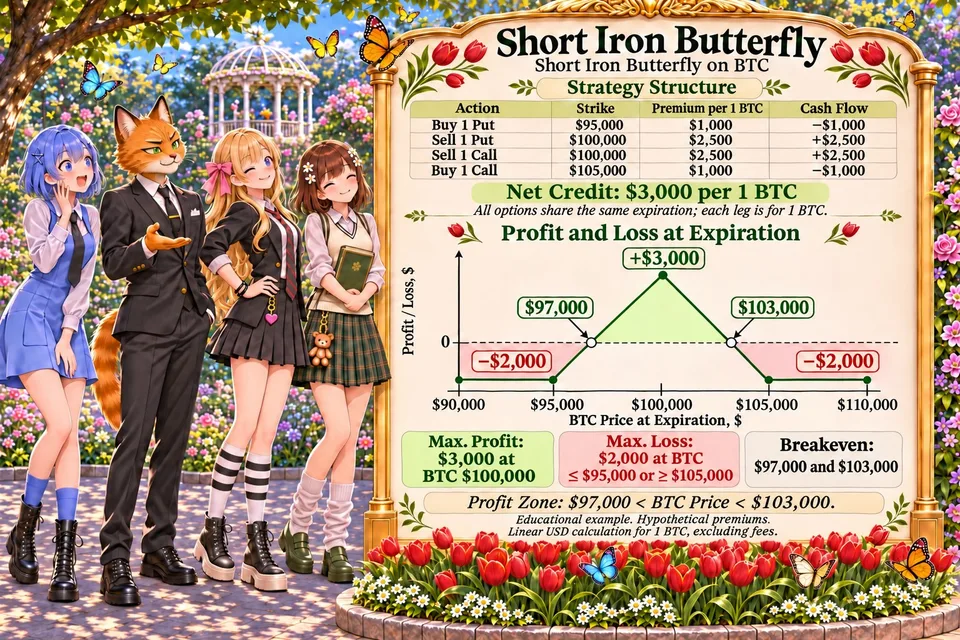
Let us consider BTC options on Bybit. Suppose the Bitcoin index price is $100,000, and the trader expects the price to remain near this level at expiration.
For this example, we use BTCUSDT options with the same expiration date. The Bybit cryptocurrency exchange offers cash-settled European-style options: they are exercised automatically at expiration, without physical delivery of the underlying asset, and settlement is made in USDT. The final settlement price is determined by the average index price over the 30 minutes before expiration.
All premiums below are hypothetical, rather than current exchange quotes. For clarity, a quantity of 1 BTC is assumed for each leg of the strategy; fees and margin costs are excluded.
Building the Position
The trader sells two options at the central strike of $100,000 and buys protective options $5,000 away in both directions.
Option | Strike | Premium per 1 BTC | Transaction | Cash flow |
|---|---|---|---|---|
Put | $100K | $2.5K | Sell | +$2.5K |
Call | $100K | $2.5K | Sell | +$2.5K |
Put | $95K | $1K | Buy | −$1K |
Call | $105K | $1K | Buy | −$1K |
Total | +$3K |
The net credit at opening is 3,000 USDT per 1 BTC of position size. This is the structure's maximum potential profit, provided that the final settlement price is at the central strike of $100,000.
Profit and Loss Calculation
BTC price at expiration | Result across four options | Credit at opening | Final profit/loss |
|---|---|---|---|
$90K | −$5K | +$3K | −$2K |
$95K | −$5K | +$3K | −$3K |
$96.9K | −$3K | +$3K | $0 |
$98K | −$2K | +$3K | +$1K |
$100K | $0 | +$3K | +$3K |
$102K | −$2K | +$3K | +$1K |
$103.1K | −$3K | +$3K | $0 |
$105K | −$5K | +$3K | −$2K |
$110K | −$5K | +$3K | −$2K |
All amounts are in USDT for a size of 1 BTC per leg. The options result shows the combined exercise value of the components at expiration before accounting for the initial credit.
For example, if BTC is at $98K, the short $100K put will create an obligation of 2,000 USDT. The protective $95K put will remain out of the money, and the call portion will have no intrinsic value. After adding the credit of 3,000 USDT, the final profit will be 1,100 USDT.
If BTC falls to $90K, the short put will create an obligation of 10,000 USDT, while the protective $95K put will yield 5,000 USDT. The combined options result will be −5,000 USDT. After accounting for the credit, the final loss will be 2,000 USDT.
Maximum Profit, Loss and Breakeven
Maximum profit occurs at a BTC price of $100,000:
Maximum profit = net credit = 3,000 USDT.
The width of each protective spread is 5,000 USDT per 1 BTC. Therefore, the maximum loss is: -5,000+3,000 = 2,000 USDT.
The breakeven points are calculated from the central strike:
lower: $100,000 − $3,100 = $97,000;
upper: $100,000 + $3,100 = $103,000.
Thus, a short iron butterfly generates a profit if the final settlement price is between the breakeven points, and the maximum profit when it expires at the central strike. Beyond the protective strikes of $95,000 and $105,000, the loss stops increasing.
These are theoretical results at expiration. The actual outcome on Bybit will depend on trading fees, fees for exercising ITM options and possible costs associated with margin requirements. Option sellers also face liquidation risk if their collateral becomes insufficient.
What if you expect a strong Bitcoin move?
In that case, you can consider a long iron butterfly—the reverse combination of the same four options:
buy a call and a put with a $100,000 strike;
sell the protective $95,000 put;
sell the protective $105,000 call.
Example of a Long Iron Butterfly Using Bybit Cryptocurrency Options — Long Iron Butterfly
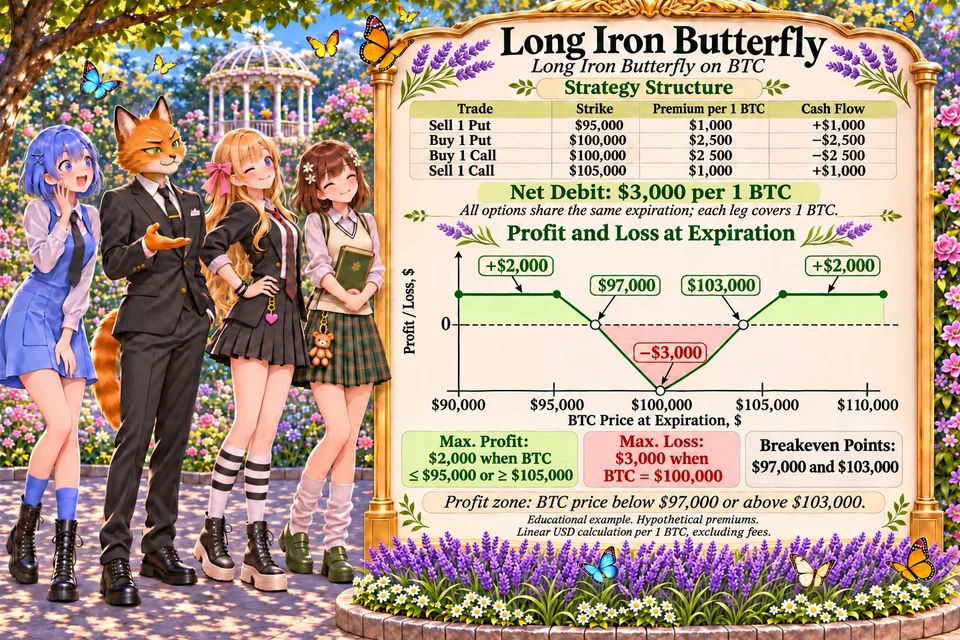
A long iron butterfly (Long Iron Butterfly) is a strategy designed for a strong upward or downward move in the price of the underlying asset. It involves buying a straddle and simultaneously selling a protective strangle with more distant strikes.
Unlike a long straddle, this structure has limited potential profit: the protective options sold offset further increases in payouts on the purchased options beyond the outer strikes.
Building the Position
We use the same parameters as in the short iron butterfly example. Suppose the Bitcoin index price is $100,000.
The trader expects a strong price movement during the life of the options but does not know which direction it will take.
He opens the following position:
Option | Strike | Premium per 1 BTC | Trade | Cash flow |
|---|---|---|---|---|
Put | $100,000 | $2,500 | Buy | −$2,500 |
Call | $100,000 | $2,500 | Buy | −$2,500 |
Put | $95,000 | $1,000 | Sell | +$1,000 |
Call | $105,000 | $1,000 | Sell | +$1,000 |
Total | −$3,000 |
The initial cost is 3,000 USDT for a notional amount of 1 BTC per leg. This is the strategy's maximum loss.
Calculating Profit and Loss at Expiration
BTC price at expiration | Result across four options | Opening costs | Final profit/loss |
|---|---|---|---|
$90K | +$5K | −$3K | +$2K |
$95K | +$5K | −$3K | +$2K |
$96.9K | +$3K | −$3K | $0 |
$98K | +$2K | −$3K | −$1K |
$100K | $0 | −$3K | −$3K |
$102K | +$2K | −$3K | −$1K |
$103.1K | +$3.1K | −$3K | $0 |
$105K | +$5K | −$3K | +$2K |
$110K | +$5K | −$3K | +$2K |
All amounts are in USDT for a notional size of 1 BTC per leg, excluding fees.
Let us consider several scenarios.
Scenario 1. Bitcoin stays around $100,000.
At expiration, all four options have no intrinsic value. The purchased call and put produce no payouts, and the sold protective options also expire unexercised.
The options result is zero. Including the initial costs, the trader loses 3,000 USDT. This is the maximum loss.
Scenario 2. Bitcoin falls to $90,000.
The purchased $100,000 put pays 10,000 USDT.
The sold $95,000 put creates an obligation of 5,000 USDT.
Both calls have no intrinsic value.
The combined options result: 10,000–5,000=5,000.
After deducting the initial costs: 5,000–3,000=2,000.
Scenario 3. Bitcoin rises to $110,000.
The purchased $100,000 call pays 10,000 USDT.
The sold $105,000 call creates an obligation of 5,000 USDT.
Both puts have no intrinsic value.
The options result is again 5,000 USDT. After deducting costs, the profit is 2,000 USDT.
Maximum profit, loss and breakeven points
The width of each protective spread is 5,000 USDT. Therefore, the maximum payout from the combination beyond the outer strikes is 5,000 USDT.
Maximum profit: 5,000−3,000=2,000
Maximum loss: 3,000
It occurs when the Bitcoin price is near the central strike of $100,000.
Breakeven points:
Lower: $100,000 − $3,100 = $97,000.
Upper: $100,000 + $3,100 = $103,000.
Thus, a long iron butterfly generates a profit if the settlement price is below $96,900 or above $103,100. Within this range, the position ends at a loss, which is greatest near $100,000.
Comparison of Short and Long Iron Butterflies
Characteristic | Short iron butterfly | Long iron butterfly |
|---|---|---|
Central options | Sell a put and a call | Buy a put and a call |
Protective options | Buy the outer put and call | Sell the outer put and call |
Cash flow at opening | +$3K | −$3K |
Maximum profit | $3K | $2K |
Maximum loss | $2K | $3K |
Where maximum profit occurs | Around $100K | Outside $95K–$105K |
Market scenario | Low volatility, price near the central strike | A strong price move up or down |
Thus, the short iron butterfly is designed for a relatively calm market, while the long iron butterfly is designed for a strong move up or down.
A nontrivial question — which butterfly to choose
Choosing a butterfly depends not only on the direction of movement but also on option prices. Even if a trader correctly forecasts the market, an unfavorable ratio of premium to potential payout can lead to a loss.
Market expectation | Suitable strategy | Main idea |
|---|---|---|
The price will stay near the target level | Long call or put butterfly | Limited loss and maximum profit near the central strike |
The price will move beyond the outer strikes | Short call or put butterfly | Earning a limited profit from a strong move |
The price will stay near the central strike; a combination of calls and puts is needed | Short iron butterfly | A credit at opening and protective options at the outer strikes |
A strong move in either direction is expected | Long iron butterfly | Buying central calls and puts and selling protective options at the outer strikes |
Conclusion
A butterfly allows you to limit risk and tailor the profit profile to a specific price scenario. A long call or put butterfly is designed for the price to be near the middle strike at expiration. A short butterfly, conversely, profits when the price moves beyond the outer strikes but loses money near the middle level.
An iron butterfly uses both calls and puts. The short version generates a premium when opened and benefits from a quiet market, while the long version requires an initial outlay and is designed for a strong price move.
When comparing strategies, it is important to consider initial cash flows, maximum profit, maximum loss, and breakeven points. Before opening a position, you must also check option liquidity, commissions, the expiration date, and margin requirements.
This material is educational and does not constitute a personalized investment recommendation. Options trading involves the risk of losing capital. Even strategies with a limited maximum loss can result in the complete loss of the amount initially invested.