
Straddles and strangles in options: how to profit from price movements

Straddles and strangles are options strategies that allow traders to trade expectations about future price movements, even when they do not know which direction the market will take. They are used ahead of earnings releases, central bank decisions and other events capable of causing sharp price fluctuations.
Both strategies combine a Call option and a Put option on one underlying asset with the same expiration date. The main difference lies in the strikes: they are identical in a straddle and different in a strangle.
The buyer of these combinations expects a strong price movement or an increase in implied volatility. The seller, conversely, expects a relatively quiet market and seeks to profit from the time decay of option premiums. However, price movement alone does not guarantee a profit. The outcome depends on the cost of the options when the position is opened, the size of the movement, the time remaining until expiration and changes in implied volatility.

The differences between a straddle and a strangle are shown in the table below.
Characteristic | Long straddle | Long strangle |
|---|---|---|
Call and Put strikes | Identical | Different |
Typical structure | Both options near the current price | Both options out of the money |
Initial costs | Usually higher | Usually lower |
Breakeven points | Usually closer to the current price | Usually farther from the current price |
Required movement | Usually smaller | Usually larger |
Maximum loss | Premiums paid | Premiums paid |
This is a general pattern, rather than a rule for all market conditions. The actual cost depends on volatility, time to expiration, liquidity and the premiums of each contract.
Straddle: a bet on a strong price movement
Straddle (straddle) is a combination of Call and Put options with the same strike and expiration date.
There are two main varieties:
Long straddle: buying a Call and a Put. The trader expects a significant price movement upward or downward.
Short straddle: selling a Call and a Put. The trader expects the price to remain near the strike and the options to decrease in value.
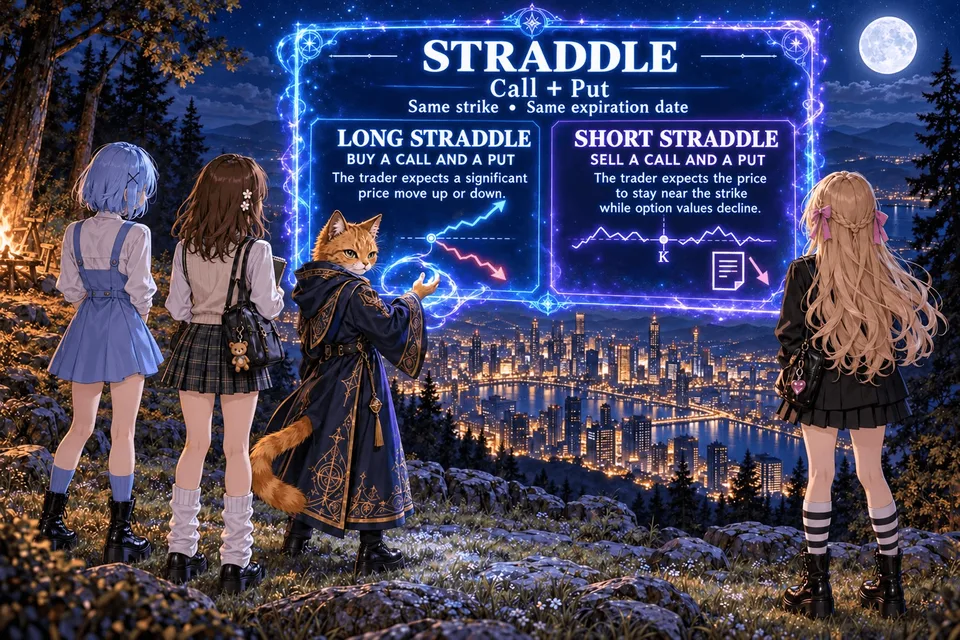
How a long straddle works
Suppose a stock is trading at $100. An important event expected within the next month could cause a strong price movement. The trader does not know how the market will react, so buys two options expiring in a month.
Parameter | Call | Put |
|---|---|---|
Strike | $100 | $100 |
Premium per share | $5 | $4 |
Transaction | Purchase | Purchase |
Cash flow at opening | −$5 | −$4 |
Total costs at opening are $9 per share.
At expiration, the Call has value if the price is above $100, and the Put if it is below $100. A purchased option cannot have a negative exercise value: if it is out of the money, its payoff at expiration is zero.
Let us consider several scenarios.
Stock price at expiration | Call payoff | Put payoff | Options payoff | Cash flow at opening | Final profit/loss |
|---|---|---|---|---|---|
$80 | $0 | +$20 | +$20 | −$9 | +$11 |
$91 | $0 | +$9 | +$9 | −$9 | $0 |
$100 | $0 | $0 | $0 | −$9 | −$9 |
$105 | +$5 | $0 | +$5 | −$9 | −$4 |
$109 | +$9 | $0 | +$9 | −$9 | $0 |
$120 | +$20 | $0 | +$20 | −$9 | +$11 |
All amounts are per one share, excluding commissions.
If the stock rises to $120, the Call will produce a payoff of +$20 per share, while the Put will expire without intrinsic value. After deducting the $9 paid, the profit will be $11.
If the price remains at $100, both options will expire without intrinsic value. The trader will lose the initial $9.
For a long straddle, the breakeven points at expiration are calculated as follows:
Upper point: strike + total premium.
Lower point: strike − total premium.
In our example, these are $109 and $91.
At a price above $109 or below $91, the position generates a profit at expiration. Between these levels, it ends in a loss, except at the breakeven points, where the final result is zero.
The potential profit as the stock rises is theoretically unlimited. On the downside, it is limited by the underlying asset reaching a price of zero. The strategy's maximum loss equals the premiums paid: $9 per share.
A straddle is used when a trader believes the market underestimates the potential size of a price movement or increase in volatility.
For example, a stock costs $100 ahead of an earnings release. The options are relatively expensive because the market already expects significant fluctuations. If the stock rises only to $104 after the release, the position will produce a loss at expiration: the options payoff will be just $4 against initial costs of $9.
However, a straddle does not have to be held until expiration. If implied volatility rises significantly after opening, the Call and Put may increase in value. The trader can close both options early and lock in a profit, even if the price has not yet moved beyond the breakeven points at expiration.
The opposite situation is also possible. After important news is released, uncertainty decreases, and implied volatility falls along with it. This is often called a volatility crush. In this case, the options may fall in value even if the underlying asset has moved noticeably.
How a short straddle works
Suppose a stock costs $100. A trader sells a Call with a $100 strike for $5 and a Put with the same strike for $4.
The cash flow at opening is +$9 per share.
The following outcomes are possible at expiration:
Stock price at expiration | Short Call payoff | Short Put payoff | Options payoff | Cash flow at opening | Final profit/loss |
|---|---|---|---|---|---|
$80 | $0 | −$20 | −$20 | +$9 | −$11 |
$91 | $0 | −$9 | −$9 | +$9 | $0 |
$100 | $0 | $0 | $0 | +$9 | +$9 |
$109 | −$9 | $0 | −$9 | +$9 | $0 |
$120 | −$20 | $0 | −$20 | +$9 | −$11 |
In this table, a negative value for a sold option represents the seller's obligation at expiration, calculated relative to the strike.
The maximum profit is $9 per share and is achieved when the price at expiration equals $100. The breakeven points are $91 and $109.
The main danger is a sharp price movement. With a strong rise, the loss on an uncovered Call is theoretically unlimited. On a decline, the loss on the Put can also be very large.
A short straddle is sometimes used when implied volatility is considered high relative to future actual fluctuations. However, the premium received is not guaranteed income: the seller assumes the risk of significant losses.
Strangle: an inexpensive bet on a strong movement
Strangle (strangle) is a combination of a Call and a Put with the same expiration date but different strikes.
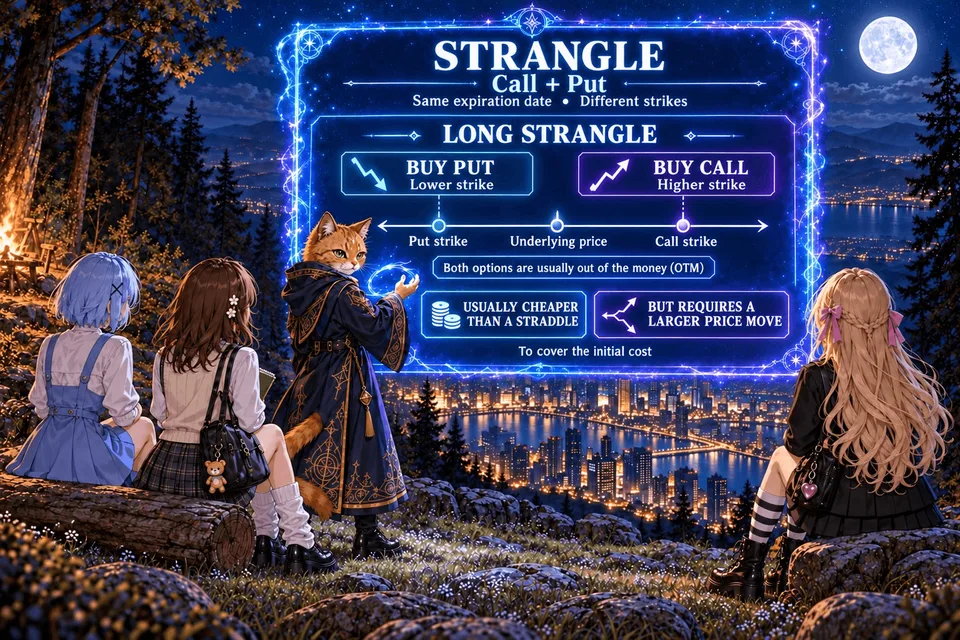
A long strangle involves buying a Put with a lower strike and a Call with a higher strike. Both options are usually out of the money (OTM). This structure usually costs less than a straddle but requires a stronger price movement to offset the initial costs.
How a long strangle works
A stock costs $100. The trader expects a strong movement within a month but wants to reduce the initial costs compared with a straddle.
The trader buys:
Parameter | Put | Call |
|---|---|---|
Strike | $90 | $110 |
Premium per share | $2.50 | $2 |
Transaction | Purchase | Purchase |
Cash flow at opening | −$2.50 | −$2 |
Total costs are $4.50 per share.
Breakeven points at expiration:
Lower: $90 − $4.50 = $85.50.
Upper: $110 + $4.50 = $114.50.
Stock price at expiration | Put payoff | Call payoff | Options payoff | Cash flow at opening | Final profit/loss |
|---|---|---|---|---|---|
$80 | +$10 | $0 | +$10 | −$4.50 | +$5.50 |
$85.50 | +$4.50 | $0 | +$4.50 | −$4.50 | $0 |
$90 | $0 | $0 | $0 | −$4.50 | −$4.50 |
$100 | $0 | $0 | $0 | −$4.50 | −$4.50 |
$110 | $0 | $0 | $0 | −$4.50 | −$4.50 |
$114.50 | $0 | +$4.50 | +$4.50 | −$4.50 | $0 |
$120 | $0 | +$10 | +$10 | −$4.50 | +$5.50 |
For example, if the stock falls to $80, the Put will pay $10 per share. After deducting costs of $4.50, the profit will be $5.50. A rise to $120 will produce the same result through the Call.
If the price remains between $90 and $110, both options will expire without intrinsic value, and the trader will lose the $4.50 paid.
The maximum loss on a long strangle is limited to the premiums. Potential profit as the price rises is theoretically unlimited, while on a stock decline it can be substantial but is limited by the fact that the asset price cannot fall below zero.
How a short strangle works
In this structure, the trader sells a Put with a $90 strike for $2.50 and a Call with a $110 strike for $2.
The cash flow at opening is +$4.50 per share.
Stock price at expiration | Short Put payoff | Short Call payoff | Options payoff | Cash flow at opening | Final profit/loss |
|---|---|---|---|---|---|
$80 | −$10 | $0 | −$10 | +$4.50 | −$5.50 |
$85.50 | −$4.50 | $0 | −$4.50 | +$4.50 | $0 |
$100 | $0 | $0 | $0 | +$4.50 | +$4.50 |
$114.50 | $0 | −$4.50 | −$4.50 | +$4.50 | $0 |
$120 | $0 | −$10 | −$10 | +$4.50 | −$5.50 |
The maximum profit is $4.50 per share. It is achieved if the price at expiration is between the $90 and $110 strikes. The breakeven points are $85.50 and $114.50.
Compared with a short straddle, this structure allows a wider price range for achieving the maximum profit but generates a smaller premium in our example. The risk of a strong movement beyond the range remains.
Synthetic straddles and strangles: how to reproduce a similar result
A synthetic position is a combination of options, the underlying asset and cash instruments that reproduces the payoff profile of another position. These structures use the relationships between Call and Put prices known as put-call parity.
For example, for European options, which are the type available on Bybit, with the same strike and expiration on an asset without dividends, a long straddle can theoretically be reproduced using the following combination:
buy two Calls with one strike;
open a short position in the underlying asset;
invest an amount in a cash instrument that will pay the strike amount at expiration.
At expiration, a synthetic straddle has the same payoff profile as one purchased Call and one purchased Put with the same strike.
For a long strangle with a Put at the lower strike (K_1) and a Call at the upper strike (K_2), a similar replication involves buying Calls at both strikes, a short position in the underlying asset and a cash instrument paying (K_1) at expiration.
This is a theoretical equivalence, rather than a guarantee of a cheaper trade. Comparing actual strategies requires taking into account initial cash flows, financing costs, dividends, short position costs, collateral requirements and trading costs.
Main risks and beginner mistakes

The first common mistake is assuming that a long straddle or strangle will necessarily produce a profit when the market moves strongly. In reality, the options payoff at expiration must exceed the initial costs (costs can be estimated on Bybit). If the options were purchased at a high price, even a noticeable price movement may be insufficient.
The second mistake is ignoring implied volatility. An increase usually raises the value of purchased Calls and Puts, all else being equal, while a decrease may reduce the value of a long combination. For an options seller, the effects are the opposite: an unexpected increase in volatility can increase the cost of closing the position.
The third mistake is forgetting about time decay. All else being equal, it works against the options buyer and in favor of the seller. However, in return, the seller assumes the risk of a significant price movement and may lose far more than the premium received.
Finally, it is important to distinguish the payoff at expiration from the final profit. The payoff shows the result of exercising the options, while profit or loss is the financial outcome after accounting for initial premiums and costs. This is why calculations must separately show the cash flow at opening, the options payoff at expiration and the final result.
Conclusion
Straddles and strangles allow traders to trade expectations about volatility without having to choose the direction of price movement in advance. Long structures limit risk to the premiums paid and can generate profits during strong movements. Short structures allow traders to earn a premium if the market remains within a suitable range, but create the risk of substantial losses.
A straddle uses identical Call and Put strikes and usually costs more. A strangle is usually cheaper but requires a more significant movement to break even. If the aim is to protect existing stock holdings against a decline, a protective Put often serves that purpose better than buying both options.
When choosing a strategy, assess not only the price forecast but also the cost of volatility, time to expiration, options liquidity, breakeven points and a predetermined acceptable loss. Profitable scenarios must be calculated after deducting premiums, commissions and other expenses.
This material is educational and does not constitute a personalized investment recommendation. Options strategies can lead to the loss of invested funds, while selling uncovered options can cause losses substantially exceeding the premium initially received.