
Bitcoin Halving: Meaning, History, and Impact on Traders

Bitcoin halving is an event programmed into the protocol in which the miner's reward for finding a block is cut in half. It occurs after every 210,000 blocks—approximately once every four years—and postpones the inevitable mining of the last of the 21 million bitcoins.
The limit of 21 million bitcoins is a fundamental rule embedded by the cryptocurrency's creator, Satoshi Nakamoto, when the protocol was launched in 2009.
This limit is not arbitrary: it has a clear mathematical basis and is intended to create predictable scarcity for the digital asset. Bitcoin was therefore designed from the outset as a system with a predetermined schedule for issuing new coins.
At first glance, halving appears to be a purely technical event. After a Bitcoin halving, miners begin receiving half as many bitcoins.
In reality, halving is essentially a deflationary mechanism for predictably reducing the volume of new BTC issuance, making it one of the first cryptocurrency's key economic structures.
Halving simultaneously affects the coin supply, mining profitability, the behavior of BTC holders, and traders' expectations.
History of Bitcoin Halvings
Bitcoin has undergone four halvings during its existence—in 2012, 2016, 2020, and 2024. Each took place in a different market environment, so rather than merely calculating price growth percentages, it is especially valuable to analyze exactly what happened to Bitcoin after each event and how market behavior changed.

Back in 2009, a miner received 50 BTC for every block found. After every 210,000 blocks, the reward automatically fell: to 25 BTC after the first halving, 12.5 BTC after the second, and 6.25 BTC after the third.
The fourth halving occurred on April 20, 2024, at block No. 840,000, and the base reward has been 3.125 BTC since then.
Now, let us take a closer look back at how it happened.
The First Halving: 2012 and the Birth of the “Halving Cycle”
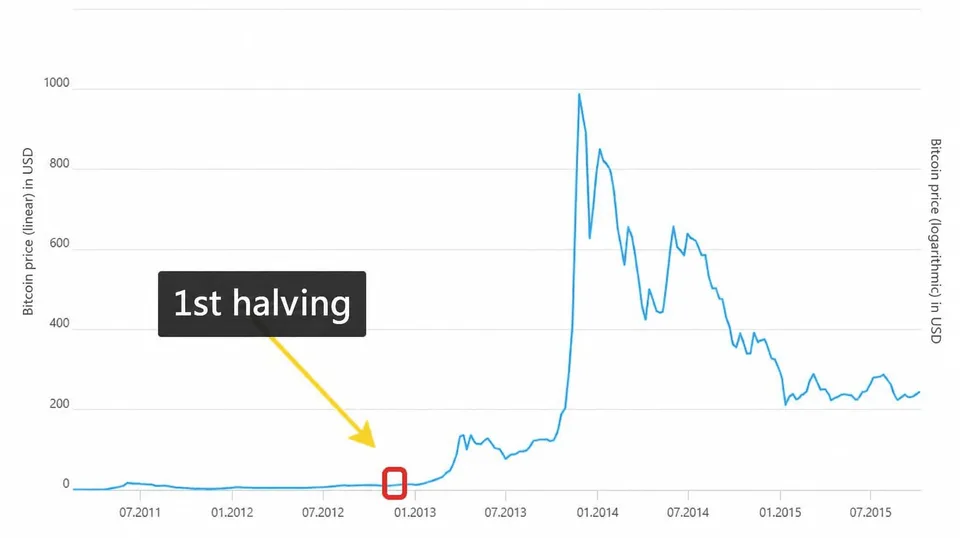
The first Bitcoin halving took place on November 28, 2012. The block reward fell from 50 BTC to 25 BTC. At the time, Bitcoin remained essentially an experiment for a small group of enthusiasts, and its price was around $12.
For miners, the event became a genuine stress test. The amount of BTC awarded for finding a block was instantly halved—and potential profitability fell along with it.
CoinDesk Research showed that the hash rate temporarily declined after the first halving (the speed at which computing equipment performs cryptographic operations during mining). Less efficient equipment ceased to be profitable, and some computing capacity left the network. However, the decline was short-lived: as soon as Bitcoin's price began to rise, mining became attractive again and computing capacity started returning.
This revealed the first important economic principle of mining: it is not a fixed business with unchanging expenses. Mining profitability is a variable that depends on the BTC price, network difficulty, and electricity costs. When profitability falls, some equipment is taken offline; when it rises, new and previously disconnected capacity returns to the network.
From a price perspective, the first halving certainly looks impressive. According to historical data, Bitcoin was worth about $12 around the time of the halving and approximately $1,000 a year later.
At its peak, according to ProShares, the price reached approximately $1,056, representing growth of about $8,500%.
However, it is easy to fall into the trap of hindsight analysis here. In 2012, the Bitcoin market was extremely small: low liquidity, a limited number of participants, and an almost complete absence of institutional interest made price movements particularly volatile.
Applying the performance of that cycle to today's market is practically impossible: the structure of demand, trading volumes, and maturity of the infrastructure are fundamentally different now.
Nevertheless, it was after the first cycle that an important idea became established in cryptocurrency culture: halving is not merely a technical change to miners' rewards, but an event that launches a multiyear cycle of expectations and speculation. Over time, this narrative began to influence market participants' behavior as much as the fundamental changes in issuance.
The Second Halving: 2016 and the Emergence of “Halving Trading”
On July 9, 2016, the reward fell from 25 BTC to 12.5 BTC. By then, the Bitcoin market had grown considerably and had begun attracting not only ideologues and programmers but also small-scale speculative capital.
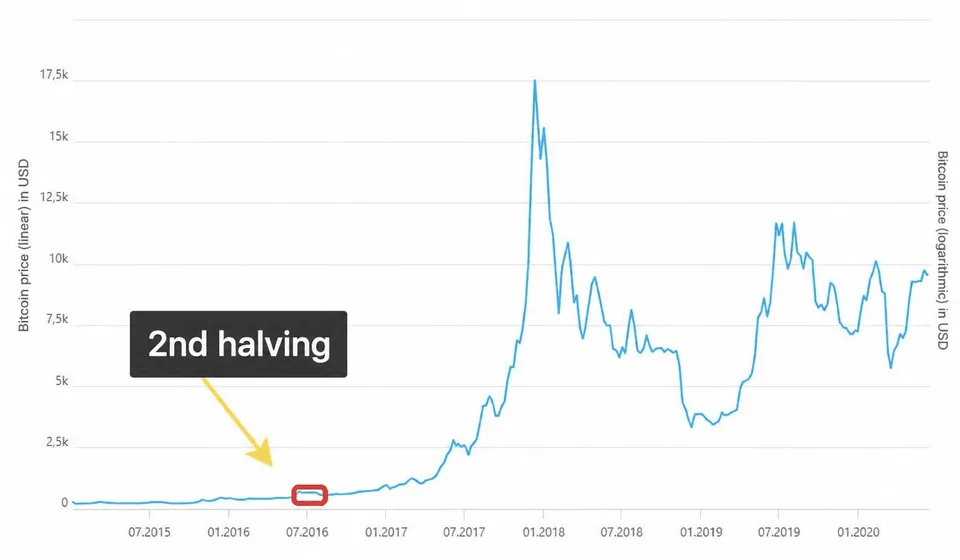
The price around the halving was approximately $650. A year later, Bitcoin was worth about $2,500, and then made history in 2017 with a rapid rise to nearly $20,000.
But something else is more important—the market's behavior immediately around the event.
In 2016, traders already knew about the halving in advance. This meant that some of the anticipated effect could have been priced in before the event itself. CoinDesk noted that the dynamics before the second halving differed from those before the first: the price rose ahead of the event and then corrected.
This gave rise to an important idea in cryptocurrency trading: the market trades not only the event itself but also expectations surrounding it.
A halving therefore does not have to produce a sharp rise on the day of the event. The price may rise for months beforehand, correct immediately before the halving, or move sideways.
The situation also changed for miners. By 2016, mining had already become an industrial business using ASIC equipment. Delphi Digital research estimated the cost of mining one BTC with typical commercial equipment of that period at approximately 217 before the halving.
Competition shifted from enthusiasts with home computers to professional operators for whom electricity costs and equipment efficiency became critical factors.
The Third Halving: 2020—Mining as a Financial Industry
On May 11, 2020, the reward fell from 12.5 BTC to 6.25 BTC.
This halving was especially interesting: by then, institutional capital had already entered the Bitcoin market, publicly traded mining companies had emerged, and the derivatives market was more developed.
Shortly before the halving, Riot Blockchain (now Riot Platforms) began actively upgrading its equipment. In May 2020, Riot explicitly reported that its old Antminer S9 machines had ceased to be profitable after the halving, so the company took them out of service. At the same time, Riot purchased more efficient S19 Pro machines and moved equipment to facilities with cheaper electricity.

This is an almost perfect illustration of how halving affects mining:
smaller reward → lower profitability → old equipment becomes unprofitable → weaker miners disconnect → efficient players gain a larger market share.
At first glance, this may appear dangerous for the network. Bitcoin, however, has an automatic difficulty-adjustment mechanism: if the network's computing power changes, the protocol gradually adjusts mining difficulty so that the average block creation time remains around ten minutes.
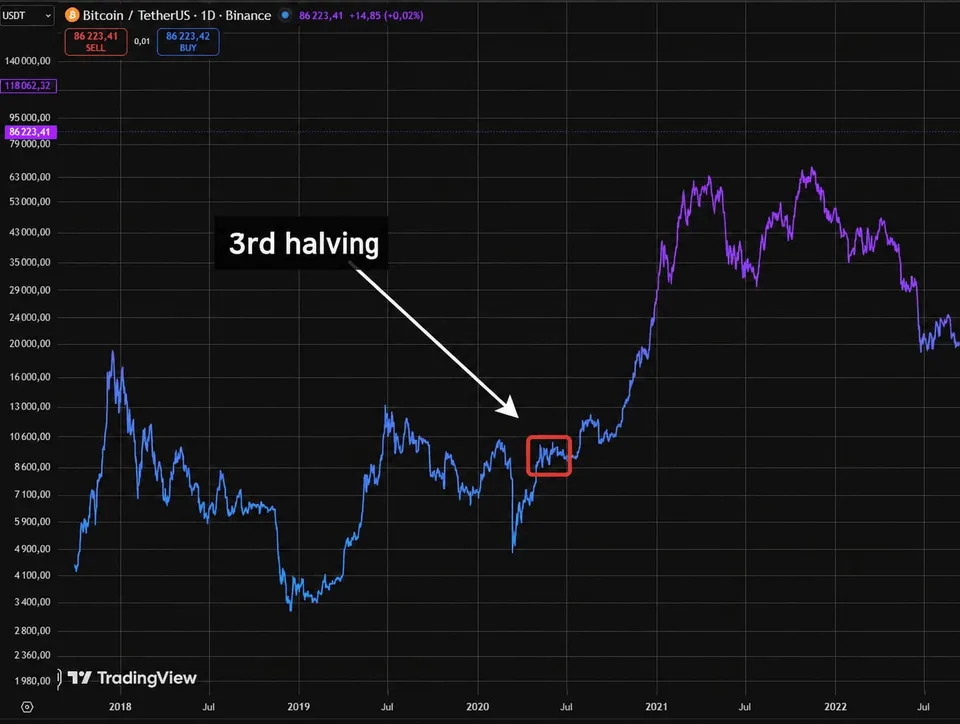
After the third halving, the price began to rise again. A year later, Bitcoin traded around 57,000 compared with approximately 8,600–9,700 during the halving period, and it subsequently reached an all-time high of around 69,000 in 2021.
Can this growth be attributed solely to the halving? No.
The years 2020–2021 were accompanied by unprecedented monetary easing, growing speculative liquidity, interest from institutional investors, and the DeFi boom.
The halving was only one factor, not the market's sole driver.
The Fourth Halving: 2024—a New Context
The fourth halving took place on April 20, 2024. The reward fell from 6.25 BTC to 3.125 BTC.
But this cycle looked fundamentally different.
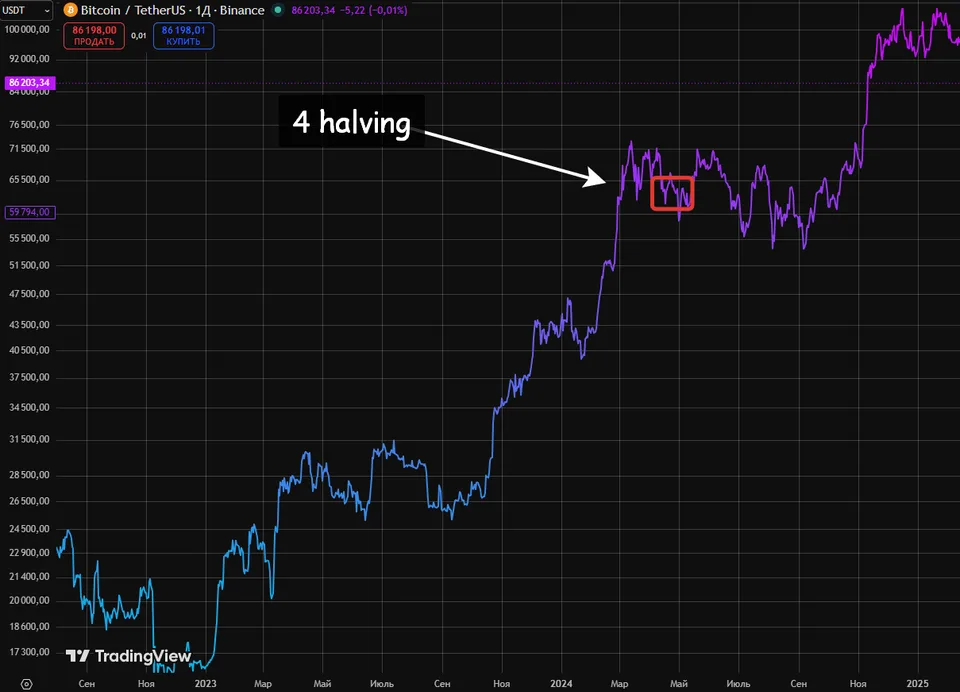
The market knew about the event in advance and actively priced in expectations before the halving. Moreover, on January 10, 2024, the SEC approved the listing of spot Bitcoin ETFs in the United States, opening a new channel through which traditional investors could access BTC.
As a result, Bitcoin set a new all-time high before the halving—73,803 in March 2024. Shortly before the event itself, the price was already around $64,000–$65,000.
This is the most important difference from the early cycles. Previously, halving itself was one of the cryptocurrency market's main narratives. In 2024, it became only part of a far more complex picture that included ETFs, institutional purchases, macroeconomics, and new ways of using Bitcoin.
On the first anniversary of the fourth halving, April 20, 2025, Bitcoin closed at around $85,100—approximately one-third above its closing price on the day of the halving. This was noticeably more modest than the historical results of the first three cycles.
Meanwhile, Bitcoin had already briefly exceeded $100,000 for the first time in December 2024. Reuters attributed this stage of growth primarily to changing political expectations in the United States, institutional demand, and general market optimism rather than solely to the April halving.
The TLAP Counter: Waiting for the Fifth Halving
TLAP has a counter tracking the time remaining until the fifth halving, which will take place on May 4, 2028.
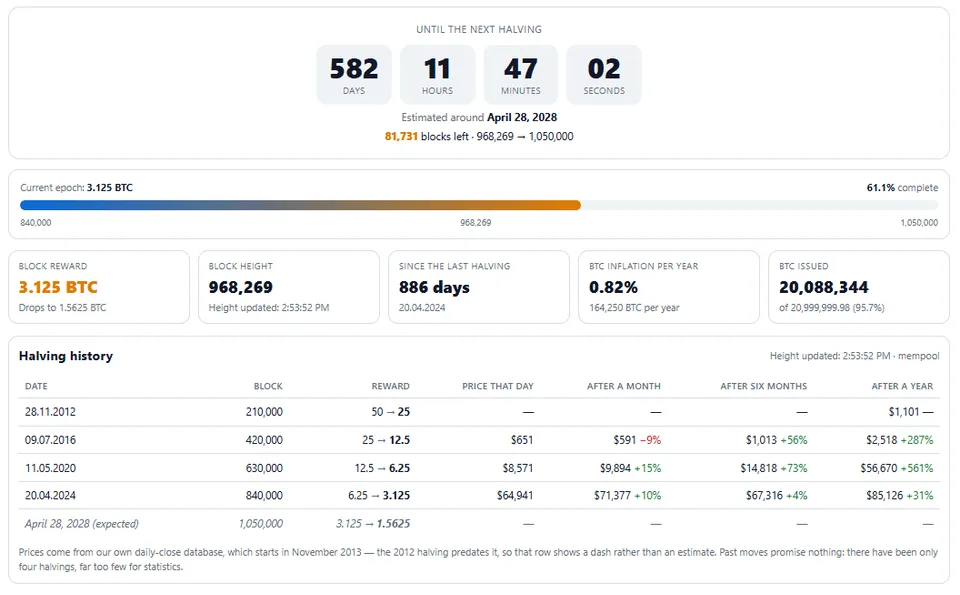
In addition to the counter, information is available about the current block height, annual inflation, and the number of coins issued. And, of course, there is a table showing the history of halvings.
The Impact of Halving on Bitcoin Supply
In terms of the mining rate, before the fourth halving the network created an average of about 900 BTC per day, while afterward this flow fell to approximately 450 BTC. On an annual basis, new issuance decreased from 328,000–330,000 BTC to 164,000–165,000 BTC.
For Bitcoin, this means a decline in the rate of supply inflation. Scarcity alone, however, does not guarantee price growth: the price is determined by the relationship between supply and demand.
If demand remains unchanged while the flow of new coins declines, the number of sellers associated with new issuance decreases. If demand rises at the same time, the effect can be significant.
This is the source of the popular idea of a “supply shock.” But halving is not an automatic growth driver.
Historically, Bitcoin has indeed risen after halvings, but its performance was simultaneously affected by interest rates, liquidity, regulation, institutional demand, the state of the global economy, and the cryptocurrency's level of popularity. As Reuters noted, historical rallies cannot be attributed unambiguously to the reduction in issuance alone.
The Impact of Halving on Miners
For a miner, the arithmetic is extremely simple.
Before the 2024 halving, every block found yielded 6.25 BTC plus fees. After the event, the reward fell to 3.125 BTC plus fees. If the Bitcoin price remains unchanged and fees do not increase, income from the subsidy (new coins that the protocol issues specifically as a block reward) is effectively halved.

Halving therefore becomes a kind of test for the mining industry. The companies most likely to survive are those with lower costs and greater resilience: cheaper electricity, more efficient ASIC equipment, a lower debt burden, better infrastructure, and a greater ability to endure a period of low margins.
The year 2024 was particularly revealing. According to Reuters, after the April halving miners faced three factors simultaneously: a smaller reward, rising network difficulty, and the need to invest in more efficient equipment. Under these conditions, some companies began seeking sites with cheap electricity outside the United States, while others repurposed their infrastructure for high-performance computing and artificial intelligence.
The day of the halving itself was also interesting. The Runes protocol launched at the same time as block No. 840,000, and users began actively using the Bitcoin blockchain to issue new tokens. This caused a sharp surge in fees.
According to Coinbase Institutional, users paid approximately 1,257 BTC in fees on April 20, 2024—one of the highest figures in the network's history. On the first day, fees temporarily accounted for an enormous share of miners' revenue.
The result was an almost symbolic situation: the halving cut the subsidy in half, but the fee market temporarily offset part of the decline.
This clearly shows the direction in which Bitcoin's economy is moving: as the subsidy gradually declines, transaction fees should play an increasingly important role in miners' revenue. This is the structural meaning of the network's long-term model: mining should become progressively less dependent on issuance and increasingly dependent on economic activity on the blockchain.
The Impact of Halving on Trading
For a trader, halving is interesting not so much because of its technical mechanics as because of how the market attempts to price it in advance.
What should you pay attention to?

Reduction in the future BTC supply. The flow of new coins onto the market declines, and with demand unchanged, this reduces pressure from sellers associated with issuance.
Investor expectations. If market participants regard halving as a positive factor, they may buy Bitcoin in advance—and thereby move the price before the event.
Miner behavior. After the reward decreases, some companies are forced to sell more BTC or use their own reserves to finance operations. Coinbase Institutional explicitly stated that potential selling pressure from miners could rise after the halving because of shrinking margins.
Speculative activity. When everyone knows that an event will occur at a particular block, traders begin pricing in expectations ahead of time.
A paradox therefore often arises around a halving: the more strongly the market believes in growth after the halving, the more substantial that growth may be before the event itself. In that case, the day of the halving may be unexpectedly calm.
This is precisely what happened in 2024: Bitcoin set a new record before the halving, while the halving itself did not instantly trigger a vertical move.
Can You Trade a Halving?
Halving is more useful as a macroeconomic reference point than as an independent trading signal.
It does not tell a trader that Bitcoin must rise tomorrow. It does not indicate an entry point, a stop-loss, or a take-profit level.
However, halving helps explain the fundamental side of the market: how much new BTC appears, how much miners may sell, and how the economic environment for mining changes.
A trader can therefore use halving together with other data:
the dynamics of supply and exchange reserves;
flows into spot ETFs;
trading volumes;
open interest and funding rates;
the behavior of long-term holders;
miners' profitability and financial condition;
macroeconomic conditions.
Halving by itself does not invalidate technical analysis or predict the price.
Looking at all four events from a broad perspective reveals an interesting picture.

Historically, all four halvings were followed by Bitcoin growth, with the first three cycles delivering especially high returns. However, the scale of returns consistently decreased while the market became considerably larger and more complex.
This leads to an important conclusion: the 2012 cycle cannot be mechanically applied to 2024, much less to future halvings.
Early in Bitcoin's existence, the reduction in issuance occurred in a small and practically illiquid market. Today, Bitcoin's market capitalization is measured in trillions of dollars, while ETFs, institutional investors, futures, options, mining companies, and global macroeconomic funds participate in trading.
Disclaimer
This material is provided exclusively for informational and educational purposes and does not constitute an investment recommendation, financial advice, or an offer to enter into a transaction involving Bitcoin or other cryptocurrencies.
Past BTC performance after halvings does not guarantee a similar result in the future. A cryptocurrency's price may change significantly under the influence of supply and demand, macroeconomics, regulation, liquidity, the behavior of major participants, and other factors.