
Why the Yen Strengthened Before the Bank of Japan’s October Decision

Intro
Did the yen strengthen because investors expect higher Japanese interest rates, or because they wanted shelter from uncertainty? Ahead of the Bank of Japan’s October 30 decision, both explanations deserve attention, but neither is established by the exchange rate alone. The useful question is whether the weekly move reflects a change in the yen’s own appeal or a temporary shift in demand for the dollar.
One exchange rate, two different time frames
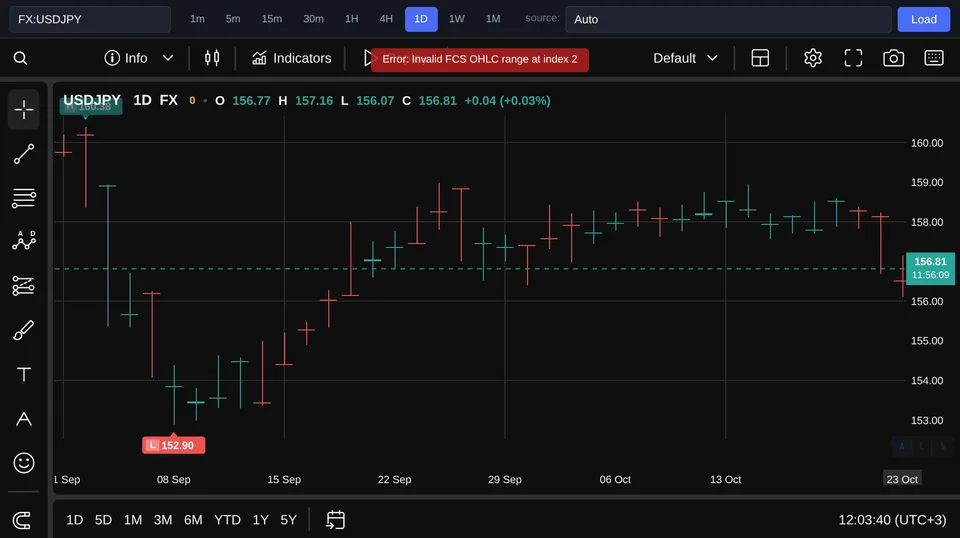
The supplied market snapshot puts USD/JPY at 156.8 JPY, up +0.20% for the day. Because the quotation measures yen per dollar, that daily increase means the yen has weakened against the dollar over the stated daily comparison. Meanwhile, Bullquill’s review published on the evening of October 23 reports that the pair finished the week near 156.81, down 0.75% over the week. The yen’s weekly appreciation and its latest daily depreciation can coexist because they use different starting points. The near-identical quoted price levels do not make those percentage changes interchangeable. A weekly decline can include a daily rebound, and the supplied snapshots do not provide the intervening path or matching reference prices needed to reconstruct either calculation. The factual foundation is therefore narrow: the review reports a stronger yen over the week, while the current snapshot shows a weaker yen on the day. Treating those observations separately prevents an ordinary change of direction from becoming an imaginary contradiction. Bullquill attributes the weekly strengthening to defensive demand and Japanese inflation. That explanation is the source’s interpretation, rather than independent proof of what drove trading. The supplied material contains no inflation reading, interest-rate pricing series, or comparison across currencies that would let us measure each factor’s contribution.
The case for a change in Japanese rate expectations
The policy explanation starts with a straightforward mechanism: if investors expect Japanese rates to rise, holding yen may become more attractive relative to the alternatives. That can support the currency before a policy change actually occurs, because markets respond to expected future conditions. The approaching October 30 decision gives investors a specific occasion to reassess that outlook. However, discussion of another increase before year-end is an expectation, not an announced Bank of Japan decision. Inflation matters to this explanation only through its implications for policy. Bullquill’s reference to Japanese inflation suggests a possible reason investors might revise their expectations, but the supplied context does not establish that they actually did so. Without evidence of changing expected rates, it would be premature to label the weekly currency move a confirmed policy repricing. A calendar entry is a catalyst for attention; it is not a signed promise from the central bank. The strongest version of this hypothesis would involve both a change in expected Japanese rates and broader demand for yen. If the yen strengthens against several currencies while expected Japanese rates rise, the policy explanation becomes more persuasive. Conversely, yen appreciation without any observable change in rate expectations would leave the mechanism unconfirmed, even if the timing looks convenient.
Defensive demand and the dollar offer competing explanations
The defensive-demand explanation asks whether investors bought yen because their appetite for risk declined. One possible mechanism is the reduction of positions financed in yen: closing those positions can require buying the currency back. That describes a potential channel, not a documented account of this particular week. The defensive explanation gains support if yen strength repeatedly coincides with risk aversion while Japanese rate expectations remain broadly stable. Its weakness is that the supplied information does not show the necessary comparison. We have the review’s attribution, but no accompanying evidence showing when defensive buying appeared or whether it persisted as market conditions changed. If the yen gave back its gains when risk appetite recovered, without a corresponding shift in expected Japanese policy, that would fit a temporary defensive move. Persistence through calmer conditions would make that explanation less sufficient on its own. There is also a dollar explanation: USD/JPY can fall because the dollar weakens broadly, even without a distinctive improvement in the yen’s appeal. A dollar decline against several currencies, accompanied by little independent yen strength in other crosses, would favor this interpretation. This is why one currency pair cannot settle the argument: both currencies influence the result, and the chart does not attach a label identifying the driver.
A working hypothesis and the evidence that would change it
The most useful working hypothesis is that expectations of tighter Japanese policy supported the yen, with defensive demand potentially amplifying the weekly move. Its relative advantage is the connection between the approaching decision and the inflation argument identified by the source. This is an editorial hypothesis with a clear test, not a finding that the rate factor dominated. The available evidence remains too limited to rank the actual contributions with confidence. Confirmation would require a coherent combination: firmer expected Japanese rates, yen appreciation across several crosses, and Bank of Japan communication that sustains that reassessment. A rate increase is not the only relevant outcome, because guidance can also change expectations about subsequent decisions. Equally, a decision that matches expectations may provide little new support. The important comparison is between what investors anticipated and what the decision and communication lead them to expect afterward. The hypothesis weakens if expected Japanese rates remain unchanged or fall while yen gains track defensive episodes or broad dollar weakness. A reversal after the decision would also need interpretation: it could reflect disappointed policy expectations, an easing of defensive demand, or a recovering dollar.
Conclusion
The yen’s weekly strengthening is consistent with a policy-expectations story reinforced by defensive demand, but the supplied facts do not establish the dominant cause. Broader yen strength alongside firmer expected Japanese rates would support that working hypothesis; stable rate expectations and moves tied to risk aversion or general dollar weakness would weaken it. The October 30 decision matters through the expectations it changes, rather than through its date alone.