
Why the MOEX Index Is Stuck Near 2336 Points

Intro
Why did the MOEX Index stall near 2336 points, and what would allow a rebound to last? The question is whether investors are mainly adjusting to persistent inflation or waiting for clarity on talks concerning Ukraine. Both explanations fit a hesitant market, but they imply different conditions for recovery and different ways to judge the next move.
Facts and the limits of the forecast
Interfax and Vedomosti reported that the MOEX Index ended its main trading session on November 26, 2026, at about 2336 points. Weekly inflation accelerated to 0.3%, while concrete details on talks concerning Ukraine remained absent. These are the confirmed elements of the market picture used here. Their coincidence identifies the setting for the stalled rebound, but it does not establish which factor caused it. BCS expects a 2300-2400 range until fresh geopolitical signals emerge. That range is a conditional forecast, so its boundaries should be treated as reference points. A move within it would fit the forecast while revealing little about the relative influence of inflation and negotiation uncertainty. The practical question is what new information could change expected earnings, the returns available elsewhere or the premium investors require for holding equities.
Why rates are the stronger working explanation
The first explanation starts with interest rates: the rebound has a price of admission, and expected returns elsewhere help set it. If inflation proves persistent, investors have less reason to expect an early reduction in interest rates. Higher expected rates reduce the present value of future corporate earnings and can keep interest-bearing alternatives attractive. This mechanism can limit what investors are willing to pay for equities even if companies' immediate operating performance is unchanged. A competing explanation puts negotiation uncertainty first: investors may demand a larger risk premium until concrete news appears. Under that view, a credible change in talks could lift valuations even before inflation improves. Our stronger working hypothesis is the rates explanation, because the available evidence contains an observable inflation acceleration and no equivalent new negotiation impulse. That ranking is an editorial judgment: one weekly reading and one trading session cannot establish causality or reveal investors' actual positioning. A weekly inflation reading is not a forecast of the full policy path, and it cannot be extrapolated mechanically into a lasting trend. Its analytical value here is that it raises the burden of proof for an argument based on rapid monetary easing. Changes in government bond yields or the market's response to central bank communication could help track rate expectations. These would be additional observations to collect, rather than evidence already contained in the current snapshot.
Why a firmer ruble can coexist with a stalled index
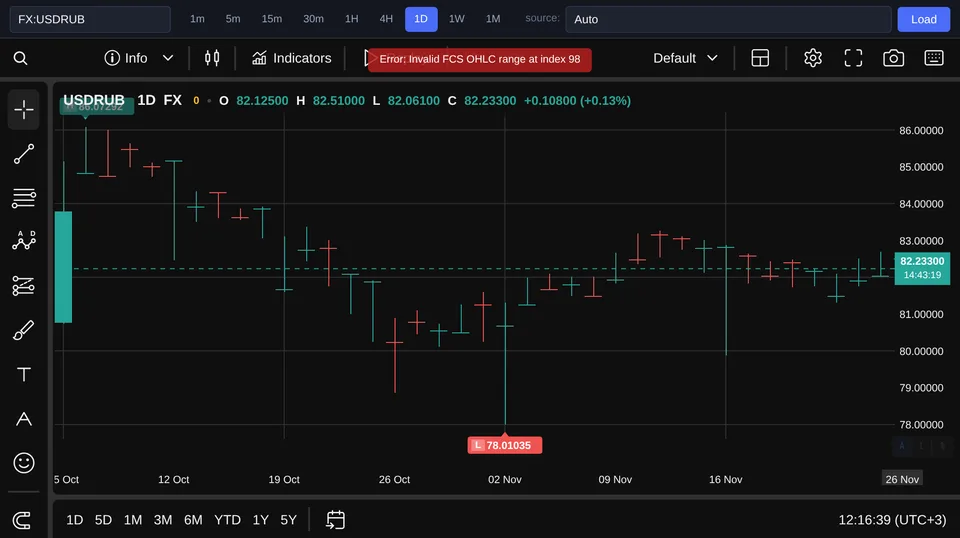
At the time of writing, USD/RUB stands at 82.17 rubles per dollar, with a daily change of -0.43%. Because this quotation measures rubles per dollar, a fall means the ruble has strengthened against the dollar. This is a separate snapshot from the index's November 26 closing level. A firmer ruble and restrained equity demand can coexist when investors expect rates to remain high. The tax period offers another possible source of support, as companies may need rubles to meet their obligations. Converting foreign-currency receipts is one route to obtaining them, although the available data do not measure those transactions. Tax-related demand is therefore a plausible contribution to the exchange rate, rather than a demonstrated explanation for the entire daily move. Expectations of high ruble interest rates may also support demand for ruble holdings, although this snapshot cannot isolate that channel. For equities, currency strength also has an earnings dimension. It can reduce the ruble value of foreign-currency revenue for exporters, while cheaper imported inputs may help other businesses. The net effect depends on revenue and cost exposure, so the currency quote alone cannot tell us whether the whole index should rise.
What would confirm or weaken the hypothesis
To test the rates hypothesis, watch the sequence of information and prices across subsequent observations. It gains support if inflation slows, policy expectations become less restrictive and the index rises persistently without fresh negotiation news. A brief positive session would offer weaker evidence, especially if the move disappears before expectations have time to adjust. The most informative comparison would involve several releases and the corresponding changes in expectations, with no other major catalyst intervening. Conversely, concrete negotiation developments followed by a sustained move above 2400, with the inflation backdrop unchanged, would weaken the claim that rates are the main obstacle. Such a response would suggest that a lower risk premium can outweigh the valuation drag from expected interest rates. A break below 2300 alone would not identify the cause, because several adverse factors could produce the same price response. Similarly, softer inflation without a sustained equity response would make the rates explanation less sufficient, even if it remained part of the story. After the tax period, compare the ruble's direction with changes in rate expectations and negotiation news. A reversal without other material changes would be consistent with temporary tax support; continued strength would require a broader explanation. If these influences move together, the evidence will remain mixed and confidence in any single-factor story should stay limited.
Conclusion
The strongest working answer is that inflation is limiting expectations of monetary easing, while uncertainty over talks keeps an additional risk premium in place. That would explain why the MOEX Index can pause near 2336 even as the ruble strengthens. A lasting recovery would become easier to explain if rate expectations eased or concrete negotiation progress reduced that premium; subsequent observations can help assess which channel matters most.