
Why a Bank of England Rate Rise Failed to Sustain Sterling

Intro
The Bank of England raised interest rates, yet sterling failed to secure lasting support against the dollar. Why did an apparently helpful decision produce an unhelpful currency response? The answer depends on what changed relative to expectations and what happened on the other side of GBP/USD. The strongest working explanation combines a limited positive surprise from British policy with broader dollar demand, although the available evidence cannot establish every link.
What the price reaction actually establishes
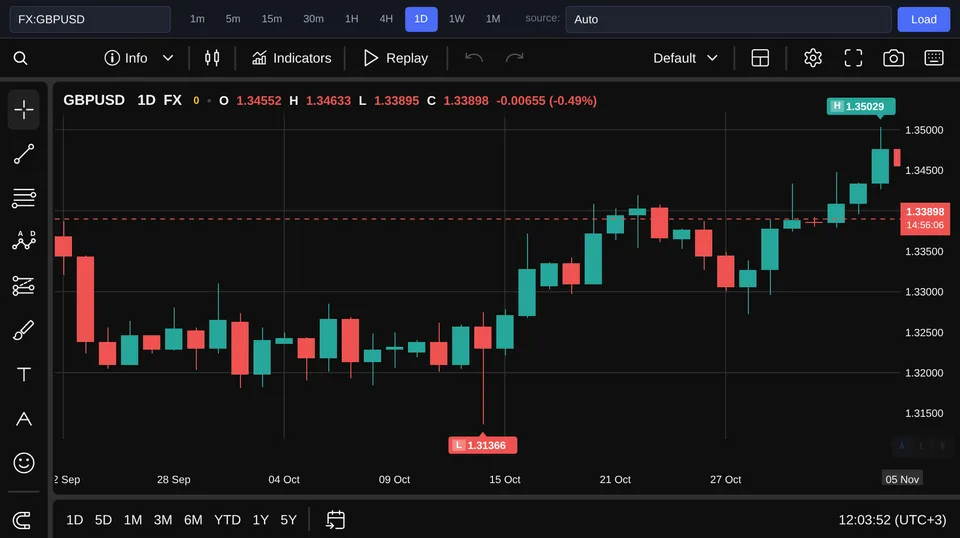
The supplied policy account records a Bank of England increase of 25 basis points to 4% on November 5, 2026. Catherine Mann preferred a larger increase of 50 basis points, while Andrew Bailey left further tightening conditional on inflation risks failing to ease. These details establish that the decision contained a restrictive policy signal; they do not establish how much additional restraint investors had expected. The supplied Babypips recap reports that GBP/USD finished the November 5 session down approximately 0.16%. Separately, the latest supplied snapshot puts GBP/USD at 1.34, with a daily change of -0.42%. These are separate observations with different reference points, not interchangeable descriptions of one trading session. The latest snapshot extends the question about sterling's support without revealing the precise path between those observations. What can reasonably be concluded is narrower than the headline suggests: the rate increase did not prevent a negative net result against the dollar. That does not mean it had no supportive effect, because sterling might have performed worse without it. An exchange-rate outcome reveals the balance of competing forces, not the isolated contribution of one announcement.
A higher rate needs a meaningful surprise
The first explanation is that the increase delivered too little new information to trigger sustained buying. Currency markets respond to revisions in the expected path of interest rates, rather than mechanically rewarding every increase in the current rate. If investors had already positioned for a comparable decision, its announcement would offer limited grounds for a further adjustment. A widely anticipated rate rise can arrive wearing a serious suit and still bring little news. Prior pricing is a plausible explanation here, not a confirmed fact. The supplied material contains no pre-decision probability estimates, positioning measures or market-implied rate paths. It therefore supports a conditional argument: the smaller the surprise, the weaker the additional currency impulse should be. It does not support declaring that the increase was fully priced in. Mann's preference for a larger step shows a difference within the committee, but her vote does not itself commit the Bank to that trajectory. Bailey's conditional willingness to tighten again likewise leaves room for different outcomes as inflation risks evolve. The relevant question is whether the announcement raised the expected future British rate path relative to the American one. A restrictive message can coexist with little change in that comparison.
Dollar strength is the stronger companion explanation
The second explanation concerns the denominator in GBP/USD. The supplied market account identifies general demand for dollars as a competing force during the reaction to the Bank's decision. Sterling can receive support from domestic policy and still decline against a currency attracting stronger buying. This makes the combination of limited policy surprise and dollar demand a coherent working explanation for the observed result. The editorial preference is for this combined explanation, with moderate confidence. It connects the reported dollar demand with the absence of sustained support in GBP/USD, while allowing the rate rise to have helped at the margin. However, the supplied context does not include a full comparison of other dollar pairs. The breadth and strength of the dollar contribution therefore remain to be checked independently. A third possibility is that investors interpreted further tightening as a threat to British growth. Higher borrowing costs can weigh on spending and investment, potentially making a higher interest rate less attractive as a currency signal. That growth-risk explanation remains an alternative hypothesis. Without evidence from sterling crosses, rate expectations or relative bond yields, treating it as the main cause would give the available facts more explanatory weight than they can carry.
The observations that would settle the argument
The first test is to compare GBP/USD with sterling's performance against the euro over matching periods. A falling GBP/USD alongside a stable or falling EUR/GBP would mean sterling held steady or strengthened against the euro, supporting a substantial dollar contribution. A rising EUR/GBP would instead show weakness in sterling beyond its dollar pairing. Broad dollar gains combined with resilient sterling crosses would strengthen the preferred hypothesis. The second test concerns expectations and relative returns. Compare British rate expectations before and after the announcement, then examine changes in British and American bond yields at comparable maturities. Little upward revision in the British path would support the limited-surprise argument; a meaningful rise in expected British rates would weaken that part of the explanation. Even then, the relative yield movement matters, because American yields could move enough to offset Britain's adjustment. The growth-risk alternative becomes more persuasive if sterling weakens against the euro while the dollar is broadly calm, especially if expectations shift toward an earlier reversal of British tightening. Conversely, resilient sterling crosses and little deterioration in the expected British rate path would leave that explanation with less support. These are observable conditions for testing the narrative, not claims that the confirming evidence already exists. Comparisons must use consistent windows, since mixing the November 5 close with the latest daily snapshot could create a misleading account of cause and effect.
Conclusion
Why did the rise to 4% fail to sustain the pound? The best working answer is that its additional policy signal may have been insufficient to outweigh demand for dollars. The supplied facts establish the tightening and the negative GBP/USD observations; they leave the size of the surprise unresolved. Dollar performance across currencies, sterling against the euro and changes in relative rate expectations will determine whether that explanation holds.