
Trade Entry Points: Aggressive, Conservative, and Retest Entries

Finding an entry point is arguably where beginners stumble most often, more so than in choosing the wrong trade. The trading idea itself may be excellent, but a poor entry turns it into a losing trade.
What is a market entry? An entry is the moment and price at which you open a position. It determines three things:
stop-loss — a protective order (beyond a level, beyond an extreme, beyond a zone);
risk/reward ratio — the closer the entry is to the reversal point, the better the R:R;
probability of success — the earlier the entry, the greater the chance that the scenario will simply not have time to be confirmed.
Combining these three parameters is one of the main cornerstones of successful trading: an early entry offers potentially better R:R but a higher proportion of false signals, while a later entry potentially reduces the proportion of errors but results in lower R:R.
Based on the trade-off described above, three types of trade entry can be identified.
Aggressive Entry — entering at an early stage of a breakout.
Breakout Confirmation Entry — entering after a candle closes beyond a level or another predetermined criterion is met, without waiting for a retest.
Breakout Retest Entry — entering after a breakout, a return of the price to the level, and a confirmed reaction to it.
An entry after breakout confirmation is often called conservative, although in many educational materials a conservative entry specifically involves waiting for a retest. This approach is described, for example, in RoboForex courses.
In this article, a conservative entry will specifically mean entering a trade after breakout confirmation.
Thus, identifying the direction of price movement is not enough for a trader. They must decide when to open a position and what confirmation of a trading signal is sufficient for entry.
In turn, the type of trade entry derives from the location of the entry point on the chart and reflects the balance between risk tolerance and R:R expectations.
Aggressive Type of Trade Entry
An aggressive entry involves opening a position before the market scenario is fully confirmed: the trader opens a position at the first signal specified by the system, without requiring a candle to close beyond the level or a subsequent retest. This approach offers a better risk/reward ratio but comes with a higher probability of false signals.
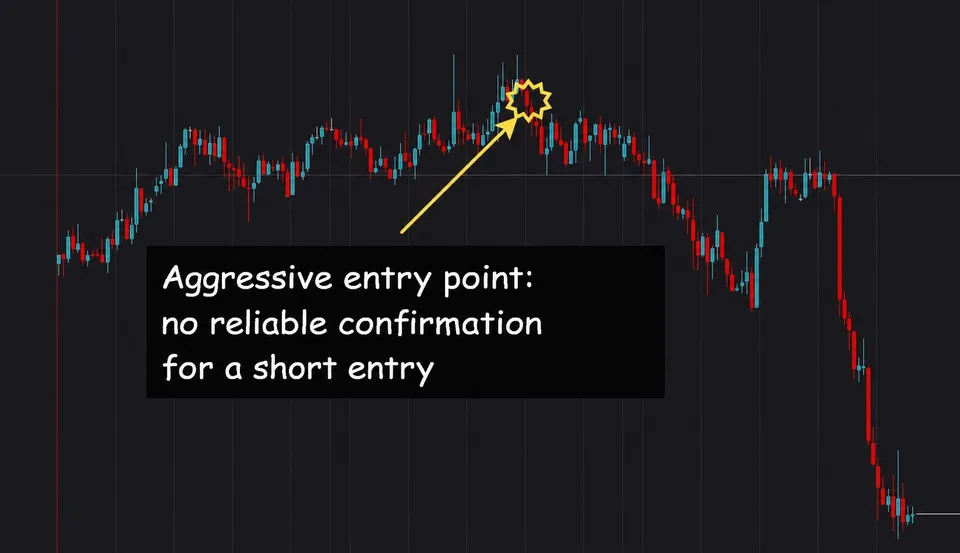
Thus, within a balanced market, the trader opens a trade (whether a market or limit trade) near one of the boundaries, expecting a reversal and a breakout through the opposite boundary of the range. When trading a breakout, in turn, the trader enters the market as soon as price crosses the level, without waiting for a breakout signal (whether using a market or stop order).
The main advantage of this approach is the opportunity to find an entry point closer to the start of the move and obtain a more favorable price. If the breakout succeeds, this can improve the ratio of potential reward to risk (R:R).
The main disadvantage, in turn, is greater uncertainty at the moment of entry. A brief move beyond a level does not yet mean the market is ready to move further. Price may return to the range, while a rapid move may be accompanied by slippage and a widening spread.
An aggressive market entry:
has a high rate of false signals;
causes psychological discomfort: a series of losing trades is normal for this style and quickly wears beginners down;
when leverage is used, mistakes are multiplied by the leverage factor—this is the most dangerous entry style for margin trading;
requires a very clear stop-loss system—otherwise, one bad day will wipe out a week's gains.

To identify an aggressive market entry point, you need to:
identify a key area of interest (a support/resistance level, a volume zone, or a channel boundary);
place a limit order inside the zone (or split it: 50% of the volume at the upper boundary of the zone and 50% at the lower boundary);
set a stop-loss beyond the zone's extreme, taking the instrument's volatility into account;
calculate the target profit level based on an R:R ratio of at least 1:3.
Psychological Profile of an Aggressive Trader
First and foremost, an aggressive trader is someone with strong discipline and tolerance for a series of losses.
An aggressive approach is more often used by traders who specialize in momentum moves and fast breakouts, can quickly assess market conditions, and define in advance the conditions that invalidate their trading scenario.
Statistically, an aggressive entry is more likely to hit the stop-loss—simply because traders can often misread the market phase: buy at the highest price or enter against the trend at the trend's point of no return.
An aggressive trader lives by the math: their win rate may be 35–45%, but with an R:R of 1:3–1:5, they end up profitable. This is the type of trader who “catches falling knives” and calmly tolerates strings of 5–6 stop-losses in a row without losing control.
Note that aggressive entries are characteristic of compulsive gamblers. The main signs of gambling are the absence of a clear system or an unwillingness to follow its rules, excessive risk, missing or moved stop-losses, and overtrading.
Conservative Market Entry
An entry after confirmation, also known as a conservative entry, means opening a position after predefined breakout criteria have been met, without necessarily waiting for the price to return to the level.
With this approach, the trader wants additional information before making a decision. Confirmation can be a candle closing above/below a key level, an indicator signal (for example, RSI reversing out of the overbought zone), a break of a local high or low, or the price moving out of a consolidation zone.
The conservative trader does not wait for the broken boundary to be retested: they enter on the breakout along with the majority of market participants.
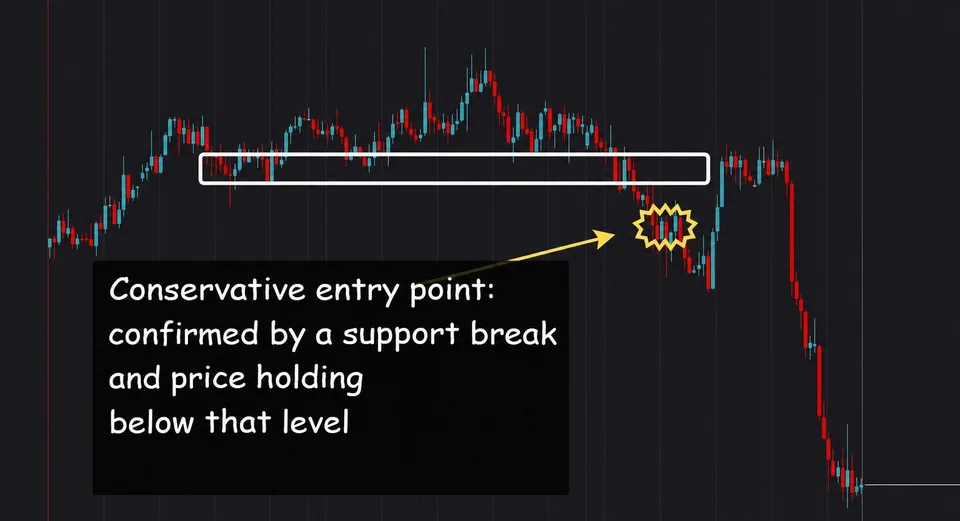
The advantages of this approach are clear.
Additional confirmation helps filter out some brief moves beyond a level after which the price quickly returns to the range. The trader also has time to assess the market structure and potential obstacles to the move.
Conservative entry points:
significantly improve the win rate—the trader avoids false breakouts and trades an already confirmed move;
are psychologically more comfortable: fewer streaks of stop-outs and less self-blame;
make it easier to follow the system with discipline—the entry is clear and unambiguous;
work well with trend trading: the trader enters an already established trend.
The main disadvantage of a conservative trade entry is a worse R:R. The trader often enters after part of the move has already occurred, with the stop farther from the entry. In addition, sharp impulses often cover a substantial part of the move, sometimes more than 50%.
Other disadvantages include:
a tendency toward FOMO: the temptation to “enter anyway, in case it keeps going” is strong, turning a conservative entry into an impulsive one;
in low-liquidity markets, confirmation can be false (a push on low volume or a stretched candle in a thin order book).
Looking for an entry point within a conservative trade entry approach involves:
a candle closing beyond the level;
continuation of the move after the breakout;
an increase in volume relative to usual values, if volume is meaningful for the chosen instrument and market;
alignment of the move with the trend direction on the higher timeframe.

A conservative entry is usually made at market after a signal or with a limit order slightly above/below the confirmation point. The stop is placed beyond the low/high of the confirming structure (a candle or a local high or low).
Psychological Profile of a Conservative Trader
A conservative trader is someone who values statistical reliability above high R:R values. They may open 3–5 trades per week, but with a higher proportion of profitable trades (55–65%).
A conservative trader is comfortable waiting—waiting does not drain their resources; it works in their favor. This is typically how people with systematic thinking, a calm temperament, and a willingness to miss some moves trade.
This approach may suit traders who prefer to make decisions after a particular stage of a move has ended and do not want to react to every price fluctuation within a candle.
For beginners, it is useful because it allows them to formalize a trading signal: define which event permits an entry and avoid changing the criteria based on emotions.
Entry on a Retest
A retest is a market situation in which the price has returned to a broken level. The entry point is near the broken level, and the trade itself is opened during this retest, preferably after a reaction signal specified by the strategy appears.
To open a trade, the trader does more than simply wait for additional confirmation of the initial move. They need to see how the market behaves as it approaches the broken boundary again.
The trader usually waits for a two-phase move:
Phase 1 — breakout or bounce. The price breaks through a level (or bounces off it) and moves away. The breakout is confirmed by a candle closing beyond the level.
Phase 2 — retest. The price returns to the broken level (which now works in the opposite direction — it was resistance and has become support) — and this return is where the market entry takes place.
A classic example: the price held above support for a long time, finally broke below it, and established itself there. Some time later, the price returns to the broken level — the trader enters a short position on the retest.
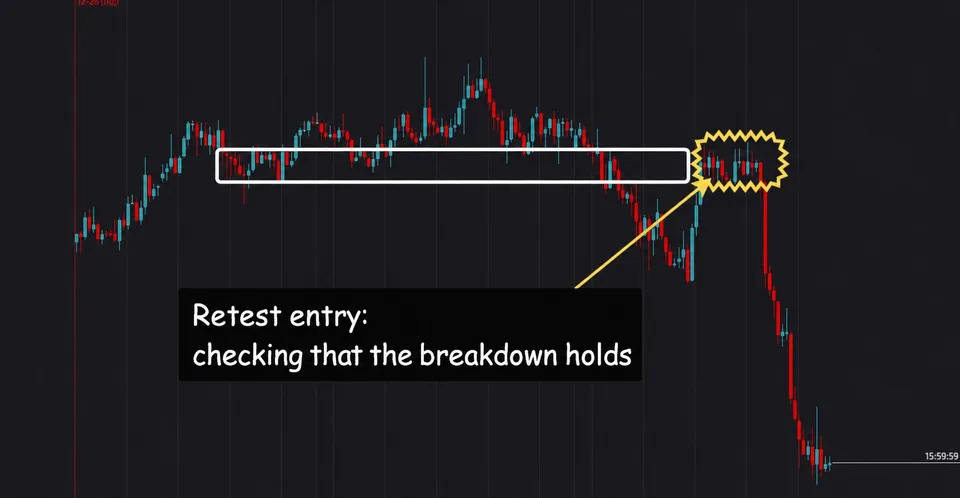
A retest helps assess whether the new price area is holding. Sometimes it offers an opportunity to enter closer to the level and identify the point at which the scenario becomes invalid using the pullback's local low or high.
The advantages of these trades are clear:
a good balance between risk and profit: the breakout has already been confirmed, but the price has not yet moved far from the entry point;
a retest is a natural point for a tight stop: if the price moves back beyond the level, the scenario is invalidated;
works very well on breakouts of levels, range boundaries, and key moving averages;
the mechanics are clear and easy to automate — retest entries are readily formalized into trading rules.

However, a retest does not guarantee a successful continuation. The price may break through a level, return to it, and then continue moving in the opposite direction. Sometimes the market crosses the same area repeatedly, indicating a lack of a sustained direction.
Meanwhile, in volatile markets (crypto, news), a retest can be sharp and deep — the stop needs to be wider.
Furthermore, the market may not provide a retest at all. The price will continue moving without returning to the level, and the trader will miss the trade.
A retest requires an understanding of volume and context: without volume confirmation of the breakout, a retest entry often turns into a game of "cat and mouse" with major players.
And the biggest pain point of entering the market on a retest: entry through a pending order may not happen. If 5 trades were executed at the price and the limit order was 6th in the queue, it will not be filled.
The trader's actions when opening a trade on a retest are as follows:
Marks the key level.
Waits for a confirmed breakout (a candle close beyond the level, preferably on increased volume).
Does not enter immediately—marks the broken level and waits for a return.
On the retest (a touch of the level or its zone, without the price closing far beyond the level in the opposite direction)—enters at market or with a limit order at the level.
Places the stop beyond the level, with a small buffer for a fakeout.
The trader's psychological profile
The psychological profile of a trader who enters trades on a retest generally matches that of a conservative trader.
This trader is even more patient, while also valuing the R:R ratio—entering on a retest significantly improves it.
Retest entries may suit traders who are willing to wait for a structure to form, prefer to determine the setup's invalidation point using a local extreme, and can pass on a trade if the price does not return to the level.
The main psychological challenge is resisting the urge to chase a move that has continued without a retest. If a trader regularly abandons waiting to enter at the current price, they are effectively mixing two different strategies.
In fact, entering on a retest is statistically one of the most consistent combinations, and a trader who works this way is considered one of the most effective.
Common mistakes and recommendations for beginners: how to choose an entry type and minimize risks
For beginner traders, it is critically important not only to understand how to identify trade entry points, but also to align their chosen style with their risk profile and psychological characteristics.
Common beginner mistakes

Treating a move beyond a level as a confirmed breakout. The price may cross a level during a candle and close back within the range. Define in advance which event qualifies as a trading signal.
Treating any confirmation as a guarantee of continuation. Even a candle closing beyond a level does not rule out a false breakout. Confirmation changes the assessment of the scenario but does not eliminate uncertainty.
Confusing a retest with a touch. A return to a level is only another test. Before entering, you need to wait for the reaction specified by the strategy.
Chasing the price after a missed entry. If there was no retest, that is no reason to abandon the rules and open a position at a worse price.
Moving the stop to keep a position open. The conditions that invalidate the scenario are defined before entry. Moving the stop simply because the position has become unprofitable increases risk and makes it harder to assess results objectively.
Drawing conclusions from a few trades. One successful breakout says nothing about the consistency of a strategy. You should analyze a series of trades, account for costs, and assess the average profit, average loss, proportion of profitable trades, and drawdown.
Recommendations for Beginners
Start by choosing one entry model and writing down its rules. Specify which level you are trading, what event allows you to open a position, where the scenario is considered invalidated, and under what conditions you should skip the trade.
Start with conservative entries. In the early stages of trading, psychological stability and discipline take priority. A conservative style lets you practice basic skills without excessive pressure from a series of stop-losses.
Master retests as your main trading style. After 3–6 months of practice, once you understand levels and volumes, retest entries become the optimal balance between win rate and R:R.
Use aggressive entries only after accumulating statistics. This style requires confident market reading and iron discipline: switching to aggressive trading prematurely is one of the main reasons traders blow their accounts.
Then test the rules on historical data and a demo account. Account for successful breakouts as well as false signals, missed moves, and situations where the potential profit after confirmation was insufficient.
Keep a trading journal. Record the entry type, reasoning, R:R, outcome, and emotions—after 50–100 trades, you will be able to assess objectively which style is most effective for you personally.
Do not choose an approach based solely on psychological preferences. An aggressive entry is not necessarily more effective because it comes earlier; an entry after confirmation is not necessarily safer; a retest does not guarantee that the level will hold.
The key is to establish in advance exactly what counts as confirmation in your system. If you are waiting for a candle to close beyond a level, do not replace that criterion with a subjective impression of momentum. If you trade retests, do not treat the touch itself as a signal to open a position.
In the early stages, it is especially useful to learn to skip trades that do not meet your rules. If the price moves away without a retest or confirmation appears too late, staying out is part of a systematic approach, not a mistake.
Always use a stop-loss. Whichever entry type you choose, set the stop before opening the position and do not move it “a little lower” when the price approaches.
Risk no more than 1–2% of your account balance per trade. This rule allows you to withstand even a series of 10 stop-losses without substantial damage to your capital.
Trade Entry Checklist

Below are three checklist templates for entering the market depending on the type of trade.
Aggressive Market Entry Type
The zone of interest is confirmed by historical price action (at least 2–3 touches).
The chart shows no strong impulsive moves against the planned direction.
The stop-loss does not exceed 1–2% of the account balance.
The risk/reward ratio is ≥ 1:3.
Position size is calculated taking leverage and acceptable risk into account.
Conservative style of opening a trade
The level is confirmed by historical price action (at least 2–3 touches).
There is a clear confirming signal (candle close, breakout of an extreme, indicator).
The stop-loss is placed beyond a local extreme, accounting for volatility.
Risk/reward ratio ≥ 1:1.5.
Position size matches the acceptable risk per trade (1–2% of the account balance).
Checklist for Entering a Trade on a Retest
The level is confirmed by historical price action (at least 2–3 touches).
The breakout of the level is confirmed by a candle closing beyond it and rising volume.
The price has returned to the level (a retest) and shown signs of a bounce.
The stop-loss is placed below the level, accounting for volatility.
Risk/reward ratio ≥ 1:2.