
Nvidia's Earnings Reversal: Why a Strong Forecast Was Not Enough

Intro
Nvidia delivered a strong earnings report and a quarterly revenue forecast above expectations, yet its shares reversed an initial gain on November 18 and closed roughly 2.9% lower. The S&P 500 also extended its losing streak to five sessions. Why did good company news fail to produce a higher share price? The useful distinction is between confidence in Nvidia's business and the price investors will pay for that confidence.
What the price move establishes
At the time of writing, Nvidia (NASDAQ: NVDA) is at 151.0 USD, with a daily change of -2.89%; the S&P 500 is at 7,324 points, with a daily change of -0.23%. These readings are a market snapshot, separate from the reported closing move. The November 18 account describes Nvidia losing its early advance despite an upbeat report and revenue guidance above expectations. Without the full release and comparable estimates compiled before publication, the size of the earnings surprise cannot be established here. The confirmed pattern is a positive corporate signal followed by a negative share-price response. It does not establish weaker demand for AI computing, and it does not reveal why individual investors sold. Nvidia's deeper decline than the broad index suggests that a market-wide explanation may be incomplete, but the comparison cannot measure the company-specific component on its own. A semiconductor peer group would provide a more useful additional benchmark.
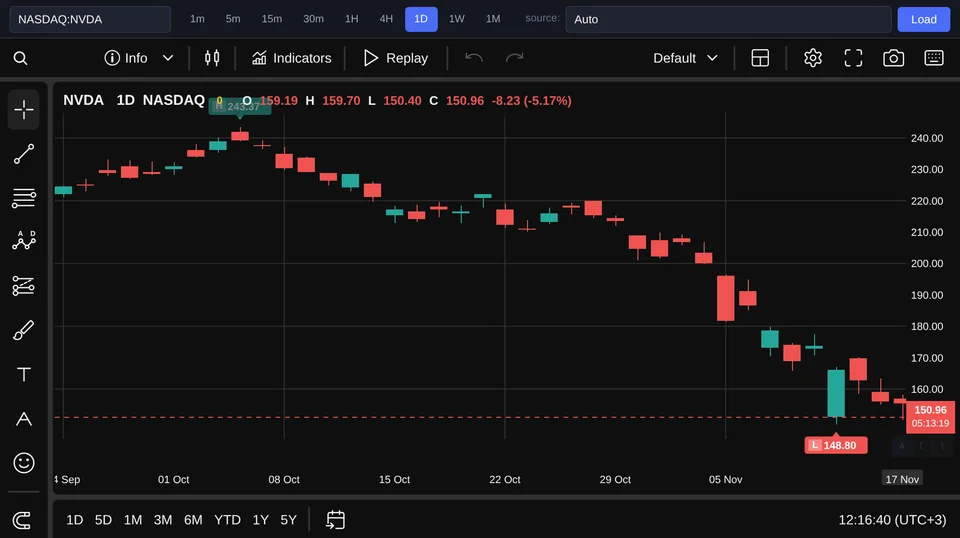
Three explanations for the reversal
The first explanation is that published expectations were lower than the hurdle already embedded in the share price. A forecast can beat the analyst consensus while leaving investors unconvinced that growth will exceed what their valuations require. A positive earnings surprise is not automatically a positive valuation surprise. A good report does not come with a receipt promising a higher share price. The second explanation is a broader retreat from risk: a falling market can outweigh encouraging company news as investors reduce exposure across portfolios. The S&P 500's losing streak is consistent with that possibility, although it does not prove that this was the dominant force in Nvidia. The third explanation is position reduction after the announcement, including profit-taking by investors who bought beforehand. That scenario could explain an early rise followed by selling, but establishing it requires evidence of earlier gains, trading volumes and subsequent price behavior. These mechanisms can overlap, so the task is to identify which one best explains the mismatch between the company's message and its share price. A single session cannot settle that question without changes in earnings estimates and comparisons with peers.
The strongest working hypothesis
The leading editorial hypothesis is a lower premium for future growth, with the wider market decline acting as an amplifier. A share price can fall even when expected profits hold steady if investors become less willing to pay for each dollar of those profits. The forward earnings multiple expresses that relationship: it compares the current price with expected future earnings. A revenue forecast above expectations can support the business outlook without preserving that multiple. This explanation fits the available combination of encouraging guidance and a falling share price without assuming a demand collapse that the evidence does not establish. It also leaves room for the broad market to influence the return investors require from a volatile growth stock. Its weakness is that neither changes in profit estimates nor changes in valuation multiples are available here. Choosing it as the first hypothesis to test is therefore a reasoned interpretation, not a finding about what motivated sellers. Revenue also cannot answer every question about earnings quality: margins, investment needs and cash generation can change the value of future sales. Any concrete deterioration in those areas would require a different explanation from a simple reduction in the growth premium.
What would confirm or challenge the hypothesis
The key test is whether earnings expectations remain intact while the price paid for those earnings falls. Stable or rising forecasts for future profit alongside a lower forward multiple would support a valuation reset. Similar changes among other AI-related companies would strengthen the case that investors are reassessing the price of growth. A lower multiple alone would not explain the cause; it would need to be read alongside those forecasts and the market backdrop. The market explanation gains weight if Nvidia moves with semiconductor peers and the broader index over subsequent sessions. Persistent underperformance while peers stabilize would instead point toward a factor more specific to Nvidia. That comparison should allow for differences in volatility, because a larger fall than the S&P 500 is not, by itself, proof of a separate company problem. The preferred hypothesis weakens if analysts cut expected profits in response to concrete evidence on demand, margins or cash flow. A quick recovery without new corporate information would make temporary position reduction more plausible, especially if supported by trading data. These are observable conditions for revising the explanation, rather than price targets or a timetable for a rebound.
Conclusion
The most defensible answer is that strong guidance may have sustained the business case without justifying a higher valuation. Investors can accept a growth story while paying less for it, particularly in a declining market. Whether that explains Nvidia's reversal will depend on earnings revisions and its performance against comparable stocks.