
Can Nvidia's Earnings Stop the AI Sell-Off?

Intro
Can strong results from a leading supplier of AI computing restore confidence in the whole sector? Nvidia's better-than-expected report followed the S&P 500's decline on November 17, and US futures and Asian AI shares rebounded on the morning of November 18. That makes the report a plausible catalyst for relief, while leaving the central investment question open: can buyers of computing power earn enough from AI to justify their spending?
What the price reaction establishes
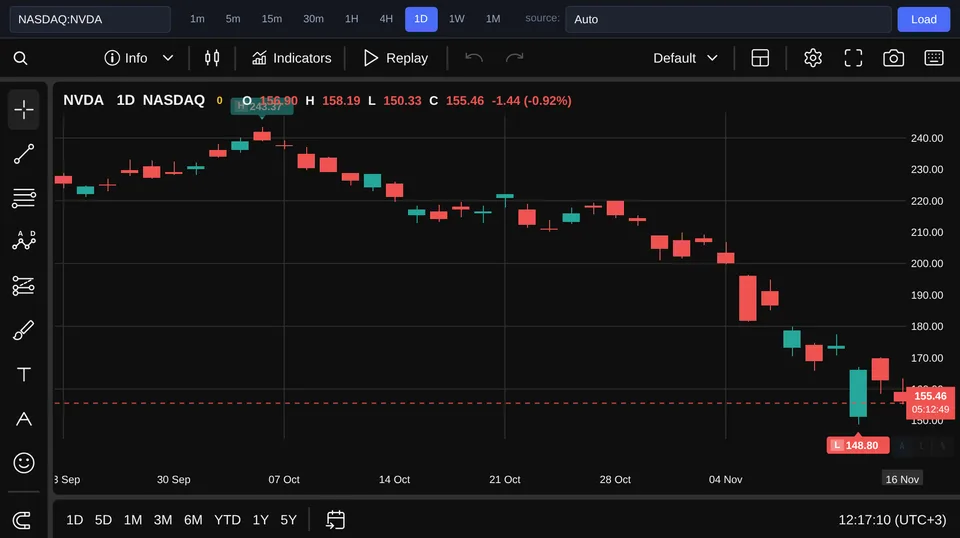
The reported facts establish an earnings beat and an early recovery in US futures and Asian AI shares. The market snapshot puts Nvidia (NASDAQ:NVDA) at $155.5, down 0.44% on the day, and the S&P 500 (SP:SPX) at 7,341 points, down 1.03%. The quote timestamps are unspecified, so these readings cannot establish the size of the reaction to the report. An index level, a futures move and trading in Asian companies describe different markets and potentially different sessions. An early improvement in sentiment can coexist with a negative daily change measured from another reference point. The early rebound establishes relief, while a durable reversal still needs evidence. The relevant comparison is how prices behave after the report against their levels before it, with each market assessed in its own trading session. Beating forecasts means clearing the bar analysts had set, and the height of that bar matters. A surprise driven by stronger underlying demand would carry a different message from one driven by costs or the timing of deliveries.
Three explanations, with different implications
One explanation is that the sell-off pushed expectations too low. Better results at Nvidia could signal that demand for computing remains firmer than investors feared, giving buyers a reason to revisit pessimistic assumptions. This case becomes stronger if the details of the results and the company's outlook support it; an earnings beat alone leaves the quality of the surprise unresolved. Sales, margins and guidance would need to tell a consistent story before extrapolating that result to the sector. Another explanation is a technical rebound, as investors adjust positions after a decline and potentially close short positions. Short covering is a possible mechanism, not a documented cause of this move. Establishing its role would require trading and positioning evidence beyond the reported price reaction. A fast recovery can therefore reveal the urgency of buying without revealing the durability of the demand behind it. Finally, investors may be reassessing AI valuations because the returns on infrastructure spending remain uncertain. Under that interpretation, strong chip sales can coexist with concerns about the profits earned by buyers. The report can reduce uncertainty about the supplier while leaving the customer's economics unresolved.
Why the customers matter most
Editorially, the third explanation is the strongest working hypothesis, although the early rebound cannot prove it. Nvidia's revenue records spending by its customers; it does not by itself show how much additional revenue or cash those customers earn from AI. A durable valuation depends on the expected profits generated across the investment chain, which makes the economics of the buyers central to the argument. The missing evidence concerns paid demand for AI services, the cost of delivering them and the cash left after infrastructure spending. Rising usage helps only if it can translate into attractive economics; discounts and higher operating costs can absorb the benefit. Even an excellent chip supplier cannot do every customer's homework. A strong report can buy the sector time, but lasting confidence requires evidence of profitable demand among its customers. There is also a timing mismatch: equipment orders arrive before many customers can demonstrate returns from the capacity they have bought. That gap leaves room for successful adoption as well as disappointment, which is why the hypothesis must remain provisional. Credible evidence could emerge through improving forecasts or disclosures before it becomes visible in cash flow.
The conditions that would change the verdict
The temporary-relief hypothesis gains support if the bounce fades by the close of regular US trading and weakness persists across most AI-related shares. It also gains support if earnings expectations for infrastructure buyers fail to improve despite better news from Nvidia. That pattern would suggest that the report eased immediate anxiety without changing the broader profit question. A narrow or short-lived rally would show limited transmission from supplier results to confidence across the sector. The hypothesis weakens if Nvidia and relevant sector indices repeatedly close above their pre-report levels and gains broaden to companies buying AI infrastructure. Stronger evidence would come from those buyers reporting improving AI-related revenue, profits or cash flow, with enough disclosure to assess the spending required. Market breadth would show that confidence is spreading, while financial results would help explain why. Price confirmation and customer economics need to reinforce each other. The signals may diverge: broader gains alongside unchanged profit expectations would challenge a bearish near-term reading without settling the valuation debate. A failed rally alongside improving customer cash generation would call for a different explanation of the selling pressure.
Conclusion
Can Nvidia's report stop the AI sell-off? It can interrupt it by easing immediate fears, but the available evidence does not yet establish a lasting reversal. The strongest working answer is a conditional one: the rebound becomes more credible if it survives regular trading, spreads across the sector and gains support from the financial results of the companies paying for AI.