
IPO: What It Is and How to Profit from an Initial Public Offering
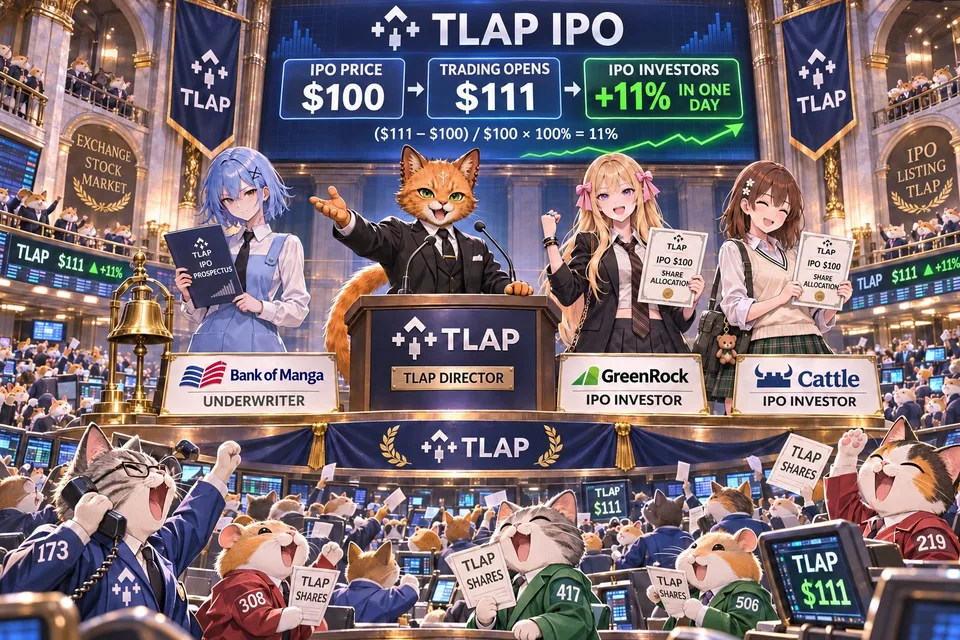
An IPO (Initial Public Offering, or the initial public offering of a company's shares) is a process in which a company offers its shares to a wide range of investors for the first time and lists on a stock exchange.
An IPO allows a business to raise capital and gives founders and early investors the opportunity to sell some or all of their stakes. For individual investors, it is a way to buy shares in a company as it enters the public market.
However, an IPO should not be confused with a secondary sale of shares. The former is a company's first public offering; the latter is the sale of existing shares by their owners. These processes can take place simultaneously, but they differ in their economic nature.
Let's examine how IPOs are conducted, how share prices are determined, how an individual investor can participate in an offering, and what opportunities and risks it creates.
What Is an IPO in Simple Terms
Before going public, a company is usually owned by its founders, employees, venture capital funds, and other private investors. Its shares are not traded on the public market, so they are quite difficult for an ordinary investor to buy.
An IPO changes this situation: the company's shares are offered to a broad range of investors for the first time and admitted to trading on a stock exchange.
Once trading begins, the shares receive a stock ticker, and their price is determined by supply and demand.
However, an IPO does not necessarily mean issuing new shares. The following may be sold as part of an initial public offering:
New company shares (Primary Shares). The company issues additional shares and sells them to investors. The business receives the proceeds.
Existing shares (Secondary Shares). Founders, funds, or other shareholders sell shares they own. The sellers receive the money, rather than the company.
Thus, an IPO is the status and procedure of the first public offering, while primary and secondary sales are ways of selling shares within it.
IPO and the Secondary Sale of Shares: What Is the Difference
It is important to distinguish between three concepts: an IPO, a primary sale of new shares, and a secondary sale of existing securities.
IPO — Initial Public Offering. A company's first public offering of shares. It is accompanied by the business's listing on a stock exchange. An IPO may include the sale of both new shares and existing shares held by shareholders.
Primary sale — Primary Offering. The company issues new shares and sells them to investors. The number of shares outstanding increases, and the money raised goes into the company's account. This allows it to finance business development, construction of factories, research, or debt repayment.
Secondary sale — Secondary Sale. Existing shareholders sell the shares they own. No new securities are issued, and the company's share count does not increase. The sellers, such as founders, venture capital funds, or the government, receive the money.
A secondary sale may take place as part of an IPO if the company is going public for the first time, but some of the shares are sold by its existing owners.
If the company is already traded on a stock exchange and its shareholders conduct a new public offering, the transaction is usually called an SPO (Secondary Public Offering) or a Follow-on Offering. A subsequent offering may also include both existing and new shares.
Example of the differences:
Characteristic | IPO: primary sale | IPO: secondary sale | SPO: secondary sale |
|---|---|---|---|
When it takes place | At the initial stock exchange listing | At the initial stock exchange listing | After the IPO |
Who sells the shares | The company | Existing shareholders | Existing shareholders |
Who receives the money | The company | Share sellers | Share sellers |
New shares are issued | Yes | No | No |
The number of shares increases | Yes | No | No |
A single offering may combine several approaches. For example, a company may issue new shares to raise capital, while the founders simultaneously sell part of their shareholdings.
Why companies conduct IPOs
The main purpose of an IPO is to gain access to the public capital market. However, the reasons for going public can vary.
Raising capital for growth. A company gains the ability to raise money from a large number of investors. The funds can be used to expand production, conduct research, develop new products, and enter new markets.
Financing major projects. An IPO makes it possible to raise substantial capital for projects that are difficult to finance solely through current profits or loans.
Reducing the debt burden. A company can use the proceeds to repay loans and bonds, reducing debt servicing costs.
Early investors exiting the business. Venture capital funds and other shareholders gain the opportunity to sell part of their stakes. This allows them to lock in profits and channel capital into new projects.
Increasing visibility. Public status makes the company more visible to customers, partners, and potential investors.
However, not every IPO is conducted to raise money for the business. Sometimes the main objective is to sell existing shares held by the founders or early investors.
How an IPO Works: Main Stages
Preparing for an initial public offering can take several months or even years.
Selecting investment banks. The company engages underwriters — investment banks that help organize the offering, value the business, and find buyers.
Preparing documents. Financial and legal checks of the business (Due Diligence) are carried out, and a prospectus is prepared describing the company, its financial performance, share capital structure, and risks.
Registering the offering. The company submits documents to the stock market regulator. In the United States, this is the Securities and Exchange Commission (SEC).
Roadshow. The company's management presents the business to potential investors, discussing its strategy, financial results, and prospects.
Building the order book (Book Building). Underwriters collect orders from investors, assess demand and participants' willingness to buy shares at a certain price.
Setting the price and allocating shares. The company and the arrangers determine the final IPO price and allocate the securities among investors.
Start of trading. Shares start trading on the exchange, after which market supply and demand begin to determine their price.
How Share Prices Are Set in an IPO
Before exchange trading begins, shares have no full public price history. The company's management, investment banks and potential investors therefore assess its value.
Several methods are used for this:
Comparison with publicly traded companies with a similar business profile.
Analysis of P/E, P/S and EV/EBITDA multiples.
Discounting future cash flows (DCF).
Assessment of assets and the business's growth prospects.
After a preliminary valuation, a price range is set. For example, shares may be offered to investors at $18–$22.
During the Book Building stage, underwriters collect orders and assess demand. If many investors want to buy the shares, the final price may be at the upper end of the range or above it. If demand is weak, the price may be lowered.
What is market capitalization in an IPO?
Market capitalization is the value of all of a company's shares, calculated using the price of one share.
Formula: Capitalization = Share price × Number of shares.
For example, if a company has 100,000,000 shares and the offering price is $20, its estimated market capitalization is $2 billion.
When calculating it, it is important to consider the capital structure. Fully diluted market capitalization (Fully Diluted Valuation) also accounts for potential shares that may be issued through the exercise of options and other instruments.
The IPO price does not necessarily reflect the fair value of the business. It is determined through negotiations between the company, underwriters and investors.
How an Individual Investor Can Buy Shares in an IPO
Some brokers allow individual investors to participate in initial public offerings.
The process usually looks like this:
The investor opens an account with a broker that provides access to IPOs.
Reviews the prospectus and offering terms.
Submits a preliminary order to buy shares.
Waits for the final price to be set and the shares to be allocated.
Receives the allocated number of shares in their brokerage account.
What is allocation (Allocation)?
Allocation is the distribution of shares among IPO participants.
For example, an investor submitted an order to buy 100 shares at $20 but received only 10. As a result, they will purchase $200 worth of shares instead of the requested $2K.
This happens when demand exceeds supply. The company and underwriters decide who receives shares and how many. Large institutional investors often receive a significant share of the offering.
Submitting an order does not guarantee receiving the desired number of shares.
Can you buy shares after trading begins?
Yes. After listing, the shares become available through brokers that provide access to the relevant exchange.
However, the price may differ significantly from the IPO price. For example, if the offering was priced at $20 and the first trades on the exchange take place at $30, an investor without an allocation will have to buy shares at the market price.
Lock-up Period, Greenshoe Option, and Share Classes
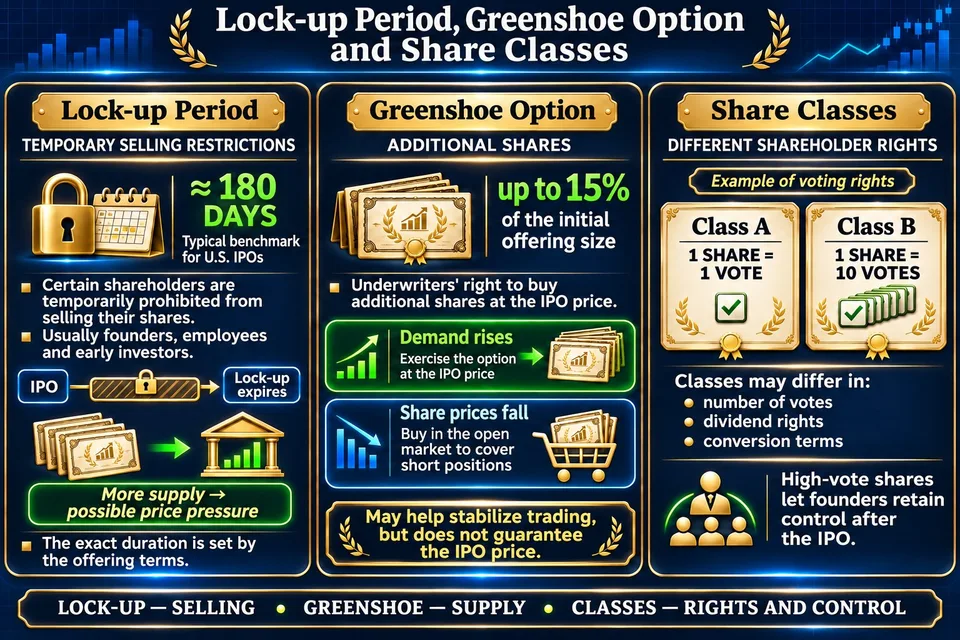
Lock-up Period — a period during which certain shareholders are prohibited from selling the shares they own. The restriction usually applies to founders, employees, and early investors.
For U.S. IPOs, 180 days is a typical benchmark, although the specific duration is set by the terms of the offering.
After the Lock-up Period ends, an additional supply of shares may enter the market, which sometimes puts pressure on share prices.
Greenshoe Option — the right of underwriters to purchase additional shares at the IPO price. The size of the option is usually up to 15% of the initial offering size.
The mechanism allows the supply of shares to be managed after trading begins. When demand rises, underwriters can exercise the option, while if share prices fall, they can buy back shares on the open market to close short positions.
The greenshoe can help stabilize trading, but it does not guarantee that the offering price will be maintained.
Share classes. Some companies issue several classes of shares — Class A, Class B, and others. They may differ in the number of votes, dividend rights, and conversion terms.
For example, Class A shares may carry one vote, while Class B shares may carry ten. This structure allows founders to retain control of the business even after going public.
How to Make Money from an IPO
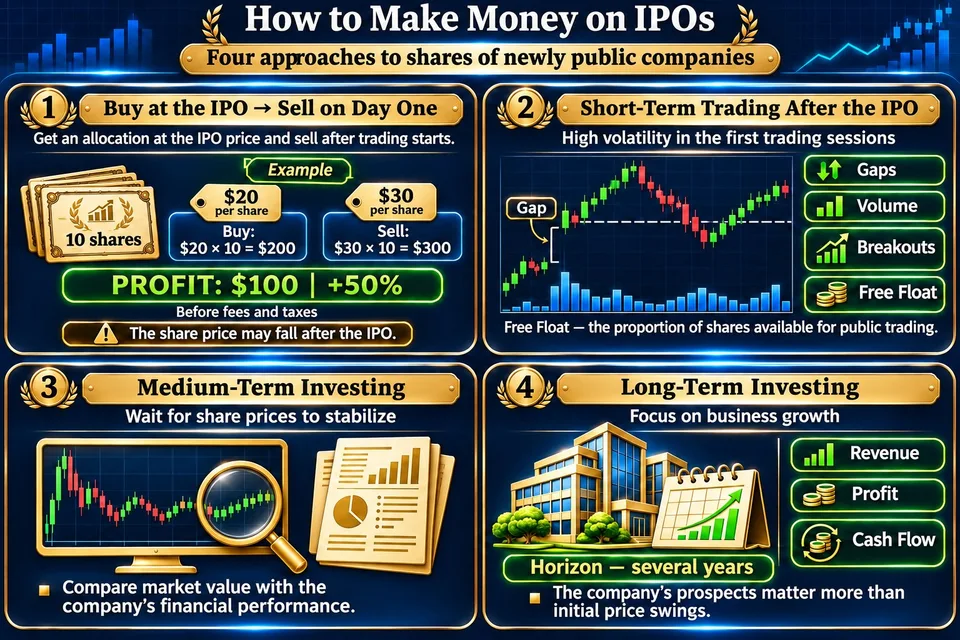
There are several approaches to trading and investing in shares of newly public companies.
Buying at the offering and selling on the first day of trading.
The investor receives an allocation at the IPO price and sells the shares after trading begins, expecting prices to rise.
For example, an investor received 10 shares at $20 and sold them at $30 after trading began. The profit will be $100, or 50% of the $200 invested, before fees and taxes.
However, prices can also fall.
Short-term trading after the IPO.
Traders take advantage of the heightened volatility of the first trading sessions. Their analysis focuses on gaps, trading volumes, breakouts of price levels, and the proportion of freely traded shares (Free Float).
Medium-term investing.
The investor can wait for prices to stabilize and assess how well the market valuation reflects the company's financial performance.
Long-term investing.
The main focus is on business growth and increases in revenue, profits, and cash flows. In this case, initial price fluctuations matter less than the company's prospects over the next several years.
If you do not have access to traditional stock exchanges, there is a convenient alternative. For example, immediately after Anthropic's IPO on November 18–19, 2026, on Nasdaq under the ticker ANT, the Bybit exchange offered two instruments for trading the company's shares:
ANTUSDT — a perpetual futures contract settled in USDT. It allows you to open long and short positions based on changes in Anthropic's share price, but does not grant ownership of the shares, voting rights, or dividends. This is a derivative contract, not a traditional CFD.
Bybit Stocks — buying and selling real Anthropic shares on the secondary market. The investor gains ownership of the shares, rather than a synthetic position tied to their price. Access depends on the country and compliance with the platform's requirements. However, Bybit Stocks does not offer the ability to receive an allocation directly in the IPO.
Why Stocks Can Fall After an IPO
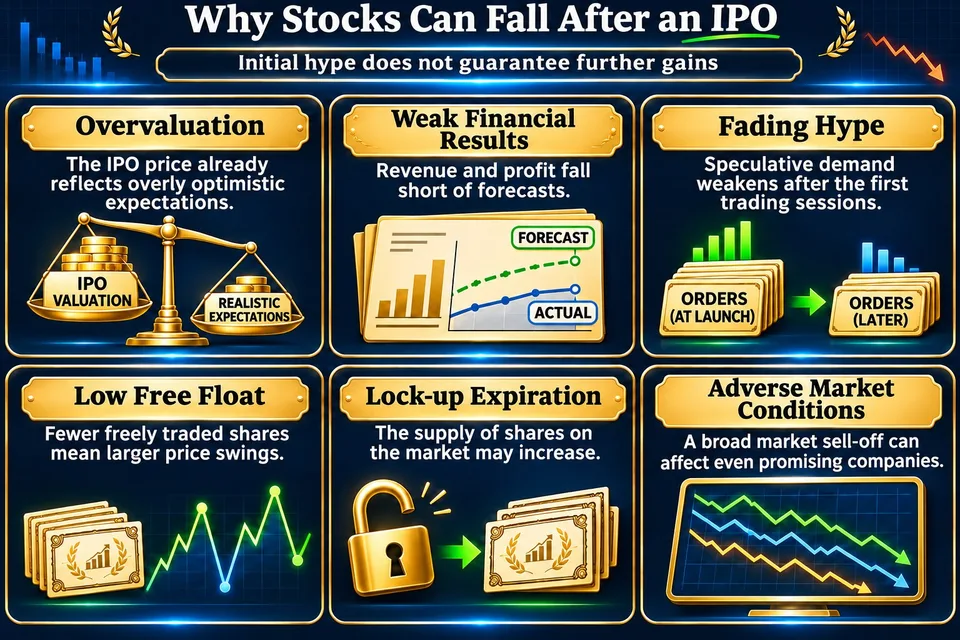
The initial hype surrounding an offering does not guarantee further share price growth.
Main reasons for a decline:
Overvaluation. The offering price already reflects overly optimistic expectations.
Weak financial results. The company fails to meet revenue and profit forecasts.
End of the hype. Speculative demand weakens after the first trading sessions.
Low Free Float. A small number of freely traded shares amplifies price fluctuations.
End of the Lock-up Period. Additional shares become available on the market.
Unfavorable market conditions. A broad stock sell-off can affect even promising companies.
How to evaluate a company before participating in an IPO
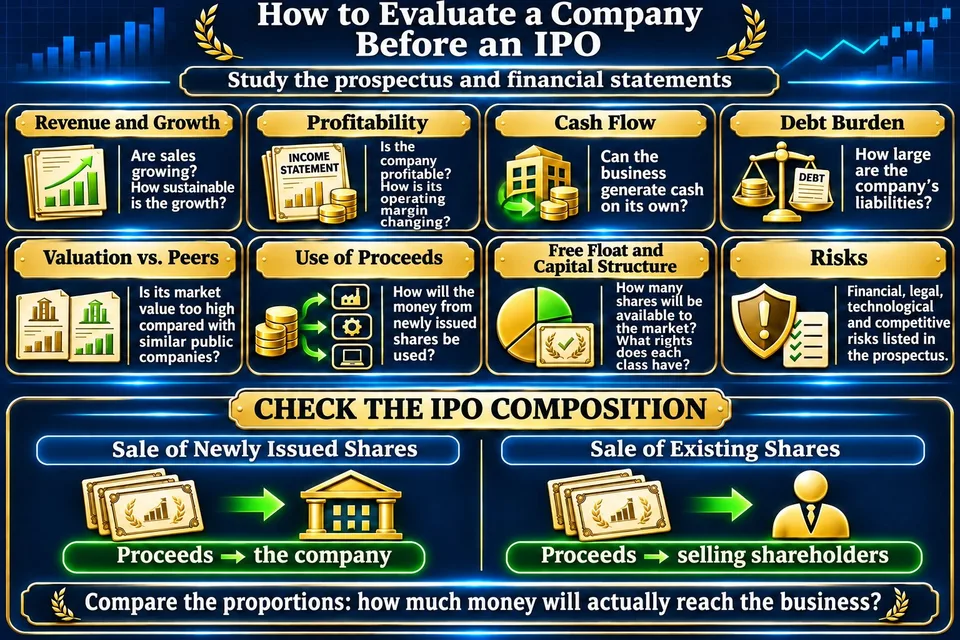
Before submitting an application, an investor should review the offering prospectus and financial statements.
Key parameters:
Revenue and growth rates. Are sales increasing, and how sustainable is this process?
Profitability. Does the company earn a net profit? How is its operating margin changing?
Cash flow. Can the business generate cash on its own?
Debt burden. How large are the company's liabilities?
Valuation relative to competitors. Is its market capitalization too high compared with similar public companies?
Use of proceeds. What exactly will the company spend the money from selling new shares on?
Free Float and capital structure. What proportion of shares will be available on the market, and what rights do different share classes confer?
Risks. What financial, legal, technological, and competitive threats are listed in the prospectus?
It is especially important to determine what portion of the IPO involves the primary sale of new shares and what portion involves the sale of existing holdings. This helps clarify how much money will actually flow into the business.
How Successful Are IPOs: Initial Public Offering Statistics
High demand for shares during an IPO does not necessarily mean the investment will be profitable. A company may go public with an offering that is oversubscribed many times over, attract considerable interest from institutional investors and show impressive growth on the first day of trading, but just a few months later its shares may be below the offering price.
Therefore, an IPO's success is best assessed using three criteria:
Demand during the offering: how interested investors are in buying shares and what allocation participants receive.
Initial trading results: how much the share price exceeds the IPO price after listing.
Maintaining the price: whether the shares remain above the offering price several months later.
Let us examine statistics for the US market, for which the most detailed historical data is available.
Demand for Shares and Allocation
One sign of strong demand for an IPO is oversubscription (Oversubscription), when the total volume of orders exceeds the number of shares offered. However, investment banks do not always disclose the full order book and the exact quantities of shares allocated among participants. This makes it difficult to assess actual allocation across the market.
The price at which a company offers its shares relative to the initially announced range can be used as an indirect indicator of demand.
According to a study by the law firm Paul Hastings, in 2025, 86% of US IPOs were priced at or above the midpoint of the initial range, compared with 66% in 2024. Meanwhile, 58% of companies priced their shares above the midpoint of the range, compared with 48% a year earlier.
Metric | 2024 | 2025 |
|---|---|---|
IPO price at or above the midpoint of the range | 66% | 86% |
IPO price above the midpoint of the range | 48% | 58% |
This indicates stronger demand for new offerings in 2025. Large companies were particularly sought after: among IPOs with an offering size of over $300 million, the proportion of offerings priced above the initial price range reached 71%.
A telling example is Figma's IPO in July 2025. Demand for shares was more than 40 times the supply. As a result, investors received significantly fewer shares than they requested, and the offering price was set at $33 — above the initial range of $30–$32.
It is important to bear in mind that oversubscription and limited allocation indicate strong demand at the offering stage, but do not in themselves guarantee a rise in share prices after listing.
How Shares Perform on the First Day of Trading
The next criterion is the change in share prices relative to the IPO price after trading begins.
For this, the First-Day Return metric is used—the return for the first trading session. It is usually calculated as the difference between the first day's closing price and the offering price.
US research firm Renaissance Capital reports the following results:
Metric | 2023 | 2024 | 2025 |
|---|---|---|---|
Average first-day return | +19.4% | +11.1% | +19.7% |
IPOs with negative first-day returns | 45.4% | 42.9% | 28.1% |
The situation improved significantly in 2025. The share of IPOs that ended their first trading session below the offering price fell to 28.1%. Thus, almost 72% of offerings did not post a negative return on the first day.
The average return also rose: from 11.1% in 2024 to 19.7% in 2025.
However, average figures can be distorted by individual IPOs with extreme gains. For example, Figma shares gained about 250% on the first day, while Circle shares gained about 169%.
Therefore, to assess a typical result, it is useful to consider both average and median returns.
Do stocks hold their IPO price after trading begins
The most telling measure of long-term success is the ability of shares to remain above their initial offering price.
According to Renaissance Capital, as of December 17 of the respective year, the following were trading above their IPO price:
Year of offering | Share of IPOs above the offering price |
|---|---|
2023 | 28.8% |
2024 | 36.9% |
2025 | 38.3% |
Thus, even in 2025, when demand for new offerings rose noticeably, only 38.3% of companies were still trading above their IPO price by the end of the year. The rest were trading at or below their offering price.
Another metric is Aftermarket Return, meaning the change in share prices after the first trading session.
In 2025, the average return on shares from the end of the first trading day through December 17 was minus 11%. For comparison, the figure was minus 9.2% in 2024 and minus 0.7% in 2023.
This means that the initial rise in share prices was often followed by a decline. An investor who received shares at the IPO price and an investor who bought them on the exchange after the first day of trading could have achieved completely different financial results.
At the same time, large offerings performed better than the market as a whole. Among IPOs of $100 million or more, the average return from the offering price by the end of 2025 was around 18%, and more than half of the companies kept their share prices above the IPO price. This shows how strongly the size and quality of an offering can affect the statistics.
IPO results in 2026
Preliminary statistics for 2026 also show that strong demand for offerings does not always translate into sustained share price growth.
According to SkyIPO data as of November 22, 2026, the median return in the first trading session among US IPOs of operating companies with available price histories was +1.4%. Meanwhile, 36% of offerings ended their first day below the IPO price.
The median return relative to the offering price after one month was +5.9%, while after three months it was already minus 0.6%.
These data are preliminary: 2026 is not over yet, and price histories were not available for all completed offerings.
What Counts as a Successful IPO
Statistics allow us to identify three levels of success for an initial public offering.
Criterion | Signs of a successful IPO | Signs of an unsuccessful IPO |
|---|---|---|
Demand during the offering | Heavy oversubscription, a price above the initial range | Insufficient demand, a lower offering price |
First trading sessions | The first session closes above the IPO price | A close below the IPO price |
Subsequent trading | The price remains above the IPO price after 3–12 months | A sustained decline below the IPO price |
However, these criteria do not always coincide. An IPO may see exceptionally strong demand during the offering, deliver substantial gains for investors on the first day, but then lose most of its initial gains.
For a long-term investor, the third measure — maintaining the price — is the most important. For a trader expecting to sell their allocated shares on the first day, initial demand and the market's reaction after listing are more important.
Thus, a successful offering for a company and a successful IPO for an investor are not the same thing. A company may raise its planned capital, and early shareholders may sell part of their holdings, even if the shares start to fall after exchange trading begins. It is therefore wrong to assess an IPO solely by the amount of funds raised or the rise in share prices on the first day.
The most famous IPOs: Saudi Aramco, SpaceX and Anthropic
The stories of the largest offerings reveal the differences between primary and secondary share sales and help explain why IPO results can differ substantially from investors' expectations.
Saudi Aramco: IPO without issuing new shares

In December 2019, Saudi Aramco went public on the Tadawul exchange in Saudi Arabia. This was one of the largest IPOs in stock market history.
As part of the offering, the government sold 3,000,000,000 existing shares, representing 1.5% of the company's capital. The price was 32 Saudi riyals per share, and the total offering size reached 96 billion riyals, or approximately $25.6 billion.
A key feature of the deal: Aramco did not issue new shares to raise capital. The seller was the Saudi Arabian government, and the proceeds from the offering went to the shares' previous owner.
Thus, in terms of the event, this was an IPO—the company's first public offering of shares—but in terms of the origin of the shares sold, the transaction was a secondary sale.
On the first day of trading, the shares rose by 10% and then gained another 10%. The company's market capitalization reached approximately $2 trillion.
The Aramco example shows that an IPO does not necessarily aim to finance the company itself. It can also be used by a government or major shareholders to sell part of the assets they own.
SpaceX: large-scale capital raising
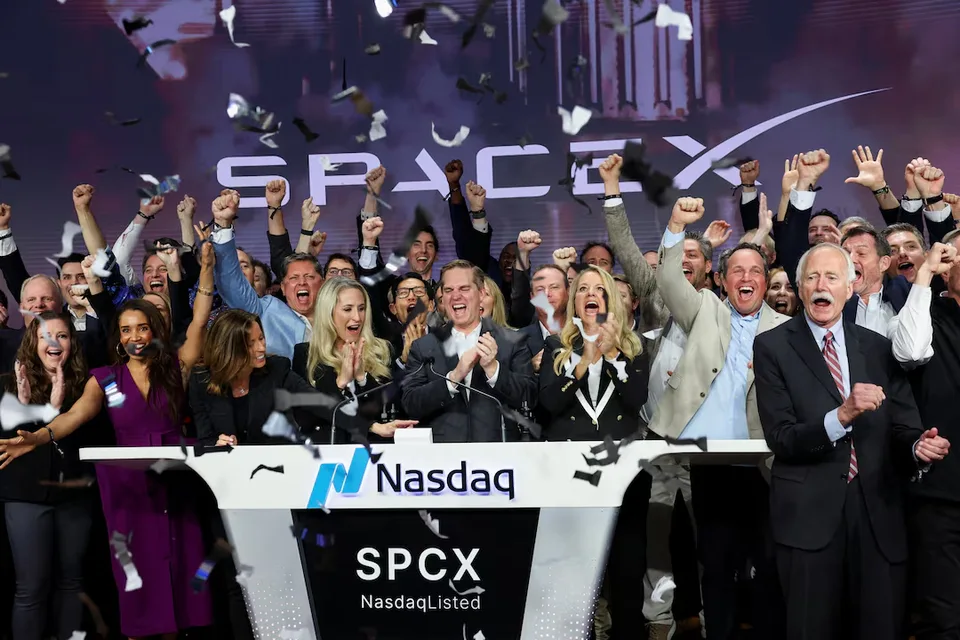
In June 2026, SpaceX held an IPO on Nasdaq under the ticker SPCX.
The company sold 555,600,000 Class A shares at $135 per share. The underwriters received the right to purchase an additional 83,300,000 shares under the Greenshoe Option. The option was exercised in full.
In total, SpaceX sold about 638,900,000 shares, and the company's net proceeds after fees and expenses were approximately $85.7 billion.
In this case, the main transaction was a primary sale: SpaceX issued and sold new shares, and the funds raised went directly to the company.
On the first day of trading, the shares opened at $150, approximately 11% above the IPO price. During trading, the price continued to change in response to supply and demand.
At the same time, the share capital structure allowed founder Elon Musk to retain control of the company through shares carrying more votes.
The SpaceX example shows how an IPO can be used to raise vast amounts of capital for business development while preserving the founders' control.
Anthropic: a combination of primary and secondary sales
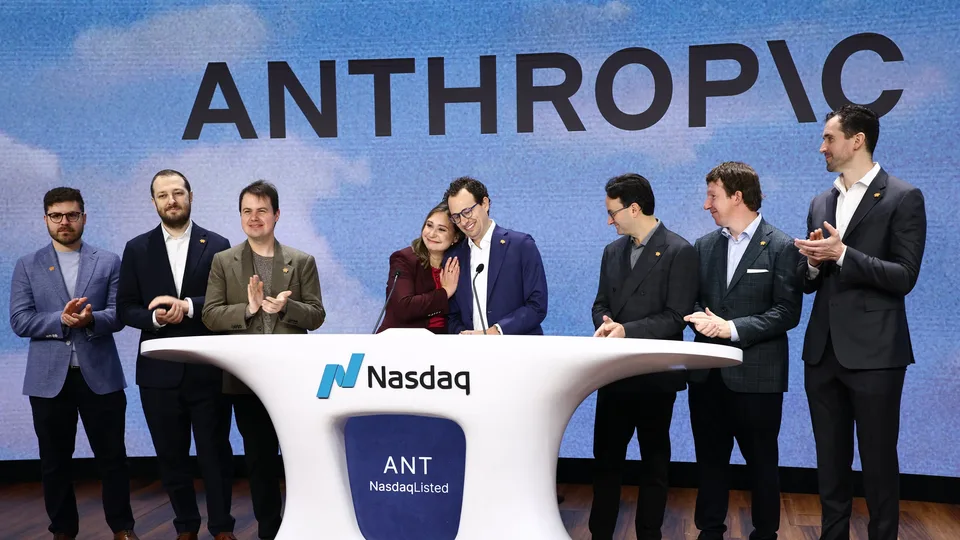
In November 2026, Anthropic, the developer of the Claude family of artificial intelligence models, went public on Nasdaq. Its shares began trading under the ticker ANT.
The IPO price was $83 per share. Initially, the company offered investors 980,000,000 Class A shares. Of these, 956,350,000 were new shares issued by Anthropic itself, while another 23,650,000 were sold by existing shareholders.
The underwriters later exercised their option in full for an additional 147,000,000 shares. As a result, the total offering reached 1,127,000,000 shares.
The IPO's gross proceeds totaled approximately $93.5 billion, of which Anthropic itself received about $91.6 billion. The remainder went to shareholders who sold their existing shares.
At the same time, the company conducted a separate private placement of Class N shares with major technology investors for about $26 billion. Participants included NVIDIA, Microsoft, Google, AMD, and other companies.
Anthropic's offering thus included several mechanisms at once: the primary sale of new shares, the secondary sale of existing shares, and a separate private placement.
On the first day of trading, the shares opened at $111.50 — approximately 34% above the IPO price. However, by the close of the session, the price had fallen to $97.17. This still represented a gain of about 17% relative to the offering price, but an investor who bought shares at the opening market price would already have been down about 13% by the end of the day.
Anthropic's story shows why it is important to distinguish between the IPO price and the market price after trading begins, and to analyze which part of the offering actually brings money into the company.
Facebook: an IPO that failed to meet expectations on the first day of trading
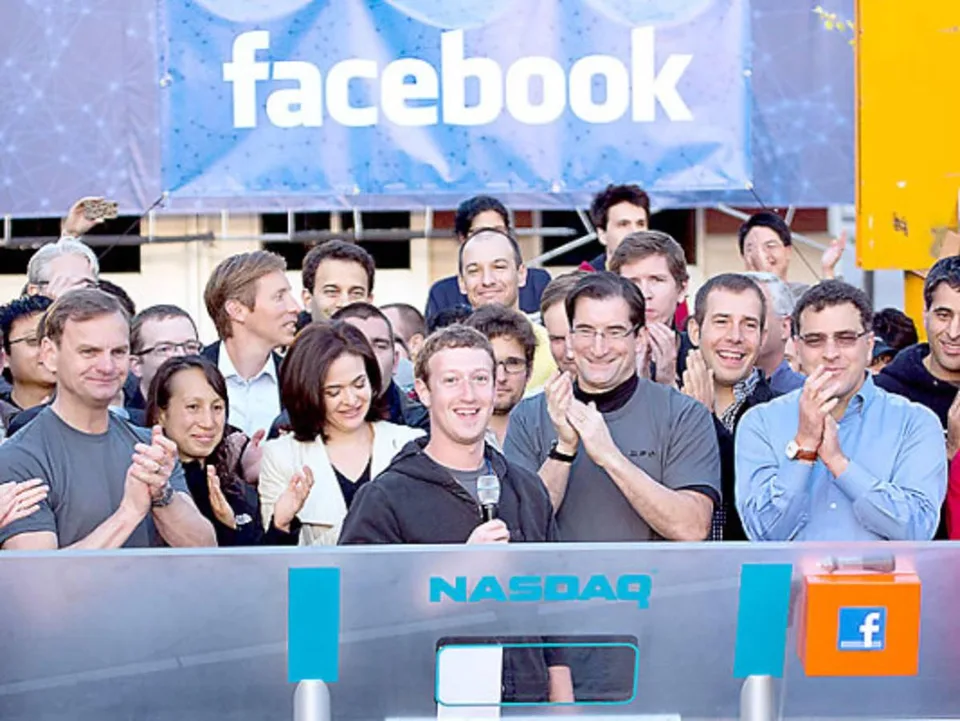
On May 18, 2012, the social network Facebook went public on Nasdaq under the ticker FB. It was one of the largest technology IPOs in history at the time. The company was valued at approximately $104 billion, and the total offering size was around $16 billion.
However, the story of this IPO is interesting not only for its scale but also for the structure of the deal. It combined primary and secondary share sales.
How the deal was structured
Facebook offered investors 421,200,000 Class A shares at $38 per share. Of these:
The company itself issued 180,000,000 new shares. Gross proceeds totaled $6.84 billion, while net proceeds after fees and expenses were around $6.76 billion.
Existing shareholders sold 241,200,000 existing shares. The sellers' net proceeds were around $9.07 billion.
Thus, secondary sales accounted for nearly 57% of the shares offered, while newly issued shares accounted for around 43%. Although the IPO raised around $16 billion, Facebook itself received only $6.76 billion after offering expenses. The remaining funds went to shareholders selling their stakes.
The deal was arranged by the largest investment banks, including Morgan Stanley, J.P. Morgan and Goldman Sachs.
First day of trading: technical problems and investor disappointment
Trading began with technical glitches on Nasdaq. The start of trading in the shares was delayed by about half an hour. The SEC later found that problems with the exchange's system left more than 30,000 buy and sell orders unprocessed for more than two hours. As a result, Nasdaq agreed to pay a $10 million fine.
The first trades in Facebook shares took place at $42.05, about 10.7% above the IPO price. During the day, the share price rose to $45 before starting to fall. Trading closed at $38.23, just 0.6% above the offering price.
Amid the initial hype, investors expected a much stronger rise. But no major jump materialized: the company's high valuation, the substantial supply of shares and doubts about the prospects for monetizing its mobile user base held back demand.
A decline of almost 50% in a few months
After the IPO, the situation worsened. In the first trading days, the shares fell below $35, and in early August 2012 they dropped below $20 for the first time. Thus, in two and a half months, the shares lost around 47% relative to the offering price.
One reason was concern about Facebook's ability to make money from its mobile user base. The company was actively growing its smartphone user base, but investors doubted that its advertising model could deliver the expected rates of revenue and profit growth.
Another factor was the approaching end of the lock-up period. Hundreds of millions of shares owned by employees and early investors were due to enter the market. The prospect of increased supply added to the pressure on share prices.
In August 2012, when restrictions on selling another tranche of shares were lifted, the shares reached new lows.
What the Facebook example teaches us
The story of Facebook's IPO shows several important features of an initial public offering.
First, a company's high profile and huge audience do not guarantee that its shares will rise after trading begins. Even one of the most recognizable internet brands of the time faced investor doubts about its valuation and prospects for generating profits.
Second, it is important to analyze the structure of the offering. If a significant portion of the shares is sold by existing owners, it is necessary to understand that a substantial share of the proceeds from the offering does not go to the company.
Third, the IPO price is not a guaranteed support level. Shares can quickly lose tens of percent of their value if the market revises its valuation of the business.
Finally, weak performance in the first months does not necessarily mean that a long-term investment has failed. To assess an IPO, it is important to distinguish between the market's short-term reaction and the company's ability to develop its business over the following years.
Advantages and Disadvantages of Investing in IPOs
Advantages | Disadvantages |
|---|---|
Opportunity to buy shares at the offering price | Allocation is not guaranteed |
Potential for rapid share price growth | High volatility |
Access to newly public companies | Limited public reporting history |
Potential for long-term capital growth | Risk of overvaluation |
Participation in the development of promising industries | Risk of increased share supply |
The main mistake novice investors make is viewing an IPO as a guaranteed opportunity to buy shares below market price.
In practice, the offering price may be too high, the allocation may be small, and share prices may fall rapidly after trading begins.
Therefore, participating in an IPO requires the same close analysis as buying shares that are already trading. Investors need to understand what business they are buying, how much it is worth, and what risks are priced in.
Disclaimer
This material is for informational purposes and does not constitute personalized investment advice.
Investing in stocks, especially those of companies that have recently gone public, carries a risk of losing capital.