
Cent Accounts in Forex: What They Are and Why They Are Needed

Hello everyone! Very many beginner forex traders do not fully understand the difference between standard (classic) and cent accounts. That is why I decided to write this small article, in order to bring clarity.
In this lesson, we will look at: where to open a cent account, what it actually is, and in which cases you need a cent account, even if you have enough money to trade on a regular account.
What is the difference between classic and cent accounts?

Cent account:
The balance is displayed in cents, a deposit of 20 $ will appear in the terminal as 2000c.
Min. lot 0.1, but since the balance is in cents, 1 pip of price movement with a 0.1 lot will equal 0.01 $, i.e. just 1 cent.
With a 0.1 lot on a cent account, 1 pip of price movement will cost 0,1 $.
Example
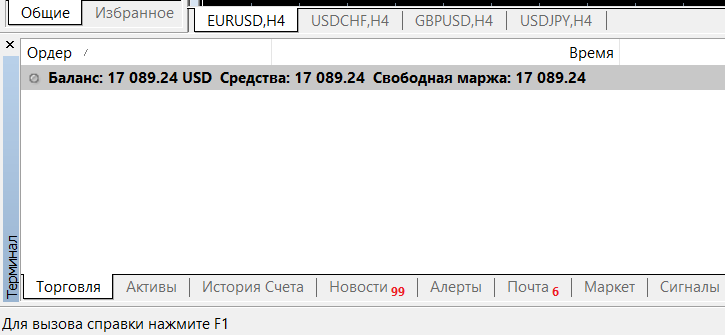
In the screenshot above we can see that the account balance is 17 000 USD. Cool, right?)
But this is only a cent account, which means we can safely remove 2 zeros at the end (divide by 100) to find out the real equivalent of the funds in the cent account.
In this example, if we decide to withdraw funds from the account, the broker will withdraw 170 dollars for us. Not 17000)
Thus, if you open a cent account and fund it with 100 dollars, then in the terminal balance you will see 10000 USD.
Next.
Let us look at an example of a trade on a cent account:
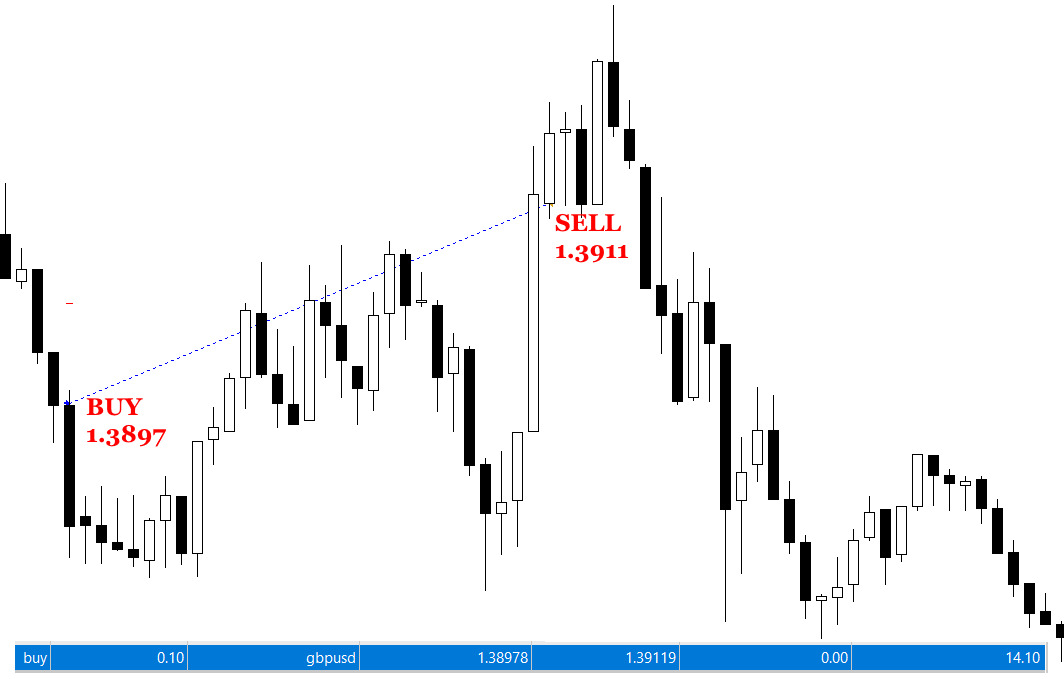
You bought GBPUSD with a 0.1 lot at 1.3897, and later closed the buy at 1.3911.
You made a profit of 14 cents.
In the case of a 1.0 lot, you would have earned 140 cents or 1,4 dollars in this example.
How to open a cent account?

To open a cent account, you need a broker that has this type of account.
Far from all brokers provide the opportunity to open a cent account.
We have compiled a selection of Recommended Brokers with cent accounts.
How can you understand which account type at a broker is a cent one?
Carefully read the “Account Types” section on the broker's website.
A cent account may be called quite obviously, for example, Cent NDD at Forex4You. Or ProCent at RoboForex.
Everything is clear here: Cent means cent. Captain Obvious_)
But this type of account can also be called Micro, as at Welltrade and XM Group.
Therefore, it is worth reading the description of account types at the broker carefully.
Otherwise, the procedure for opening and funding cent accounts is no different from regular accounts. With some brokers, when depositing/withdrawing funds from a cent account, you need to specify the amount in cents, be careful.
In which cases is a cent account needed?

- Try trading with a minimal amount of risk
A cent account allows you to feel the sensations both of earning and of losing real, albeit small, funds.
Psychology plays an important role in trading, many well-known traders advise not using demo accounts at all, but trading on small accounts until you learn stable trading. A cent account is perfect for this purpose.
Why do I need a cent account, if on a regular account type the minimum deposit is often 10 $?
Yes, you can trade with a small deposit on classic accounts too, but a cent account makes it possible to apply full-fledged precise money management.
Example
You have 200 $ in a classic account with a minimum lot of 0.01.
You want to open a position with a stop-loss of 100 old pips (for example, trading on D1), while risking 1% of the deposit.
But this is impossible)
Since your minimum lot is 0.01, the loss from a 100-pip stop with a 0.01 lot will be 10 dollars. That is 5% of your account.
Now imagine that you opened a cent account with a deposit of 200$, which turned into 20000 balance units.
You want to open the same position with a stop-loss of 100 old pips, risking 1%.
You should open a position with a 0.2 lot.
At stop-loss, you will lose 200 balance units on this position. Or 1% of the deposit.
The risks are observed thanks to the peculiarities of the cent account type.
With this, I think, everything is clear. To check on real, albeit small, money the performance of an expert advisor or a manual strategy. In the case of successful tests, transfer the system to a traditional account type.
3. An account on which everything is allowed
Has this ever happened to you: you see on the chart that right now there is definitely a reversal! A full 100%! But formally there is no signal from your strategy. Yet you want to open a position) What should you do?
Do not touch the main account, but open all emotional and non-standard trades on a cent account, your special “casino” account.
This way you will quench your thirst for trading. If your “insights” turn out to be correct, then you will earn a little, but if, which is more likely, they were only an emotional reaction to the market, then you will also lose only a little.
4. Robots whose trading is based on a grid of orders
Perhaps the most frequent use case for a cent account.
There are a great many, hundreds, thousands of expert advisors that use a grid of orders in trading.
What kind of strategy is this?
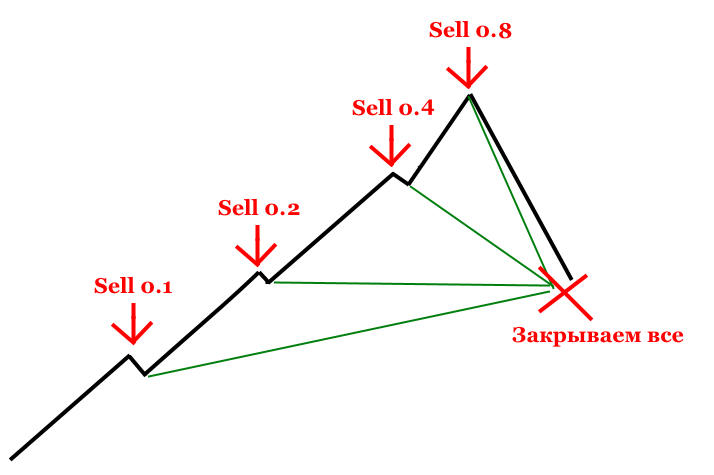
Everything is very simple. Currency pairs, as a rule, return to average price values. This is a feature of the Forex market. If the price goes against our position, for example, a sell, we may not close the order with a loss, but open one more. Perhaps even with a slightly larger lot. And then, when the price continues to move against us, we will open one more order. And so on.
When the price finally turns back in our direction, because we opened the orders with a larger lot, we need a much smaller movement to reach break-even on the series of orders. Or even a profit.
The essence of the method is in the image below:
It is worth noting that such strategies are not ideal and blow accounts on strong trends.
Why do we need a cent account for such systems?
Everything is the same as in the example with money management above. Only in the case of grid robots, we need not only accuracy in lot calculation, but also many orders. In some robots, the count goes into the dozens.
On a classic account type, such strategies often require 5000-20000 $. Not a small amount for trading a risky (and such strategies are risky) system, is it?
Therefore, it is quite reasonable to manage with an amount 100 times smaller on a cent account.
Therefore, it is quite reasonable to get by with an amount 100 times smaller on a dime.
Conclusion

Respectfully, Pavel Vlasov
Tlap.io