
Why Fewer Crypto Liquidations Do Not Yet Confirm a Recovery

Intro
Crypto liquidations have fallen sharply, yet Bitcoin and Ether are still losing ground. Is the market finding a floor, or has the pressure simply changed form? The question is whether fewer forced position closures can support a lasting recovery while the pool of dollar stablecoins is shrinking.
The facts show relief, with important limits
ByKaranteli's data, published on November 16, put liquidations across 12 platforms at $412.5 million for November 15, down 71.7%. At the time of writing, Bitcoin (BINANCE:BTCUSDT) trades at 64,465 USDT, with a daily change of -1.36%. Ether (BINANCE:ETHUSDT) is at 1,806 USDT, with a daily change of -1.60%. The confirmed divergence is smaller liquidation totals alongside falling prices. Goodman Macro reports that dollar stablecoin supply fell by $4.475 billion over the week ending November 15. That measures a change in the stock of tokens that can serve as buying power within crypto; it does not measure completed purchases or available bids. The daily liquidation figure and weekly supply change cover different windows, so their coexistence does not establish a cause for the price declines. Aggregate liquidations also combine long and short positions. Closing a leveraged long can involve selling, while closing a short can involve buying; without that split, a fall in total liquidations cannot be translated directly into fewer forced sales. Coverage of 12 platforms further limits any claim about the entire market. The reported decline is therefore evidence of less liquidation activity, with the effect on selling left open.
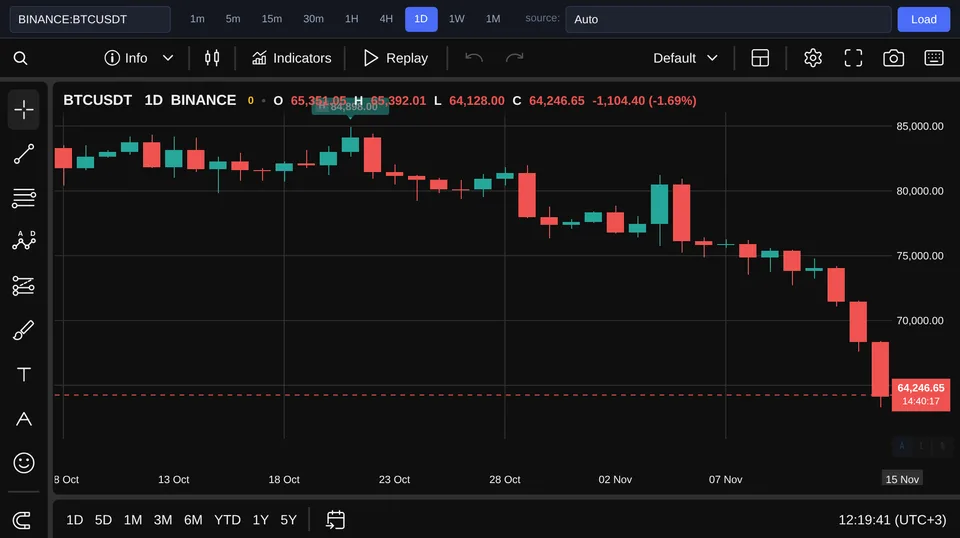
Three explanations compete for the same numbers
The first explanation is that the most vulnerable leveraged positions have already been closed. With fewer such positions left, liquidation activity could subside even if ordinary buying remains weak. A quieter derivatives market can reflect reduced leverage without renewed demand. The market may have caught its breath while buyers are still checking their wallets. The second explanation is that an early recovery is forming before the quoted daily price changes reveal it. That is possible, but the figures cited here contain no independent evidence of stronger spot buying. For this version to gain weight, purchases would need to keep supporting prices after the initial pressure eases, rather than produce a brief bounce. A negative daily return can conceal an intraday bounce, so price direction alone cannot settle this version. The third explanation concerns the stablecoin measure itself. Supply could shrink through redemptions or changes in demand for the tokens, with a weaker connection to purchases of Bitcoin and Ether than the headline suggests. The reasons for the supply decline remain unverified. A smaller token stock can still circulate, so the relationship between supply and buying is not mechanical.
Why a pause is the strongest working hypothesis
Of these explanations, a pause after leverage reduction, with demand still unproven, is the strongest working hypothesis. It fits the lower liquidation total and the continuing daily losses without requiring an unseen surge in purchases. The stablecoin contraction adds a reason to examine the funding backdrop, although it does not settle the argument. This reading supports caution about declaring a turn, without claiming certainty about the next price move. This is an editorial inference, not a confirmed account of who sold or why. Liquidation data describe the closing of positions under exchange rules, whereas spot demand concerns buyers willing to hold the asset at prevailing prices. Reducing one source of pressure does not create a new source of demand. Existing stablecoins can change hands, and other funding routes can support purchases, so contracting supply does not make a recovery impossible. A rebound driven mainly by short covering would require its own check. It could lift prices while leaving persistent spot demand unproven, which makes the composition of the next move more useful than its direction alone. Rising turnover would also need interpretation, because every trade has a buyer and a seller. Evidence of buyers lifting offers and sustaining higher prices would be more informative than volume alone.
The observations that would change the verdict
The pause hypothesis would gain support if stablecoin supply kept shrinking, spot demand showed no sustained net buying, and prices remained weak even as liquidations stayed subdued. These conditions should be assessed over comparable periods and across consistent datasets. Weak prices with modest liquidations would suggest that ordinary demand is still insufficient, although they would not identify the sellers. It would lose support if Bitcoin and Ether sustained gains accompanied by persistent spot purchases and deeper order books. Depth matters because it shows how much can trade near current prices without moving them sharply; a busier market can still have thin bids. A renewed expansion in stablecoin supply would strengthen the recovery case, especially if it coincided with visible buying. The evidence should persist beyond a single burst of trading to distinguish continuing demand from a temporary adjustment. Stablecoin issuance is neither a required starting signal nor proof of a turn by itself. A recovery could begin using existing balances, while newly issued tokens could remain idle or serve other purposes. The practical test is whether demand keeps absorbing sales over repeated observations, with liquidation direction and trading depth checked alongside price. The figures available here provide a starting point for that comparison, but do not contain the necessary order book or flow measurements.
Conclusion
Fewer liquidations alone do not establish a durable crypto recovery. The strongest working view is a pause after leverage reduction; a lasting turn needs evidence that buyers can sustain prices and that trading liquidity is improving.