
Bitcoin After $55,100: Recovery to $62,000 or Risk of $50,000?

Intro
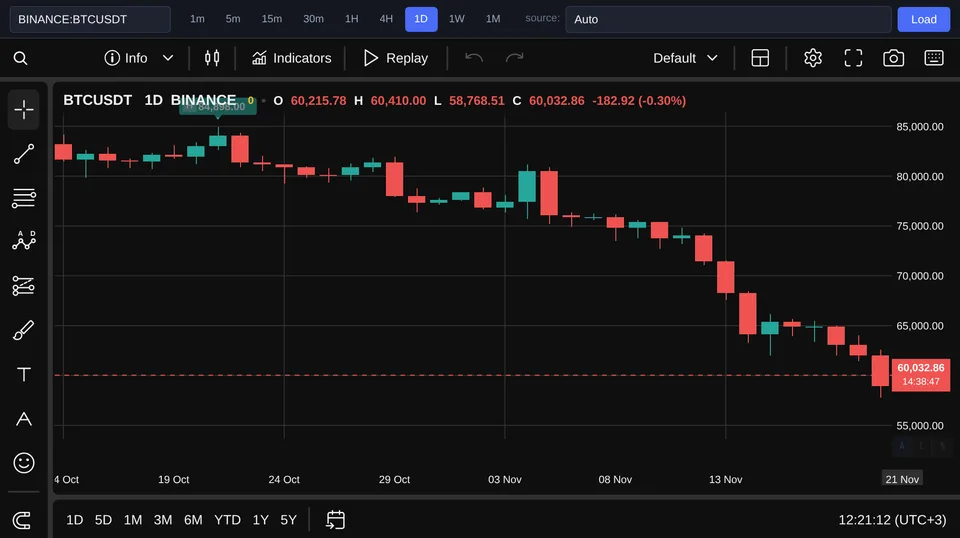
Bitcoin has recovered from the $55,100 low described in a November 21 market review, but does that mean demand is returning, or has the selloff merely paused? At the time of writing, Bitcoin (BINANCE:BTCUSDT) stands at $59,800, down 0.69% for the day. That daily change measures a different interval from the rebound off the reported low, so both observations can be true at once.
What the price and sources establish
Reported facts: the CryptoCompass review dated November 21 describes a decline to $55,100 and identifies $60,000-$62,000 as the first area in which to test a recovery. The current quote is above that reported low, yet below the lower edge of this zone. A rebound is visible; a recovery through resistance is still unconfirmed. The $57,700-$58,000 band comes from a Reddit discussion in r/LongOrShortBets, where participants consider stabilization. The same discussion raises $50,000 as a possible destination if support breaks. These are community scenarios, not evidence that either level will hold or be reached. The available material does not establish why buyers returned, how much spot demand entered the market, or whether short positions were closed. Price levels are reference points, not measured probabilities. Treating a popular target as a forecast would give the discussion more authority than the evidence supports.
Three explanations for the bounce
The first explanation is a return of durable demand. Under this reading, the decline attracted buyers willing to keep absorbing supply as the price rises, rather than only at the lowest available levels. This becomes more convincing if Bitcoin passes through $60,000-$62,000 and then holds the zone when sellers test it again. The second explanation is a technical rebound after heavy selling. Some traders may buy a sharp dip, while others may close short positions by buying back Bitcoin; either mechanism can lift price without establishing a lasting change in direction. Short covering is a possible mechanism here, not an observed fact, because the available evidence includes no positioning or liquidation data. The third explanation is consolidation before another decline. Selling can slow temporarily while prospective buyers wait and existing holders decide whether to reduce exposure on a bounce. A rejection in the recovery zone followed by weaker support would fit that account, although a single unsuccessful attempt to rise would not prove it. These explanations can overlap: a rebound may begin with short covering and later attract sustained demand. The task is therefore to compare what the price does next, rather than assign a single cause to every trade. A bounce can pass its first audition without getting the whole job.
Why the recovery remains unconfirmed
Editorial assessment: the strongest working hypothesis is a technical rebound with an unconfirmed trend reversal. This is a judgment about the available evidence, not a finding about the trades that caused the rise. At $59,800, Bitcoin has recovered ground but is still below the review's $60,000-$62,000 test zone. This reading asks for fewer assumptions than declaring either a completed recovery or an inevitable slide to $50,000. The first claim requires evidence that buyers can overcome resistance and defend higher prices; the second requires support to fail first. Neither condition is established by the current snapshot. The practical distinction is between touching a level and holding it. A brief move into the recovery zone can reflect a burst of buying, while continued trading above it and a successful retest would show that the market has accepted a higher range. Conversely, staying above $57,700-$58,000 would only show that the proposed support has survived that test. Holding support limits the bearish case; it does not complete the bullish one. Bitcoin could remain between the two areas without resolving the question, so sideways trading would leave the hypothesis open. The sequence matters: approaching a zone, rejecting it, and defending it provide different evidence even when the quoted price is similar.
The conditions that would change the verdict
To challenge the cautious working hypothesis, watch for a daily close above $62,000, followed by a return to $60,000-$62,000 that holds rather than collapsing back below it. A breakout followed by a successful retest would strengthen the durable recovery explanation. It would weaken the interpretation that the move is merely a temporary bounce, though it would not guarantee further gains. To strengthen the bearish alternative, look for rejection in that same zone followed by a loss of $57,700-$58,000. That sequence would make a renewed test of $55,100 more plausible because both the recovery attempt and the proposed support would have failed. A rejection alone is weaker evidence: the market might still consolidate while buyers defend the lower band. The $50,000 scenario needs another step: a daily close below the reported $55,100 low followed by a failed attempt to regain it. That sequence would give the downside case a clearer foundation; the community's target would still be a scenario, not a promised destination. If Bitcoin instead regains lost support and holds it, that would weaken the continuation argument. These tests need a consistent daily chart and a clear record of closes and retests. An intraday move through a level can disappear before the daily candle closes, so switching between the two can create a misleading verdict. A failed breakout followed by a reclaim would also require a fresh assessment rather than treating the earlier signal as permanent.
Conclusion
The available evidence supports a rebound from the reported low, not a confirmed route to either target. Recovery toward and through $62,000 needs the market to clear and defend $60,000-$62,000; the $50,000 case becomes stronger only after support and then $55,100 fail. For now, the decisive information is how Bitcoin behaves at those levels.