
Bitcoin After $1.29 Billion in Liquidations: What Would Confirm the Rebound?

Intro
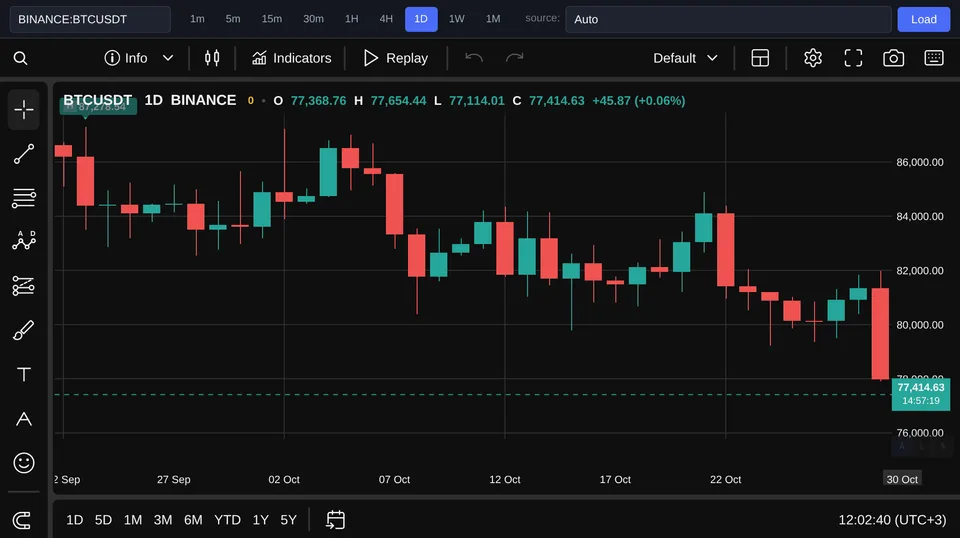
Bitcoin has recovered from the low reported during a sharp liquidation episode, but has the market finished selling, or merely paused? At the supplied snapshot, Bitcoin (BINANCE:BTCUSDT) trades at $77,358, with a daily change of -0.01%. That near-flat reading offers little help by itself: it describes a daily comparison, not the strength of buyers after the drop. The useful question is whether the recovery can survive once forced selling subsides and ordinary trading takes over.
What the liquidation figure actually establishes
The factual starting point is the October 30 report from 24/7 Wall St.: crypto long positions worth $1.29 billion were liquidated over a day, while Bitcoin fell to $76,301. The liquidation total concerns crypto longs across the market; the supplied context does not assign the entire amount to Bitcoin. The October 31 AD HOC NEWS review describes continuing pressure, which cautions against treating the initial recovery as a completed reversal. Liquidations establish that leveraged positions were forcibly closed; they do not establish that underlying demand has recovered. When losses exhaust the collateral supporting a leveraged long, its closure can add selling pressure regardless of the holder's longer-term view. That mechanism can accelerate a decline, so its eventual exhaustion can also make prices easier to lift. Yet removing an urgent seller and attracting a committed buyer are separate developments. The move back to $77,358 therefore establishes a recovery from the reported low, with an important limit: the available evidence does not explain who bought it. Nor does the daily change of -0.01% demonstrate that volatility has ended. A market can travel a considerable distance and still finish near its daily reference point.
Three explanations for the same recovery
The first explanation is that the liquidation impulse has weakened. Once vulnerable longs have been closed, fewer positions remain that must sell immediately, allowing available bids to support a recovery. This is consistent with the reported sequence, but the liquidation total alone cannot show that all vulnerable leverage has disappeared. The market has cleared some crowded seats; that does not tell us who has booked the next row. A second possible explanation is short covering. Traders who sold Bitcoin short may buy it back to realise gains, creating upward pressure without expressing lasting confidence in the asset. Such buying can produce a real rebound, but its support may fade when those closures are complete. Short covering is a plausible mechanism here, not a fact established by the supplied reports. The third explanation is that demand remains weak and the recovery attracts fresh leveraged longs before a durable base forms. Those positions could become another source of forced selling if price falls again, creating the conditions commonly described as a long trap. However, there are no supplied readings for spot flows, open interest or funding rates to demonstrate that this rebuilding is happening. Calling the recovery a confirmed trap would therefore outrun the evidence just as much as calling it a confirmed reversal.
The strongest working hypothesis
The strongest editorial hypothesis is a recovery after a liquidation shock, with durable demand still unconfirmed. It fits the reported fall and subsequent recovery while requiring fewer unsupported assumptions than either a decisive bullish reversal or an established long trap. It also allows the mechanisms to overlap: reduced forced selling and short covering can both contribute to a bounce while spot buyers remain cautious. This distinction matters because price direction alone cannot identify the quality of demand. A recovery supported by sustained spot buying would offer a stronger basis for persistence than one accompanied mainly by renewed leveraged exposure. That is an analytical comparison, not a description of measured conditions today. The supplied material contains no figures that let us choose between those demand profiles. The hypothesis would gain support if Bitcoin retained the recovery through subsequent selling attempts while liquidation pressure eased. It would need revision if stronger buying repeatedly absorbed supply and carried price beyond the source's recovery threshold. Conversely, renewed forced closures and a failure to regain lost support would favour the weaker-demand explanation. The point is to let observable behaviour change the assessment, rather than let the size of yesterday's liquidation number decide tomorrow's direction.
What would confirm or weaken the rebound
The 24/7 Wall St. author's scenario identifies $79,107 as a level above which sustained trading would strengthen the rebound case. It also describes a close below $76,600 as a risk condition for a move toward $73,107. These are conditional levels from the source's scenario, not guaranteed outcomes or independently calculated targets. The supplied context does not specify the timeframe for a close or for confirmation above resistance, so the levels do not constitute a fully defined trading signal. For the bullish interpretation, the useful observation would be acceptance above $79,107 followed by an ability to retain the advance when selling returns. Spot volume and buying flows would help assess whether demand extends beyond derivatives positioning. An increase in open interest would require interpretation alongside price and funding: it could reflect renewed participation, but would not by itself prove that the recovery is healthy. For the weaker-demand interpretation, a close below $76,600 followed by an inability to reclaim that area would be more persuasive than a brief dip alone. Fresh long liquidations, rising leverage during an unsuccessful rebound, or funding that becomes more positive while price struggles would add evidence of vulnerability. These are observations to seek, not current readings supplied in the brief. Even if they emerged, $73,107 would remain the source author's conditional downside objective rather than an inevitable destination.
Conclusion
The answer is a rebound that still needs confirmation. Bitcoin's recovery to $77,358 shows that price has moved away from the reported low, but the $1.29 billion liquidation total cannot establish a durable reversal. Holding the recovery, demonstrating sustained demand and meeting clearly defined confirmation conditions would strengthen that case. Losing support and failing to reclaim it would increase the risk that new longs entered before selling pressure had finished.