
Bitcoin Holds Steady After the Binance Hack Report: Resilience or an Unfinished Reaction?

Intro
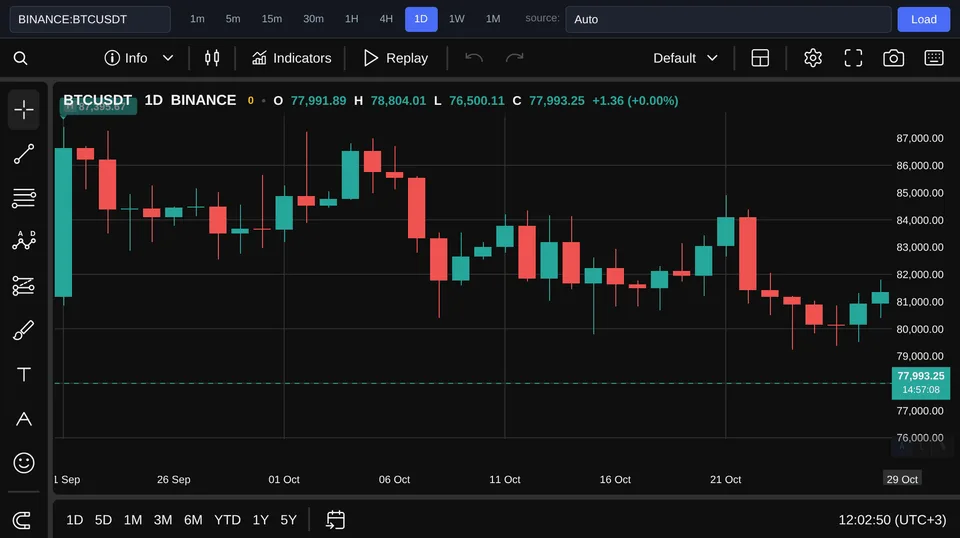
How can bitcoin look almost unchanged when a report describes billions of dollars leaving a major exchange? The supplied snapshot puts Bitcoin (BINANCE:BTCUSDT) at 78 031, up +0.05% for the day, alongside an allegation of a $6.36 billion incident at Binance. That apparent mismatch raises one question: has the market judged the risk manageable, or has the relevant evidence and investor response simply not arrived yet?
What the available information actually establishes
The supplied account attributes to TRM Labs, as of 00:30 UTC on October 30, a report that approximately $6.36 billion left Binance wallets on the evening of October 29. It also says the exchange suspended withdrawals across several networks. These are attributed claims in the supplied material: the underlying pages and independent confirmation are unavailable here, so neither the reported amount nor the nature of the transfers can be treated as conclusively established. A reported wallet outflow is not automatically a verified, permanent loss. Establishing that would require evidence about authorization, ownership of the funds, subsequent transfers and any recovery. The available context also does not justify attributing the alleged attack to a particular actor, or assuming that customers will ultimately bear the reported amount. The price snapshot is narrower evidence than it first appears. Ether (BINANCE:ETHUSDT) stands at 2 229, down -1.08% for the day, while bitcoin is marginally positive; this shows different daily performances, but does not establish their cause. Daily changes do not isolate the period after the report, and Binance quotations alone do not describe the whole market.
The strongest reassuring explanation: the risk stays local
The first explanation is that traders regard the alleged incident as a problem for one exchange rather than for bitcoin itself. A custody failure does not, by itself, alter the Bitcoin protocol or establish that coins held elsewhere are compromised. If withdrawals resume and obligations remain covered, a serious operational event could have a limited effect on the wider asset market. This is a plausible mechanism, but successful containment is not an established fact. The supplied information does not show the exchange’s verified exposure, available resources or final withdrawal status. Reading the quiet price as proof that all these questions have been resolved would make the conclusion depend on facts we do not yet possess. There is another complication: restrictions on moving funds can affect how prices should be interpreted. If traders cannot transfer assets normally, arbitrage between venues may become harder, allowing an exchange quotation to diverge from prices elsewhere. A steady number on one screen therefore needs a cross-market check before it earns a certificate of calm.
Why the ETF inflow cannot settle the question
The second explanation is timing: part of the institutional response may still be pending. According to the supplied account, US bitcoin ETFs recorded a $17.2 million inflow for October 29, but that flow formed before the alleged attack. Money committed before an event cannot demonstrate investor confidence after it. The next trading session is consequently relevant because it offers a later observation of fund demand. Even then, aggregate ETF flows will not be a direct opinion poll on Binance: portfolio adjustments, broader market conditions and unrelated allocation decisions can influence them. Outflows following the report would be consistent with weaker demand, but would not independently prove that the incident caused it. The third explanation concerns the information itself: investors may be waiting to learn whether the initial description is accurate and economically material. The reported scale, the distinction between transfers and losses, and the withdrawal restrictions all require clarification before traders can estimate consequences. This makes delayed assessment plausible, although it does not establish that a delayed sell-off must follow.
The working hypothesis and the evidence that could overturn it
The strongest working hypothesis is that the observed price reflects an incomplete assessment of the event. This editorial inference requires fewer unsupported assumptions than declaring the alleged losses successfully contained: it acknowledges both the unsettled facts and the absence of a post-event ETF observation. It also accommodates a benign outcome, because further evidence could show that the original concern overstated the lasting damage. The first test is confirmation of what happened: the character of the transfers, the verified loss if any, and the status of withdrawals. The second is price agreement across venues, measured over the period after the report rather than inferred from a daily percentage. Persistent or widening differences would weaken the claim that a stable Binance quotation represents broad market confidence, although they would still need an explanation. The third test combines the next session’s final ETF flows with price behavior across exchanges. Restored withdrawals, stable prices across venues and an absence of ETF outflows would weaken the delayed-reaction hypothesis. Confirmed material losses accompanied by withdrawal problems, widening price differences and ETF outflows would strengthen it, while leaving causality open to further examination. No single observation should carry the whole argument. An ETF outflow without broader price weakness could reflect routine positioning, while a price decline without confirmation of losses could reflect other pressures. The useful evidence is whether operational facts, market access and investor demand tell a consistent story.
Conclusion
Bitcoin’s almost flat daily performance does not yet answer whether the reported Binance incident is contained. The available evidence supports a narrower conclusion: the alleged losses remain unverified in the supplied context, and the cited ETF inflow predates the event. Market resilience becomes a stronger explanation only if clarified losses, functioning withdrawals, prices across venues and subsequent ETF demand support it together.