
Binary Options: A Path to Financial Ruin
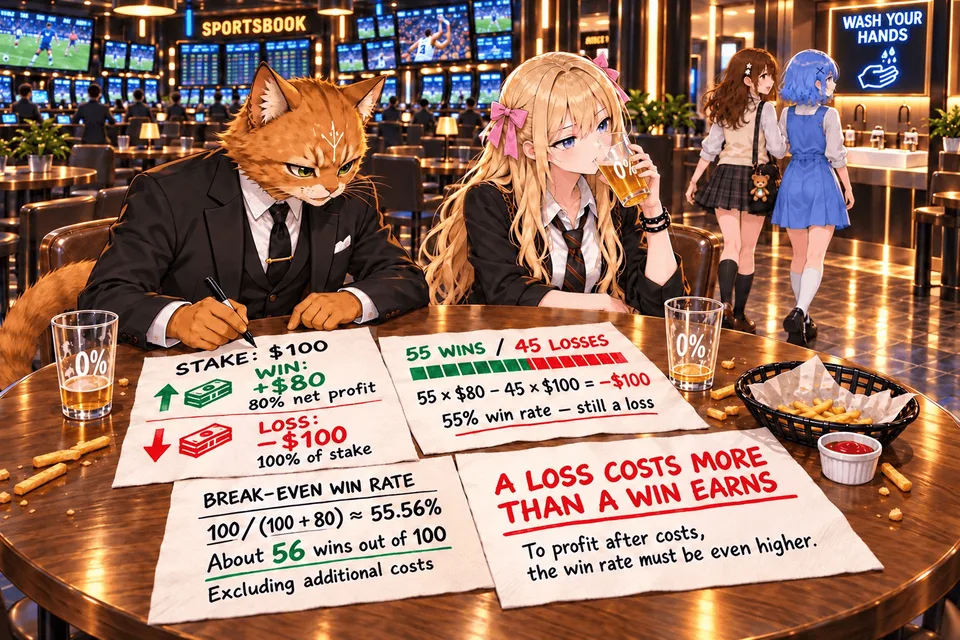
Binary options offer a fixed profit if a prediction about an asset's price proves correct. If the condition is not met, the client usually loses the entire amount committed to the trade.
Opening a position does not require buying currency, stocks, or cryptocurrency: simply choose the direction of the price movement, the amount, and the expiration time. The simplicity of this arrangement attracts beginner traders.
However, binary options differ substantially from conventional trading in financial markets. Correctly predicting the direction of the price is not enough: you must do so often enough to offset the total losses on unsuccessful trades.
What binary options are in simple terms
A binary option (Binary Option) is a contract whose payout depends on whether a predetermined condition is met. The main possible outcomes are a fixed payout or no payout.
For example, a client predicts that the EUR/USD exchange rate will be higher than its current value in five minutes. If the condition is met, the client receives the profit specified in the contract. If the prediction proves incorrect, the client loses the amount committed to the trade.
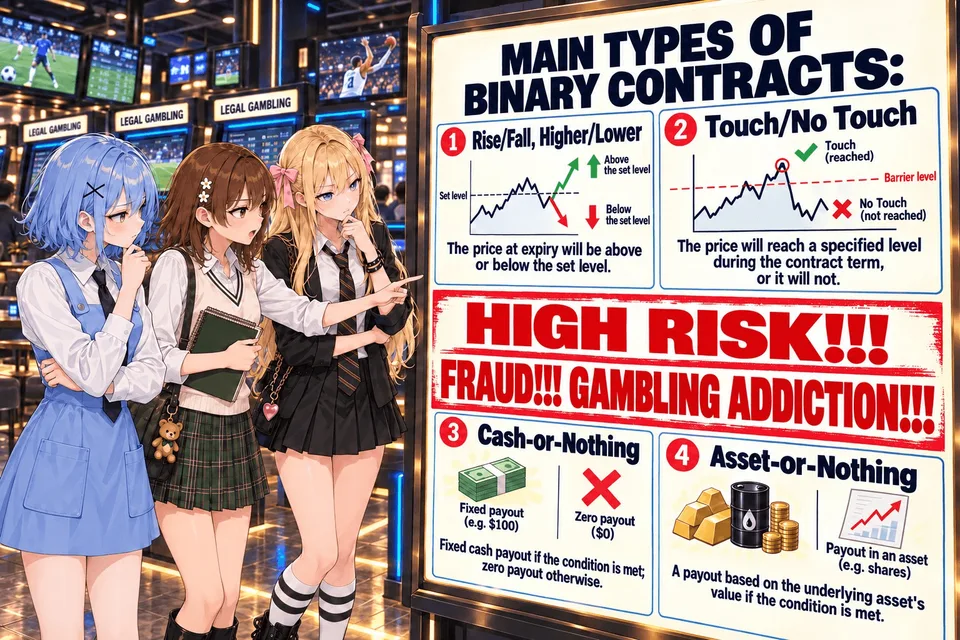
The main types of binary contracts:
Rise/Fall, Higher/Lower — the price at expiration will be above or below a specified level.
Touch/No Touch — the price will reach a certain level during the contract's term or will not reach it.
Cash-or-Nothing — a fixed cash payout if the condition is met and a zero payout otherwise.
Asset-or-Nothing — a payout that depends on the value of the underlying asset if the condition is met.
Thus, a binary option does not necessarily involve only a prediction of a rise or fall. The condition may involve reaching a price level, falling within a range, or the occurrence of a particular event.
Binary options on traditional and cryptocurrency exchanges
Binary options were used in the financial sector long before trading apps became widespread.
In 2007, changes were proposed that enabled these instruments to be standardized for exchange trading. In 2008, US regulators approved rules for listing binary options: NYSE Amex launched trading in them, followed by the Chicago Board Options Exchange (CBOE).
The history of exchange-traded contracts is documented in filings with the US Securities and Exchange Commission (SEC).
The United States also has regulated derivatives markets offering binary-type contracts. The registers of the US Commodity Futures Trading Commission (CFTC) include products linked to the price of Bitcoin and Ether. However, a contract's presence in a register does not mean it is currently actively traded, has sufficient liquidity, or is available to every retail investor. Current listings and client eligibility rules must be checked separately.
In the early 2010s, online platforms aimed at individual clients became widespread. They offered a simplified interface: users selected an asset, the direction of movement, the trade duration, and the amount. They did not need to understand option pricing models, volatility, or complex contract parameters.
However, simplifying the interface did not make market forecasting easier or guarantee favorable terms for clients.
On cryptocurrency exchanges such as Bybit, spot trading, futures, and conventional call/put options are common. Short-term contracts based on whether the price will be “up or down in a minute” are not a universal standard product on major cryptocurrency exchanges, although they can be found on some third-tier exchanges.
Prediction markets, where participants trade event outcomes, use mechanics similar to binary options: Polymarket is one example.
Differences between conventional and binary options
A conventional exchange-traded option gives the buyer the right, but not the obligation, to buy or sell the underlying asset at a predetermined price under specified conditions.
For example, the buyer of a call option on a stock with a $100 strike has positive intrinsic value if the stock is worth more than $100 at expiration. The higher the stock price relative to the strike, the greater the option's exercise value. The final profit also depends on the premium paid.
The payout works differently in a binary contract.
Parameter | Conventional option | Retail binary option |
|---|---|---|
Outcome | Depends on the asset's price relative to the strike | Depends on whether a specified condition is met |
Payout amount | Usually changes with the asset's price | Predetermined or zero |
What the trader predicts | Price, volatility, and other parameters | Whether a specific condition will be met |
Buyer's potential loss | Usually limited to the premium paid | Usually equals the entire stake |
Early closure | Often possible on an exchange or through a counterparty | Depends on the platform's terms |
Suppose a stock costs $100. The buyer of a conventional call option with a $100 strike receives intrinsic value of $20 per share at expiration if the price rises to $120. At a price of $105, it will be only $5.
Now imagine a binary contract with the condition “price above $100 at expiration.” Whether the stock is worth $105 or $120, the payout will be the same. If the condition is not met, the client will lose the invested amount under the contract's rules.
Binary options and betting
The similarity between binary options and bets is primarily economic. In both cases, participants risk a certain amount for a payout whose size depends on the outcome of an event.
An exchange-traded binary option and a bookmaker's bet are not the same thing. However, binary options for retail investors are effectively bets.
A binary option is a contract whose terms may depend on the value of a financial asset, a price level, or another event. Depending on its structure and the laws of a particular country, it may be classified as a financial derivative.
A bookmaker's bet is placed as part of gambling. Participants make a prediction about an event, and the payout is calculated according to the bookmaker's rules. Binary options trading platforms operate in exactly the same way.
The ways trades are organized also differ. On a regulated exchange, a binary contract may have standardized terms, official specifications, and a transparent settlement procedure. On a retail online platform, clients may enter into contracts directly with a provider that determines the available payouts and execution rules.
Thus, the words “broker” or “financial instrument” on a website do not prove that the product is actually offered within a regulated financial market.
Why the retail arrangement is gambling
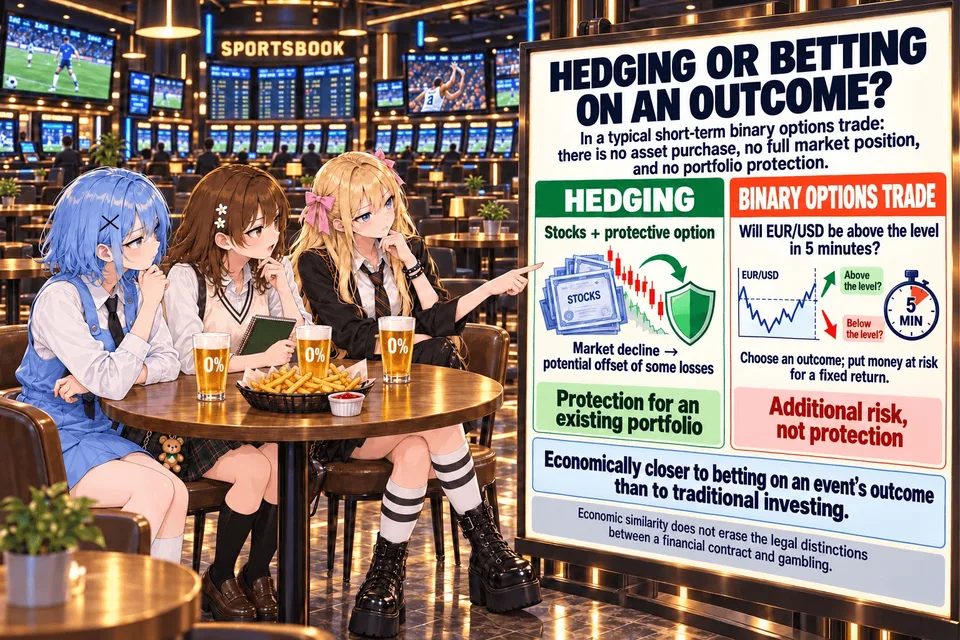
In a typical short-term trade, clients do not purchase the underlying asset, establish a full market position, or hedge an existing portfolio. They choose one of the outcomes and risk an amount for a fixed return.
If clients own stocks and buy a protective option, that instrument can offset part of their losses from a market decline. This is hedging.
However, if clients bet money that EUR/USD will be above a certain value in five minutes, their capital does not become better protected. They take on additional risk.
This is why short-term binary trades are economically closer to betting on an event's outcome than to conventional investing: economic similarity does not eliminate the legal differences between a financial contract and gambling.
The legality of binary options trading
Global practice can be reduced to three main regulatory models:
A ban on retail distribution. Applied, for example, in the United Kingdom and Australia, as well as in EU countries where corresponding national restrictions are in force.
In 2018, the European Securities and Markets Authority (ESMA) introduced a temporary EU-wide ban on the marketing, distribution, and sale of binary options to retail clients. In July 2019, ESMA stopped renewing this temporary measure because national regulators in most EU countries had adopted their own permanent restrictions.
Thus, the current framework consists of national regulatory measures rather than a single temporary ESMA ban. Their precise scope must be checked under the laws of the relevant country.
In July 2026, ESMA separately reiterated that the restrictions may cover new prediction market contracts if their legal nature makes them binary financial derivatives. Depending on their characteristics, event outcome contracts may also fall under national gambling laws.
Trading through regulated venues and market participants.
In the United States, binary options are not banned as a separate category of financial instruments. However, their offering and trading are regulated depending on the underlying asset, the contract's structure, and applicable securities and commodity derivatives laws.
Legal trading is possible on appropriately registered and regulated exchanges. At the same time, numerous websites offer binary options without the necessary registration or in violation of US legal requirements.
The Commodity Futures Trading Commission (CFTC) and the Securities and Exchange Commission (SEC) warn about cases involving refusal to allow withdrawals, software manipulation, and misuse of clients' personal data.
Permission under special conditions. Japan regulates retail foreign exchange binary options by imposing requirements on providers and product design. The rules of the Financial Futures Association of Japan (FFAJ) stipulate that the strike price must be determined at least two hours before settlement, and the minimum period between the start of a trade and determination of its outcome is two hours. The frequency of settlement times is also restricted.
Regulation of binary options in Russia
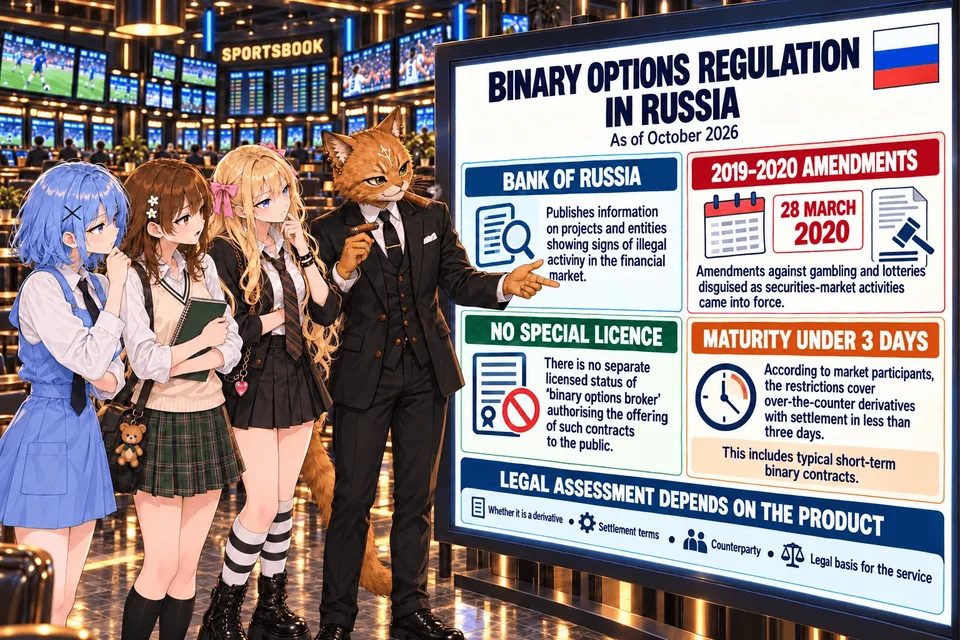
The Bank of Russia publishes information about projects and participants identified as showing signs of illegal activity in the financial market.
In 2019–2020, Russian legislation was amended to prevent the organization of gambling and lotteries under the guise of professional activities in the securities market. The corresponding amendments took effect on March 28, 2020.
As of October 2026, Russian legislation has no separate licensed status of “binary broker” that would, by itself, grant the right to offer such contracts to the public.
According to explanations from financial market participants, the restrictions cover, in particular, over-the-counter financial derivatives with very short settlement periods of less than three days: typical short-term binary contracts fall within such arrangements. However, the actual legal assessment depends on the product's actual structure: whether it is a financial derivative, what its execution terms are, who acts as the counterparty, and on what basis the company provides the service.
What this means for clients of foreign platforms
A substantial proportion of retail binary options platforms operate through companies registered outside Russia. If such a company is not supervised by the Bank of Russia, clients cannot and should not expect the same level of legal protection as when dealing with a regulated Russian financial market participant.

Buyers of binary options may encounter, and do encounter difficulties recovering funds, disputing trade outcomes, and enforcing court judgments in foreign jurisdictions.
Before deciding to transfer money, it is necessary to identify the legal entity, verify its license in the relevant register, study the trade settlement rules, and understand which regulator will consider client complaints.
The mathematics of binary options works against the client
What a typical binary options trade looks like
Let us consider a typical binary options trading arrangement.
Step 1. Choosing an asset. The client opens the platform and selects EUR/USD. The interface displays the current quote: say, 1.1000.
Step 2. Choosing a direction. The client expects the price to be above 1.1000 in five minutes and selects Higher or Rise.
Step 3. Determining the trade amount. Suppose the client risks $100. The platform offers a net profit of 80% for a correct prediction.
Step 4. Choosing the expiration. The client sets the trade's end time: for example, in five minutes. After confirmation, the contract's terms are fixed according to the platform's rules.
Step 5. Calculating the result. There are two main possible outcomes:
If the price is 1.1005 at expiration, the condition is met. The client receives $80 in net profit, and the stake is returned according to the contract's terms.
If the price is 1.0998, the condition is not met. The client loses $100.
The treatment of a price exactly equal to the threshold and the possibility of early closure are determined by the contract specifications.
Note that the client's profit is not proportional to the price change. A rise of one pip and a rise of one hundred pips can produce the same payout if the condition is met in both cases. This is the main principle that binary options share with gambling.
Thus, the player's stake is $100: the trade produces either an 80% net profit or a 100% loss. Accordingly, one win yields $80, while one loss costs $100. Because of this difference, wins must occur more often than losses.
Suppose the client risks $100 each time and makes 100 trades.
Outcome | Profit from wins | Losses from losing trades | Net result |
|---|---|---|---|
50 wins and 50 losses | $4,000 | $5,000 | −$1,000 |
55 wins and 45 losses | $4,400 | $4,500 | −$100 |
56 wins and 44 losses | $4,480 | $4,400 | +$80 |
Even if the client correctly predicts the direction in 55% of cases, they still make a small loss. Breaking even with this payout requires winning approximately 56 trades out of 100. To make a profit with a margin for additional costs, accuracy must be even higher.
This is the model's main mathematical drawback: a loss costs more than a win earns.
The break-even threshold changes depending on the payout. If a successful trade earns less than 80%, the required proportion of correct predictions becomes even higher. If the payout is larger, the threshold falls, but that alone does not guarantee a positive result.
Disclaimer

This material is provided solely for informational purposes and is intended to explain how binary options work, their pricing characteristics, potential risks, and the mathematics of trades. It does not constitute a personalized investment recommendation, an offer to enter into a trade, advertising for a particular financial instrument, or a recommendation to use a specific trading platform.
Binary options are high-risk instruments. Depending on the contract's terms, clients may lose the entire amount invested in a trade. A fixed payout for a correct prediction does not guarantee a positive financial result over a series of trades. Even if the direction of price movement is correctly identified in a substantial proportion of cases, the profit-to-loss ratio may lead to a negative result.
The calculations presented in this article are hypothetical mathematical examples. They are based on the stated win and loss amounts and do not account for possible commissions, taxes, additional costs, execution restrictions, or other terms of a specific product. The break-even formula applies when profit and loss amounts remain constant and a trade has two possible outcomes. Actual results may differ from calculated results.
Past trading results, statistics for individual client groups, and examples of successful trades do not guarantee similar results in the future. Having a strategy, technical indicators, or a statistical edge does not rule out losses. Short-term market price movements contain a random component, so predicting an outcome at a specific point in time involves substantial uncertainty.
The service provider's status requires particular attention. Having a website, an app, Russian-language support, or the ability to accept deposits does not confirm that a company is entitled to provide the relevant services in the client's country of residence. Before transferring funds, clients should check the legal entity, its license, and its details in the relevant regulator's official registers, and study the rules for contract execution, determining the expiration price, closing trades, and withdrawing funds.
The legal status of binary options depends on the contract's structure, jurisdiction, the market participant's status, and applicable laws. Binary options, exchange-traded derivatives, and bookmaker bets are not identical products, even if their economic outcomes appear similar. The regulatory information in this article is general in nature and does not replace legal advice. Before entering into a contract, clients must independently check current legal requirements and restrictions for retail clients.
Trading platforms and financial instruments are mentioned to illustrate the market and do not imply approval of their activities or confirmation of their reliability. Product availability, trading terms, and companies' legal status may change. Users are responsible for checking whether this information remains current.
The author and website owner do not guarantee accurate predictions, profits, or preservation of invested funds and are not responsible for financial decisions made solely on the basis of this material. Before using any financial instruments, you must independently assess the risks and ensure that potential losses will not jeopardize your financial position.