
TLAP Risk Management Calculators for Forex

A high-quality trading setup never guarantees a profitable outcome. Before opening any position, every trader should ask one essential question:
"Is this trade worth taking?"
This is where effective risk management begins.
Many beginner traders believe that risk management simply means placing a stop-loss. In reality, it involves much more. Before entering a trade, you should calculate your position size, define your maximum potential loss, estimate the expected reward, check the required margin, and understand how a series of losing trades could affect your trading account.
TLAP trading calculators make this process fast and straightforward, allowing you to perform all of these calculations in just a few minutes before placing a trade.
Why Most Traders Mismanage Risk
Many beginner traders make the same risk management mistakes.
The first is focusing only on the stop-loss distance.
A stop-loss defines where a trade will be closed, but it does not determine how much money will be lost. A 50-pip stop can result in a $20 loss or a $500 loss, depending entirely on the position size.
The second mistake is choosing the trade size arbitrarily.
Statements like "I'll trade 0.5 lots" or "I'll open one lot" have little meaning without first calculating the risk. Position size should always be based on the amount you're prepared to lose—not on how much you hope to make.
The third mistake is thinking only about the next trade.
Even profitable trading strategies go through losing streaks. If the risk per trade is too high, a series of losses can severely damage your trading account or even wipe it out.
Professional traders therefore evaluate not only the risk of a single position but also the long-term resilience of their entire trading strategy.
Using TLAP Calculators for Risk Management
Step 1. Calculate the Correct Position Size
Once you've identified a trading opportunity, the next step is to determine the appropriate position size.
Two TLAP tools are designed for this purpose: Pip Value Calculator and Lot Size Calculator
Calculate the Pip Value
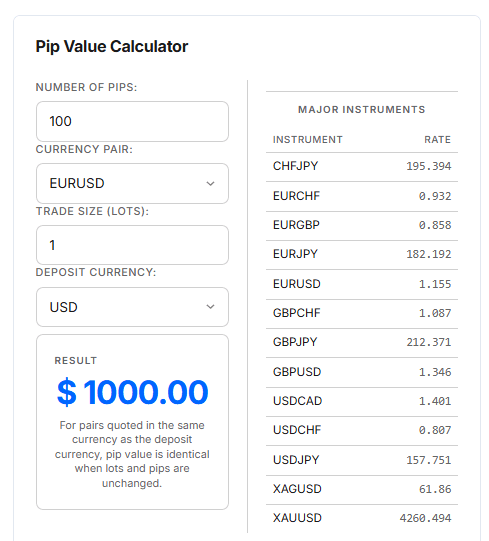
The value of a pip depends on the currency pair, position size, and your account's base currency. Knowing the pip value allows you to calculate how much money you stand to gain or lose for every pip the market moves.
For example, if the pip value is $8 and your stop-loss is 30 pips, your maximum potential loss is approximately $240.
The TLAP Pip Value Calculator provides this information instantly, giving you the foundation needed to calculate the correct position size and manage risk effectively.
Calculate the Position Size
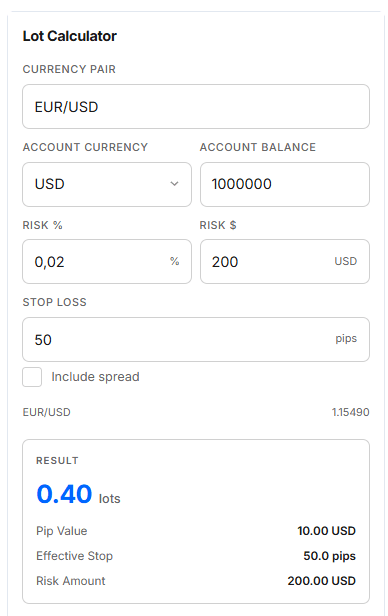
The next step is to determine a position size that matches your risk management rules.
For example, if you're willing to risk no more than 1% of your trading account on a single trade, the TLAP Lot Size Calculator automatically calculates the maximum position size that keeps your risk within that limit.
After completing the calculation, you'll know three key values:
The optimal position size
The value of one pip
Your maximum potential loss if the stop-loss is hit
With these values in place, you can confidently move on to the next stage of your trade planning.
Step 2. Check the Margin Requirements
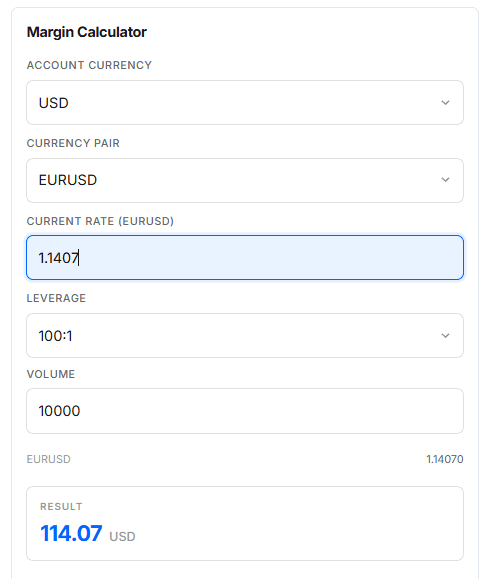
Even if your risk is properly calculated, you're not ready to place the trade until you've confirmed that your account has sufficient margin to support the position.
The TLAP Margin Calculator helps you determine:
How much margin will be required to open the trade
How much free margin will remain after the position is opened
Whether your leverage is being used at a safe level
If opening the trade leaves too little free margin, even a relatively small adverse price movement could trigger a Margin Call or Stop Out, forcing the broker to close your position.
For this reason, experienced traders rarely use the maximum leverage available. Instead, they maintain a healthy margin buffer to reduce the risk of forced liquidation during normal market fluctuations.
Step 3. Evaluate the Potential Profit
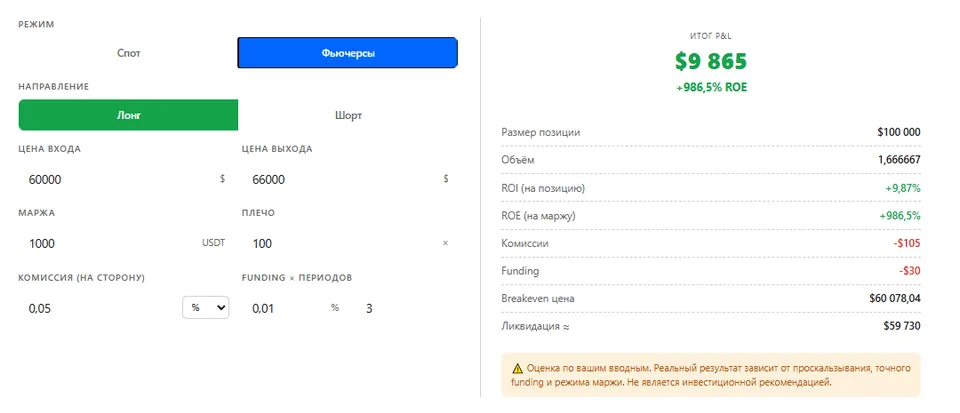
Once your position size and margin requirements have been confirmed, the next step is to evaluate the trade's potential outcome.
The TLAP P&L (Profit & Loss) Calculator estimates:
Potential profit
Maximum possible loss
The expected financial result in your account currency
This allows you to determine whether the trade meets the requirements of your trading plan before entering the market.
For example, a trade offering a potential profit of $100 with a possible loss of $90 is generally less attractive than one offering $300 of potential profit while risking the same amount.
This is where the risk-to-reward ratio becomes essential. Many trading strategies require a minimum ratio of 2:1, meaning the potential reward should be at least twice the amount at risk. Maintaining a favorable risk-to-reward ratio allows traders to remain profitable even if only a portion of their trades are successful.
Step 4. Think Beyond a Single Trade
Once you've calculated the potential profit and loss, it may seem like the analysis is complete.
In reality, this is where effective risk management truly begins.
Every trading strategy experiences losing streaks. Even a system with a strong historical win rate can produce five, seven, or even ten consecutive losing trades.
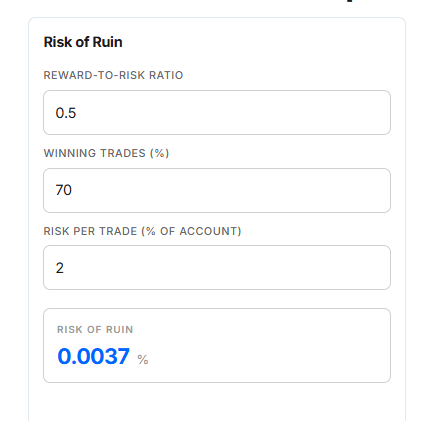
The key question is: "Can your trading account survive that losing streak?"
The TLAP Risk of Ruin Calculator helps answer this question by estimating the probability of losing a significant portion—or even all—of your trading capital based on your strategy's performance and the amount you risk on each trade.
Consider three examples:
Risking 1% per trade
With conservative risk, even an extended losing streak typically results in a manageable drawdown, leaving enough capital to continue following the trading plan.
Risking 2% per trade
Drawdowns become noticeably larger, requiring more winning trades to recover the losses. The psychological pressure also increases.
Risking 5% per trade
A relatively short losing streak can severely damage the trading account, making recovery much more difficult and increasing the likelihood of abandoning the strategy.
For this reason, many professional traders limit their risk on any single trade to 0.5%–2% of their account balance, helping ensure long-term survival through both winning and losing periods.
Step 5. Focus on Long-Term Growth
Many traders increase their risk in the hope of growing their account more quickly. In practice, this approach often produces the opposite result.
The TLAP Compound Interest Calculator helps you evaluate long-term account growth by modeling different combinations of returns, risk levels, and investment periods.
One of the most important lessons is that a more conservative approach often delivers better results over time. For example, reducing your risk from 3% to 1% per trade may lower the profit from individual winning trades, but it also significantly reduces drawdowns and makes the account much more resilient during losing streaks.

As a result, equity tends to grow more steadily, while the likelihood of suffering a major loss decreases substantially.
Successful trading is not about making the largest possible profit in a single week. It's about protecting your capital and building consistent returns over months and years.
What the full trade assessment algorithm looks like
After combining TLAP indicators and trading calculators, a consistent decision-making system is obtained.
First, the trader analyzes the market:
assesses participant sentiment using the open positions indicator;
finds liquidity zones by stop-losses and limit orders;
checks data relevance through the Order Book;
confirms strong levels using MAGMA;
looks for an entry point using technical analysis tools.
Only after this does risk calculation begin:
the position size is determined ;
the point value is calculated ;
the required margin is checked ;
potential profit and loss are assessed ;
the probability of a significant drawdown is checked using Risk of Ruin ;
long-term capital growth is modeled .
If at least one of the stages does not comply with the rules of the trading system, it is better to skip the trade.
Final checklist before opening a position
Before pressing the Buy or Sell button, make sure that all conditions are met:
✓ There is a trading signal.
✓ The open positions indicator confirms the scenario.
✓ Liquidity zones for stop losses and limit orders are defined.
✓ The Order Book confirms the presence of large volumes.
✓ MAGMA shows a strong level.
✓ An entry point has been found using technical analysis tools.
✓ The optimal lot size has been calculated.
✓ The point value is known.
✓ Margin requirements have been checked.
✓ Potential profit and loss have been calculated.
✓ The Risk/Reward ratio complies with the strategy rules.
✓ The Risk of Ruin metric has been checked.
✓ The trade complies with the rules of your trading system.
Conclusion
Successful trading begins not with opening a position, but with making the right decision.
TLAP indicators help answer the questions “Where to look for a trade?” and “When to enter?”.
Trading calculators answer the next question: “Is it worth opening this trade with exactly this volume?”
Only the combination of high-quality market analysis and strict risk management makes it possible to turn individual trading ideas into a consistent and sustainable trading system. That is why professional traders first assess the probability of a trade’s success, then calculate the risk, and only after that make the final decision to open a position.