
10 Strategies That Can Get You Banned by Your Broker
 There are many tactics and trading systems in Forex: from moving average crossovers to searching for patterns on the chart and tracking Trump's Twitter.
But there are other tactics too. Not very honest. Forbidden. The kind your broker definitely will not pat you on the head for. Using them will most likely lead to your account being blocked. If anything, I did not tell you this...
Introduction

Trading on the Forex market means working with a trading system or strategy that involves a sequence of profitable and losing trades. This activity never comes without losses, the probability of which grows over time, leading to forced parameter optimization or a radical change of the trading algorithm. Professionals view this state of affairs as ordinary work routine, but beginners who have come to Forex recently or returned some time after completely losing their deposit believe in the existence of the "Holy Grail." This is what people call a conditionally win-win trading strategy for the financial markets or a profitable trading tactic that more than covers rare losses with its profits.
Seek and you shall find: some beginners really do find simple and effective ways to quickly and safely grow a deposit, sometimes without having to master knowledge of chart technical analysis. Many of them earn substantial profits in a short time, but the "success story" ends with the broker "banning the account" or forcibly writing off the profit. This article is devoted to explaining why this happens and which strategies are prohibited by many Forex companies.
1. Arbitrage

Beginners often blow their deposit, but just as often they blame anyone but themselves, in particular shifting part of the losses onto the actions of the Forex broker. This pushes a novice trader to test their own abilities and trading strategies across many companies. Some notice the periodically arising difference in quotes for the same instrument at different dealing centers. It can sometimes be found even within one company if you open Metatrader 4 and Metatrader 5 accounts. From time to time, especially during the release of news, the trader will notice "slipping through" differences in the rates of currency pairs.
Reasons for the mismatch in rates of the same currency pair at different brokers

The international Forex market is an interbank system available to a narrow circle of participants, where the exchange rate of a currency pair is broadcast as a reference value compiled from instantly updated data on the latest trades of market participants.
Each broker, in turn, may either be a participant in this market or an intermediary tied to its liquidity provider, which acquires the client volumes. Sometimes a dealing center even operates on the principle of a bucket shop and does not send trades to the real market. In all the cases described, current quotes follow different paths before reaching Metatrader through intermediary servers of banks, prime brokers, dealers, and so on.
In the 21st century, technology has reduced the lag to milliseconds, but during strong moves or an imbalance of real supply and demand at the liquidity provider, quotes from different brokers or terminals may diverge.
How the broker-banned Forex strategy "Arbitrage" works

We carefully study information about brokers, choosing liquidity providers and dealing centers, open two accounts, and gather empirical statistics on quote discrepancies across several currency pairs, calculating the most frequent periods of divergence and selecting instruments.
Then the actual trading begins: we simultaneously open two opposite positions, short and long, at the moment a price discrepancy appears in the quotes of the same currency pair, followed by closing them and locking in profit when the rates converge.
Reasons why the "Arbitrage" strategy will not work

- The trader's account or profit will be blocked by the broker for violating clauses of the Agreement or Contract.
If arbitrage takes place within one dealing center, then the problem is that the prohibition on using simultaneous opposite trades on the same currency pair is usually spelled out in advance in the terms of service.
- Requotes, slippage, widened spreads, and so on.
The broker knows about the lagging problem, so at moments when quote refresh times increase or during news releases it will not execute orders, badly "setting up" the trader whose order elsewhere will trigger without any problem. But even if the trade instruction is executed, the benefit may be "eaten up" by a widened spread or a change in the execution price of the market order.
- Information sharing between brokers, leading to accounts being blocked at both companies.
Broker security departments exchange client information by means of "blind" database comparison, which makes it possible to identify active accounts operating simultaneously at two dealing centers. This is a reason for a detailed joint review of the client's positions. In this case, the trader may violate Agreements in two places at once and lose service at both.
2. Carry Arbitrage

Trading positions carried over to the next day have swap debits/credits that depend on the ratio of interest rates set by national central banks. If the trader has bought a currency with a larger swap than the other half of the pair, then every day a small positive amount will be credited to the account.
For example, in the case of EURUSD, a zero ECB rate and 2.75% at the Fed will provide the pair short with a daily positive swap. To profit from it, you should simultaneously open a EURUSD long with a broker offering an "Islamic account" or connect the "swap free" service.
Swap accruals are not that high, but annual profit can reach 30% without any truly serious risk, which is why many beginners like this idea of earning money.
Reasons why the carry arbitrage strategy will not work

- If "Islamic Forex" is chosen, proof or justification for that choice will be required;
- A swap-free account may include a fee for carrying or holding a position;
- The broker may "recalculate" swap earnings, reducing or zeroing them out for various contrived reasons;
- If the Security Department "identifies" two active opposite accounts, the trader may be accused of violating the user Agreement.
3. Carry Arbitrage on Swap Differences

In theory, the swap accrual, which depends on the difference in central bank interest rates of the currencies used in the pair, should be the same at all brokers, but in reality its value varies greatly, creating arbitrage situations.
By selecting two brokers with the strongest deviations from the average swap value, a trader can receive daily accruals on one of the platforms without even resorting to Islamic or swap-free accounts.
Take note of the Forex broker swap table for major pairs, where you can clearly see options for earning positive accruals on a short EURUSD that significantly exceed the charges for a long position on the same pair if it is opened on an account with another company. You can view this table on the Myfxbook service here.
Reasons why the inter-swap arbitrage strategy will not work

Companies know about strong differences in swap size across accounts, so they actively "identify" long-term positions. A trader may face the write-off of swap profit by receiving an "adjusted" position close price where it will be offset by the size of the loss.
The broker may also unexpectedly close the position, limit how long it can be held, and even cap the maximum profit per lot. Note that a strong difference in swaps is found mainly at little-known companies, and if they detect a carry trade during information exchange with other Forex brokers, they may well block the account, writing off both the profit and the remaining funds.
4. Trading Spikes - Non-Market Quotes

Day traders pay attention to the frequent occurrence of "spikes" - sharp price deviations that significantly exceed the usual trading range.
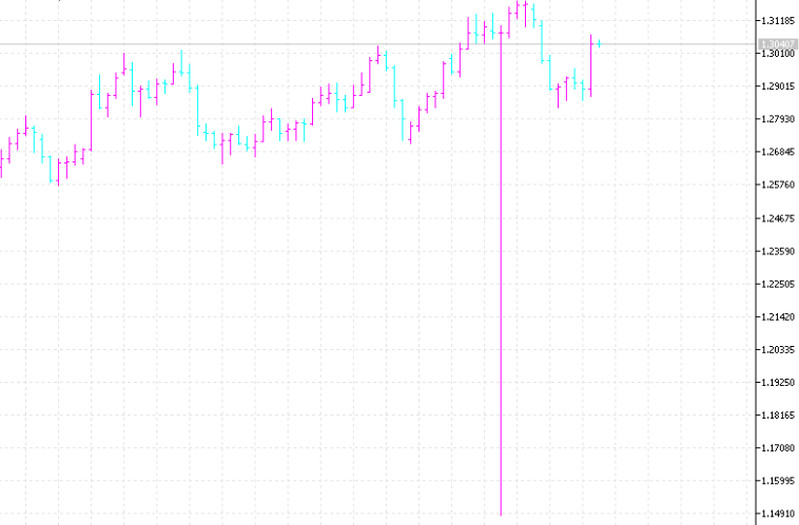 Such phenomena mostly occur during periods of low liquidity and are found in peripheral currency pairs. After a strong change, the rate instantly levels out, and brokers explain this by a technical failure or a large trade that "swept the book" - all orders in the Sellers' or Buyers' market.
Since such anomalies arise during a period of market calm, they are accompanied by a flat - fluctuations within certain price boundaries, without the formation of a trend. Therefore, traders place pending orders to buy and sell at a distance of two or three figures (200-300 points) in order to catch this move, while take-profit is placed inside the range.
Why Spike Trading Will Not Bring Profit

If you look at the historical chart, not a single quote will indicate a past spike. Brokers remove the "wicks," returning funds to those traders whose positions were unexpectedly closed by triggered stop-losses.
Profit earned on a non-market deviation and discovered during the spike investigation is written off from the trader's account "retroactively."
5. Bonus Hunting
 Strong competition in the Forex services market forces brokers to conduct various marketing campaigns. In particular, a large number of trader clients can be attracted with a no-deposit bonus or by offering an additional amount credited to the first (or subsequent) deposit.
If the bonus participates in drawdown or does not require a deposit, the trader can "take" its amount by opening another account with another broker in order to simultaneously hold opposite positions in the same currency pair.
Tactics for Working With the Bonus Hunting Strategy Prohibited by Forex Brokers

The essence of the strategy lies in repeatedly repeating the procedure of receiving bonuses by registering several accounts, followed by attempts to "earn" by blowing one account and making a profit on the other. This cycle is repeated as long as the no-deposit bonus promotion lasts.
Reasons Why the Bonus Hunting Strategy Will Not Work

- Opening new accounts will require a whole set of measures to conceal the IP address and involve third parties to submit unique personal data;
- It is difficult to withdraw profit from a bonus account without fulfilling certain conditions - they usually require opening a specified number of trades + trading turnover size matters, while the second, opposite position will already have been "blown," and there may not be enough time to open a new one if the broker's offer is limited by time;
- The bonus is almost always provided by the Forex broker on terms allowing it to be canceled at any moment.
6. Strategy for Earning on a Fictitious Affiliate Program

Forex brokers are ready to "share" part of their earnings in exchange for attracting new clients who open an account with the company. A trader can enter into an affiliate agreement and receive part of the commission profit (spread) from each real trade of the person they referred.
Convincing other traders to open an account through a special link so that the account is identified as an affiliate one and gives the right to profit is a difficult task. It is much easier to create a fictitious network and "accelerate" the reward with a large number of trades using robots with high-frequency trading algorithms. In theory, the "blown" deposit will be smaller than the share of commission payouts.
Tactics for Earning With the Fictitious Affiliate Program Strategy Prohibited by Forex Brokers

- Find a broker with a minimal set of documents for registration and high percentage-of-spread payouts;
- Choose account types with a fixed spread for the fictitious affiliate network;
- Find and install Expert Advisors with an HFT (high-frequency trading) algorithm on the accounts of the fictitious traders.
Reasons Why the Fictitious Affiliate Program Will Not Work

Any Forex broker provides for blocking accounts and writing off affiliate remuneration for detected facts of fraud. For additional protection against manipulations with the affiliate program, payouts are made after a certain period. Penalties may also be imposed on future rewards.
In addition, the Affiliate Agreement may stipulate write-offs and termination of the contract for:
- High-frequency trades by partners - the minimum holding time of a position and the size of the fixed profit/stop-loss are stipulated;
- 70% of turnover from one of the referred clients;
- Lack of activity from most referrals, that is, trades must occur on each account at least once a month;
- Any matches in the personal data of referrals in other opened accounts (IP, e-mail, etc.);
- Referrals ignoring the company's verification contacts to confirm identity.
Profitable Forex Trading Strategies Prohibited by the Broker

If the above earning methods were blocked by the broker for clear and understandable reasons, then the strategies of scalping and news trading are prohibited by many companies unfairly.
The "tradition" of getting rid of profitable traders appeared when the profit of many dealing centers consisted of lost deposits. Trading in currency pairs was conducted inside the companies, for which they received the nickname "bucket shops," so any steady trader win was perceived by the company as a loss.
At that time, the novelty of the Forex topic led to a large influx of new clients, among whom only a few percent of traders were actually profitable. It was easier for the broker to get rid of these accounts despite the risk of reputational losses. Later, in order to minimize them, profitable strategies were identified and prohibited in the Client Agreement.
7) Pipsing or Scalping

Trades with a short time spent in a position, with the loss or profit fixed at several points (pips), are called scalping or pipsing. Many resources devoted to trading often "separate" these concepts, but the boundary between the definitions of high-frequency trading strategies is rather blurred.
It is believed that scalping can be carried out not only on one-minute but also on 15-minute candles, whereas pipsing is exclusively trading by ticks - second-by-second price changes with each new trade carried out by any trader on Forex.
A high-frequency trading strategy is quite difficult technically and emotionally, with a high threshold of negative results, without a "right to make a mistake" that can deprive the trader of all of the day's already not very high net profit. Therefore, its use requires serious preparation and training.
The reason why the broker prohibits pipsing is the "follow-the-leader" trading strategy. As in the case of arbitrage, the trader uses the prime broker's quotes with an advance movement of the rate change in the dealing center terminal.
Having calculated the time lag measured in ticks and using one-click trading or an Expert Advisor that allows orders to be placed with an automatic stop-loss and take-profit level of several pips, one can enter before the beginning of the quote movement in the dealing center. Since the trading result will be known in advance because of the leading movement of currency pairs at the prime broker, the strategy will bring profit on most trades.
Reasons Why Pipsing Will Not Bring Profit With Many Forex Brokers

The Forex broker stipulates the duration of trades or their number during one session, so the profit will be written off for violating the Agreement. If the trader continues to escalate the conflict, their account may be blocked.
8. News Trading

The publication of important economic indicators is always accompanied by a surge in volatility and the appearance of candles with an abnormally wide price range. The impulsive surge allows the trader to place two opposite orders with take-profit set in advance. If the profit-taking levels are set correctly, most orders placed under this tactic will close in profit.
This tactic allows you to work without forecasting the market's reaction to the news. The system is described in more detail on the site in the article "How to Trade the News".
Reasons Why News Trading Does Not Work with Forex Brokers

- A short position holding time may violate the terms of the Agreement with the broker;
- At the moment the news is released, spread widening in the terminal will open trades with slippage;
- Requotes are a delay in trading for several minutes during the publication of the news;
- Cancellation of triggered or closed orders without explanation or under the pretext of a technical failure.
9. Trading Volatility Using Maximum Leverage

A volatility trading strategy is one of the tactical responses traders use to Forex brokers' bans on news trading.
To earn guaranteed profit regardless of the movement of the currency pair, a volatile instrument is chosen, for example, USDJPY. The trader opens two accounts, selecting terms that provide maximum leverage of 1 to 1000. Then two opposite positions are placed on the same currency pair before the news release or the publication of a significant political event, the opening of the European session (the strategy "London Explosion"), and so on.
Having calculated in advance a take-profit that covers the losses from blowing one of the deposits, which are equal to each other, the trader earns money (usually +100%) on the impulsive spike of quotes in one account, while the second is wiped out. This becomes possible thanks to the large size of the leverage.
Reasons Why Volatility Trading Does Not Work with Forex Brokers

- The broker may prohibit trading with the entire deposit when leverage is high;
- At the moment the news is released, quote movement on the two accounts may change in different directions;
- The broker may write off the profit because of an alleged technical failure;
- The trader may be caught opening the opposite position with another company and have both accounts blocked.
10. Catching Gaps, or "Price Gaps"

A strategy of opposite-direction trading on two accounts opened with different Forex brokers makes it possible to use 1 to 1000 leverage to catch gaps, price gaps that arise in the first minutes after the market opens.
This is a rare phenomenon for major currency pairs, which can be seen only on Monday if significant events occurred over the weekend. But for many national currencies with weak economies or a short business day, gaps are a constant accompanying attribute.
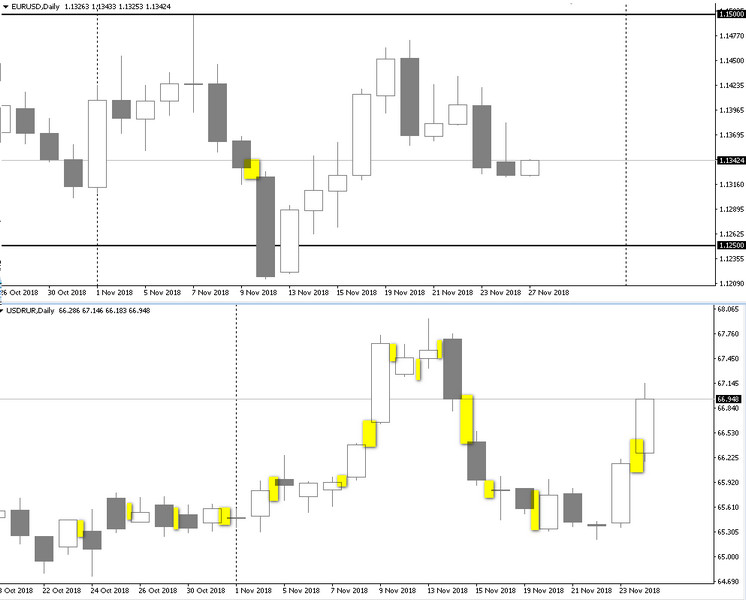 The trader uses the tactic already described in the volatility trading strategy, with the only difference being that the opposite-direction position is opened in the final seconds before the end of the session.
The price gap that appears at the opening of the next day "kills" one of the trades, generously covering the loss with profit in the other account.
Reasons Why "Gap Catching" Does Not Work with Forex Brokers

It is quite difficult to find a broker that allows trading "peripheral" currency pairs with high leverage. If a company agrees to such conditions, it means it limits the possibility of a trade to 100% of the deposit. If this obstacle is absent, the trader can fall into a trap: the position will disappear from the terminal if a positive-side gap is expected. It is not difficult to calculate its direction several hours before the start of the session, so the broker deliberately cleans the premarket.
Conclusion

To avoid account blocking or the write-off of profit already earned, a trader should avoid strategies that use discrepancies or any other obvious "holes" in the operation of the broker's servers. If the company was unable to close these loopholes technically, then they are closed at the legal level. Therefore, you should carefully read all clauses of the Agreement with the Forex broker and obtain a full explanation of any unclear provisions.
Profitable strategies that work on the basis of discovered algorithms are better implemented in partnership with large and significant brands that allow scalping under special conditions. Finding an opportunity to trade the news without requotes and slippage is more difficult because this problem arises when trading in any markets.
Sincerely, Pavel Vlasov
TradeLikeaPro.ru