
Why WTI Is Retreating: Supply Threats Meet Diplomatic Hopes

Intro
Why is oil retreating when the threat to supply has hardly disappeared? WTI rose 3% on October 28, then began surrendering part of that gain on the morning of October 29. The apparent contradiction becomes easier to understand once we separate a possible interruption from an observed loss of supply. Prices can rise because traders fear missing barrels, then fall because that fear becomes less convincing, even before physical deliveries change. The question is whether diplomacy is reducing the premium attached to uncertainty or whether the market has received evidence of a different supply outlook.
What the price snapshot actually tells us
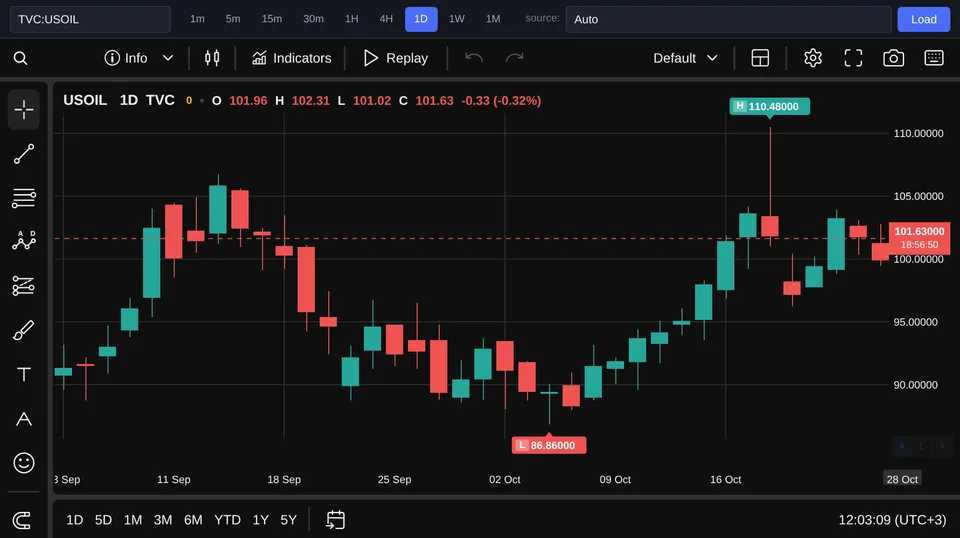
The supplied snapshot puts WTI (TVC:USOIL) at USD 101.7, down 1.05% on the day, and Brent (TVC:UKOIL) at USD 110.8, down 3.95%. These daily declines belong to the current session; WTI's 3% advance belongs to October 28. The latest decline represents a retreat after the previous day's rise, not evidence that the entire gain has disappeared. Calculating the remaining gain precisely would require comparable closing prices and consistent observation times. Brent's larger percentage decline is worth investigating, but it does not explain itself. Without aligned quotation times and comparable instrument details, the difference cannot establish which contract is reacting more strongly to diplomacy or supply concerns. It is a clue that needs checking against better matched data. The firm observation is narrower: both supplied daily changes are negative, while their magnitudes differ substantially.
A reported threat is not a measured supply loss
The factual starting point is a Houthi statement claiming a strike on Ras Tanura. Saudi authorities had not confirmed that claim in the cited publications. That leaves several separate questions unresolved: whether the reported event occurred as described, whether infrastructure suffered damage, and whether any damage affected operations or deliveries. The supplied context establishes a claim about an attack, not a confirmed interruption of oil supply. This distinction matters because a risk premium can emerge before any barrels are lost. Buyers may accept higher prices when the probability of disruption appears to increase, especially while reliable operational information is scarce. The market can charge for the umbrella before the rain arrives. But if subsequent information fails to substantiate the feared interruption, some of that additional price can unwind without a corresponding improvement in measured production. An absence of confirmation still does not prove that facilities are operating normally. It limits what we can conclude from the available reporting and prevents an alarming statement from becoming an assumed physical shortage. Evidence about refinery activity and export loadings would carry more weight in assessing actual supply than repeated versions of the original claim.
Three explanations, with different levels of support
The first explanation is diplomatic repricing. A new draft deal was passed to Iran through Qatar, according to the supplied context. That is a reported diplomatic step, but it is not an accepted agreement or proof that supply risks have been resolved. The editorial inference is that the prospect of progress may have made traders less willing to pay the previous risk premium. The second explanation is a reassessment of the physical threat after the initial alarm. With no confirmed disruption established in the supplied reporting, traders may have reduced the probability they attached to lost supply. This overlaps with the diplomatic explanation, but the mechanisms differ: one concerns the prospects for easing tensions, while the other concerns whether the feared operational damage has materialized. Both could contribute to falling prices without any demonstrated increase in available barrels. A third possibility is profit taking after WTI's 3% rise. It is plausible that some holders chose to close positions, but the supplied material contains no positioning or transaction evidence that would establish this as the main driver. Price action alone cannot identify who sold or why. The strongest working hypothesis is therefore a partial reduction in the supply risk premium, supported by a diplomatic opening and uncertainty about actual disruption; its precise contribution remains unmeasured.
What would confirm or weaken that hypothesis
The next useful evidence should connect official statements to observable operations. Updates on Ras Tanura's condition, changes in refinery activity, and export loading information would help establish whether the threat has affected physical supply. Diplomatic developments also need substance: a confirmed response to the draft or an agreed next step would provide more information than the fact that a proposal was delivered. The hypothesis gains strength if supplies remain intact and prices fall further alongside verified diplomatic progress. It would weaken if credible reports established operational interruptions and prices returned to sustained gains in response. That combination would suggest that the market was assigning greater weight to actual lost supply. Confirmation of damage alone would require further interpretation, because damage and a reduction in deliverable oil are separate observations. The scale and persistence of any operational effect would matter more than the dramatic wording of a headline. Price responses should also be compared at consistent times across comparable instruments. A brief decline after a diplomatic announcement would offer limited evidence; a sustained response alongside continued deliveries would be more persuasive. If negotiations advanced while confirmed interruptions also emerged, the signals would point in competing directions. In that case, the honest conclusion would be that the available evidence does not yet identify the dominant force.
Conclusion
WTI can fall after a sharp rise because the price attached to a possible disruption can shrink before the supply situation is fully established. On the supplied evidence, partial removal of that risk premium is the strongest working explanation for the retreat, rather than a demonstrated change in physical availability. It remains an editorial hypothesis. Verified operations, export flows, diplomatic progress, and the price response to those developments will determine whether it holds.