
Why Bitcoin Is Stalling at $87,000 Despite ETF Inflows

Intro
Bitcoin is receiving institutional capital, yet the price still cannot turn the $87,000 area into reliable support. At the time of writing, Bitcoin trades at $86,027, up 0.30% for the day, while Ether stands at $2,717 with a 0.25% daily gain. The immediate question is therefore narrower than whether investors like crypto: why are positive flows into spot Bitcoin ETFs not producing a decisive breakout? The apparent contradiction disappears once ETF demand is separated from the breadth, consistency, and liquidity of the wider market.
The confirmed facts: money is entering Bitcoin, but not crypto broadly
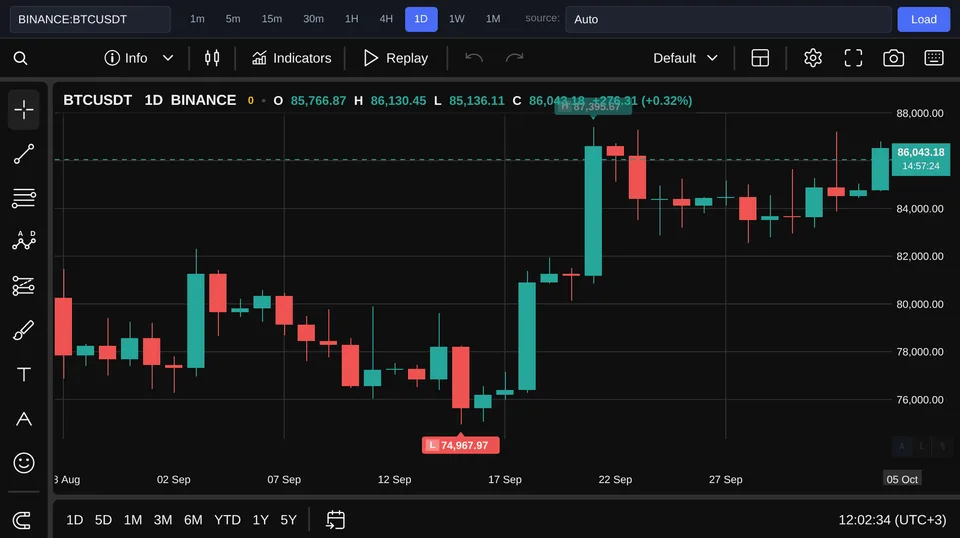
The published weekly figures establish a clear divergence. Spot Bitcoin ETFs attracted $241.1 million over the previous week, marking a third consecutive week of inflows, while funds focused on Ether recorded $138 million of outflows. At the same time, BTC again retreated from the $87,000 zone on October 5 and now changes hands at $86,027, even though its daily move remains positive at 0.30%. Ether offers useful context because it is not confirming an enthusiastic market-wide expansion. ETH trades at $2,717 and is up 0.25% on the day, but the weekly fund outflow shows that a small daily price gain should not be confused with sustained demand from investment products. The confirmed picture is one of capital choosing Bitcoin specifically, not investors indiscriminately buying the entire digital-asset market. That distinction matters because a durable Bitcoin advance usually becomes easier when demand is visible in several places at once: spot markets, derivatives, investment funds, and major alternative assets. The current ETF figures demonstrate a source of support, but they do not prove that the market has enough participants willing to keep buying above resistance. One sturdy leg can hold up a table for a surprising moment, but markets generally prefer more than one.
Three explanations for the stalled breakout
The first explanation is simply scale and timing. A weekly inflow of $241.1 million is constructive, but its price impact depends on whether purchases are steady, concentrated in a few sessions, offset by selling elsewhere, or associated with portfolio reallocations rather than entirely new risk-taking. Positive ETF flows can absorb available supply and limit declines without being large or persistent enough to force an immediate breakout. The second explanation is competition from US yields. When dollar-denominated bonds and cash-like instruments offer attractive returns, investors face a higher opportunity cost for holding an asset that produces no contractual income. This does not automatically cause Bitcoin to fall, but it can reduce the urgency of marginal buyers, especially near a visible resistance level where the risk-reward calculation becomes less forgiving. The third explanation is the split between Bitcoin and Ether funds. Investors may be expressing a defensive preference inside the crypto market: they want exposure to the most established asset, but not enough exposure to embrace ETH and less liquid altcoins. Under this interpretation, the $138 million leaving Ether funds is not merely an isolated disappointment for ETH; it is evidence that risk appetite remains narrow. All three explanations can operate together, but they are not equally informative. The size of weekly flows may explain a temporary pause, and high US yields describe an important external restraint. The BTC-versus-ETH divergence, however, connects the resistance problem directly to the internal structure of demand: capital is present, but participation is selective.
The strongest working hypothesis: accumulation without breadth
The most convincing working hypothesis is that the market is accumulating Bitcoin selectively rather than rejecting it, while still lacking the broad demand required for a sustained move beyond $87,000. The ETF inflows help keep BTC close to the upper boundary, which is consistent with the price holding at $86,027 rather than suffering a sharp reversal. Yet the failure to remain above resistance suggests that sellers and profit-takers are still finding enough demand to exit without chasing the price materially higher. This hypothesis also explains why Bitcoin can outperform the tone implied by Ether fund flows. Institutional or portfolio-driven buyers may regard BTC as the cleaner vehicle for digital-asset exposure, while treating ETH and altcoins as additional layers of market and liquidity risk. The divergence therefore looks less like a vote of confidence in a full crypto rally and more like a concentrated allocation to Bitcoin. Broad participation matters because it improves the market's capacity to absorb sales after a breakout. If liquidity remains weak outside Bitcoin, traders have less evidence that fresh risk capital is entering the ecosystem, and a brief move above $87,000 can become vulnerable to reversal. A resistance break based mainly on short covering or a narrow burst of ETF-related buying may look impressive on a chart while remaining structurally fragile. This is still an interpretation, not a confirmed fact. ETF flow data do not reveal every buyer's motive, and Ether outflows cannot by themselves prove that all altcoin liquidity is deteriorating. Nevertheless, the hypothesis fits all the supplied observations without requiring the assumption that either ETF investors or the price signal must be wrong.
What would confirm or invalidate the hypothesis
Confirmation requires more than Bitcoin briefly trading above $87,000. The first condition is sustained acceptance above that level: repeated closes or continued trading over the former resistance, followed by buyers defending it during a pullback. A breakout becomes more credible when $87,000 changes from a ceiling into observable support. The second condition is persistence and expansion in spot Bitcoin ETF inflows. Another positive week would help, but stronger evidence would be inflows distributed across several sessions and products rather than one unusually large contribution.
Conclusion
The short answer is that ETF inflows are supporting Bitcoin, but they are not yet broad or forceful enough to guarantee a breakout. The contrast between $241.1 million entering Bitcoin ETFs and $138 million leaving Ether funds points to selective demand, while attractive US yields and weak altcoin liquidity constrain follow-through. Bitcoin at $86,027, up 0.30% on the day, remains close enough to $87,000 for accumulation to be plausible, but proximity is not confirmation. A sustained hold above resistance, continuing ETF inflows, and improving market breadth would support the bullish hypothesis; renewed rejection and weakening flows would refute it.