
Wall Street’s Rebound: A New Rally or Just a Technical Reset?

Intro
Wall Street ended Friday, October 9, with an apparently encouraging answer to the week’s technology selloff. The major indexes rose together, and the S&P 500 moved back toward its record. Yet the most important counterweight did not disappear: the ten-year Treasury yield closed at 5.24%, leaving investors with a highly competitive risk-free alternative and keeping pressure on equity valuations. That creates a focused market question: was Friday the beginning of a durable new advance, or merely a technical recovery after a sharp decline? The evidence supports neither an automatic bearish verdict nor immediate celebration. The rebound was real, but one positive session cannot establish a new market regime. To judge it properly, we need to separate confirmed facts from three plausible explanations and then define what the market must do next.
What Friday’s numbers actually established
The confirmed facts are straightforward. The S&P 500 and Nasdaq Composite each gained 0.6% on Friday, while the Dow rose 0.8%. At the latest reading supplied for this analysis, the S&P 500 stood at 7,812, up 0.59% for the day, and the Nasdaq 100 was at 30,883, up 0.51%. The S&P also returned close to its record after the technology-sector selloff. Those figures show that buyers returned across the headline indexes, not only in a single technology benchmark. The Dow’s stronger percentage gain is also consistent with at least some demand outside the most valuation-sensitive growth shares. Friday therefore delivered a meaningful rebound with hints of broader participation. It did not, however, prove that breadth was sufficiently strong or persistent to carry the market through another rise in bond yields. The other confirmed fact is less comfortable for equity bulls. The ten-year Treasury yield finished at 5.24%, so the rebound occurred without relief from the discount rate that investors use, directly or indirectly, to value future corporate cash flows. A high yield does not mechanically force stocks lower, but it raises the standard they must meet. When government bonds offer 5.24%, investors can demand better prospective returns from equities instead of accepting ambitious valuations out of habit.
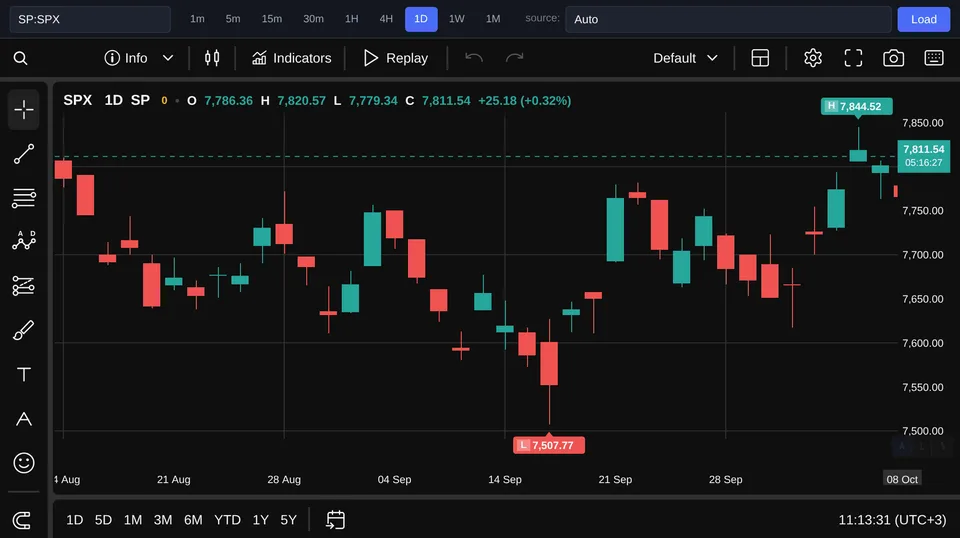
Three explanations are competing for the same rally
The first explanation is a technical bounce. After concentrated selling in technology shares, short-term traders may have covered bearish positions, systematic strategies may have rebalanced, and investors waiting for lower prices may have stepped in. Under this interpretation, Friday says more about the intensity of the preceding decline than about an improvement in the market’s underlying outlook. Even a rubber ball looks impressively energetic immediately after hitting the floor. The second explanation is a genuine return of risk appetite. Investors may have concluded that the selloff went too far and that corporate earnings prospects still justify buying equities despite expensive financing. If so, the simultaneous gains in the S&P 500, Nasdaq Composite, and Dow would represent the early stage of renewed accumulation rather than temporary bargain hunting. This explanation becomes credible only if demand survives beyond the first relief session. The third possibility is rotation rather than a simple market-wide change in mood. Capital could be moving from richly valued technology leaders into a wider group of companies whose prices depend less heavily on distant earnings. That would allow broad indexes to advance even while the ten-year yield remains near 5.24%. Rotation would be healthier than a rally driven by a few giant companies, but it is not automatically bullish for every index: the Nasdaq 100 could struggle if its largest constituents lose leadership faster than other sectors gain it. These explanations can coexist for a while. Friday may have begun with short covering and then attracted broader buyers, while some portfolios simultaneously shifted away from duration-sensitive technology stocks. The task is not to invent a perfectly pure label. It is to identify which mechanism becomes dominant after the initial rebound has exhausted its easiest fuel.
The strongest hypothesis is a bounce with early signs of breadth
The most defensible working hypothesis is that Friday was.
The next sessions provide clear tests
The working hypothesis will be supported if the S&P 500 holds around or above 7,812 and the Nasdaq 100 holds around or above 30,883 after the initial excitement fades. Exact intraday touches matter less than whether the indexes establish those areas as support rather than quickly surrendering them. Continued gains across several sectors would add stronger evidence, particularly if the Dow and other non-technology groups remain involved instead of handing leadership straight back to a few mega-cap names. Bond behavior is the second test. If the ten-year Treasury yield stays at or below roughly 5.24% while equities consolidate or rise, the market would show that it can absorb the existing valuation pressure. A meaningful rise beyond 5.24% would make the experiment harder: stocks could still advance, but they would need stronger earnings expectations or wider participation to justify doing so. A rally that tolerates high yields is stronger than one that merely waits for them to fall. The hypothesis would be weakened by a quick return of the S&P 500 below 7,812 and the Nasdaq 100 below 30,883, especially if technology resumes its earlier underperformance. It would also be challenged if the headline indexes rise while most sectors or stocks fall, because that would expose dependence on a small group of index heavyweights. Such concentration can lift a benchmark for a time, but it leaves the advance vulnerable to any disappointment among its leaders. Conversely, several sessions of stable prices followed by renewed gains would argue against a fleeting short-covering bounce.
Conclusion
The short answer is that Wall Street produced a convincing rebound, but it has not yet earned the description of a new rally wave. Confirmed price action shows renewed buying and an encouraging hint of breadth; the editorial inference is that technical forces still offer the simplest explanation for the first day of recovery. The deciding evidence will come from whether the S&P 500 and Nasdaq 100 defend 7,812 and 30,883, whether participation broadens, and whether equities can progress without the ten-year Treasury yield moving materially above 5.24%. Until those tests are met, the prudent label is a technical bounce with potential, not a completed change in trend.