
Wall Street’s AI Optimism Meets the 5% Yield Test

Intro
Why are US equity futures falling when enthusiasm about artificial intelligence remains intact? Friday’s momentum from Microsoft and newly announced AI products offered investors a familiar promise: more demand, higher productivity, and potentially large future profits. Yet the next session is opening under a less accommodating set of conditions, with oil and bond yields rising and geopolitics adding another layer of uncertainty. The central issue is not whether the AI story has disappeared, but how much investors should pay today for profits expected years from now. Three explanations deserve attention: routine profit-taking, an oil-driven inflation shock, and a valuation reset caused by yields approaching 5%. They overlap, but they do not carry equal weight.
The market signal: technology is taking the heavier hit
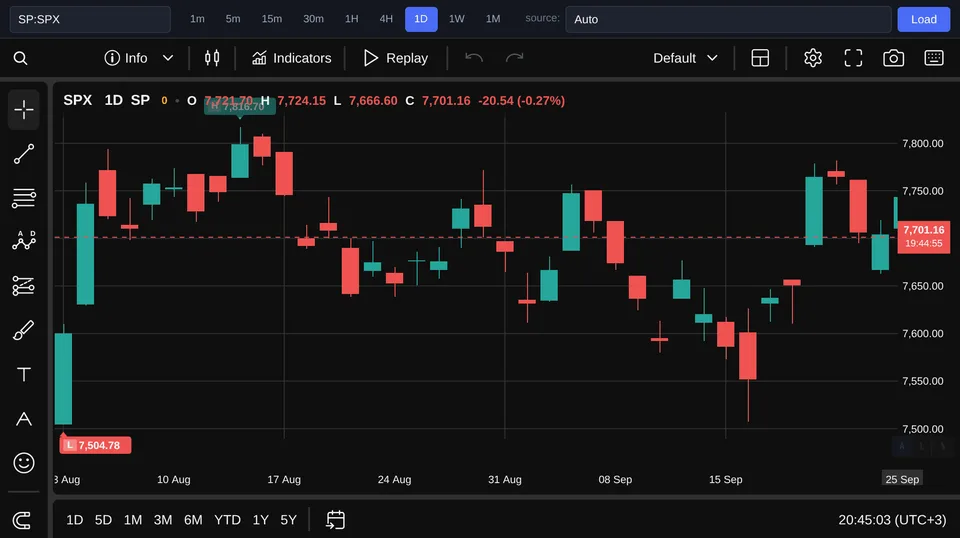
The confirmed market facts establish the anomaly. The S&P 500 stands at 7,700 USD, down 0.56% for the day, while the Nasdaq 100 is at 30,338 USD, down 0.88%. Both benchmarks are weakening, but the technology-heavy index is falling more sharply even after fresh AI enthusiasm helped the previous session. That relative underperformance matters more analytically than the direction of either index alone. If investors were simply responding to a broad geopolitical scare, defensive positioning could drag down most risk assets without such a clear valuation pattern. The greater decline in the Nasdaq 100 is consistent with pressure on companies whose prices depend heavily on distant earnings growth. It is not proof that yields are the cause, because one session cannot establish causality, but it is an observable clue. The distinction is important because AI optimism and falling technology shares are not contradictory. Investors can remain confident that AI adoption will expand while becoming less willing to assign generous present values to the profits it may eventually produce. The market is effectively asking a tougher question: not whether AI will create revenue, but whether that revenue will arrive quickly enough to compete with a nearly 5% low-risk alternative.
Explanation one: ordinary profit-taking after the AI bounce
The first explanation is the simplest. Microsoft and new AI products helped revive demand for large technology shares on Friday, and some investors may now be locking in gains before the opening. Short-term positioning often produces reversals after a strong thematic session, especially when traders have crowded into the same liquid names. Sometimes the market merely needs to digest a large meal; no elaborate macroeconomic mystery is required. Profit-taking plausibly explains the timing of the retreat, but it does not fully explain its shape. If the move were mainly a mechanical reversal of Friday’s gains, the pressure should fade once positions are adjusted, provided the underlying outlook remains unchanged. It would also be reasonable to expect the strongest prior winners to suffer most, rather than a persistent valuation-based divide across the technology segment. This explanation therefore remains possible but incomplete. It accounts for why selling might begin after an AI-led advance, yet it says little about why investors are reassessing long-duration growth precisely as yields move toward a psychologically and financially important threshold. It becomes convincing only if the decline proves brief, yields cease rising, and technology shares recover without requiring new evidence of faster AI monetization.
Explanation two: oil turns geopolitics into an inflation problem
The second explanation begins with higher oil prices and the geopolitical premium embedded in them. More expensive energy can raise transport, production, and household costs, slowing demand while keeping headline inflation uncomfortable. That combination is unfriendly to equities because it can squeeze corporate margins and reduce the central bank’s freedom to ease policy. Oil matters most here as a bridge from geopolitical risk to inflation expectations and interest rates. The weakness of this explanation is that an oil shock must persist to have a durable valuation effect. A temporary geopolitical premium may lift volatility and encourage investors to reduce risk, but it does not automatically change the long-run earnings capacity of AI companies. If oil quickly retreats, inflation expectations remain contained, and bond yields follow lower, the direct case for a lasting technology sell-off becomes much weaker.
Explanation three: a 5% discount rate challenges distant profits
The third explanation is the strongest working hypothesis.
What would confirm or overturn the hypothesis
A useful market hypothesis must produce observations that can prove it wrong. The yield-led explanation would gain support if government yields remain near or above 5%, the Nasdaq continues to lag the S&P 500, and high-multiple technology companies stay weak even when they release favorable AI news. It would become stronger still if companies with solid current cash flow outperform peers whose valuations depend on profits expected much later. The decisive test is whether technology weakness tracks the persistence of high yields rather than the daily intensity of geopolitical headlines. If oil settles down but yields remain elevated and the Nasdaq still underperforms, the discount-rate argument survives. If yields decline materially and expensive technology shares recover, the same relationship would also support it, although other variables would still need to be considered. Several outcomes would challenge the hypothesis. A rapid fall in yields combined with continued technology weakness would suggest that earnings expectations, positioning, regulation, or concern about AI capital expenditure deserves more weight. Conversely, a strong Nasdaq recovery while yields remain around 5% would imply that expected AI profits are improving fast enough to offset the higher discount rate. Finally, if all major sectors move together regardless of valuation, the episode would look more like broad risk reduction than a technology-specific repricing.
Conclusion
The best current answer is that renewed AI optimism has not failed; it is being repriced under harsher financial conditions. Profit-taking can explain part of the immediate reversal, and higher oil adds inflation and geopolitical pressure, but yields near 5% provide the clearest explanation for the Nasdaq’s greater weakness. The working conclusion is therefore conditional: AI remains a credible growth theme, yet investors now require earlier, more visible profits to justify expensive valuations. Persistent high yields and continued Nasdaq underperformance would confirm that view; falling yields without a technology recovery would require a different diagnosis.