
Swing Trading for Beginners: Strategies and Risk Management

Swing trading (Swing Trading) is a trading style in which a trader holds an open position for several days to several weeks, seeking to profit from an individual price movement within a larger trend or trading range.
Unlike scalping and intraday trading, a swing trader does not need to achieve a result within a few minutes or close all positions before the trading session ends. They look for a movement large enough to compensate for the trade's risk and trading costs, and try to hold the position until the selected portion of that movement is complete.
The name comes from the English word swing, meaning “swaying” or “oscillation.” In a market context, it describes alternating upward and downward price movements. Even when a market is in a pronounced uptrend, it usually does not rise in a straight line: the price rises, pulls back, rises again, and forms a sequence of local highs and lows. A swing trader tries to profit from one or several of these movements.
For example, BTC is trading at $100K on the Bybit exchange. After a correction to $95K, it starts to recover. The trader expects the upward movement to continue, buys bitcoin at $97K, and plans to exit around $108K. If the scenario plays out, they will profit from part of the movement without necessarily trying to buy at the absolute low and sell at the absolute high.
Trading is possible within a medium-term sideways range if its boundaries are sufficiently well defined.
The main advantage of swing trading is the ability to trade relatively large price movements without having to make decisions every minute. There are usually fewer trades than in scalping, and analysis can be carried out on a set schedule. But this approach also has limitations.
First, positions remain exposed to news, price gaps, and changes in liquidity. Second, a movement may develop more slowly than expected, leaving capital tied up for a long time. Third, infrequent trading opportunities can encourage low-quality trades. Finally, a low trading frequency does not guarantee lower risk: risk depends on position size, volatility, leverage, and the money management system.
Swing trading also requires patience when testing a strategy. A few profitable trades do not prove that a trading system has a sustainable edge. Results must be assessed over a sufficiently large series of observations, accounting for commissions, slippage, and other costs.
All liquid instruments are suitable for swing trading. Naturally, it is better to avoid instruments with low liquidity, wide spreads, unpredictable price spikes, or insufficiently transparent execution conditions, since high volatility alone does not make an instrument suitable for swing trading. It can increase potential profit, but also requires wider stops or a smaller position size.
The key selection criteria are the ability to define a trading scenario, calculate risk, and execute a trade at acceptable costs, rather than the maximum magnitude of a movement.
Main Features of Swing Trading

Swing trading is defined by the position holding period. Certain features of this type of trading follow from this.
1. A trade lasts several days or weeks.
The typical swing trading horizon ranges from one day to several weeks. Some positions are closed sooner, while others are held longer if the market scenario remains valid. There is no mandatory duration, such as five or ten days.
The duration of a trade depends on the instrument's volatility, the scale of the expected movement, and the trading system used.
2. The main analysis is conducted on higher timeframes.
Swing traders often use daily and four-hour charts as their working charts. The weekly chart helps assess the broader market context, while the hourly chart helps refine the entry point. This combination of timeframes allows the analysis to be divided into several tasks:
Weekly chart: identify the overall trend, major levels, and important price areas.
Daily chart: find a correction, breakout, reversal pattern, or range boundaries.
Four-hour or hourly chart: refine the entry, stop-loss placement, and potential reward-to-risk ratio.
The timeframes are not a rigid rule. A trader can use other intervals if they fit their system. What matters more is that the chart makes the target movement visible without excessive attention to market noise.
3. There is no need to stay at the trading terminal constantly.
An intraday trader often needs to monitor the market directly during the trading session. A swing trader can define entry and exit conditions in advance, place the necessary orders, and check the position several times a day or on a set schedule.
However, this does not mean a trade can be left completely unmonitored. Economic releases, corporate reports, changes in volatility, and other events can alter market conditions. Nevertheless, to avoid trouble, the trader places a stop-loss.
4. Positions have to be held overnight and over weekends.
A swing trader usually leaves a position open after the trading day ends. This creates additional risk.
For example, a company may publish an unexpected financial report after the exchange closes. In the next session, the stock opens significantly below its previous closing price. A stop-loss does not guarantee execution at the specified price: in the event of a price gap, the actual loss may exceed the planned amount.
In the foreign exchange market, sharp movements can occur after weekends and important macroeconomic events. In the cryptocurrency market, trading takes place around the clock, but this does not eliminate the risk of sharp price changes and deteriorating liquidity.
5. The number of trades is usually lower than in intraday trading.
A swing trader does not have to enter the market every day. They wait for situations where the potential movement justifies the risk.
This helps avoid unnecessary trades, but creates another problem: a suitable setup may not appear for a long time. If, for various reasons, a trader needs to be in a trade constantly, they risk starting to open positions without sufficient grounds.
6. Account size.
Swing trading is well suited to traders with substantial account balances who follow risk management rules. A small account grows very slowly, which often pushes traders with small balances to open trades that put a large proportion of their capital at risk.
Calculating Risk in Swing Trading
Swing trading requires the maximum acceptable loss to be defined in advance. You cannot open a position first and then decide how much money you can lose.
The calculation consists of four main stages: defining risk per trade, choosing a stop-loss level, calculating position size, and assessing total portfolio risk.
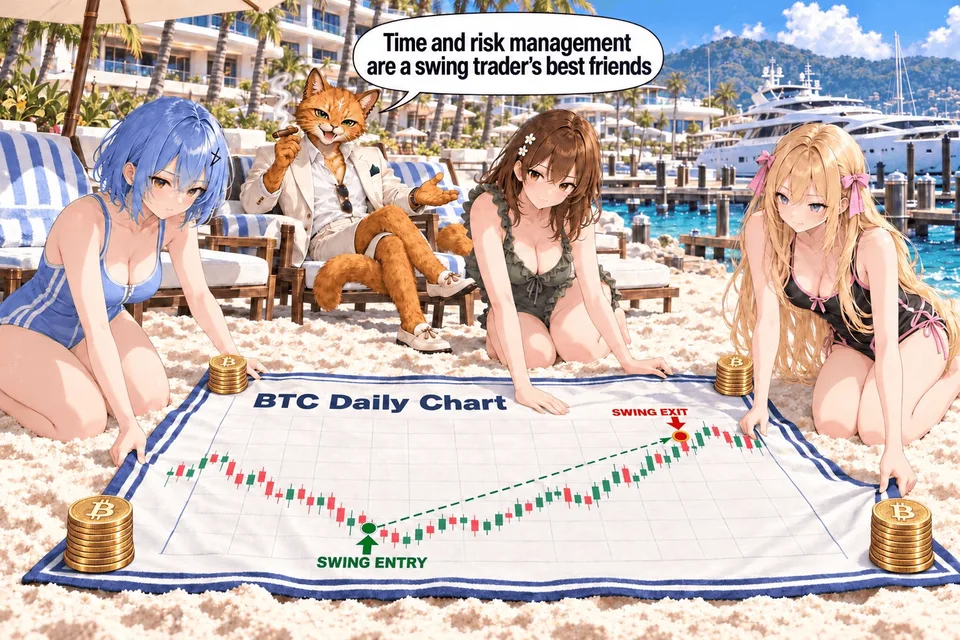
Step 1. Define the risk for one trade.
Risk per trade is the amount the trader plans to lose if the price reaches the stop-loss level and the position is closed according to plan.
The risk percentage depends on the trading system, the trader's experience, the amount of capital, and the acceptable drawdown. There is no universal figure suitable for everyone, but risking 1–2% of the account balance is a useful guide. A beginner can use a small share of capital as a learning guideline so that mistakes do not lead to a substantial reduction in the account.
It is important to understand that this refers to planned risk, rather than a guaranteed maximum loss. With price gaps, slippage, and liquidity problems, the actual loss may be higher.
Step 2. Define the level of the stop-loss.
A stop-loss should be placed where the original trading scenario is invalidated, rather than simply at an arbitrary distance from the entry point. This requires taking the instrument's volatility into account. If the price frequently fluctuates sharply, a stop placed too close may be triggered by ordinary market noise. However, increasing the distance to the stop without adjusting position size is dangerous. The farther the stop is from the entry, the smaller the position must be for the same acceptable monetary risk.
For a long position, this may be a level below a local low, a support boundary, or an area that should hold under the expected scenario. For a short position, the stop is usually placed above a local high or resistance whose breakout would contradict the trading idea.
Step 3. Calculate the position size.
Consider a simple stock trading example. The account holds $10K. The trader accepts a planned loss of $100, or 1% of capital. They are considering buying a stock at $100 and setting a stop-loss at $95. Thus, the risk per share is $100 − $95 = $5, and the position size is $100 ÷ $5 = 20 shares.
The purchase will cost $2K. If the price reaches the stop level and execution occurs at $95, the planned loss will be $100, excluding commissions and slippage. If the trader instead wants to place the stop at $90, the risk per share rises to $10. With the same acceptable loss of $100, the position size must be reduced to 10 shares.
The general principle is: position size = acceptable monetary risk ÷ risk per unit of the instrument.
For currency pairs, futures, CFDs, and other instruments, the calculation may account for pip value, contract size, account currency, and other characteristics. In such cases, it is important to use the correct instrument specifications and a pip value calculator or position size calculator.
It is also necessary to recognize that position value, required margin, and trade risk are different quantities. A small margin requirement does not mean the potential loss will be small.
Step 4. Assess potential profit relative to risk.
After calculating the stop-loss, you need to determine whether the intended target justifies the trade's risk.
Suppose a stock position is entered at $100, the stop-loss is set at $95, and the target price is $110. The risk per share is $5, and the potential profit is $10. The potential reward-to-risk ratio is 2:1. With a position of 20 shares, the planned loss is $100, and the potential profit is $200 before costs.
This does not mean the trade is automatically favorable. If the strategy frequently produces losses, even a 2:1 ratio may not deliver a positive result. You need to account for the probability of reaching the target, the frequency of stops being triggered, commissions, slippage, and other expenses.
It is important to assess not an individual trade in isolation, but the trading system's statistics over a series of trades.
Step 5. Account for total exposure.
One common mistake is to treat each position as a separate trade and overlook the fact that they all depend on the same market factor.
For example, a trader buys several technology stocks simultaneously. Technically, these are different instruments, but if the technology sector declines broadly, they may all fall at the same time. If each position has a planned risk of 1% of the account, three positions create a total risk of around 3% if all stops are triggered—and potentially more when slippage and price gaps are taken into account.
Therefore, you need to limit both the risk of an individual trade and the total exposure of the capital committed to trading. Particular care is needed when trading correlated instruments and leveraged positions.
Holding Period for a Swing Trade
A swing trader holds a position not because a certain number of days have passed, but for as long as the rationale for the trade remains valid.
Three exit criteria are usually used.
1. The target price has been reached.
The price has reached a predefined area where the expected movement may end or where the ratio of further profit to risk becomes less attractive. The trader closes the position fully or partially according to their system.
2. The trading scenario is no longer valid.
The price has reached the stop-loss or formed a signal that contradicts the original idea. In this case, the position is exited regardless of how long it has been in the market.
3. The trade has dragged on or market conditions have changed.
The price has not moved in the expected direction for a long time, volatility is declining, an important event is approaching, or a more significant risk factor has emerged. The trading system may provide for a time-based exit or a reassessment of the position.
For example, a trader opened a buy position expecting the price to recover within several days. A week later, the price remains in a narrow range, and the original momentum is absent. If the system expects the movement to occur within a limited period, there is no need to hold the position indefinitely just to wait for it to become profitable.
At the same time, a trade should not be closed merely because it has moved into a temporary loss. Conversely, it should not be held solely because of an unwillingness to realize a loss. The decision must follow predefined rules.
Should You Move the Stop-Loss as the Price Moves?
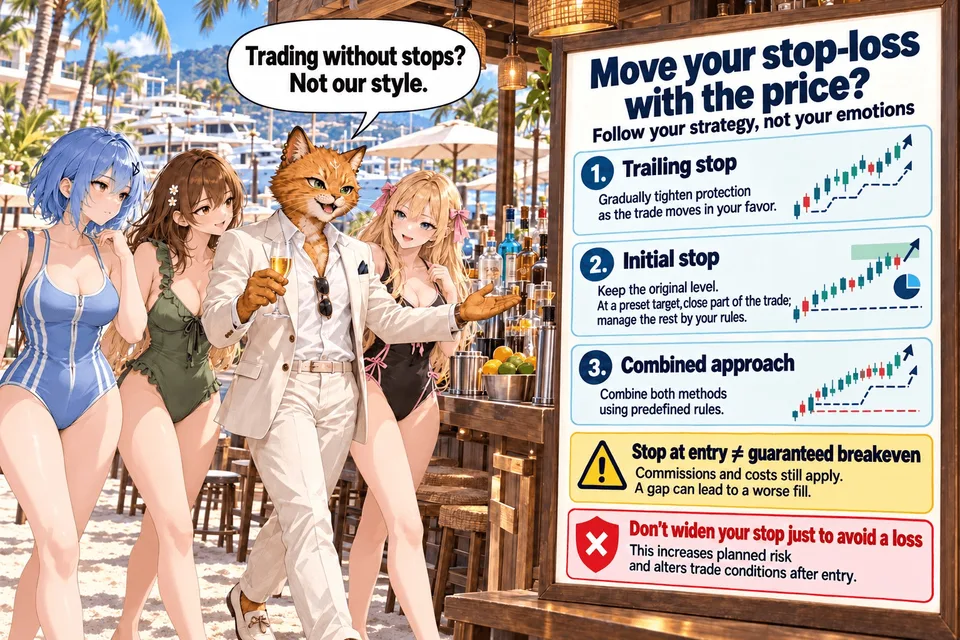
Some swing traders use a trailing stop, gradually moving the protective level as a profitable movement develops. Others keep the original stop fixed and, once a certain level is reached, partially close the position or adjust the remainder according to the strategy's rules. Still others combine both approaches.
In any case, moving the stop-loss to the entry price does not guarantee breaking even: commissions and other expenses may remain, and a price gap may lead to execution at a less favorable price.
The main rule is not to widen the stop solely to avoid realizing a loss. Such a decision increases the originally planned risk and changes the terms of the trade after entry.
Psychological Profile of a Swing Trader
Swing trading may suit those who want to participate in the market regularly but are not prepared to watch a chart throughout the trading day. The determining factor is less about temperament than the ability to follow rules and tolerate uncertainty over several days.
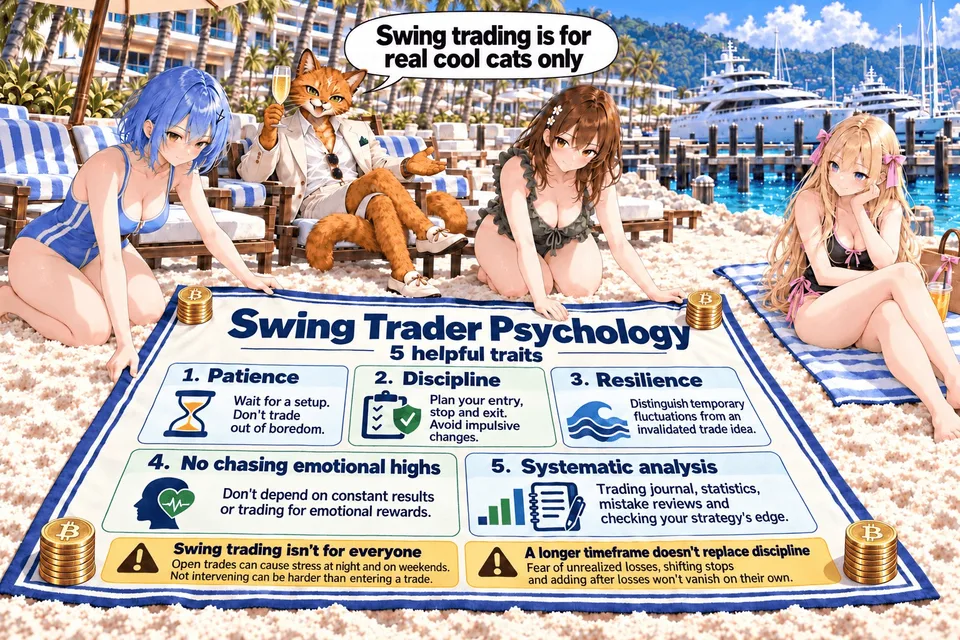
The following qualities are useful for a swing trader:
Patience. The ability to wait for a suitable setup rather than open a trade out of boredom or a desire to be in the market constantly.
Discipline. The willingness to define the entry, stop-loss, and exit conditions in advance and then avoid changing them impulsively.
The ability to withstand temporary fluctuations. The price may move against a position for some time without invalidating the original scenario. It is important to distinguish ordinary movement from the actual invalidation of the trading idea.
A moderate need for constant feedback. If a trader needs to see results continuously and place trades for emotional reinforcement, the swing trading format may also prove challenging.
A willingness to conduct systematic analysis. You need to keep a trading journal, assess statistics, review mistakes, and check whether the chosen strategy really has an edge.
Swing trading does not necessarily suit everyone who cannot sit at a trading terminal all day. Positions can cause anxiety at night or over weekends, and deciding not to interfere with a trade can sometimes be harder than opening it.
If a trader cannot tolerate unrealized losses, constantly moves stops, increases positions after losses, or cannot follow predefined rules, extending the trading horizon will not solve the problem by itself.
Conclusion
Swing trading is a trading style focused on individual market movements lasting from several days to several weeks. It allows decisions to be made less frequently than in intraday trading, but requires patience, systematic analysis, and a willingness to hold positions under uncertainty.
For a beginner, the main task is to learn not so much how to find entry points as how to combine the trading scenario, stop-loss, position size, and exit rules into a single system. Potential profit is assessed before entry, risk is controlled at the level of each trade and the entire portfolio, and the decision to hold a position is made according to predefined conditions.
Swing trading does not guarantee profit and is not automatically less risky than short-term trading. Its practical value lies in the fact that, when properly organized, it allows traders to work with the market at a calmer pace and assess trading decisions based on rules rather than constantly reacting to every price change.
Disclaimer. This material is solely educational and informational and does not constitute personalized investment advice or a call to place trades. Trading financial instruments involves the risk of losing capital. Using leverage can increase losses, and actual execution of stop orders may differ from the specified price. Before using real capital, you need to study the instrument's characteristics, the broker's terms, trading costs, and your own ability to tolerate financial losses.