
Can 30% Earnings Growth Justify the S&P 500 Above 7,800?

Intro
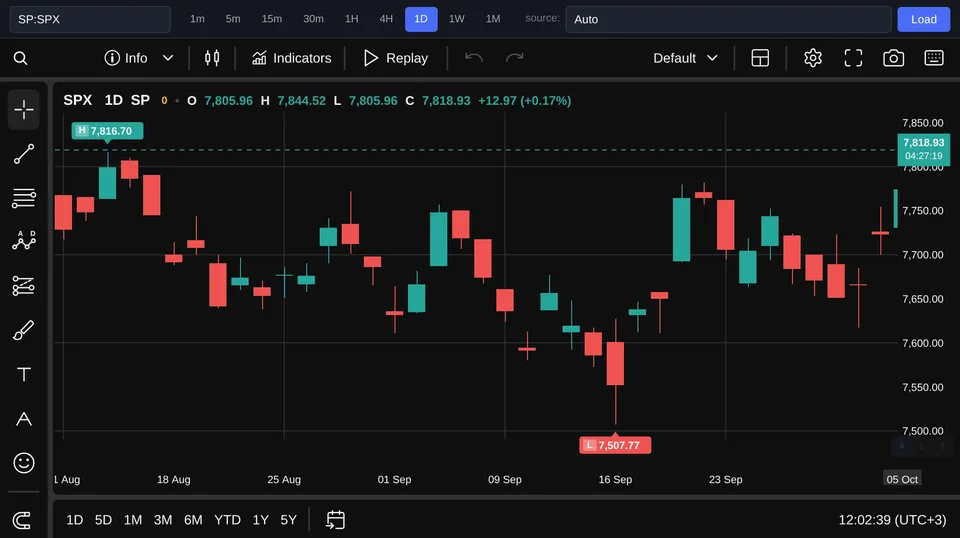
The S&P 500 has entered its third-quarter reporting season carrying unusually heavy expectations. On October 6, the index closed above 7,800 for the first time, while the Nasdaq Composite also reached a record. The immediate question is therefore not whether investors feel optimistic—they plainly do—but whether corporate results can justify the price already paid for that optimism. The confirmed numbers set a demanding benchmark. At the time of writing, the S&P 500 (SP:SPX) stands at 7,819 USD, up exactly 0.58% for the day. According to LSEG estimates cited by Reuters, analysts expect third-quarter earnings for S&P 500 companies to grow by more than 30% year over year. The market is not merely anticipating a decent reporting season; it is pricing in a dramatic acceleration in profits.
What the record tells us—and what it does not
Several facts behind the rally are clear. Falling bond yields have supported equities by reducing the relative appeal of fixed-income assets and increasing the present value assigned to future corporate cash flows. Demand for companies associated with artificial intelligence has provided another source of momentum, helping the technology-heavy Nasdaq Composite reach a new high alongside the S&P 500 milestone. Yet a record index level is evidence of investor expectations, not proof that those expectations are correct. The move to 7,819 USD and the daily gain of 0.58% show that buyers remain willing to add exposure at elevated prices. They do not reveal whether the advance reflects better operating performance, more generous valuation multiples, or a concentrated rush into a small set of fashionable businesses. Price confirms confidence; earnings must still confirm the underlying business case. That distinction matters because expected profit growth above 30% leaves little room for merely respectable results. Companies can report substantial gains and still disappoint if investors have already assumed something stronger. The index has effectively arrived at the restaurant before the kitchen has served the meal, and the bill reflects a generous estimate of what is coming.
Three competing explanations for the rally
The first explanation is fundamentally optimistic: investors may be correctly anticipating a broad and powerful earnings recovery. If revenue growth is improving, margins are expanding, and previous investments are beginning to generate returns, then a higher index level can be supported by a larger earnings base. Under this interpretation, the rally is an early recognition of real operating momentum rather than an exercise in wishful valuation. The second explanation gives bond yields the leading role. Lower yields mechanically make distant cash flows more valuable in standard valuation models, particularly for growth companies whose expected profits lie further in the future. In that case, shares can rise even before analysts increase their forecasts or companies demonstrate stronger demand. A rally driven mainly by discount rates can look fundamental on the screen while remaining dependent on the bond market. The third explanation is concentration. AI-related leaders may be producing exceptional growth and carrying the capitalization-weighted index upward, while the typical constituent experiences a much less spectacular quarter. Aggregate earnings growth above 30% would still be mathematically valid, but it could offer a misleading picture of the corporate sector as a whole. This version is especially important because a narrow rally is more vulnerable to guidance disappointments from a few very large companies.
The strongest working hypothesis: breadth is the real test
The most persuasive working hypothesis combines elements of all three explanations. Lower yields have probably helped valuations, and AI demand has probably strengthened the earnings outlook for particular businesses. Neither factor is inherently artificial. The problem arises only if investors treat concentrated gains and favorable discount rates as evidence that profit acceleration is widespread. For the record to gain durable fundamental support, the reporting season must deliver more than the headline figure. A large share of companies should beat expectations, positive results should appear across multiple sectors, and management teams should maintain or raise their outlooks. Revenue, margins, and capital expenditure plans matter because current profit can be improved temporarily through cost control, whereas healthy sales and credible investment returns say more about future earning power. Our editorial judgment is that growth above 30% can justify an index above 7,800 only if it is broad, repeatable, and supported by forward guidance. This is a probabilistic conclusion, not a confirmed fact. If most of the increase comes from a handful of AI heavyweights, the aggregate number may satisfy the headline without validating the market’s wider optimism. There is also an important sequencing issue. If earnings estimates rise after reports and share prices hold their gains, the market will have converted anticipation into evidence. If prices require another decline in yields despite strong reported profits, investors may be paying more for each unit of earnings rather than responding to a genuinely improved outlook.
Observable signals that will confirm or reject the case
The hypothesis can be tested with concrete observations. Confirmation would begin with widespread earnings beats rather than one or two outsized contributions. It would strengthen if analysts revise future-quarter estimates upward, if non-AI sectors participate in the advance, and if management teams raise revenue or margin guidance. Stable capital spending plans would also indicate that executives see enough demand to keep investing rather than merely defending current profitability. Market behavior after the announcements provides another test.
Conclusion
The short answer is conditional. Earnings growth above 30% can justify the S&P 500 above 7,800, but the percentage alone cannot do so. The current level of 7,819 USD and the 0.58% daily advance demonstrate strong buyer confidence; they do not establish that the record is fundamentally secure. The decisive evidence will be the breadth and durability of profit growth. If earnings strength extends beyond the largest AI beneficiaries, analysts raise future estimates, and management guidance remains constructive, the rally will have a credible operating foundation. If growth is concentrated, guidance weakens, or further gains depend mainly on falling yields, the market will have priced an exceptional scenario more quickly than companies can deliver it.