
Condor in Options: Strategy Types and Calculation Examples

An options condor (Condor Spread) is a combination of four options that allows a position to be structured for a particular price movement scenario. Depending on the structure, a trader can profit from the price staying within a range or moving beyond that range.
Condors are used when forecasting market direction alone is insufficient. It is also important to assess the magnitude of the move by expiration. For example, a trader may expect a stock to remain between $95 and $105 or, conversely, anticipate a sharp rise or fall.
There are several varieties of condor: traditional structures using calls or puts, as well as the iron condor, which combines both option types. They have different profit and loss profiles, so when choosing a strategy, it is necessary to consider not only its name but also which options are bought and sold.
Options condors are classified as follows.
Strategy | Which options are used | Cash flow at entry | Where maximum profit is achieved |
|---|---|---|---|
Long call condor | Four calls | Debit — payment for the position | Between the two inner strikes |
Long put condor | Four puts | Debit — payment for the position | Between the two inner strikes |
Short call condor | Four calls | Credit — premium received | Beyond the outer strikes |
Short put condor | Four puts | Credit — premium received | Beyond the outer strikes |
Short iron condor | Two puts and two calls | Usually a credit | Between the strikes of the sold options |
Long iron condor | Two puts and two calls | Usually a debit | Beyond the outer strikes |
In a traditional condor, all four options are of the same type. An iron condor uses both calls and puts.
However, the words “long” and “short” should not be interpreted as a universal indication of market direction. This is especially true of the iron condor: terminology varies in professional literature. It is therefore more reliable to specify the position's composition, net debit or credit, and maximum profit region.
All profit and loss calculations use the same principle:
Final profit/loss = options payoff at expiration + net cash flow at entry − additional expenses.
The options payoff at expiration includes payments from purchased contracts and obligations on sold contracts. Net cash flow at entry is all premiums received minus those paid.
Therefore, the options payoff does not equal the final profit. For example, if a trader received $4 per share at entry and the options payoff at expiration was −$10, the final loss is $6 per share.
All prices and premiums in this article are hypothetical, rather than actual market quotes. Calculations are presented per one share or unit of the underlying asset, excluding commissions, taxes, and slippage. All options are assumed to have the same expiration, with equal distances between adjacent strikes.
Long condors
Long condor using calls — Long Call Condor
A long call condor is used when a trader expects the price to remain within a particular range by expiration. The trader buys a call at the lowest strike, sells a call at the second strike, sells another one at the third, and buys a call at the highest strike.
The strategy is usually opened for a debit. Maximum profit is achieved between the two inner strikes, while the maximum loss equals the initial cost.
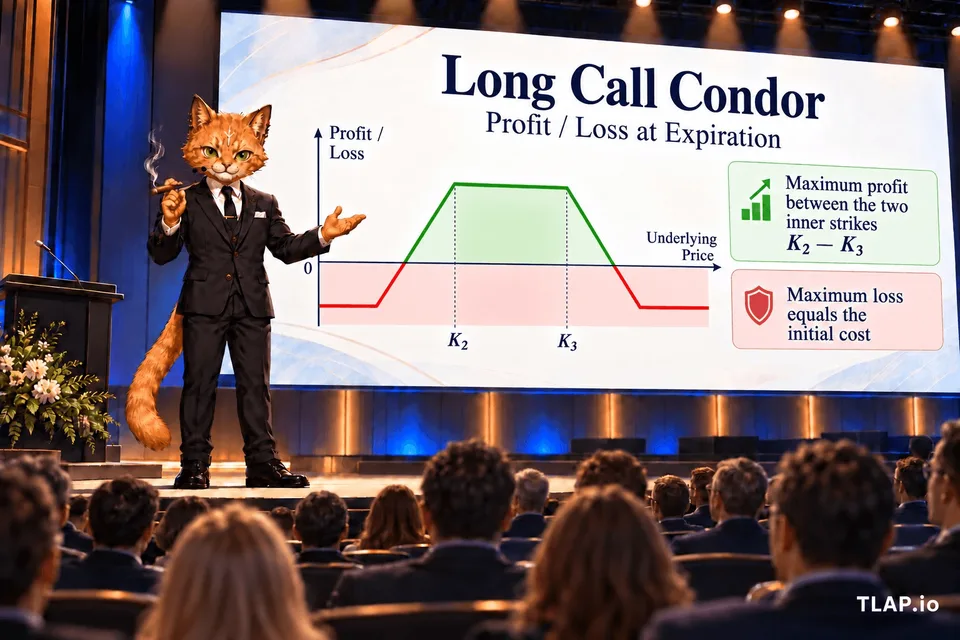
Suppose a stock is trading at $100. The trader expects its price to remain around $95–$105 in a month.
Option | Strike | Premium per share | Action | Cash flow |
|---|---|---|---|---|
Call | $85 | $17.00 | Buy 1 | −$17.00 |
Call | $95 | $10.00 | Sell 1 | +$10.00 |
Call | $105 | $5.00 | Sell 1 | +$5.00 |
Call | $115 | $2.00 | Buy 1 | −$2.00 |
Total | −$4.00 |
The initial cost is $4 per share.
The outcome at expiration is as follows.
Stock price | Options payoff | Cash flow at entry | Final profit/loss |
|---|---|---|---|
$80 | $0 | −$4.00 | −$4.00 |
$89 | +$4.00 | −$4.00 | $0 |
$90 | +$5.00 | −$4.00 | +$1.00 |
$95 | +$10.00 | −$4.00 | +$6.00 |
$100 | +$10.00 | −$4.00 | +$6.00 |
$105 | +$10.00 | −$4.00 | +$6.00 |
$110 | +$5.00 | −$4.00 | +$1.00 |
$111 | +$4.00 | −$4.00 | $0 |
$115 | $0 | −$4.00 | −$4.00 |
$120 | $0 | −$4.00 | −$4.00 |
Between the $95 and $105 strikes, the options payoff reaches $10 per share. After deducting the cost, the maximum profit is $6 per share.
Key parameters:
Maximum profit: $10 − $4 = $6 per share.
Maximum loss: $4 per share.
Lower breakeven point: $85 + $4 = $89.
Upper breakeven point: $115 − $4 = $111.
Beyond the outer strikes of $85 and $115, the options payoffs offset each other, so the final loss equals the initial debit of $4.
Long condor using puts — Long Put Condor
A long put condor is designed for the same scenario: the price should remain around a specified range by expiration. The difference lies in the option type and the order of the strikes.
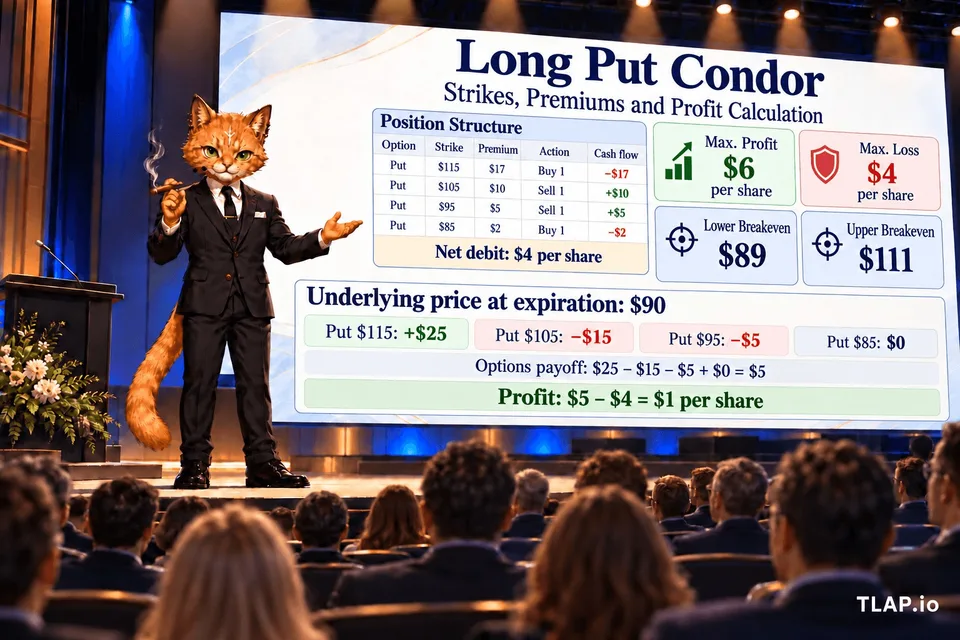
The trader buys a put at the highest strike, sells two puts at the inner strikes, and buys a put at the lowest strike.
The stock is trading at $100. The trader expects the price to remain around $95–$105.
Option | Strike | Premium per share | Action | Cash flow |
|---|---|---|---|---|
Put | $115 | $17.00 | Buy 1 | −$17.00 |
Put | $105 | $10.00 | Sell 1 | +$10.00 |
Put | $95 | $5.00 | Sell 1 | +$5.00 |
Put | $85 | $2.00 | Buy 1 | −$2.00 |
Total | −$4.00 |
The net cost at entry is $4 per share.
The payoff check is as follows.
Stock price | Purchased $115 put | Sold $105 put | Sold $95 put | Purchased $85 put | Options payoff | Final profit/loss |
|---|---|---|---|---|---|---|
$80 | +$35 | −$25 | −$15 | +$5 | $0 | −$4 |
$85 | +$30 | −$20 | −$10 | $0 | $0 | −$4 |
$89 | +$26 | −$16 | −$6 | $0 | +$4 | $0 |
$90 | +$25 | −$15 | −$5 | $0 | +$5 | +$1 |
$95 | +$20 | −$10 | $0 | $0 | +$10 | +$6 |
$100 | +$15 | −$5 | $0 | $0 | +$10 | +$6 |
$105 | +$10 | $0 | $0 | $0 | +$10 | +$6 |
$110 | +$5 | $0 | $0 | $0 | +$5 | +$1 |
$111 | +$4 | $0 | $0 | $0 | +$4 | $0 |
$115 | $0 | $0 | $0 | $0 | $0 | −$4 |
$120 | $0 | $0 | $0 | $0 | $0 | −$4 |
All values are per one share, excluding commissions. For example, at a price of $90, the purchased $115 put provides $25 in intrinsic value. The sold $105 and $95 puts create obligations of $15 and $5. The combined options payoff is $5, and after deducting the $4 debit, the profit is $1.
Key parameters:
Maximum profit: $6 per share.
Maximum loss: $4 per share.
Lower breakeven point: $89.
Upper breakeven point: $111.
With consistent premiums and identical strikes, long call and put condors have the same payoff profile at expiration. In practice, their actual premiums may differ.
Short condors
Short condor using calls — Short Call Condor
A short call condor is the reverse of a long call condor. The trader sells calls at the outer strikes and buys two calls at the inner strikes.
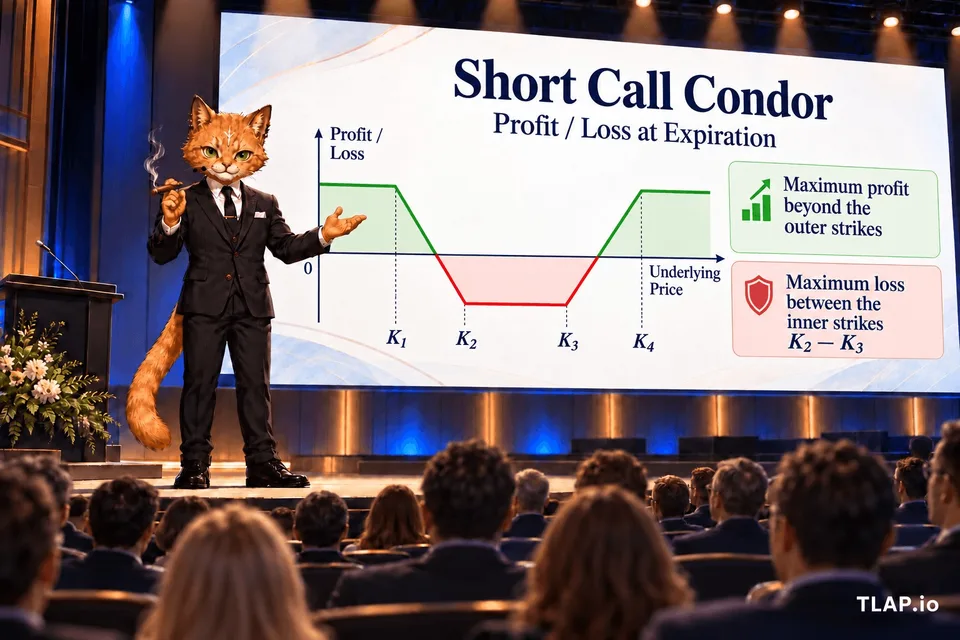
This structure is usually opened for a credit and is intended for trading a strong price move. Maximum profit occurs beyond the outer strikes, while the maximum loss occurs between the inner strikes.
We use the same strikes and premiums as for the long condor.
Option | Strike | Action | Cash flow |
|---|---|---|---|
Call | $85 | Sell 1 | +$17.00 |
Call | $95 | Buy 1 | −$10.00 |
Call | $105 | Buy 1 | −$5.00 |
Call | $115 | Sell 1 | +$2.00 |
Total | +$4.00 |
At entry, the trader receives a credit of $4 per share.
Stock price | Options payoff | Credit at entry | Final profit/loss |
|---|---|---|---|
$80 | $0 | +$4.00 | +$4.00 |
$85 | $0 | +$4.00 | +$4.00 |
$89 | −$4.00 | +$4.00 | $0 |
$90 | −$5.00 | +$4.00 | −$1.00 |
$95 | −$10.00 | +$4.00 | −$6.00 |
$100 | −$10.00 | +$4.00 | −$6.00 |
$105 | −$10.00 | +$4.00 | −$6.00 |
$110 | −$5.00 | +$4.00 | −$1.00 |
$111 | −$4.00 | +$4.00 | $0 |
$115 | $0 | +$4.00 | +$4.00 |
$120 | $0 | +$4.00 | +$4.00 |
The maximum profit is $4 per share. It is achieved at a price no higher than $85 or no lower than $115. The maximum loss is $6 per share and occurs between $95 and $105.
The breakeven points are $89 and $111.
Thus, the profile of a short traditional condor is the opposite of a long condor: maximum profit lies beyond the outer strikes, while the maximum loss is in the central region.
Short condor using puts — Short Put Condor
A short put condor is the reverse of a long put condor. The trader sells puts at the outer strikes and buys two puts at the inner strikes.
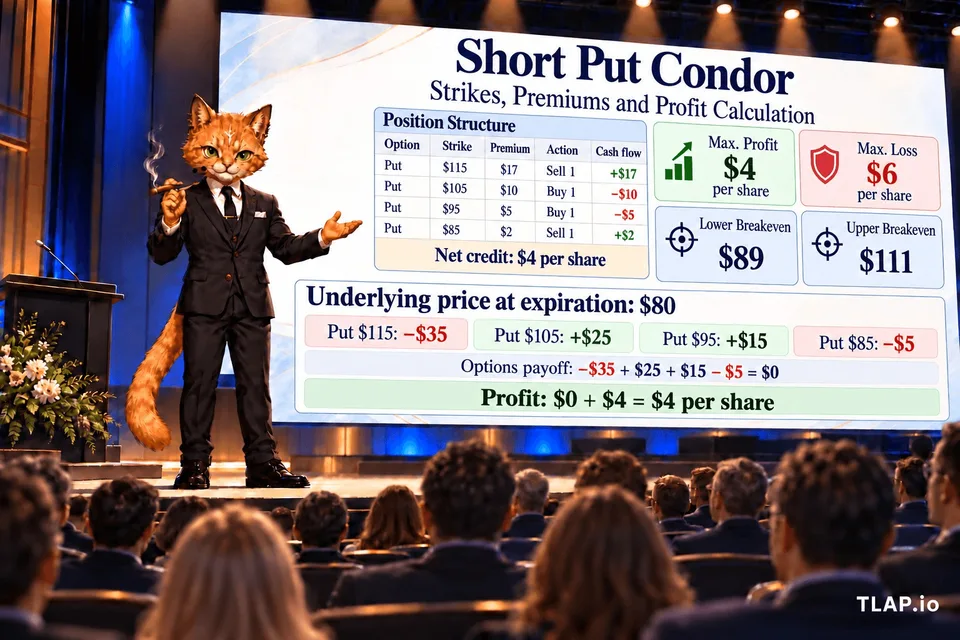
The strategy is designed for the price to move beyond the outer strikes.
Option | Strike | Action | Cash flow |
|---|---|---|---|
Put | $115 | Sell 1 | +$17.00 |
Put | $105 | Buy 1 | −$10.00 |
Put | $95 | Buy 1 | −$5.00 |
Put | $85 | Sell 1 | +$2.00 |
Total | +$4.00 |
The net credit at entry is $4 per share.
Stock price | Options payoff | Credit at entry | Final profit/loss |
|---|---|---|---|
$80 | $0 | +$4.00 | +$4.00 |
$85 | $0 | +$4.00 | +$4.00 |
$89 | −$4.00 | +$4.00 | $0 |
$90 | −$5.00 | +$4.00 | −$1.00 |
$95 | −$10.00 | +$4.00 | −$6.00 |
$100 | −$10.00 | +$4.00 | −$6.00 |
$105 | −$10.00 | +$4.00 | −$6.00 |
$110 | −$5.00 | +$4.00 | −$1.00 |
$111 | −$4.00 | +$4.00 | $0 |
$115 | $0 | +$4.00 | +$4.00 |
$120 | $0 | +$4.00 | +$4.00 |
For example, if the stock falls to $80, the sold $115 put creates an obligation of $35 per share, the purchased $105 and $95 puts provide $25 and $15, and the sold $85 put creates an obligation of $5. The combined options payoff is zero. After accounting for the credit, the final profit is $4 per share.
Key parameters:
Maximum profit: $4 per share.
Maximum loss: $6 per share.
Lower breakeven point: $89.
Upper breakeven point: $111.
Iron condors
Short iron condor — Short Iron Condor
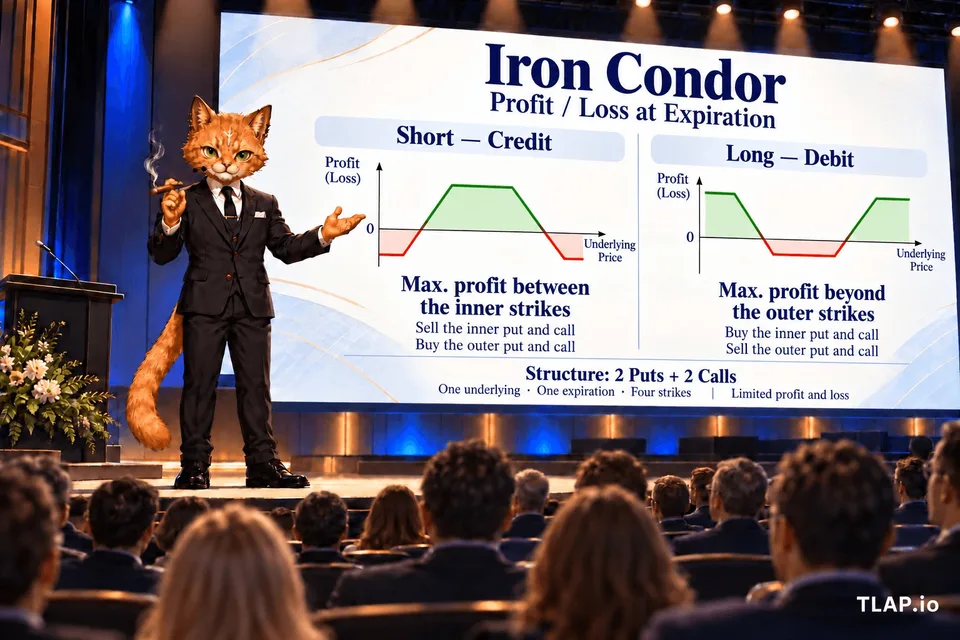
An iron condor differs from a traditional condor in that it combines calls and puts. In the standard short structure, the trader sells a put with a higher strike and a call with a lower strike, then buys a protective put below and a protective call above.
A short iron condor is designed for the price to remain between the strikes of the sold options. The strategy is usually opened for a credit. Maximum profit is achieved inside the central range, while the protective options limit losses during a strong move.
In this article, we will use the term “short iron condor” for a credit structure that profits in a sideways market. This is common usage, reflected in materials from Schwab and OIC. When comparing sources, remember that the names of long and short iron condors are not fully standardized.
Suppose Bitcoin is trading on the Bybit exchange at around $100K. The trader expects the price to remain within the $90K–$110K range by expiration.
We use hypothetical premiums for BTC options settled in USDT. These are not current Bybit quotes. For clarity, a size of 1 BTC is assumed for each leg.
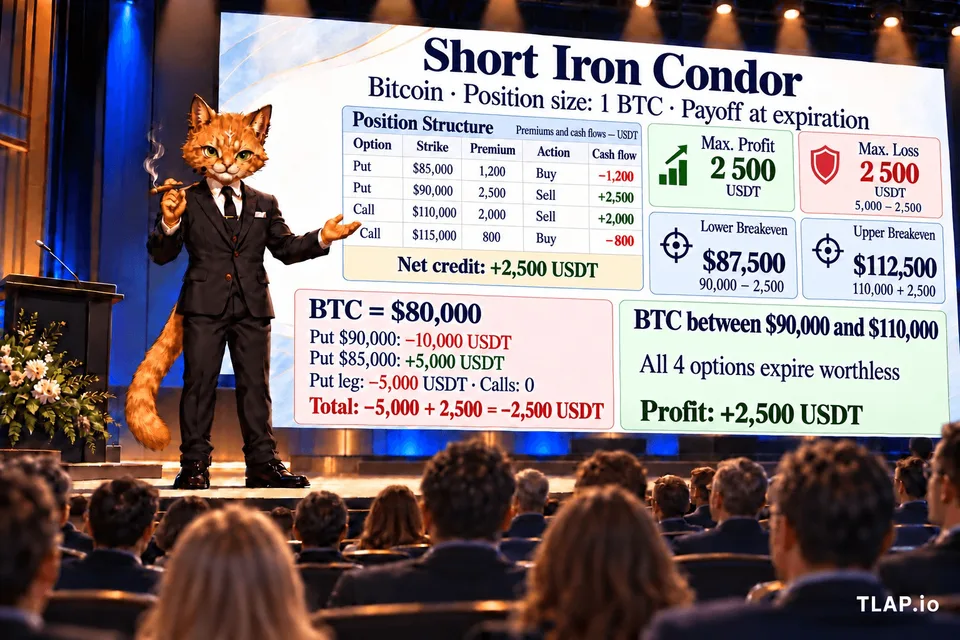
Option | Strike | Premium per 1 BTC | Action | Cash flow |
|---|---|---|---|---|
Put | $85K | $1.2K | Buy | −$1.2K |
Put | $90K | $2.5K | Sell | +$2.5K |
Call | $110K | $2K | Sell | +$2K |
Call | $115K | $800 | Buy | −$800 |
Total | +$2.5K |
The net credit at entry is 2,500 USDT.
Outcome at expiration
BTC price at expiration | Options payoff | Credit at entry | Final profit/loss |
|---|---|---|---|
$80K | −$5K | +$2.5K | −$2.5K |
$85K | −$5K | +$2.5K | −$2.5K |
$87.5K | −$2.5K | +$2.5K | $0 |
$90K | $0 | +$2.5K | +$2.5K |
$100K | $0 | +$2.5K | +$2.5K |
$110K | $0 | +$2.5K | +$2.5K |
$112.5K | −$2.5K | +$2.5K | $0 |
$115K | −$5K | +$2.5K | −$2.5K |
$120K | −$5K | +$2.5K | −$2.5K |
All amounts are in USDT for a hypothetical size of 1 BTC per leg and exclude commissions.
If Bitcoin falls to $80K, the sold $90K put creates an obligation of 10,000 USDT, while the purchased $85K put provides 5,000 USDT in intrinsic value. The net outcome for the put portion is −5,000 USDT. After adding the credit of 2,500 USDT, the loss is 2,500 USDT.
If the price remains between $90K and $110K, all options expire without intrinsic value, and the trader keeps the premium of 2,500 USDT.
Key parameters:
Maximum profit: 2,500 USDT.
Maximum loss: $5K − $2.5K = 2,500 USDT.
Lower breakeven point: $90K − $2.5K = $87.5K.
Upper breakeven point: $110K + $2.5K = $112.5K.
On Bybit, the contract specifications, settlement price determination rules, commissions, and collateral requirements must be considered separately. The calculated loss at expiration does not eliminate the risk of liquidation before expiration if margin is insufficient.
Long iron condor — Long Iron Condor
A long iron condor, also called a reverse iron condor, is the opposite structure to a short iron condor. It is usually opened for a debit and is designed for a strong price move up or down.
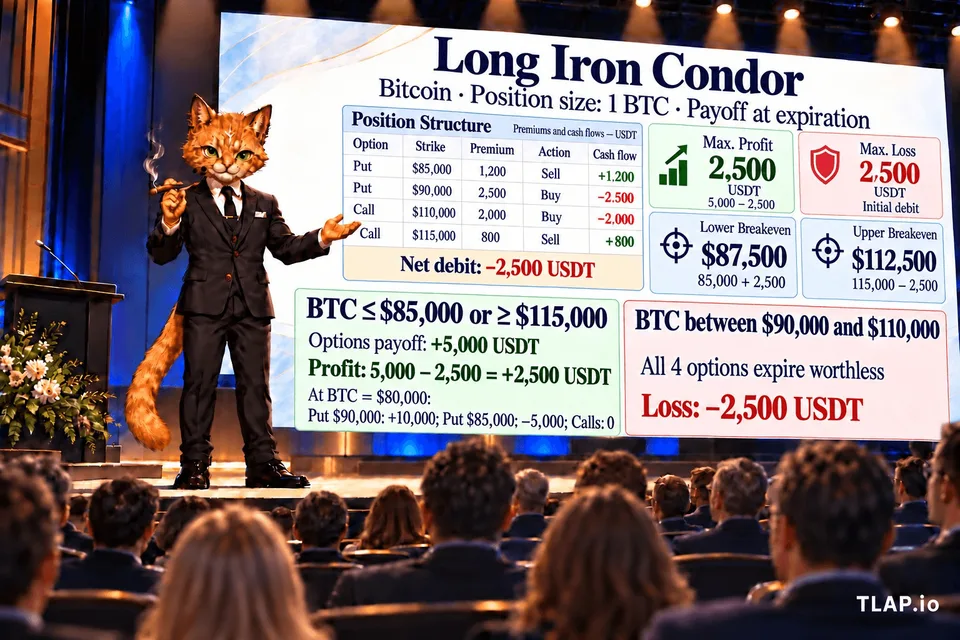
The trader sells the far put, buys a put at a higher strike, buys a call at the lower of the upper strikes, and sells the far call. As a result, maximum profit is achieved beyond the outer strikes, while the maximum loss occurs between the inner, purchased options.
We use the same hypothetical strikes and premiums as in the short iron condor example. Reversing the position changes the sign of all four cash flows, so the debit at entry is 2,500 USDT.
BTC price at expiration | Options payoff | Cost at entry | Final profit/loss |
|---|---|---|---|
$80K | +$5K | −$2.5K | +$2.5K |
$85K | +$5K | −$2.5K | +$2.5K |
$87.5K | +$2.5K | −$2.5K | $0 |
$90K | $0 | −$2.5K | −$2.5K |
$100K | $0 | −$2.5K | −$2.5K |
$110K | $0 | −$2.5K | −$2.5K |
$112.5K | +$2.5K | −$2.5K | $0 |
$115K | +$5K | −$2.5K | +$2.5K |
$120K | +$5K | −$2.5K | +$2.5K |
The maximum loss equals the initial debit of 2,500 USDT and occurs between the purchased options' strikes of $90K and $110K. The maximum profit is 2,500 USDT and is achieved beyond the outer strikes of $85K and $115K.
The breakeven points are $87.5K and $112.5K.
Thus, long and short iron condors have opposite profiles: the former requires payment at entry and is designed for a strong move; the latter generates a credit and is designed for the price to remain within a range.
Differences between traditional and iron condors
Characteristic | Long traditional condor | Short traditional condor | Short iron condor | Long iron condor |
|---|---|---|---|---|
Composition | Four calls or four puts | Four calls or four puts | Two puts and two calls | Two puts and two calls |
Cash flow at entry | Debit | Credit | Credit | Debit |
Main scenario | Price within a range | Strong move beyond the outer strikes | Price within a range | Strong move beyond the outer strikes |
Maximum profit region | Between the inner strikes | Beyond the outer strikes | Between the sold strikes | Beyond the outer strikes |
Where maximum loss occurs | Beyond the outer strikes | Between the inner strikes | Beyond the outer protective strikes | Between the inner strikes |
Maximum loss | Debit paid | Wing width minus credit | Wing width minus credit | Debit paid |
Most importantly: a long traditional condor and a short iron condor are usually intended for a calm market, but have different compositions and cash flows. A short traditional condor and a long iron condor are intended for the price to move beyond a range.
This is the key difference. The market scenario cannot be inferred from the word “long” or “short” alone without checking the position's composition.
How to choose a strategy
Market expectation | Suitable strategy | Main idea |
|---|---|---|
The price will remain within a particular range; a structure using one option type is needed | Long call or put condor | Maximum profit between the inner strikes |
A strong move is expected; a structure using one option type is needed | Short call or put condor | Maximum profit beyond the outer strikes |
The price will remain within a range; the trader wants to combine calls and puts | Short iron condor | Receiving premium with limited risk |
A strong move up or down is expected, with limited risk | Long iron condor | Paying for a position for potential profit beyond the range |
The choice depends on more than the expected move. Option prices, distances between strikes, liquidity, time to expiration, implied volatility, and trading costs must also be considered.
Conclusion
The condor is a family of options strategies that can be used to tailor a profit and loss profile to a specific price scenario.
Long call and put condors usually profit if the price remains between the inner strikes at expiration. Short traditional condors, conversely, generate maximum profit when the price moves beyond the outer strikes.
An iron condor combines calls and puts. The short credit structure profits in a relatively calm market, while the long debit structure is designed for a strong move. Because names vary, it is best to always specify a strategy's composition, cash flow, and profit profile when describing it.
Before opening a position, it is necessary to calculate the initial cash flow, outcome at expiration, breakeven points, and maximum profit and loss. When trading cryptocurrency options, the contract specifications, settlement rules, and collateral requirements should also be checked.
This material is educational and does not constitute a personalized investment recommendation. Options trading involves the risk of losing capital. Even strategies with a limited maximum loss can result in the loss of the entire premium initially paid.