
Ethereum’s ETF Outflows and the $5 Billion Short-Squeeze Question

Intro
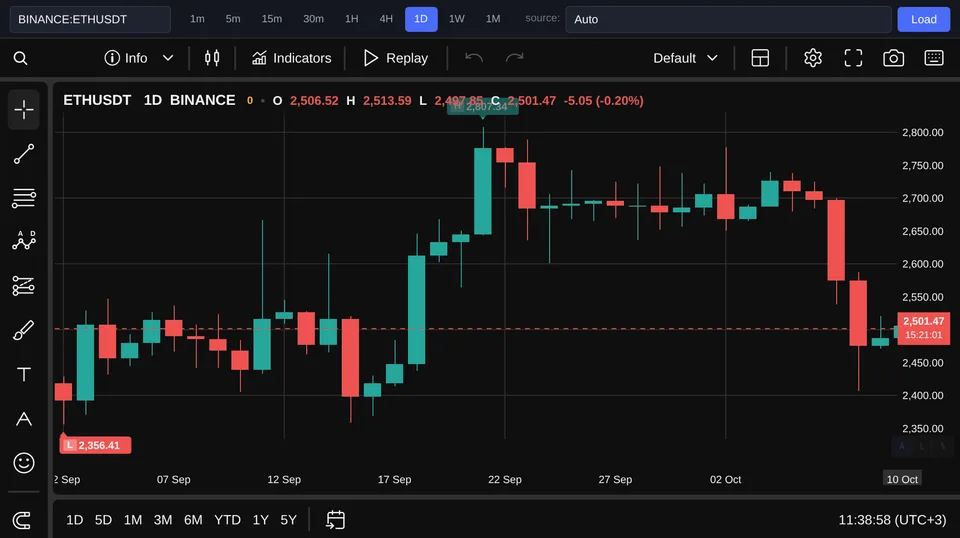
Ethereum is caught between two market forces that appear to point in opposite directions. On one side, capital has been leaving US Ethereum exchange-traded funds for nine consecutive sessions, reinforcing the evidence of weak spot demand. On the other, an analyst estimates that roughly $5 billion in short-liquidation liquidity has accumulated above the market, creating the conditions for a potentially sharp rebound. At the time of writing, Ether trades at $2,501 on Binance’s ETHUSDT market, down 0.23% for the day. That restrained decline does not look dramatic by itself, but it sits inside a more persistent pattern of institutional selling. The question is therefore not whether a short squeeze is mechanically possible; it is whether the market can find the initial buying pressure required to start one.
What the ETF data actually says
The confirmed evidence is straightforward. According to data published on October 10, US Ethereum ETFs recorded a net outflow of $56.1 million during the October 9 session. That was their ninth consecutive day of net withdrawals, bringing cumulative outflows since September 29 to approximately $697 million. This sequence matters more than any single daily figure because it shows that demand through a major regulated investment channel has remained consistently weak. ETF flows do not represent the entire Ethereum market, and an outflow does not prove that every institution has turned bearish. Nevertheless, repeated redemptions can create or accompany real spot-market selling, while also signaling that new buyers are not yet absorbing available supply with conviction. The current price reinforces that interpretation without making it conclusive. ETH at $2,501, with a daily move of minus 0.23%, suggests pressure rather than capitulation: the market is slipping, but it is not displaying a disorderly collapse. For now, the observable fact is sustained ETF weakness; claims about why investors are withdrawing remain explanations rather than established facts.
Three explanations for the apparent contradiction
The first explanation is also the simplest: institutional investors are reducing Ethereum exposure, and weak spot demand is allowing those sales to weigh on price. Under this view, the nine-day outflow streak is not a temporary statistical curiosity but evidence that buyers want either a lower entry point or less exposure altogether. The modest daily decline does not invalidate the thesis, because persistent selling can work through the market gradually rather than arrive as one theatrical red candle. A second possibility is temporary portfolio rebalancing rather than a durable rejection of Ethereum. ETF investors may be adjusting risk, realizing gains or moving capital elsewhere without changing their longer-term assessment of the asset. This explanation would become more credible if outflows quickly diminished and then gave way to stable or positive flows while ETH held near current levels. The third explanation focuses on derivatives. Analyst Ted Pillows estimates that roughly $5 billion in liquidity associated with potential short liquidations sits above the current price. That figure is an analyst’s estimate, not a confirmed pool of automatic buying and not a guarantee that the market will travel toward it. It does, however, suggest that bearish positioning may be crowded enough for an upward move to feed on itself once short sellers begin closing positions. These explanations can coexist. Real spot selling may control the market today while crowded shorts increase the violence of a future rebound. Markets are perfectly capable of keeping two uncomfortable ideas on the same sofa.
The strongest working hypothesis
The strongest working hypothesis is that spot demand remains the dominant force at present, while derivatives create asymmetry rather than direction. ETF outflows are completed transactions that reflect capital leaving the products; the estimated liquidation cluster is only a map of what could happen if price rises far enough. Actual selling has greater explanatory power than hypothetical forced buying until an upward trigger appears. This distinction is essential because liquidation liquidity is often misunderstood as a magnet that must pull price toward it. A crowded short trade can supply fuel, but fuel does not light itself. The first advance still requires buyers willing to absorb spot supply, a change in ETF flows, or another catalyst strong enough to push ETH into levels where short positions become uncomfortable. If that initial move occurs, the balance could change quickly. Rising prices can force some short sellers to repurchase ETH, those purchases can push price higher, and the next group of shorts may then face liquidation or voluntary closure. The resulting feedback loop could make the rebound much faster than the preceding decline, even if the original improvement in demand was relatively modest. That is why the bearish and bullish readings are not equally timed. The ETF data describes pressure already operating in the market, whereas the short-squeeze thesis describes a conditional risk. The latter becomes actionable only after price and flow data begin confirming the required change.
Signals that would confirm or reject the squeeze thesis
The first confirmation signal would be an end to the consecutive ETF outflows. A single less-negative session would be encouraging but insufficient, because slower selling is not the same as renewed demand. A transition to repeated net inflows would offer stronger evidence that regulated spot products have stopped acting as a source of pressure and begun contributing buying power. The second signal would be a sustained price recovery rather than a brief intraday spike. ETH would need to hold its gains after moving away from $2,501, showing that buyers are willing to remain in the market once the first shorts begin covering. A rally that immediately fades while ETF flows stay negative would look more like a temporary technical bounce than the start of a durable squeeze.
Conclusion
Ethereum is not yet in a confirmed short squeeze. Nine consecutive ETF outflow sessions, including $56.1 million on October 9 and about $697 million since September 29, show that weak spot demand remains the stronger present influence. The estimated $5 billion of short-liquidation liquidity makes the market vulnerable to an accelerated rebound, but it is potential energy rather than a catalyst. The concise answer is that ETF outflows can help crowd the bearish trade, yet a squeeze requires those flows to stabilize, spot buying to return and price gains to persist long enough to force shorts out.