
CoreWeave and Oracle: Why a Stock Rebound Does Not Resolve AI Debt Risk

Intro
Who pays for the AI infrastructure boom when shareholders welcome a rebound but creditors demand higher yields? CoreWeave and Oracle bring that question into focus: their shares are recovering even as reported bond yields signal pressure on financing. The apparent contradiction becomes easier to understand once we separate the promise of future growth from the cash needed to fund it.
The rebound answers only part of the question
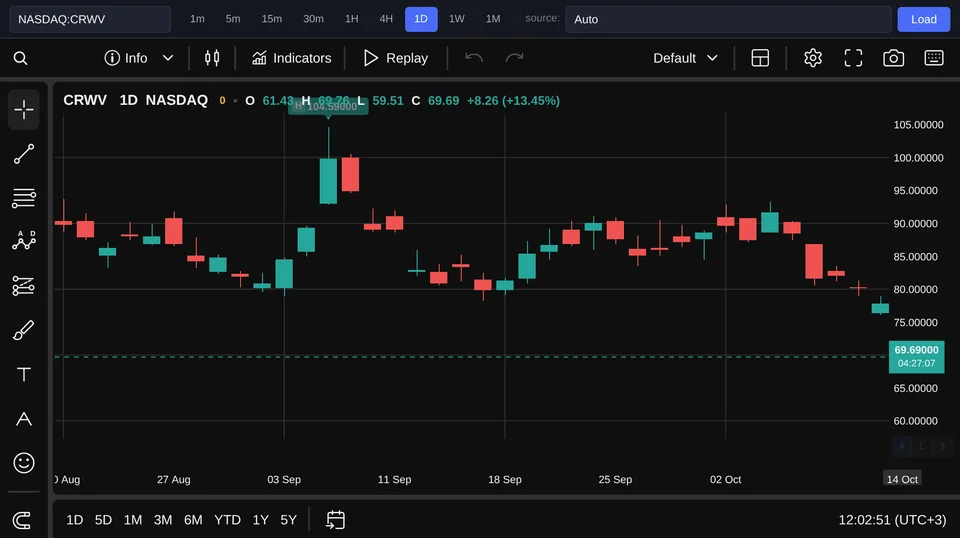
The supplied market snapshot puts CoreWeave, listed as NASDAQ:CRWV, at USD 69.69, up 5.94% for the day, and Oracle, listed as NYSE:ORCL, at USD 134.5, up 3.00%. The accompanying reports describe an S&P 500 recovery after the morning AI selloff on October 15, alongside record bond yields for both companies. These are the reported observations; they do not establish why investors traded as they did. A rising share price does not establish that financing conditions have improved. Equity prices reflect expectations about future profits, together with positioning and appetite for risk. Bond prices reflect the value of promised payments, including the possibility that those payments become harder to make and the return available on alternative investments. Shareholders and creditors can therefore respond differently to the same expansion plan. Shareholders participate in the upside if new infrastructure produces substantial profits, while creditors receive contractual payments and bear losses if repayment fails. Both groups attend the AI banquet, but they read different parts of the bill.
Three explanations for the split
The first possible explanation is a technical rebound: buying after a sharp decline, including the closing of bearish positions, can lift shares without changing the underlying business outlook. This is a plausible market mechanism, not a confirmed explanation of the supplied price moves. It would become more persuasive if the recovery faded without any improvement in company disclosures or credit conditions. The second explanation is confidence in future AI revenue. Equity investors may expect demand for computing capacity to justify today's construction and equipment spending, while creditors remain cautious about when that demand will generate usable cash. Confidence in eventual growth can coexist with concern about the timing of repayment. The third explanation concerns the financing burden itself: large investment needs may require repeated access to capital before projects generate enough cash internally. Creditors could demand greater compensation for that dependence even while shareholders see attractive long-term returns. Our working editorial hypothesis combines the second and third explanations: investors still value AI growth, but the debt market wants stronger evidence that cash receipts will support the expansion.
How expensive debt reaches the business
A bond's market yield rises when its price falls, other things being equal, but that does not automatically increase the coupon on existing fixed-rate debt. Higher required yields matter directly when a company issues new bonds or refinances maturing obligations. The effect on interest expense depends on the actual debt structure, including maturities and any exposure to floating rates. The financing risk lies in the gap between spending cash and collecting it. Infrastructure requires money before it can generate revenue, and accounting revenue need not arrive at the same moment as customer payment. A growing contract book can support the investment case without resolving the immediate need to pay suppliers, fund construction and service borrowing. There is also an important limit to the reported yield records: a corporate bond yield contains both a government-bond benchmark and compensation for additional risks. Without comparable benchmark yields and credit spreads, we cannot attribute the entire increase to anxiety about either company. The reports raise a financing question; they do not, by themselves, prove a deterioration in repayment capacity.
What would confirm or weaken the hypothesis
The first check is whether credit spreads widen relative to government bonds of comparable maturity. Persistent widening, especially alongside less attractive terms on new borrowing, would support the view that creditors require more compensation for funding these businesses. Falling corporate yields caused mainly by lower benchmark rates would provide less evidence that company-specific concerns had eased. The second check is operating cash flow relative to capital expenditure, interest payments and upcoming funding needs. Improving cash coverage and narrower credit spreads would weaken our hypothesis of mounting financing pressure. Continued investment that depends increasingly on fresh borrowing, combined with persistently wider spreads, would strengthen it, although borrowing alone would not establish that projects are uneconomic. The third check is whether announced business converts into delivered services, recognized revenue and cash collections on a timetable consistent with spending commitments. Reporting that clarifies those links would be more useful than a large headline contract figure alone. Readers should also distinguish cash already collected from expectations about receipts that remain dependent on future delivery. The supplied LSEG forecast of 30.6% S&P 500 earnings growth lacks a specified reporting period and comparison base, so it cannot serve as a reliable benchmark here. Even with those details, aggregate index profit growth would not demonstrate that CoreWeave's or Oracle's infrastructure investments earn an adequate return. The relevant evidence must connect each company's investment commitments, financing costs and resulting cash generation.
Conclusion
Who pays for the AI buildout? Initially, the burden falls on the companies and the capital supplied by shareholders and creditors; customer receipts must ultimately sustain the economics if the investment case is to hold. The strongest working explanation for the current split is continued equity optimism alongside a tougher demand for proof from lenders. The share rebound shows renewed willingness to own the upside, while cash coverage, credit spreads and new financing terms will show whether funding that upside is becoming more manageable.