
Brent Falls, WTI Holds: How the Market Is Repricing the Hormuz Risk

Intro
The oil market is presenting an awkward combination. Negotiations with Iran have reportedly stalled, risks to shipping remain in focus, and yet Brent has fallen sharply instead of extending its earlier rise. At the time of writing, Brent is trading at $97.84, down 7.07% on the day, while WTI stands at $92.73 and is up 0.14%. That divergence is the real story. If the market were reacting mainly to a sudden deterioration in global oil demand, both benchmarks would normally be expected to move lower together. Instead, the internationally oriented benchmark has dropped while the US benchmark has barely moved. The central question is therefore not whether geopolitical risk has disappeared, but whether traders are cutting the price they are willing to pay for protection against a disruption in the Strait of Hormuz.
The confirmed facts: a large divergence, not a broad oil sell-off
Several facts can be separated from interpretation. Talks with Iran have lost momentum, the safety and continuity of shipping remain uncertain, and the Strait of Hormuz continues to matter because disruption there could affect major seaborne export flows. Meanwhile, Brent is at $97.84 after falling 7.07% during the day, whereas WTI is at $92.73 after gaining 0.14%. The previously discussed Brent area of roughly $99–107 belongs to the preceding market context, not the current quote. The fall below that range shows that some premium has already been removed, even though the political and logistical questions have not been resolved. What is confirmed is the repricing itself: Brent has suffered a substantial one-day decline without a comparable fall in WTI. That distinction matters because prices do not measure risk in a simple yes-or-no fashion. They reflect both the estimated probability of disruption and the potential cost if disruption occurs. A market can still regard the Strait as dangerous while deciding that an earlier price jump overstated the immediate probability of lost supply. The risk premium can fold and unfold faster than a diplomatic road map, which is inconvenient for anyone seeking a tidy narrative but entirely normal for a market driven by headlines.
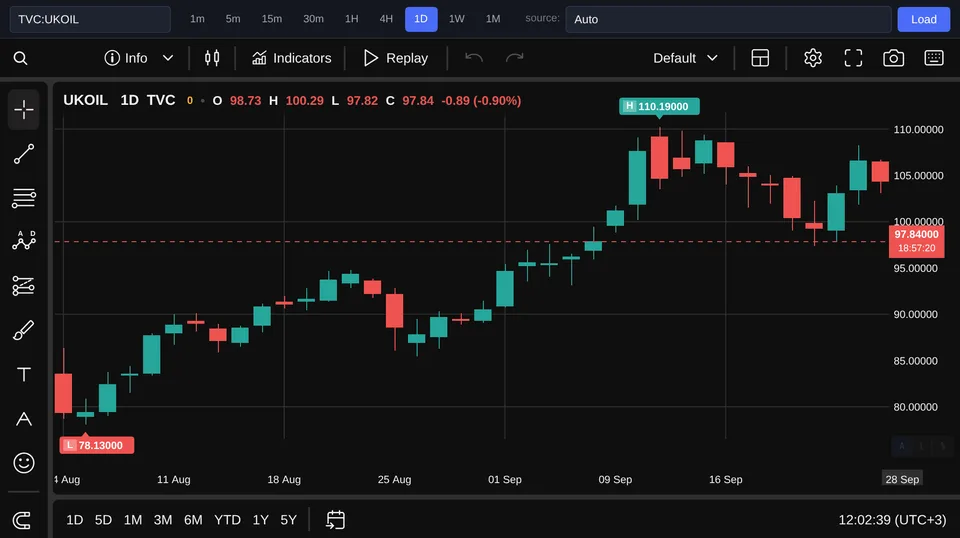
Three explanations for the Brent–WTI split
The first explanation is that traders are unwinding an excessive geopolitical premium accumulated during the earlier rise. Under this view, the stalled negotiations are not new enough, or threatening enough, to justify the highest recent prices. Profit-taking, reduced demand for short-term protection and the reversal of crowded positions could then amplify Brent’s decline without requiring a major change in physical supply. The second explanation concerns the structure of the benchmarks. Brent is more directly connected to the global seaborne market, so it tends to be more sensitive to threats involving tanker routes, freight availability, insurance costs and export access. WTI reflects a US-centered market with different infrastructure and regional supply conditions. A risk concentrated in maritime trade can therefore move Brent much more strongly than WTI, even when the underlying barrels are economically connected. The third explanation is a largely technical correction. Fast price increases often create fragile positioning: when momentum reverses, stop orders and short-term trading systems can turn an ordinary retreat into a steep daily move. This possibility cannot be dismissed from the price action alone. However, a purely technical account is incomplete because it does not explain why the correction is so uneven between benchmarks whose movements are usually closely related.
The strongest working hypothesis
The most convincing interpretation is a combination of the first two explanations. Brent appears to be surrendering part of a previously inflated geopolitical premium, while its closer relationship with seaborne trade makes that adjustment much larger than the move in WTI. This is an editorial, probabilistic conclusion rather than a confirmed fact; daily prices alone cannot reveal the precise motives of all market participants. The near-flat performance of WTI is important evidence. At $92.73 and up 0.14%, it does not support a clean story of collapsing worldwide petroleum demand. If traders had suddenly discovered a severe demand problem, simultaneous weakness across both benchmarks would be more persuasive. Instead, Brent’s decline to $97.84, down 7.07%, looks more like a reassessment of a benchmark-specific risk premium than a verdict on total oil consumption. The working hypothesis is that the market still prices a Hormuz risk, but is rapidly reducing the amount assigned to an immediate interruption. In other words, the premium has not necessarily vanished; its probability component is being marked down. Stalled talks can preserve uncertainty without automatically implying that physical exports will be lost. The market is distinguishing between an unresolved political situation and an observable disruption to flows, even if that distinction changes with every meaningful shipping report.
What would confirm or overturn the hypothesis
Confirmation would come from a continued narrowing of the Brent premium over WTI following credible signs of safer transit, normalized vessel movements or renewed diplomatic progress. Brent could remain more volatile and decline further without an equivalent fall in WTI. That pattern would suggest that traders are removing insurance against a shipping shock while leaving their broader assumptions about demand largely intact. Physical indicators are essential. Stable transit, ordinary loading activity and no sustained rise in transport or insurance costs would support the idea that the market had previously paid too much for an immediate disruption scenario.
Conclusion
The sharp fall in Brent does not show that the Strait of Hormuz has ceased to matter. It shows that the market can reduce the premium for an immediate disruption even while negotiations remain stalled and shipping risks have not been fully resolved. WTI’s stability makes a broad demand-driven sell-off a weaker explanation for the current session. The concise answer is that oil is still trading the Hormuz risk, but the size of that premium is being reassessed much faster than the underlying political problem is being solved. Safer transit and continued divergence would confirm further premium removal; physical disruption or rising transport costs would reverse that conclusion. Until one of those observable paths emerges, Brent’s volatility should be read chiefly as a changing price for geopolitical insurance, not as definitive evidence of a new global demand trend.