
Bitcoin’s Rising Open Interest: Healthy Demand or a Crowded-Long Warning?

Intro
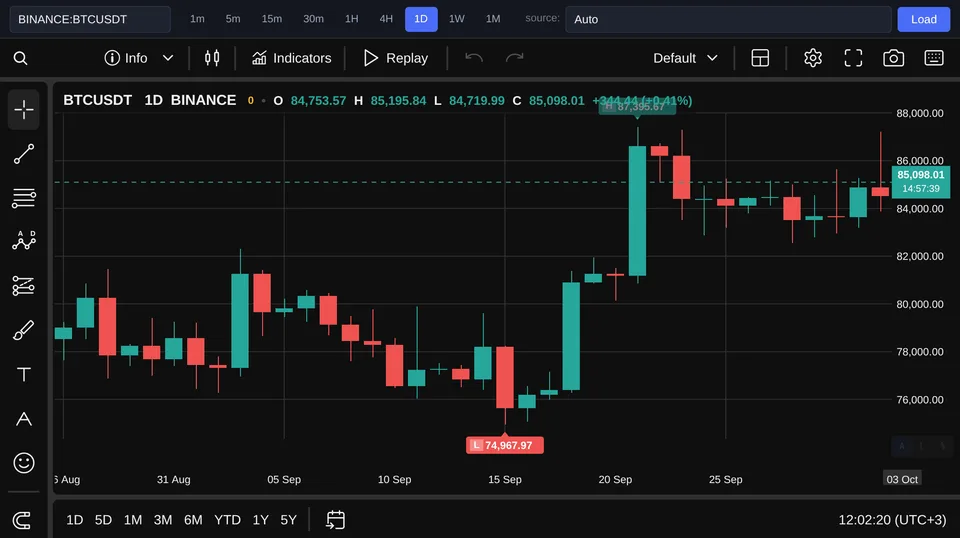
Bitcoin presents a useful market puzzle. Its price on Binance stands at 85,106 USDT, up just +0.42% for the day, yet derivatives traders appear considerably more enthusiastic than that restrained move suggests. According to CoinDesk data reported on October 2, Bitcoin open interest had increased by approximately $2.3 billion since September 30, while perpetual funding rates had also risen. Those observations lead to one focused question: does the return of leveraged bullish positioning represent healthy demand, or has the market already assembled a vulnerable crowd of expensive longs? The answer matters especially around weekends, when thinner liquidity can make an otherwise ordinary price move travel farther. The central anomaly is not that Bitcoin is rising, but that leverage appears to be returning faster than the price is advancing.
What the confirmed data actually tell us
First, the facts should be separated from the interpretation. Bitcoin is trading at 85,106 USDT on Binance and has gained +0.42% over the day. CoinDesk reported that open interest had risen by about $2.3 billion from September 30 to October 2, while higher perpetual funding indicated stronger demand for positions designed to benefit from further price appreciation. Open interest measures the outstanding value of derivative contracts that have not yet been closed. Its growth means that traders are adding exposure, but it does not identify every position as a fresh directional bet: one side’s long always has a corresponding short, and activity can include hedging, arbitrage, and market-making. Funding provides more directional information because increasingly positive rates generally mean that long holders are paying short holders to keep perpetual contracts aligned with the underlying market. There is also an important qualification. The recovery in open interest began from a relatively low base after earlier positioning had been reduced. A $2.3 billion increase can therefore look dramatic without necessarily returning the market to an extreme historical level. Rising open interest is confirmed; excessive leverage is not yet confirmed. Any conclusion about overheating must depend on how open interest, funding, and price behave together rather than on one large-looking figure.
Three explanations for the divergence
The first explanation is straightforwardly bullish. Traders may expect the move above recent levels to continue and may be using perpetual contracts to establish exposure quickly. If that demand reflects well-capitalized participants and is accompanied by genuine buying in the underlying market, higher open interest can support a durable advance rather than threaten it. Under this reading, the modest +0.42% daily gain is consolidation before another attempt higher. The second explanation is more mechanical. Open interest may simply be normalizing after positions were cleared or voluntarily closed. Because the increase started from a low base, the market could absorb additional contracts without becoming dangerously crowded. Funding may rise during such a rebuilding phase because traders are willing to pay for immediate upside exposure, even though leverage across the system remains manageable. The third explanation is less comfortable: leveraged optimism may be advancing without enough price confirmation. Bitcoin at 85,106 USDT is not falling, but a +0.42% daily move is restrained compared with the reported $2.3 billion expansion in open interest. If funding continues to become more expensive while the price stalls, long holders accumulate carrying costs and increasingly depend on the same outcome. The row of longs then starts to resemble an audience trying to leave through one narrow door. All three explanations fit the current snapshot, but they imply very different paths once the price moves. The first expects leverage to be validated by stronger demand, the second expects calm normalization, and the third expects a small reversal to trigger forced selling.
Why conditional overheating is the strongest hypothesis
The most convincing working hypothesis is not that a liquidation cascade is inevitable. It is that vulnerability is increasing conditionally: further growth in open interest and positive funding would become dangerous if Bitcoin failed to produce a comparable price impulse.
The observable test for the weekend
The hypothesis can be tested with concrete market behavior. Evidence in its favor would be a continued increase in open interest and funding while Bitcoin remains near 85,106 USDT, moves sideways, or begins to decline. A subsequent drop accompanied by a sharp reduction in open interest and a rise in long liquidations would indicate that positions were being forcibly removed rather than merely transferred between traders. The timing of those changes matters. If price falls first and open interest collapses with it, liquidation pressure becomes a plausible amplifier. If open interest declines gradually while the price remains stable, the market may instead be reducing leverage in an orderly way. A cooling funding rate without material price damage would also suggest that the imbalance is resolving before it becomes disruptive. The bearish interpretation would be weakened further if Bitcoin advanced while funding stabilized or declined. That would show that price appreciation no longer depended on traders paying progressively more for perpetual exposure. Stronger price performance with controlled leverage would fit the healthy-demand explanation, particularly if open interest stopped accelerating. Confirmation requires leverage to keep growing while price confirmation deteriorates; invalidation requires the market to advance or deleverage without a sharp sell-off. These conditions are more informative than treating any single open-interest reading as a forecast. They also prevent an analysis of risk from quietly turning into a confident prediction about direction.
Conclusion
Bitcoin’s rising open interest and funding do raise the risk of a long-liquidation shakeout, but the current evidence does not make one inevitable. The $2.3 billion recovery in open interest began from a low base, while the price at 85,106 USDT remains positive by +0.42% for the day. The decisive signal would be continued leverage growth combined with increasingly expensive funding and a stalled or falling price. Until that pattern is confirmed, the balanced conclusion is that vulnerability has increased, while outright overheating remains a hypothesis to be tested.