
AI Rally Meets Its Earnings Test as Treasury Yields Reach 2002 Highs

Intro
The question facing investors is narrower than the usual debate about whether artificial intelligence is transformative: can corporate earnings justify the prices already attached to that transformation? US stocks slipped immediately after reaching records, while long-term Treasury yields touched levels not seen since 2002. That combination does not prove that the AI rally is over, but it changes what the market must deliver next. Expectations alone are becoming less persuasive when investors can earn unusually high yields without buying equities.
Confirmed facts: a small decline under a large valuation question
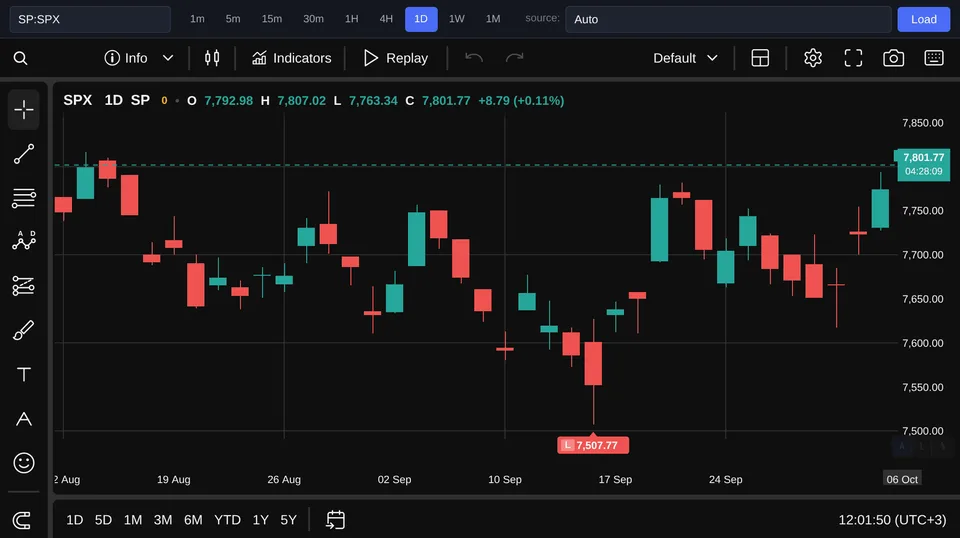
On October 7, the S&P 500 and Nasdaq retreated after the previous session's records, while the Dow declined 0.7%. The current readings show the S&P 500 at 7,802, down 0.22% for the day, and the Nasdaq 100 at 31,160, down 0.21%. These are modest moves rather than evidence of indiscriminate selling. The size of the decline says “pause,” but the market backdrop makes the reason for that pause important. At the same time, yields on 10-year and 30-year US Treasuries reached intraday highs last seen in 2002. That is the more consequential confirmed fact because government-bond yields influence the price investors are willing to pay for future corporate cash flows. The effect is especially relevant to technology and AI-linked companies whose valuations often depend on rapid earnings growth extending well beyond the next quarter. The juxtaposition is therefore clear: equities remain near record territory, but the alternative return available in the bond market has become more demanding. High yields do not mechanically force stocks lower, and a single weak session cannot establish a trend. They do, however, raise the standard that corporate results must meet.
Three explanations for the pause
The first possible explanation is ordinary profit-taking. After record highs, some investors may reduce exposure simply because gains have accumulated and short-term risk-reward has become less attractive. Under this interpretation, the 0.22% decline in the S&P 500 and the 0.21% fall in the Nasdaq 100 are market housekeeping, not a change in the underlying AI thesis. The second explanation is a valuation adjustment caused by higher Treasury yields. When the discount rate rises, profits expected far in the future are worth less in today's terms, all else being equal. Expensively valued growth companies are particularly sensitive because more of their implied value rests on those distant earnings. At yields last seen in 2002, “promising later” competes with “paying now,” and the bond market has become a rather persuasive neighbor. The third explanation is that investors are waiting for earnings reports to resolve uncertainty. State Street investment chief Michael Arone has linked the emergence of a more durable market trend to the coming reporting season. This view treats the retreat neither as random profit-taking nor as an automatic bond-driven selloff, but as a pause before companies show whether AI demand and investment are translating into revenue, margins, and credible guidance.
Working hypothesis: the rally is shifting from narrative to proof
Our working hypothesis is that the market has not abandoned the AI investment case. Instead, it is moving from broad enthusiasm toward more selective pricing based on demonstrated earnings power. The next phase is likely to reward companies that convert AI spending into measurable profit while exposing those whose valuations rely mainly on distant expectations. This explanation is stronger than the profit-taking theory because it accounts for both sides of the market setup. It recognizes that the declines are too small to confirm a reversal, while also explaining why elevated yields can make investors less tolerant of weak results. Pure profit-taking describes the selling but does not fully explain what could turn one quiet session into a sustained trend. It is also more useful than assuming that high yields must end the rally. Strong earnings growth can offset a higher discount rate if profits arrive faster or at a greater scale than investors anticipated. Conversely, even stable yields may not protect richly valued shares when revenue growth, margins, or management guidance disappoint. Earnings and yields interact; neither should be read in isolation. This remains a probabilistic editorial judgment, not a confirmed fact. The modest index declines provide insufficient evidence of a broad change in investor positioning. The hypothesis earns its place because it generates specific tests that the reporting season and subsequent market behavior can answer.
What would confirm or reject the hypothesis
Confirmation would require more than companies merely exceeding carefully managed quarterly estimates. Investors should look for profit growth supported by durable revenue, resilient margins, and management guidance that shows AI-related demand producing economic returns rather than only larger capital budgets. If those results arrive and the S&P 500 and Nasdaq 100 stabilize or advance despite persistently high Treasury yields, the evidence would support the idea that earnings can carry the rally forward. Market breadth would provide another useful signal. A healthier version of the hypothesis would involve gains spreading toward companies with visible AI-related cash flows, rather than depending on a small group of highly valued leaders. Selectivity would not invalidate the rally; it would indicate that investors are distinguishing between operational delivery and attractive presentation slides. The hypothesis would be weakened by disappointing profits, falling margins, cautious guidance, or evidence that AI expenditure is rising faster than the revenue it produces.
Conclusion
The October 7 decline is better understood as a test of the AI rally's quality than as proof of its end. The S&P 500 at 7,802, down 0.22%, and the Nasdaq 100 at 31,160, down 0.21%, show hesitation rather than capitulation. Yet Treasury yields at their highest intraday levels since 2002 mean that elevated equity valuations now require firmer evidence. The concise answer is that corporate earnings can still justify AI-related valuations, but only if reported profits and forward guidance demonstrate that enthusiasm is becoming durable cash flow. Until that evidence arrives, the most defensible conclusion is a conditional one: the rally is pausing for verification, and the reporting season will determine whether that pause becomes renewed growth or a sustained repricing.