Stop Loss and Take Profit - the Foundation of Success in Trading

Stop loss and take profit are two order settings (sometimes simply buttons) that separate chaotic exchange gambling from conscious trading. Calculating and setting a stop and profit is a necessary routine action for everyone engaged in the trading business. Otherwise, trading is merely a game of chance.
In this article, we will figure out what stop loss and take profit are, why even experienced players drain their deposit without them, how to set these orders correctly, and how to choose the optimal risk-to-reward ratio for your trading style.
Almost every beginning trader faces the same problem. When the price goes against the position, hope appears: "It will reverse now." The loss grows, while the trade remains open. As a result, a small minus turns into a serious loss of the deposit.
But the opposite situation also happens. As soon as the trade moves into a small profit, the fear of losing that profit appears. The trader closes the position too early, although the market could have brought significantly more.
It is precisely to solve these two psychological problems that two basic trade management tools exist:
Stop Loss - limits the maximum loss.
Take Profit - automatically locks in profit.
Without these tools, it is impossible to build a stable trading system.
What Is a Stop Loss
Trading is a business of probabilities. A stop loss is the only way to set a fixed amount of risk for each trade. Without it, it is impossible to calculate the position size for a trade.
A stop loss is a preset price level at which a trade is automatically closed with a loss known in advance. In simple terms, a stop loss is capital insurance.
The main task of a stop loss is not to make money, but to preserve money for the next trades.
For example, a trader bought an asset at a price of 100 dollars. Analysis shows that if the price falls below 97 dollars, the trading scenario will become invalid. Therefore, the stop loss is set at 97 dollars. If the price really falls, the trader loses only the pre-calculated 3 dollars, not the entire deposit.
What Setting a Stop Loss Gives

Limiting Losses
The main advantage is obvious: one trade will not be able to destroy the deposit.
Suppose: deposit - 1000 $, risk per trade - 1%. The maximum loss will be only 10 dollars.
Even after a series of 10 losing trades, you will lose about 10% of your capital and be able to continue trading. Without a stop loss, one mistake can lead to the loss of 30-50% of the deposit, and sometimes even wipe it out completely.
Protection from Strong Market Moves
During the release of important news (statistical data from the economic calendar, statements by regulators), as well as when unexpected factors affecting the market appear (force majeure events, statements by politicians), the price can move tens or hundreds of points literally within a few minutes and sometimes even seconds.
If there is no stop loss, the loss may turn out to be dozens of times larger than expected.
Emotion Control
When the loss level is known in advance, the trader stops making emotional decisions.
There is no need to constantly think: "Maybe wait a little longer?", "It will probably reverse now..."
The decision has already been made before the trade is opened.
The ability to correctly calculate position size
Before placing an order, professional traders first determine:
where to place the stop;
the size of acceptable risk;
the position volume.
Without a stop loss, it is impossible to calculate risk correctly.
Why trading without a stop loss almost always leads to losses
Many beginners make the same fatal mistake: they do not set a stop loss. There is a whole bunch of “reasons” for this:
“The broker is hunting my stops,”
“I am watching the chart anyway; I will have time to close manually,”
“So what if it drops a little; then it will rise later, I am not a speculator,”
“A stop eats the deposit piece by piece; it is better to sit it out.”
Each of these arguments is a deadly trap. Let’s look at what using them leads to.
For example, 10 profitable trades at +2% and one trade without a stop (
–35%). As a result, most of the profit disappears.
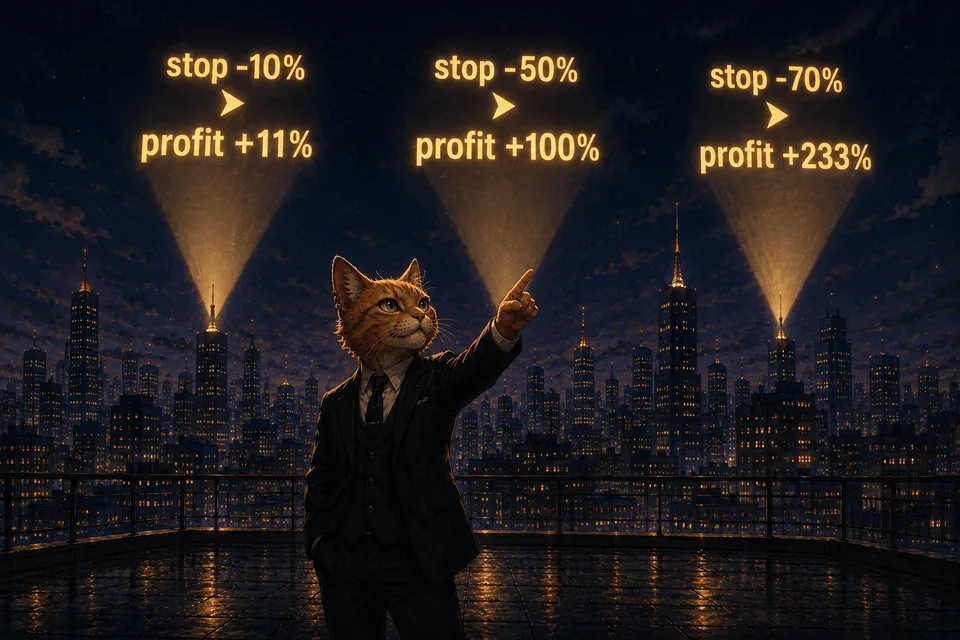
The larger the drawdown, the harder it is to restore the account. This is tied to the mathematics of capital recovery.
Loss | Need to earn |
|---|---|
-10% | +11% |
-20% | +25% |
-30% | +43% |
-50% | +100% |
-70% | +233% |
A 50% drawdown on one trade is a common situation when no stop loss is set. Making back 100% profit on the remaining half of the deposit by simply “sitting out” positions is practically impossible. That is why professionals do not try to avoid all losing trades. They try to make sure none of them is too large.
A trader who opens a trade without a stop, instead of admitting a mistake and losing, say, 1% of capital, starts persuading himself: “This is only a temporary correction. I will wait until it comes back.” The loss grows: 2%, 5%, 10%. Now closing is painful, very painful. The brain turns on protection: “I am not realizing the loss, so I have not lost yet. I just need to wait. This is now a long-term investment.”
Thus a day trade turns into many months of “investing” in a dying asset. In the end, either the purchase is closed at the very bottom with a huge loss because the nerves give out, or first a margin call comes, and then a trade-out.
How to set a stop loss correctly
Setting a stop loss at random, at a “nice” round number, or simply 10 points away from the entry is no better than not having one. The stop must have a logical basis. Here are the three main approaches.
Technical: beyond key levels
The simplest and most reliable way to place a stop is to place it. The stop is placed beyond a strong level whose breakout completely invalidates the trading idea.
When buying, the stop loss is placed slightly below the local low, support level, trend line, or significant cluster of prices.
When selling, the stop is placed slightly above the local high, resistance, or the upper boundary of a downtrend.
Why exactly “slightly below” or “slightly above”? Because large players often arrange false breakouts, “taking out” clusters of stops behind obvious levels.
How do you find levels with a concentration of the crowd’s stops on Forex? To do this, you need to use the TLAP crowd stops indicator.
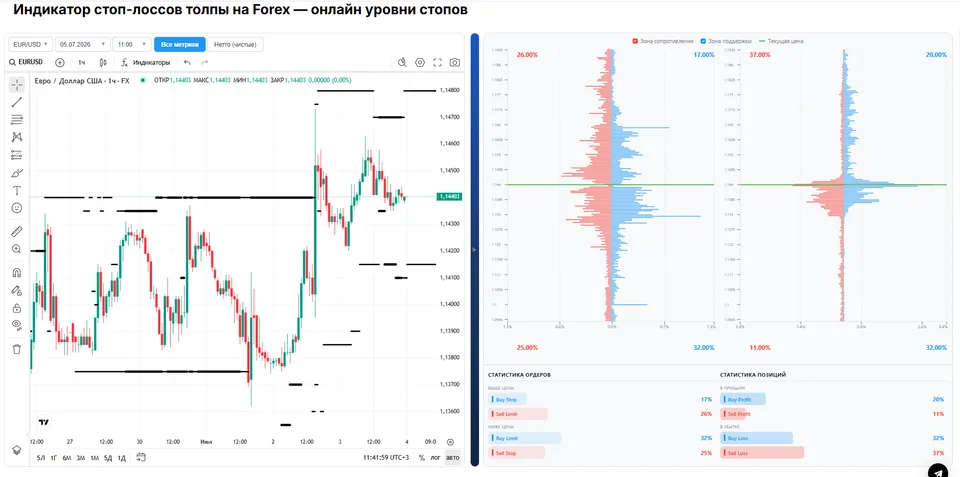
The crowd stop indicator on Forex is very simple to use. On the left is a regular chart with stop concentration levels, on the right is the order book and statistics of open orders.
By Volatility — the ATR Indicator
Average True Range (ATR) shows the average range of price movement over a certain period. With it, a stop can be placed at a distance proportional to current market activity.
The rule is simple: place the stop at a distance of 1.5–2 ATR from the entry point.
For example, if a trader enters on the daily chart, and the 14-day ATR is 50 points, a stop at a distance of 75–100 points makes it possible to ignore market noise.
Financial — Risk as a Percentage of Capital
The golden standard of money management: risk per trade should not exceed 1–2% of your deposit. This comes first!
A trader does not choose a stop for a random distance, but calculates what it should be in order to lose a strictly defined amount.
The algorithm is simple.
Determining acceptable risk: deposit of 100,000 rubles, risk 2% = 2,000 rubles per trade.
Finding a technically justified stop on the chart. Suppose the optimal stop from the entry point is 100 points (or 100 rubles per share).
Calculating position size: 2,000 rub. / 100 rub. = 20 shares.
If the technical stop turns out to be too far away and the potential loss with a comfortable volume exceeds 2%, it is necessary either to reduce the volume or skip the trade.
Time Stop
If the price does not move in the expected direction for a long time, the trading idea loses relevance.
You can set a rule: “If after 5 candles after entry I have not received movement in my direction, I close the trade manually.” This does not cancel the usual price stop, but protects against capital being frozen.
What Is Take-Profit

Take-profit is a preset price level at which profit is automatically fixed when reached.
For example, when buying an asset at a price of $100, a trader sets a stop-loss at 98 and a take-profit at $106. If the price reaches 106 dollars, the trade is automatically closed with a profit.
What Take-Profit Gives
Profit Taking
The market is constantly changing. Very often, after strong growth, a correction begins.
Take-profit allows you to take profit before the price reverses.
Excluding Greed
Many traders make the same mistake. The price has reached a good profit. And immediately the thought arises: “I’ll wait a little longer.”
Then the market reverses. Profit decreases. Sometimes the trade even closes at a loss.
Take profit excludes such situations.
Trade Automation
It is not always possible to monitor the market.
If a stop and take are set, the trade can be fully managed automatically.
Why Trading Without Take Profit Can Reduce a Strategy's Profitability
Many believe that the absence of take profit is always better. In reality, this is far from true.
Imagine a situation. The price regularly moves 2-3%, then reverses, but the trader stubbornly waits for 8% every time.
As a result of unfounded expectations, many trades close at breakeven, some profitable trades turn into losing ones, and average profit falls.
As a result, the overall effectiveness of the strategy decreases, which is especially critical for short-term trading.
How to Set Take Profit Correctly
The same principle works with take profit as with stop loss: targets should be placed where profit-taking by major players or a reversal is highly likely to begin.
By Key Levels
If a trader buys from support, the first target will be the nearest resistance level. The second target is the next one. This way the trader takes profit before sellers start pushing the price down.
When trading level breakouts, you can measure the width of the consolidation and project this distance in the breakout direction.
Based on the Risk/Reward Ratio (R:R)
We will look at this method in more detail a little below, but in short it looks like this.
The trader measures the distance to the stop loss (risk R), multiplies it by the chosen coefficient, and gets the minimum distance to the target. For example, a stop of 50 points, and a target at a 1:3 ratio is 150 points.
The target must definitely make technical sense. If the nearest resistance is only 100 points away, setting take profit at 150 is overconfident, because the price is highly likely to reverse earlier.
Taking Profit in Parts
To smooth out the conflict between the desire to take reliable profit and the fear of missing a huge move, traders use exit scaling, i.e. partial profit-taking.
The first part (30-50%) is closed at the nearest target with a conservative R:R (say, 1:1 or 1:1.5).
The second part (30-50%) is closed at the next level with a ratio of 1:2 or 1:3.
The remainder (0-20%) can stay in the market with a trailing stop to catch the trend.
This scheme seriously improves trading psychology, because the trader regularly sees locked-in profit while still keeping the chance to receive a pleasant bonus by participating in a stronger move.
What Is the Risk/Reward Ratio

Risk/Reward Ratio (R:R) shows how much a trader plans to earn for every dollar they risk in a trade. It is a universal unit for measuring trade efficiency.
Risk is your risk per trade in monetary terms or in points.
Reward is the potential profit in the same units.
For example, if the stop size is $100 and the take profit is $300, then Risk/Reward = 1:3. That is, the risk is one part, and the potential profit is three parts.
Let us assume a very realistic situation. A trader made 10 trades, half of which were profitable and half of which were losing.
Ratio 1:1 (5 wins : 5 losses). Result: 0%
Ratio 1:2 (5 wins at +2R : 5 losses at -1R). Result +5R. Even with 50% successful trades, the strategy remains profitable.
Ratio 1:3. Even if profitable trades are only 35-40%, the strategy can still deliver a positive result.
There is no universal Risk/Reward Ratio value; everything depends on the strategy. But we can talk about certain benchmarks.
Trading style | Risk/Reward |
Scalping | 1:1 - 1:1.5 |
Active intraday | 1:1.5 - 1:2 |
Classic intraday | 1:2 - 1:3 |
Swing trading | 1:3 - 1:5 |
Position trading | 1:4 - 1:8 |
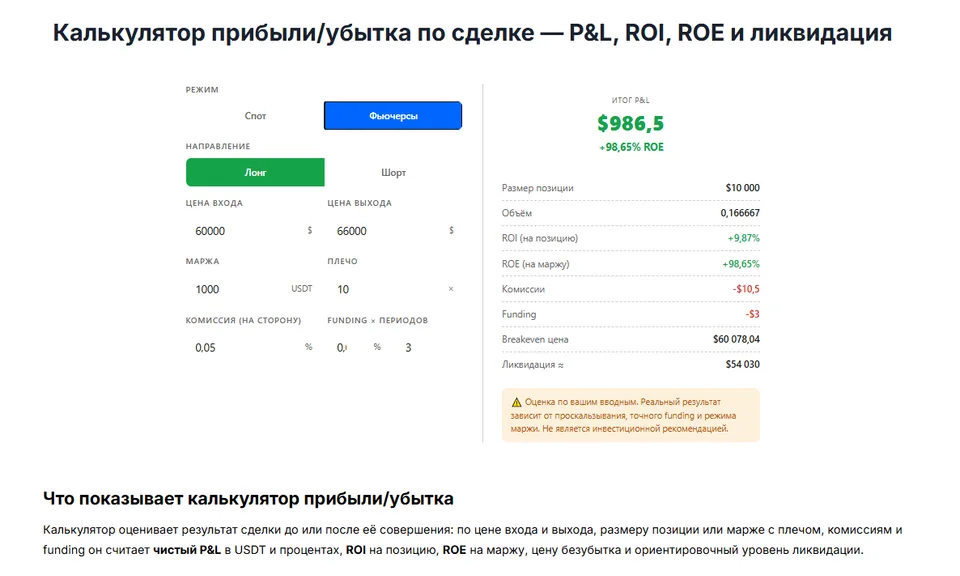
TLAP has developed a special trade profit/loss calculator - P&L, ROI, ROE, and liquidation. This calculator does not show the direct R:R value, but it lets you estimate in money the real stop and real profit, taking into account all types of additional mandatory payments (commissions, funding, etc.).