
Margin Trading from A to Z
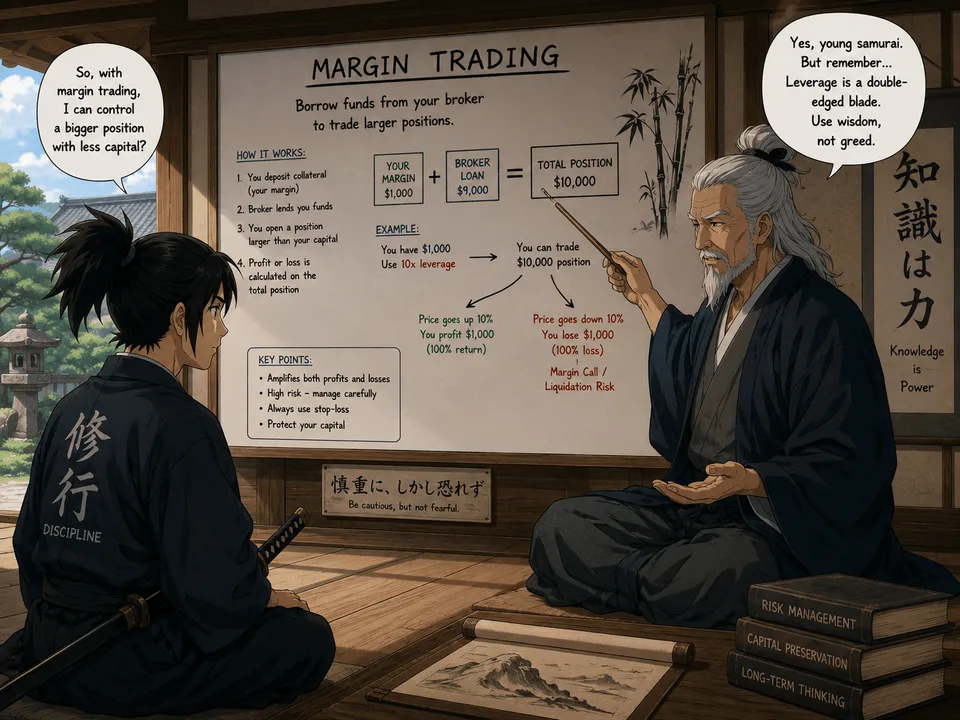
Margin trading is a way to make trades for an amount that exceeds the trader's own capital. A broker or exchange provides the missing funds as a loan, and blocks part of the client's deposit as collateral — the margin. This approach multiplies both potential profit and risks.
In this article, we will figure out what margin trading is, how margin trading differs from leveraged trading (spoiler: in the broad sense, they are one and the same, but there are nuances), learn how much and for what a broker charges fees in margin trading, and also how leveraged trading works on Forex, futures, the crypto market, and the stock market.
This material is informational in nature and cannot and should not be regarded as consultation or advice.
What Margin Trading Is in Simple Terms
Margin trading (Margin Trading) is entering into trades using borrowed funds, where the trader's own money or assets serve as collateral. This collateral is called margin (margin). It guarantees that the trader will be able to cover possible losses.
The general scheme of margin trading looks as follows.
The trader deposits a certain amount into an account with a crypto exchange / forex dealer / broker — for example, 1,000 dollars.
The broker gives the right to open a position for an amount that is a multiple of the deposited amount (for example, x10, which equals 10,000 dollars).
To do this, it blocks an agreed amount in your account — the initial (maintenance) margin (initial / maintenance margin), also called collateral. While the position is open, this money cannot be used, as it is pledged as collateral.
When the trade is closed, the profit or loss is calculated from the full position size and credited to the account (or debited from it). The borrowed funds are automatically returned to the broker.
The key concept in margin trading is leverage. This is a ratio showing how many times the position size exceeds the amount of collateral. For example, with 1:10 leverage, having 1,000 dollars, a trader controls a position of 10,000 dollars. The higher the leverage, the less of one's own funds are required to open a trade — and the more strongly the slightest price movement affects the balance.
Margin Trading and Leveraged Trading: What Is the Difference
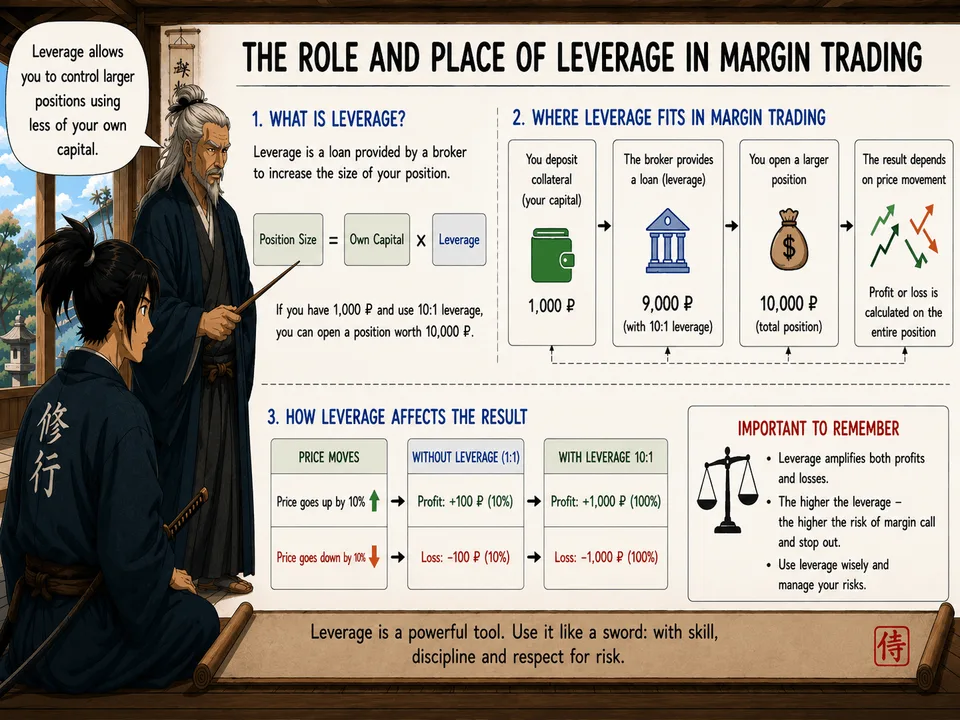
The terms “margin trading” and “leveraged trading” are often used as synonyms, but their semantic nuance is different.
Margin trading is the process itself of using borrowed money against collateral.
Leveraged trading is the result of applying margin mechanics, the numerical expression of the leverage effect. We say: “I trade with 1:5 leverage” — that is, I increased the position 5 times relative to my capital.
In practice, their connection is inseparable: margin trading makes it possible to obtain leverage, while leverage is implemented through margin accounts and collateral. Sometimes “margin trading” is understood narrowly as operations on spot markets with a real loan of an asset (for example, stocks or cryptocurrencies), whereas “leveraged trading” means derivatives (futures, CFD). But in the broad sense, this is one phenomenon.
Broker Fees for Margin Trading
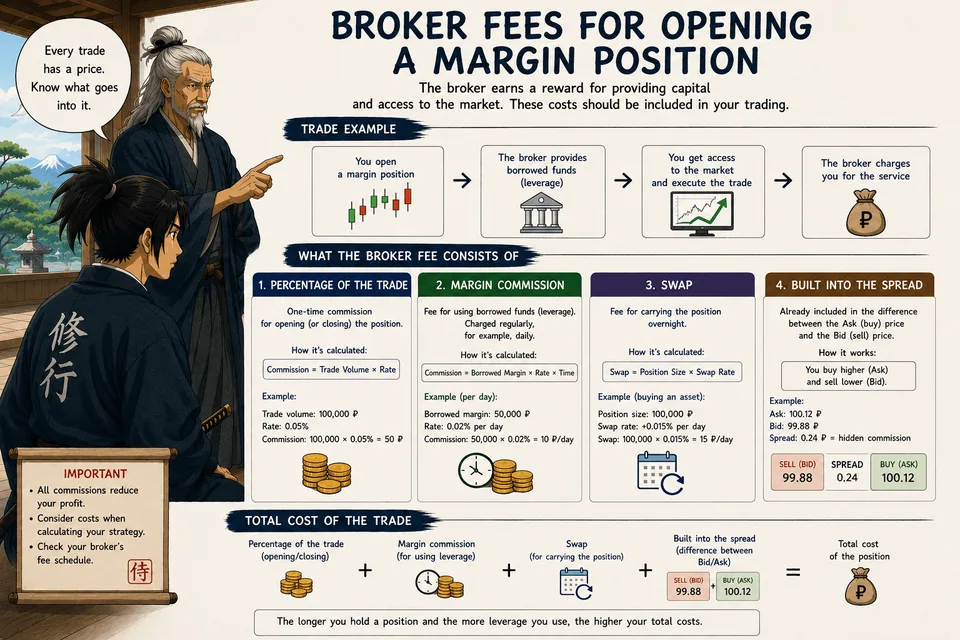
There is always a charge for using borrowed funds and infrastructure. Its form depends on the market and the type of instrument.
Swap — Fee for Carrying a Position Over
In the Forex and CFD market, if a trader holds a position for longer than one trading day, the broker / dealer accrues or charges a swap. This is the interest rate difference between the two currencies involved in the pair. It can be either positive or negative.
Suppose the current ECB rate is 2% per year, and the Fed rate is 1%. When buying EUR/USD (euros for dollars), the swap is positive and equals 1%, since the difference between the ECB and Fed interest rates is 1%. In turn, when selling EUR/USD, the swap becomes negative (also 1%).
In the example above, at the moment of rollover (carrying the position over to the next day), in the first case 1% is credited to the account, and in the second case 1% is debited.
Interest on a Margin Loan
In the stock market and the spot crypto market, the broker (or exchange) directly lends the trader money or assets. An annual interest rate is charged for this, broken down by day:
Daily fee = Annual rate × Loan amount / 365 (or 360).
The rate is formed from the broker's base rate plus a risk premium. For stocks, it may be, for example, 8–12% per year, while for cryptocurrency spot it is much higher and often changes dynamically.
Funding rate
In cryptocurrency perpetual futures (perpetual swaps), the leverage fee is implemented through the funding rate. Every 8 hours, settlement takes place between buyers (longs) and sellers (shorts). If the market is overheated to the long side, longs pay shorts, and vice versa. This way, the contract price is tied to the spot price.
You can learn more about crypto funding in our article above.
Trading Commissions
Trading commission is charged for order execution (only when opening a position, or when opening and closing a position) and is direct income for the broker/exchange. The commission may be:
Fixed — for example, $5 per contract on the futures market;
A percentage of turnover — typical for Forex (spread or ECN commission) and crypto exchanges (maker/taker);
Built into the spread — the broker widens the difference between the buy and sell price, taking its share without a separate line.
Thus, the broker fee for margin trading may consist of several parts: the loan fee (swap, interest, funding) and transaction commissions. The greediest brokers charge a loan fee, a commission for opening a trade, and widen the spread as well.
Margin Forex Trading
In the Forex market, margin mechanics are especially pronounced. Brokers offer leverage from 1:30 (in regulated jurisdictions) to 1:500 and even 1:2000 (offshore companies).
Margin in Forex is expressed as a percentage of the full position size. With 1:100 leverage, margin = 1%: to open a trade for 100,000 currency units, you need to have at least 1,000 units in your account. Some brokers reduce leverage on weekends.
When opening a position, the broker blocks the initial margin. If the loss approaches the margin amount, a margin call is triggered — a requirement to top up the account, or the broker will forcibly close the position. In essence, this is a classic collateral scheme.
In Forex, swaps are the most common fee for carrying a position overnight. They are charged at 00:00 server time and may be triple on the night from Wednesday to Thursday. The exception is so-called Islamic accounts, where a fixed commission is charged instead of a swap.
Note that in addition to swaps, Forex brokers often charge commissions — either only the spread (especially wide with “dealing desk” brokers), or a narrow spread + commission per lot (ECN/STP model).
Margin trading in Forex does not imply real delivery of currency: it is always speculative CFD or spot contracts, settlements for which are made in cash.
Margin Futures Trading
Futures are standardized contracts on an exchange (CME, MOEX, etc.). Here the margin nature is built into the instrument itself. The main concepts when trading futures are as follows.
Initial margin requirement (IM) — the amount that the exchange blocks in the trader's account as initial margin. It is a fraction of the contract's full value: for example, an oil futures contract with a volume of 1,000 barrels at a price of $70 is worth $70,000, while the IM may be $7,000 (leverage ~1:10).
Note that the IM changes when the instrument's volatility rises and falls. The size of the initial margin requirement also usually increases when positions are carried over the weekend.
The next important concept is variation margin: a daily (and often intraday) recalculation of profit/loss. This happens during clearing, in the process of which the exchange either credits profit to the account or debits the loss.
On the derivatives market (futures), there is no explicit leverage fee, since the trader does not borrow from the broker but deposits an insurance deposit (initial margin requirement). However, the cost of leverage is indirectly embedded in the futures price — in the form of contango or backwardation, reflecting the financing cost of the underlying asset, and also in the tick (point) value.
The commission consists of the exchange fee and the broker's markup. Usually this is a fixed price per contract.
A margin call in futures occurs if the funds in the account are not enough to maintain the IM. The broker has the right to forcibly close positions.
For example, the initial margin requirement for an oil contract is 2000$, the value of one tick (price step in cents) is 10$. If the market moves against the trader by 2$, the broker may close the position if there are not enough funds in the account to maintain the position.
Margin Crypto Trading
The cryptocurrency market offers two main formats of margin trading.
Margin Spot (Margin / Cross/Isolated Margin)
The trader borrows a specific asset (for example, USDT or BTC) from the exchange or liquidity pool to open an increased position on the spot market.
Leverage is usually up to 1:10.
Interest is charged hourly or once per day. The rate depends on supply and demand for lending. It is announced by the exchange.
Margin is of two types.
Isolated margin — a limited amount is allocated for a specific position; in liquidation, only it is lost.
Cross margin — the entire available balance is used as collateral, which makes liquidation harder but increases losses in an extreme scenario.
Perpetual Futures (Perpetuals)
In fact, it is the cryptocurrency equivalent of a futures contract without an expiration date, with high leverage (up to 1:125) and a funding rate mechanism. The fee for leverage here is not charged as interest, but is paid to counterparties every 8 hours — this can bring both expenses and additional income if you are on the “right” side of the market.
Maker/taker entry and exit fees are usually small as a percentage, but significant at high turnover. Liquidation comes quickly because of extreme leverage — the bankruptcy level is calculated by the mark price.
Margin Trading in Stocks
In the stock market, margin trading is strictly regulated. The broker opens a margin account for the client, where they can buy stocks by borrowing money from the broker (long), and sell short by borrowing the stocks themselves.
Leverage for stocks is usually modest.In the US, initial margin is 50% — that is, 1:2 leverage for most stocks. Day traders can use leverage up to 1:4 intraday. In other jurisdictions, the numbers may differ, but the principle is similar.
If initial margin in the stock market is usually 50%, then maintenance margin is the minimum share of equity that must remain in the account (usually 25–30% for long positions) during losing trading. If equity falls below it, the broker issues a margin call.
By the way, a similar mechanism also exists with forex dealers, but the numbers there are somewhat different.
The payment to the broker in the stock market consists of interest on the debit balance and a standard commission.
Interest on the debit balance is calculated daily on the loan amount. The rate is published by the broker and may be, for example, “base rate + 1.5%”. For a short, an additional fee may be charged for borrowing hard-to-borrow stocks (hard-to-borrow fee).
Standard commission for a stock trade (or zero, as with many modern brokers, though the spread is still paid through order flow).
The Difference Between Margin Call and Trade Out (Stop Out)
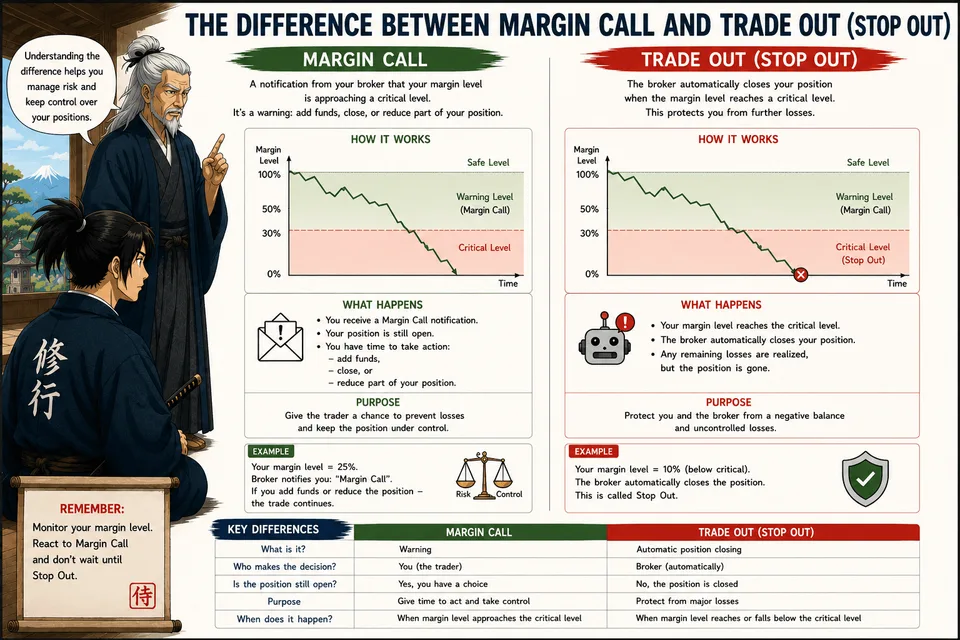
Margin Call — this is a notification that appears in the terminal, arrives by email, SMS, or push notification when the ratio of equity to collateral (Margin Level) falls to a certain value set by the broker — for example, 100% or 50%.
At this point, opening new positions is usually no longer possible. To raise the margin level above the danger line, the trader must either add money to the account or close part of the losing positions. Forced closing has not yet occurred.
For example, a trader has $1 000 on deposit, and the collateral on the position is $200. The loss has grown to $800. There are almost no free funds, the margin level = (equity / collateral) × 100% = (200 / 200) × 100% = 100%. The broker sends a margin call notification — “fund the account or close part of the trades”.
The term Trade Out is not strictly regulatory, but it is widely used in the interfaces of many brokers and crypto exchanges. In the Russian-speaking environment, it corresponds to the concepts of stop-out, forced closing, and position liquidation.
Trade Out (stop-out) occurs when the margin level falls even lower — to a critical threshold that the broker has set as the line beyond which it is not ready to risk its own money. Usually this is a level of 50%, 30%, or even 10% (in the crypto market).
Forced closing happens as follows. The broker (or exchange) automatically begins closing positions, starting with the most unprofitable one, to return the margin level to an acceptable level. Closing occurs at current market prices, and often this happens at the most unsuitable moment. After a stop-out, usually only the balance remains in the account, equal to the blocked margin (or even less if slippage occurred).
If we consider the previous example, imagine that the loss has grown to $900, and the margin level has fallen to 50%. If stop-out is set at 50%, the broker forcibly closes the position. After closing, $100 will remain in the account out of $1 000 (equity minus loss). Thus, the trader lost 90% of the deposit without having time to intervene.
Basic Rules of Money Management in Margin Trading
The first rule is that risk per trade must be limited in advance. In practice, this means: before entering, the trader knows where they will exit at a loss, what percentage of capital they are ready to lose, and what position size fits this. Exchanges themselves recommend monitoring margin ratio / margin level and using lower leverage, because it is high leverage that most quickly leads to liquidation.
The second rule is to use a stop-loss at a safe distance.
The third rule is not to load the entire deposit into one position.
The fourth rule is not to mix learning and aggressive speculation. For a beginner, it is better to first practice one instrument, one timeframe, one entry scenario, and one risk size. As discipline grows, it is already possible to expand leverage, the number of positions, and move to more complex modes.
To properly follow the rules listed above, we recommend using the Forex margin calculator, which will help calculate all the necessary parameters for opening a trade.