Lot in trading: what it is and how to calculate trade volume without unnecessary risk

Beginning traders often get confused by the most basic concepts. One of the main exchange concepts is a lot. It was first used in the stock market, although for many it is inseparably linked with the Metatrader terminal and Forex.
Intuition suggests that a lot is simply the “quantity” of an asset (stocks, futures, currency, cryptocurrency). In reality, everything is a little more complicated, which means it is necessary to understand what a lot is, how it differs from a futures contract or a unit of a financial asset (a share, a crypto coin). We will also explain and show how to choose the right lot size and how to manage capital in order to stay in the market.
What is a lot in trading
A lot is a standardized unit for measuring trade volume. In simple terms, it is the minimum “package” of an asset that can be traded on an exchange or through a broker. The size of this package depends on the market.

The concept of a lot originated in the stock market.
In the United States, 1 (standard) lot once equaled 100 shares, but with the development of fractional shares this rule effectively disappeared. On the Moscow Exchange, a lot may be 1 share (Sber, Gazprom, Lukoil) or a package of several securities if the price of one share is very low (for example, a VTB lot was 10,000 shares for a long time, now it is 1 share).
The lot size is set by the exchange in the instrument parameters.
In the Forex currency market, 1 standard lot = 100,000 units of the base currency. For example, for the EUR/USD pair this is 100,000 euros. A little after 2000, brokers began to allow trading in fractional parts: first mini lots appeared (0.1 lot = 10,000 units), and a few years later it was the turn of micro lots (0.01 lot = 1,000 units). And this happened against the background of constantly increasing leverage.
In the derivatives market, it is not customary to talk about lots, although one futures or options contract contains the same volume of an asset (stocks, oil, grain, crypto coins). And in this sense, 1 futures contract is identical to 1 lot, although everything is a little more complicated.
As an example, let us show that 1 lot of EUR/USD is 100,000 euros. However, 1 6E contract (EUR/USD futures) is 125,000 euros. Both a lot and a contract are based on an agreed quantity of the underlying asset.
In the cryptocurrency market, everything is much simpler.
If we are talking about cryptocurrency spot trading, then the lot may be the minimum purchase volume (for example, 0.001 BTC). In the futures market, 1 contract is often equal to 1 dollar or 1 unit of the coin, while the lot is the number of these contracts.
How a lot differs from a futures contract
Understanding the difference between a lot and a contract is quite important in order to understand market mechanics.
In the futures market, people often say: “I bought one lot of a futures contract.” It sounds as if “lot” and “contract” are synonyms, but in essence this is not the case.
A lot is a unit for counting volume, while a contract is an instrument with unique terms. The main differences here are as follows.
Volume standardization. On Forex, a lot of 100,000 units is a convention accepted by brokers, and you can open a trade of 0.11 lots (11,000 units). A futures contract is always a rigid instrument that cannot be split.
Content. A spot lot is simply a quantity of a commodity (currency, stocks) that immediately passes into ownership. A futures contract contains an expiration period (execution date), the amount of initial margin, the price tick, and the value of the price tick.
Lots in the stock and cryptocurrency markets
The concept of a lot in the stock market
In the stock market, the concept of a lot historically arose to simplify trading. Previously, all trades were made in standard packages, and trading in random quantities was not allowed. Now the situation is somewhat different and depends on the exchange, instrument, and broker.
Lot as the minimum order volume (mandatory parameter)
On many exchanges, including the Moscow Exchange, previously it was impossible to submit an order to buy “any number of shares.” But it was possible to submit an order in lots, which contain the same number of shares. Therefore, in exchange terminals the trader specifies not the number of shares, but the number of lots.
For example, Aeroflot shares cost 47 rubles at the time of writing. The exchange set the lot size: 1 lot = 10 Aeroflot shares, i.e. buying fewer than 10 shares is simply impossible. The lot value is 4700 rubles. Further on, the volume must be a multiple of the lot (2 lots = 20 shares, 200 lots = 2000 shares, and so on).
In the American market, Exxon Mobil shares are a good example; their minimum lot size is also 10 shares.
When a lot equals one share
For blue chips on many exchanges, the rules have long been simplified. Now you can easily buy one share of the same Gazprom or Microsoft.
In this case, there really is no difference between “buy 10 shares” and “buy 10 lots.” The terminal still operates with the concept of a lot, as we discussed just above; it is just that one lot equals one share.
Fractional shares
With the emergence of fractional shares, it seems that the concept of a lot has disappeared. </span>There are two types of share splitting.
A split is an increase in the number of shares of an issuing company with a simultaneous decrease in their value.
The decrease in value is proportional to the multiple increase in shares outstanding: for example, the number of shares outstanding after a split doubled, and the share price fell by half. The company’s capitalization did not change with unchanged company capitalization. At the same time, one expensive share is replaced by several cheaper ones. In this situation, the standard lot volume may remain unchanged, but its price will be cut in half.
The second type of splitting takes place “inside” the broker. This allows clients to hold positions such as 0.3 or 0.75 of a share, even if only whole shares trade on the exchange.
How is this different from a forex bucket shop? In that the broker keeps internal records of fractional shares, while "behind the scenes" it still aggregates such orders with other clients and goes to the exchange with whole lots.
In the USA, the standard exchange lot (round lot) for most shares is 100 units. Anything smaller is called an odd lot and is processed with delays.
The concept of a lot in the cryptocurrency market
On crypto exchanges (Binance, Bybit, OKX, etc.), the term “lot” is used even less often than in the stock market, but it is also present. Here, volume regulation happens through two key restrictions that set discreteness
Step Size — the first restriction — is the minimum change in the number of coins that can be specified in an order. If for BTC/USDT step size = 0.00001, it means you can buy 0.00001 BTC; 0.00002 BTC, and so on, but not 0.000015 BTC. This step essentially forms the concept of the minimum lot on spot.
Often in exchange APIs and trading bot settings, this parameter is called exactly that — min_lot or lot_size. One “lot” in this understanding is 0.00001 BTC (or another value set by the exchange). All volumes must be multiples of this step.
Min Notional — the second restriction — is the minimum trade amount in the base currency (usually in USDT or another quote currency). Suppose, for some pair, the minimum purchase amount is 10 USDT. This restriction does not allow buying coins priced at 0.001 cent for less than 10 USDT.
The presence of min notional makes the concept of a lot somewhat blurred: even if step size allows you to buy 1 coin, but it costs 1 cent, you will not pass the notional threshold.
Lot in Forex: a full breakdown
In Forex, a trader trades in lots. A lot in Forex has no expiration term, is not tied to delivery, and can be practically any size thanks to fractioning.
Historically, the interbank foreign exchange market operates with large volumes. To standardize trades, a standard lot was introduced.
1 standard lot = 100 000 units of the base currency.
The base currency is the first one in a currency pair. For EUR/USD, the base currency is the euro. This means that when opening a trade of 1 lot in EUR/USD, the trader buys or sells 100 000 euros.
For other pairs:
1 lot GBP/USD = 100 000 British pounds; 1 lot USD/JPY = 100 000 US dollars; 1 lot AUD/CAD = 100 000 Australian dollars.
Not all private traders can trade standard lots, because this requires a large deposit. Therefore brokers introduced fractional parts of a lot.
Mini, micro, and nano: what Forex lots can be
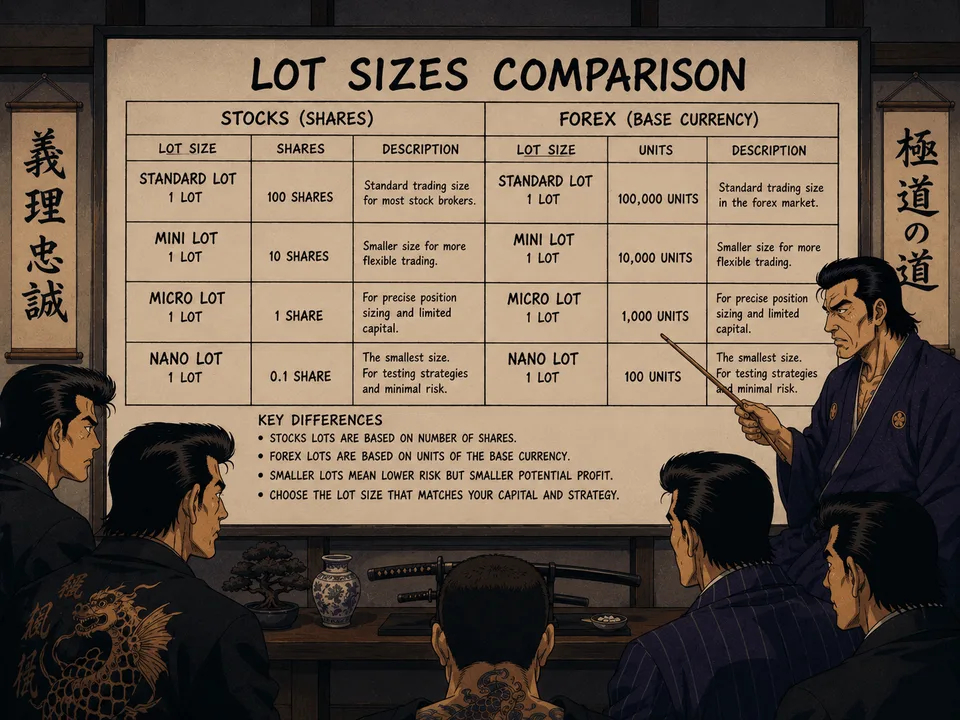
Name | Designation in the terminal | Amount of base currency | Share of a standard lot |
|---|---|---|---|
Standard | 1 | 100 000 | 1 |
Mini | 0,1 | 10 000 | 1/10 |
Micro | 0,01 | 1 000 | 1/100 |
Nano | 0,001 | 100 | 1/1000 |
Nano lots are not available from all brokers, but many modern platforms allow entering volume with precision up to 0.001 lot (or even up to 0.0001, but that is already an exception).
Thus, a trader with a small account can open positions with a volume of 0.01 lot (micro lot) and risk an acceptable amount. This is especially important in algorithmic trading, grid trading, and testing a trading strategy.
How to calculate lot size for your risk and deposit
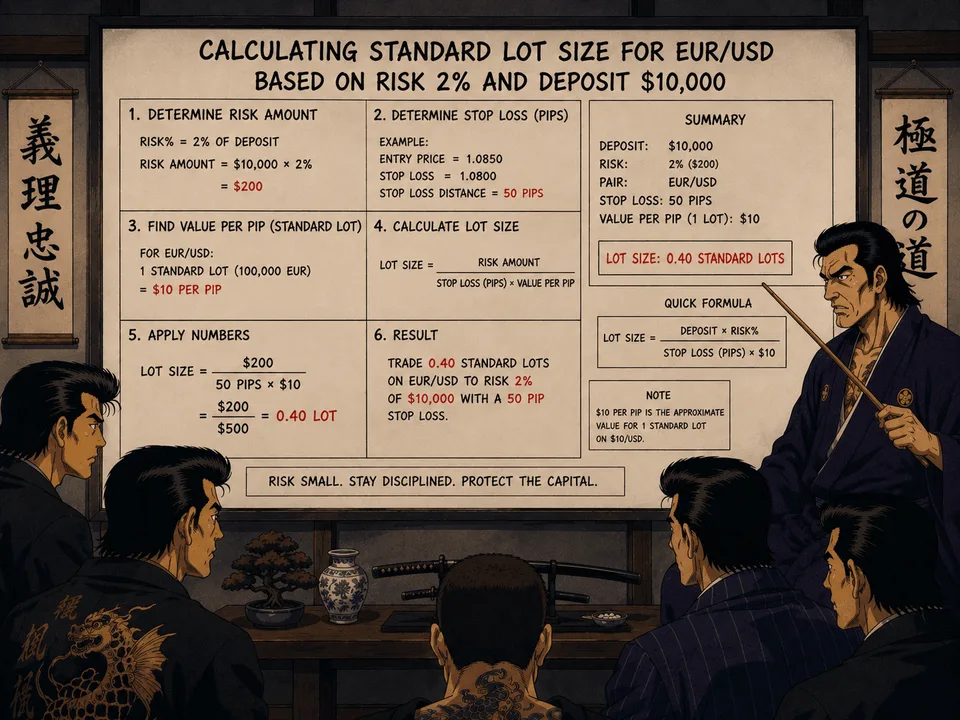
Mathematical lot calculation is only the first level of deposit protection. Calculating lot size for a risk management system looks as follows.
Calculating risk in money. For example, a $10 000 deposit, 2% risk = $200 per trade.
Calculating stop loss in points. Suppose the strategy implies the possibility of a loss of 40 points (for 4-digit quotes).
Calculating the point value for 1 lot of the traded pair. Let it be EUR/USD → $10 per point.
Calculating lot size using the formula. The following formula is used for this.
Lot=Stop (points)×Point value for 1 lot
In our example, the calculation is as follows. Lot=
40×10
200
=
400
200
=0.5 lot. When the stop is triggered, the loss will be exactly $200.
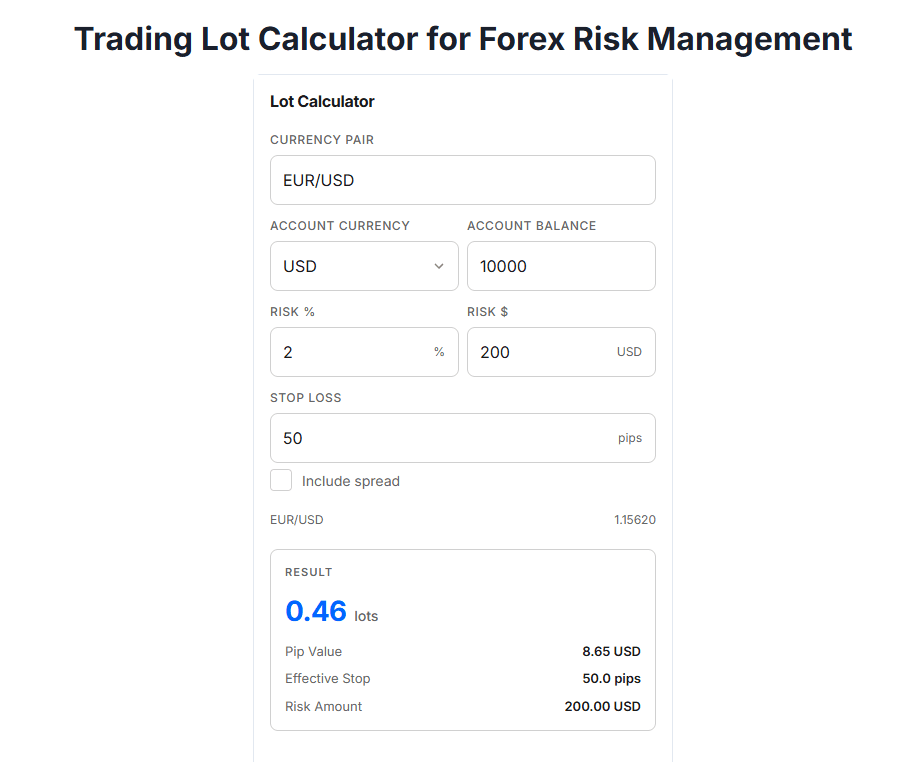
To simplify lot calculation in forex and CFDs, we developed a convenient online lot calculator, which takes into account the risk level in currency, points, and percentages of the specified deposit. Thanks to the calculator, you can accurately calculate position volume for each trade.