
Cryptocurrency market capitalization: looking at CoinMarketCap and the Fed balance sheet

Cryptocurrencies as a phenomenon appeared in the early 2010s. By the end of the decade, almost all stock exchange / forex players had heard about them, but not everyone was yet ready to invest in crypto. Institutional investors were only beginning to look at Bitcoin: in 2017, the CME exchange launched BTC futures for them.
Time passed, and the generation that grew up on cryptocurrency hype replaced the seasoned Forex market speculators. In those days there was little real liquidity, and the market cap was low. This gave unlimited opportunities for a pump even to players with several thousand dollars in their pockets.
After 2020, serious speculators with very large bags of money came into crypto, which sharply increased the capitalization of cryptocurrencies. It would seem, what could be simpler: speculative money came in, bought up coins at market, raised the price, and everyone is happy. But there are always nuances.
In the article:
- We will discuss the features of cryptocurrency capitalization, where and how to view it.
- We will determine crypto's place among various asset classes through the lens of market capitalization.
- We will explain why and how crypto market cap is connected with the Fed balance sheet.
- We will talk about the speculative nature of cryptocurrency capitalization.
Where to look at market cap
Market capitalization (or Market Cap) is the total value of a company or project at the moment. The calculation formula is understandable even to an elementary school student:
Capitalization = Current price of one coin × Total number of coins
In the world of cryptocurrencies, the market cap metric is very important because it helps distinguish the “monsters” from the “bubbles.” There are hundreds and thousands of times more of the latter than of the former.
If the price of one coin is 1 dollar, that says nothing. A price of 1000 dollars per coin also says nothing if it is unknown how many coins are available on the market. If 1 billion coins at one dollar and 1000 coins at $1000 are available on the market, then the market cap of the first coin is 1000 times higher than that of the second.
In fact, the concept of capitalization is broader and includes:
- Market Cap (regular). Price × the number of those coins/shares that are already in free circulation.
- Fully Diluted Valuation (FDV). Price × the future number of ALL issued coins (including even those that are still locked).
- Circulating Supply. The number of “live” coins in circulation at the current time (not to be confused with Total Supply).
The best resource for evaluating the capitalization of cryptocurrencies is coinmarketcap.
What to look at on Market Cap and why
Comparing scales
You can compare Bitcoin and some coin.
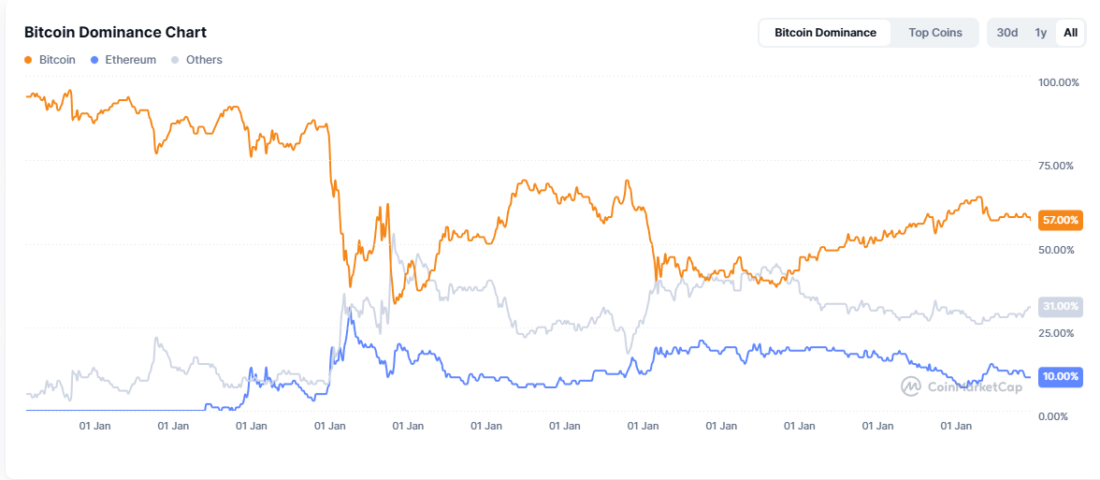
But how can you compare Bitcoin with some new coin if it occupies 57% of the crypto market by capitalization? Correct, no way. Bitcoin can only be compared with the total capitalization of all alts, and then we will be able to determine altseason: a time when Bitcoin's share of capitalization decreases slightly relative to the total capitalization of crypto.
For comparison, you can use the Bitcoin dominance index, which shows this well.
But let's get back to market capitalization. By capitalization size, coins can be divided into the following categories:
Large capitalization (large cap) — Bitcoin and Ethereum. To move their price, huge amounts of money by crypto market standards are needed. It is hard to crash them with one piece of news, but they also cannot suddenly grow 10 times, because they are too large from the crypto market's point of view. They are considered more reliable.
Coins with capitalization from $4 billion can also be included here.
Medium capitalization (mid cap) — Solana, Cardano, etc. Their volatility is higher both intraday and as a percentage of value, so the risks are also higher. But these are good instruments with predictable parameters. The size of a mid cap is from $100 million.
Small capitalization (small cap) — all the trash, but not only that: the TRUMP coin is here too. With low capitalization, it is much easier for a “whale” to manipulate the market. Hence pump&dump: carefully buy up or, even more fun, issue a coin, promote it through posts on X, and sell your coins at the top. The price will collapse simply because the capitalization is inflated and there are no real people willing to invest in the asset.
We are of the opinion that it is better to compare the capitalization of coins with good medium-cap altcoins. And under no circumstances should you get into coins with capitalization below $10 million: you can get burned very badly.
What is a good altcoin? Let us figure it out.
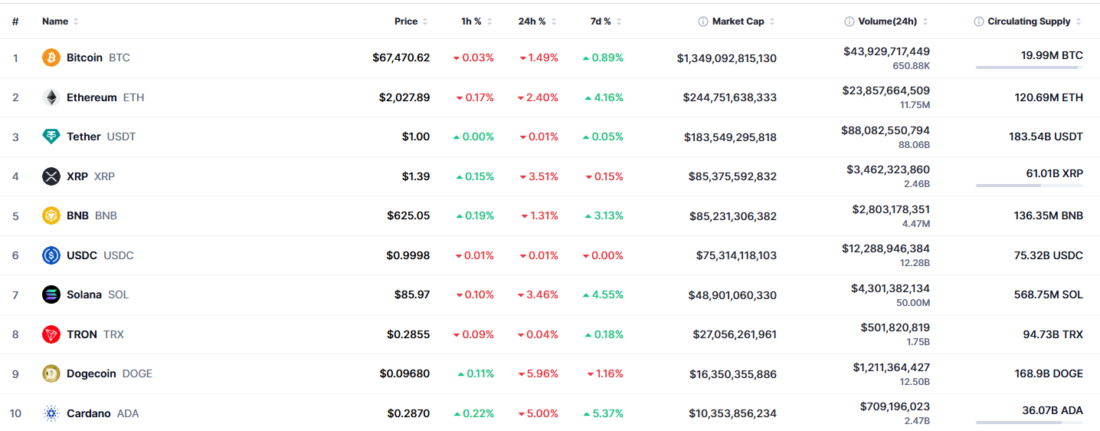
The image shows the TOP-10 cryptocurrencies and stablecoins by capitalization. We look from number 4 through number 10. If XRP and BNB have more or less decent capitalization at around $85 billion each, then SOL's capitalization is almost two times smaller, TRON's is more than 3 times smaller, and so on.
But these are still big numbers for crypto.
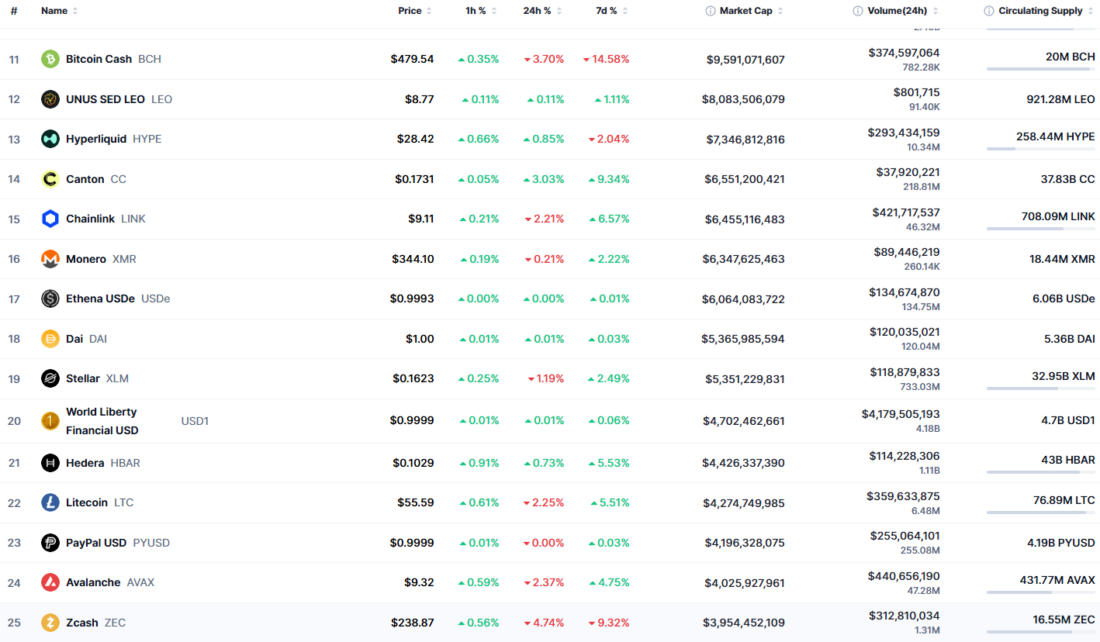
The next 15 coins (TOP-11 to TOP-25) have a market cap from $9.5 billion to $4 billion. It looks pretty good.
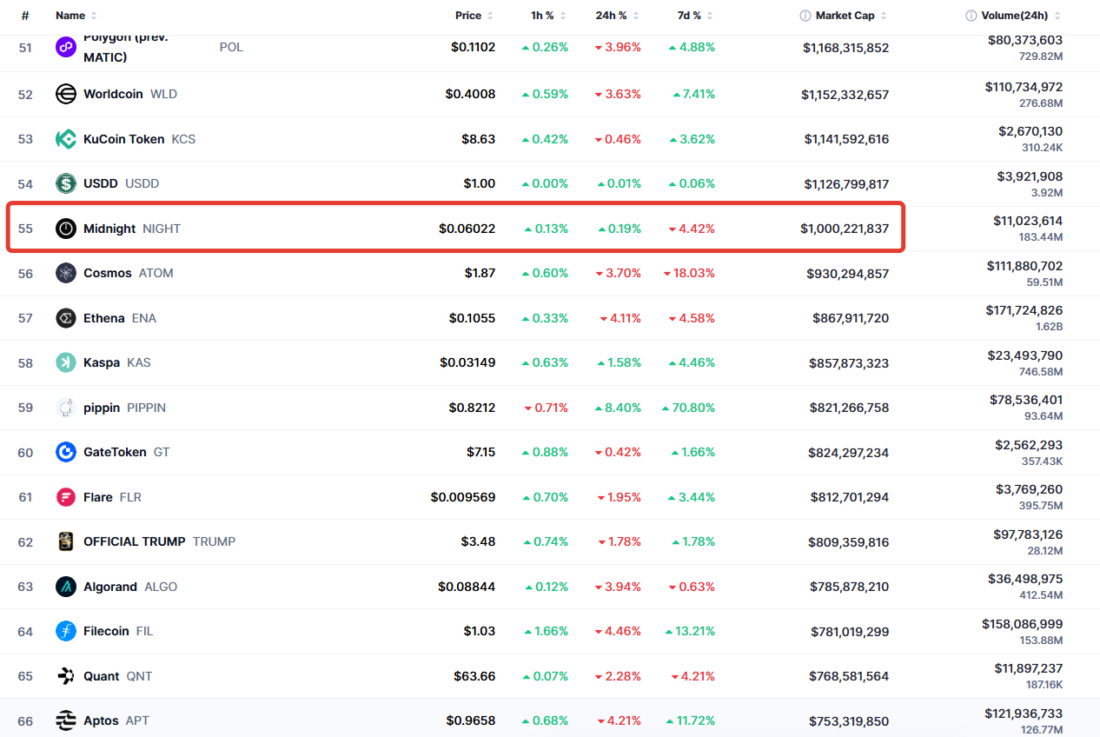
NIGHT is the last coin whose market cap is above a billion. It is 55th in the ranking. And the 66th coin has a market capitalization of $750 million.
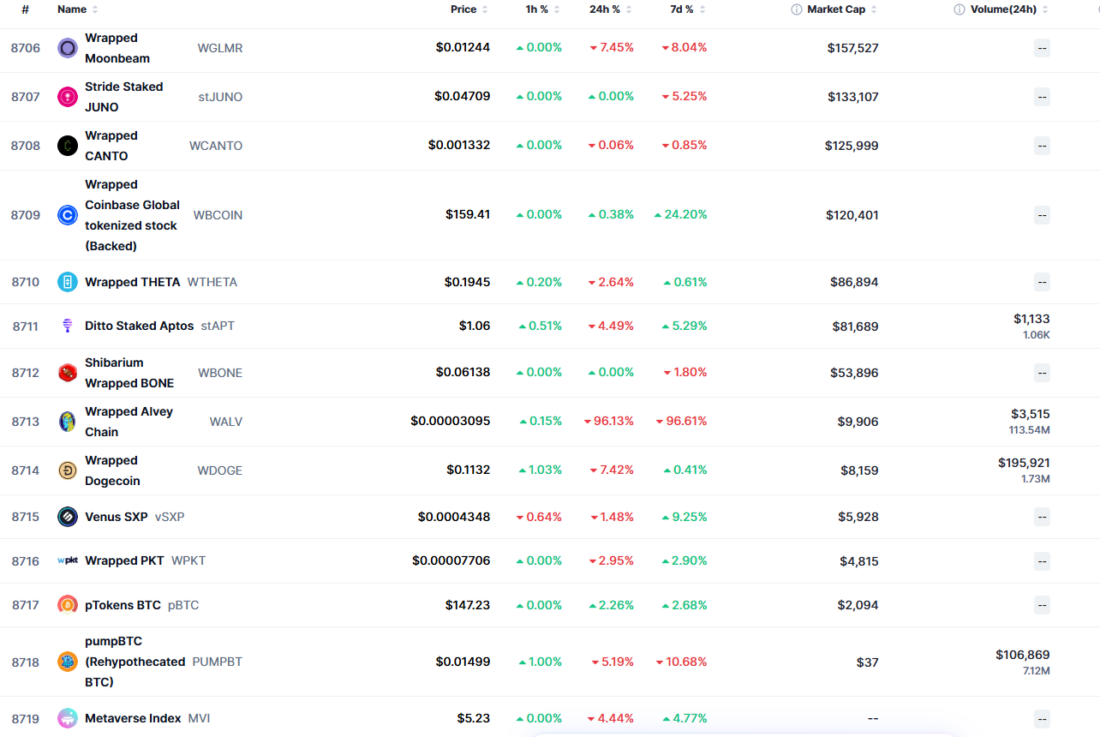
In total, coinmarketcap presents the capitalization of 8731 currencies. The last coins in the list look like this:
Assessing Risks and Reliability
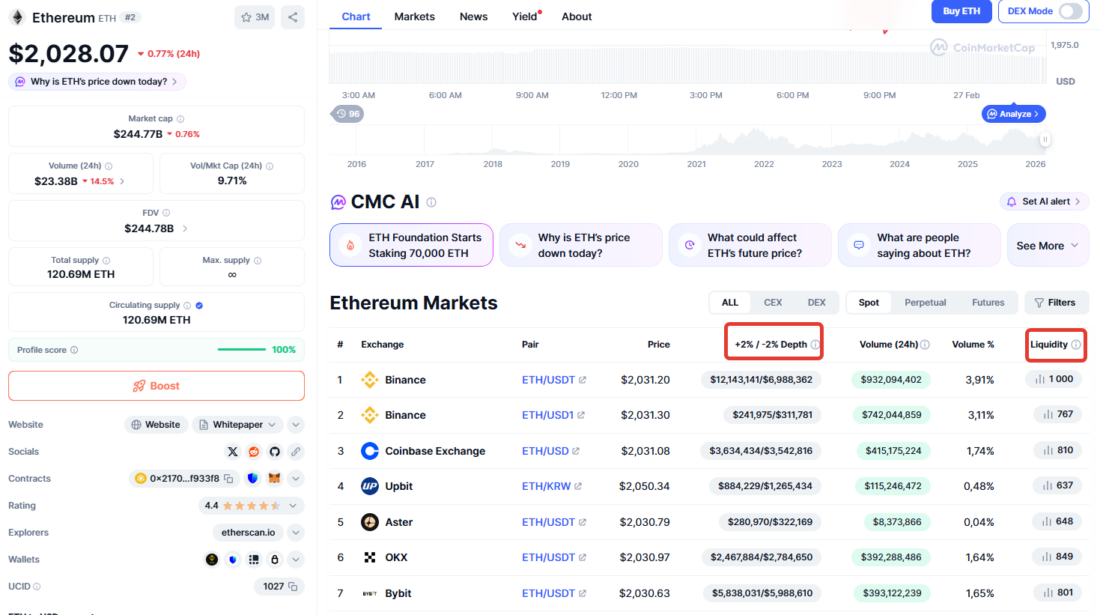
You can quickly assess risks on CoinMarketCap using the Liquidity and +2% / -2% Depth indicators.
The first indicator has values from 1 to 1000 and shows how available liquidity is on the instrument: the higher, the better. In essence, we are talking about the order book (depth of market).
The second indicator shows how much liquidity needs to be poured into the market to move the price by 2%, which ultimately also reflects the presence of liquidity in the order book, simply from the other side.
Let us consider ETH. Everything is fine here with overall liquidity on the leading exchanges. It is amusing that on Bybit, for example, to move the quote by +2% you need to pour in $5.84 million, while on Aster only $280 thousand is enough. Colossal arbitrage opportunities.
And now let us look at the cryptocurrency IoTeX, which occupies the honorable 402nd place by capitalization:
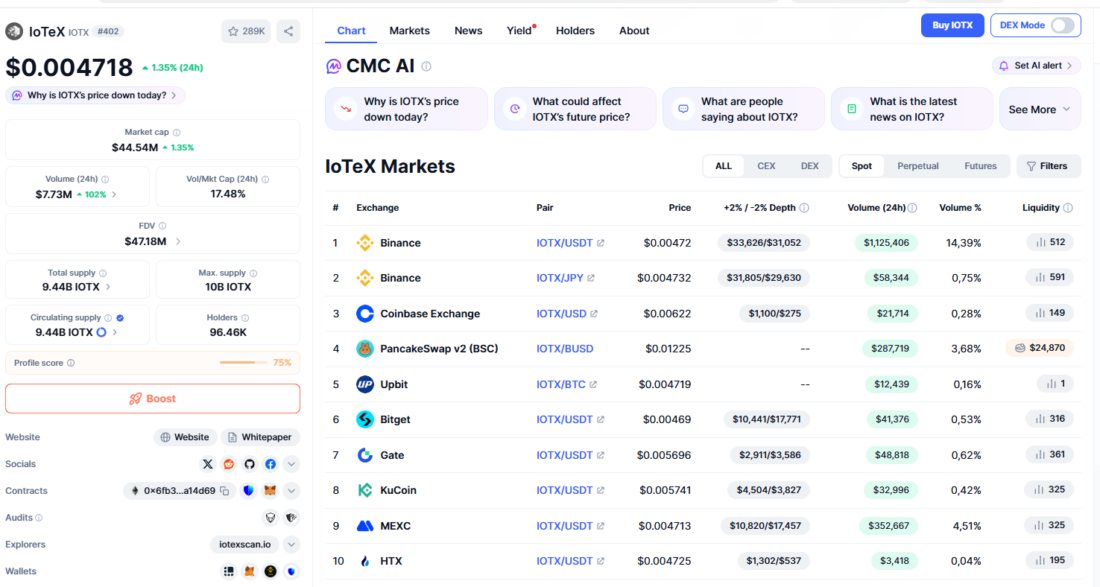
With a total capitalization of $44.54 million, we see some liquidity problems (often an inability to open a trade at the terminal price) and the amount of money required to move the quote by 2%. On the HTX exchange, for example, it is enough to pour in $537 for the IoTeX price to drop by a substantial 2%. In general, it is dangerous to work with such a coin.
And here, for example, is RAIN (number 201 in the market cap list, $4.49 billion). With liquidity, despite the decent capitalization, there are obvious problems. To move the quote by 2%, you need to pour roughly the same amount into the market as for IoTeX.
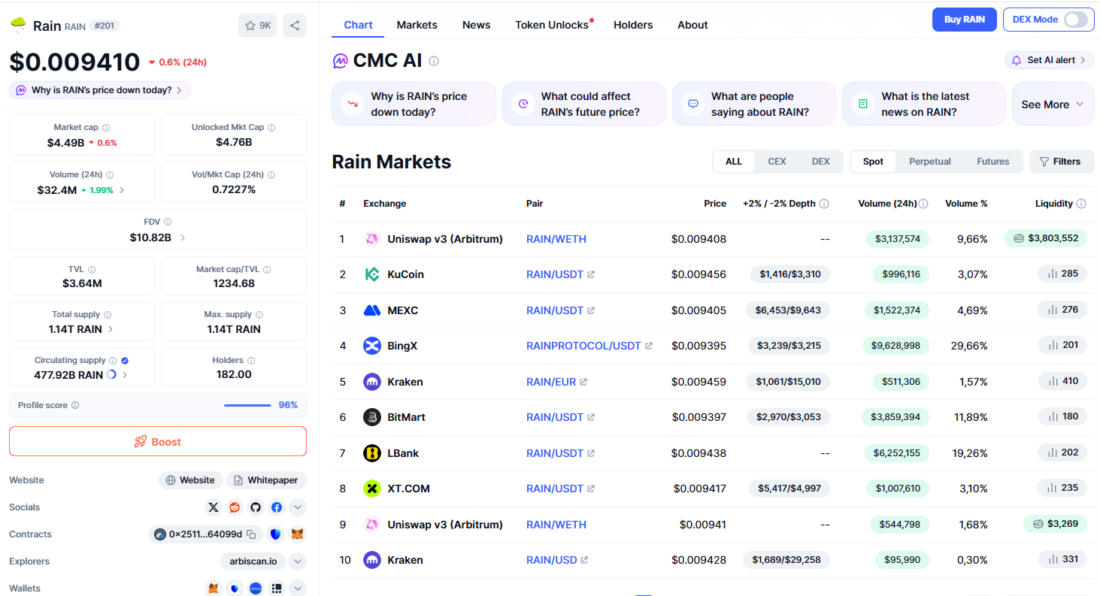
And do not forget to look at daily volumes: the higher the volume, the more money there is and the better the liquidity situation, which means it is easier to enter and easier to exit.
In general, everything is clear here.
And what about Trump?
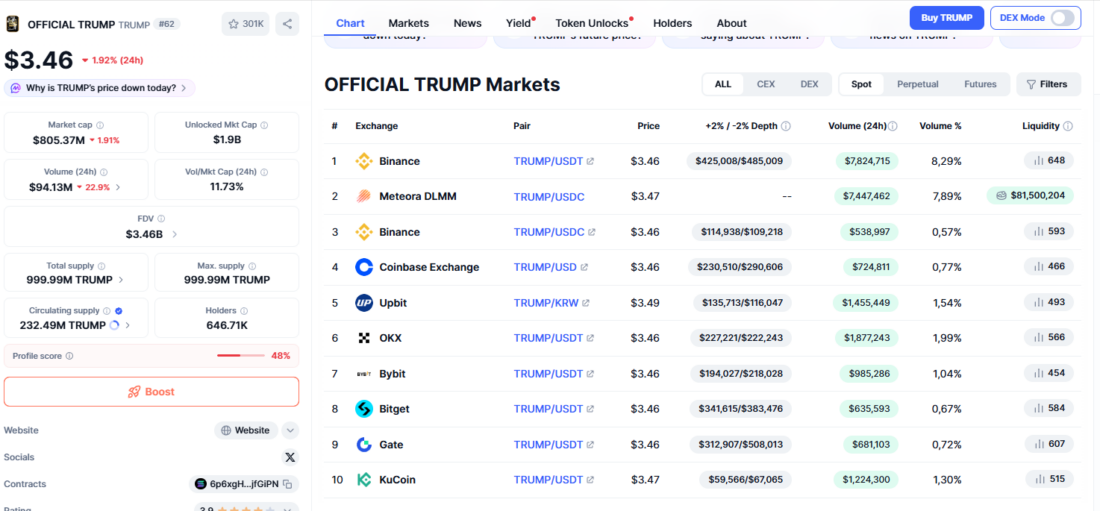
Liquidity is average, capitalization is less than a billion, but to move the quote by 2% you need a lot of money. It is strange to see such amounts required to move the quote with a small capitalization and average liquidity indicator readings. Something is off here.
A Brief Excursion into the Recent History of Crypto Capitalization
The younger generation of traders is convinced that crypto is very, very important. It is time to show crypto's real place in the world.
And its place is this: the capitalization of all crypto is smaller than the capitalization of art and collectibles.
But let us go through everything in order. The total capitalization of crypto at the time of writing is $2.33 trillion.
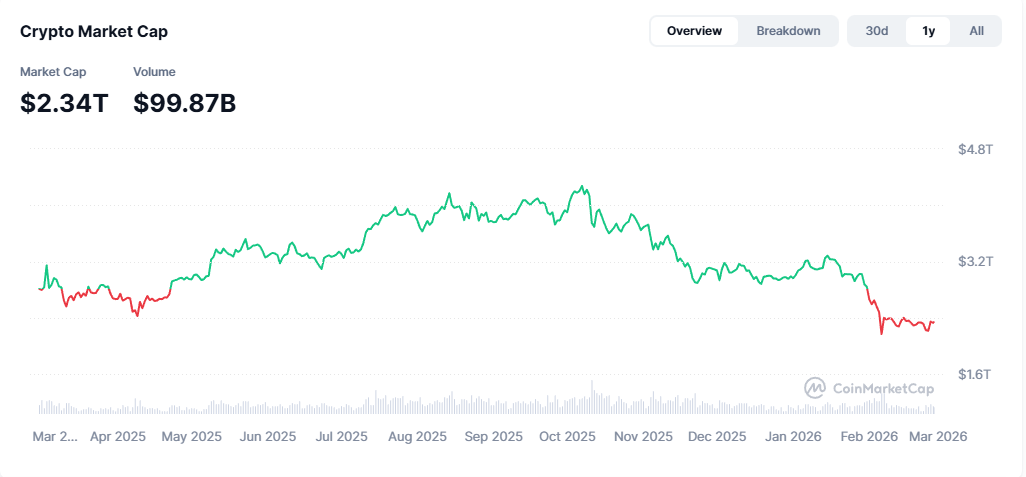
Cryptocurrencies reached their historical peak in capitalization in October 2025 - $4.38 trillion. For crypto people, that is a lot of money on the screen, and for some, in their pocket too.
But $4.38 trillion at the peak is only 6.2% of the capitalization of the U.S. stock market (stocks, bonds, ETF). After the crash at the beginning of 2026 by 47.5%, the overall market cap fell to a modest $2.3 trillion. And U.S. funds then lost about $2 trillion, i.e. less than 1.5%.
The decline in capitalization in dollars is comparable, but in percentage terms it is completely incomparable.
| Period | Crypto | U.S. stocks | Crypto / U.S. ratio | Crypto change over the period |
|---|---|---|---|---|
| October 2025 (peak) | $4.38 trillion | $71 trillion | 6.2% | — |
| February 2026 | $2.30 trillion | $69 trillion | 3.3% | -47.5% |
What can crypto capitalization be compared with?
For example, with the capitalization of the German stock market (≈ $2.75-2.85 trillion USD) or France (≈ $3.42 trillion USD). At the peak of capitalization, it could be compared with India (≈ $5.3 trillion USD).
In general, the entire crypto market is a good mid cap by global standards if compared with the stock markets of developed or large states.
A little above, I said that the market cap of art and collectibles is higher than the market cap of crypto. Well then, Christie's, Sotheby's, and private collections amount to a modest $6.5 trillion in capitalization.
| Rank | Asset class | Value (trillion USD) | % of global (~820 trillion) | Comment |
|---|---|---|---|---|
| 1 | Global real estate (housing, commercial, land) | 410 | 50.0% | Humanity's largest asset. Grows by 3-5% per year |
| 2 | Global stock market (all stocks in the world) | 135 | 16.5% | U.S. - 51%, Japan 6%, China 11%, India 3.8% |
| 3 | Global bonds (government + corporate) | 130 | 15.9% | Including U.S. Treasuries (~28 trillion) and Chinese government bonds |
| 4 | Cash and bank deposits | 95 | 11.6% | Money in accounts, deposits, money-market funds |
| 5 | Gold (all mined) | 35.9 | 4.4% | 216,000 tons x $5,187 per ounce |
| 6 | Private equity and venture capital (Private Equity + VC) | 15 | 1.8% | Non-traded companies, buyouts, startups |
| 7 | Art, collectibles, wine | 6.5 | 0.8% | Christie's, Sotheby's + private collections |
| 8 | Silver (all mined) | 4.9 | 0.6% | ~1.8 billion kg x $87 per ounce |
| 9 | Other commodities (oil, copper, gas, etc.) | 12 | 1.5% | Physical reserves + futures |
| 10 | Cryptocurrencies (entire market) | 2.30 | 0.28% | Bitcoin ~1.35 trillion + ETH + altcoins |
But at the same time crypto is the fastest-growing asset class. Since 2020, the share of cryptocurrencies has grown from 0.05% to 0.28% of global assets - the fastest growth, though during a period of unrestrained money printing. As soon as a liquidity shortage appears in the system, crypto is first in line for a sharp drop in capitalization. And that is a serious indicator of heightened speculation.
The Dependence of Crypto Capitalization on the Fed's "Printing Press"
If the central bank "prints" trillions of dollars and buys bonds, this is called QE (Quantitative Easing). The Fed first launched QE in 2009. In 2020, amid the covid-19 pandemic, the Fed injected trillions. There was so much money that it flowed into the trashiest trash: NFT and so on.
Before 2020, crypto was growing mainly because of retail hype. After 2020, the main driver became the availability and volume of liquidity. When the Fed prints, crypto takes off. When it takes money back (QT), it falls.
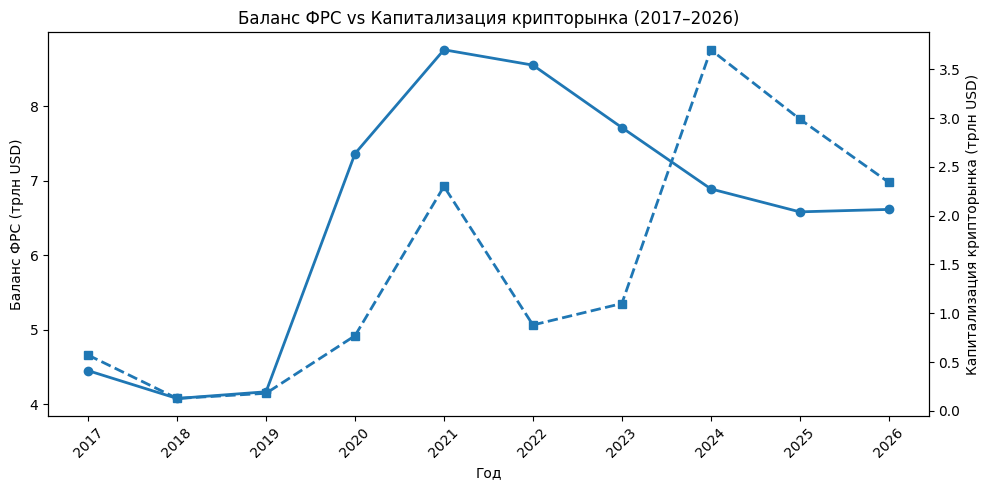
The chart clearly shows that after covid, crypto capitalization grew together with the QE program. As soon as the Fed stopped printing money, a pullback began in crypto.
The last impulse came against the backdrop of a decline in the Fed's balance sheet. Could everything really be so good that crypto has stopped being an exclusively speculative instrument?
No, crypto has not ceased to be primarily a speculative asset. Although its significance as a substitute for the dollar has grown since 2022, that was not what caused the latest pump.
From 2020 to 2022, the Fed printed so much money that speculators had enough of it until the end of 2025. And then the money ran out, and it became impossible to keep pumping speculative assets. On top of that, geopolitical tension led real money to flow into gold.
In general, the supply of liquidity is not infinite, and by the end of 2025 - the beginning of 2026, there was almost no free money left to drive up crypto capitalization.
The Speculative Nature of Crypto Capitalization
Based on all of the above, it is easy to conclude that cryptocurrencies have a clearly pronounced speculative nature, which often dominates their utilitarian functions (means of payment, decentralized applications). This means that the main price driver is not so much their practical application as the fear and greed of speculators.
Here are the main factors explaining why cryptocurrencies are a highly speculative asset:
1. Extreme volatility
Cryptocurrency exchange rate fluctuations can reach tens of percent in a single day. While the prices of large-company stocks or currencies rarely change by more than 1-3% per day, for altcoins a 10-20% rise in 24 hours or a 30-40% drop in a week is common.
2. Lack of "fundamental" value
Unlike stocks (which grant a share in a company) or bonds (which guarantee debt repayment), most cryptocurrencies are not tied to a real cash flow. Their price is determined solely by the balance of supply and demand:
- Demand: If people stop buying the coin tomorrow, it could lose all value and fall to zero.
- Value: Value is often calculated on the basis of hype, theories, and expectations ("imagined value").
3. The influence of news and "hype"

The price of cryptocurrencies depends heavily on the information backdrop:
- Positive: Elon Musk's tweet, the launch of an ETF (exchange-traded fund), or legalization in some country lead to explosive growth.
- Negative: Bans in China, an exchange hack, or rumors of regulatory claims in the US crash the market.
This creates an ideal environment for speculation: buy on rumors, sell on facts.
4. Low entry threshold and "success stories"

The ease of buying cryptocurrency (from a smartphone) and the huge number of stories about people who "got rich overnight" on memecoins (like Dogecoin or Shiba Inu) attract masses of inexperienced investors. These investors are driven by fear of missing out (FOMO), which inflates bubbles even more.
5. Margin trading and leverage
Crypto exchanges offer huge leverage (x10, x25, x100), allowing traders to open positions for amounts many times greater than their own capital. This multiplies both potential profit and risk many times over (with even the slightest move in the opposite direction, the position can be forcibly closed with the loss of all funds).
6. The role of "whales"
The cryptocurrency market is less regulated and more concentrated than traditional markets. Large holders ("whales") can manipulate the market: artificially sell large volumes to push the price down and trigger panic (forcing small traders to sell the asset cheaply), and then buy it back.
Conclusion
Market Cap is the most important indicator when choosing a cryptocurrency for speculation.
When searching for a ticker for speculation, you need to look not only at total capitalization, but also at daily trading volumes, liquidity indicators, and the amounts needed to move the quote by 2%.
Depending on the ratios of these parameters, you can select more or less calm instruments and assess the possibility of opening/closing trades at prices in the order window, rather than at random prices with slippage of almost a % of the quote.
Together with coinmarketcap, do not forget to look at other resources (Arkham, Deribit, etc.) for a more complete picture. By combining data, you can sharply improve the quality of swing trading strategies.
But all of this is relevant at those moments when the Fed turns on the printing press. If the press is not on, you should not expect tens of percent on quality coins; you can count on 5-10%, no more. This is roughly the level of oil volatility and many times higher than the volatility of the US stock market.