
How to Monitor the Activity of Miners, Whales, and Funds Through Arkham

In the world of cryptocurrency, information is money. While most beginners trade using charts, news, and intuition, experienced traders look "under the hood" of the blockchain. They see where whales, funds, and exchanges are moving billions of dollars. This is exactly where Arkham Intelligence enters the scene as the most powerful platform for deanonymizing on-chain data.
Arkham turns anonymous wallet addresses into recognizable names: BlackRock, MicroStrategy, Vitalik Buterin, Satoshi Nakamoto. For a beginner trader, this is like getting access to a "closed Wall Street database" in real time.
In this article, we will break down what Arkham is, how to use it, how to make money with it, and what pitfalls await beginners.
What Arkham Is and Why a Trader Needs It
Arkham Intelligence is the American company Arkham Intelligence, Inc., founded in January 2020 by Miguel Morel in San Francisco. The headquarters is located in the Dominican Republic, and the main global offices are in London and New York. Among the investors are Sam Altman (OpenAI), Tim Draper, Joe Lonsdale (Palantir), and others.

In 2022, Arkham exposed Celsius Network's debts, tracked the $477 million FTX hack, and helped prosecutors with Sam Bankman-Fried's money.
In February 2026, rumors began circulating about the closure of the Arkham exchange, but the company denied them and announced a transition to a fully decentralized model. Intel remains the company's core product.
Arkham has already helped track Germany's sale of BTC worth $2+ billion, the Mt.Gox distribution, hacker fund movements, and much more.
The Arkham platform solves crypto's main problem: anonymity. The blockchain is public, but addresses look like a random set of letters and numbers. Arkham uses the ULTRA artificial intelligence system, which matches wallets with exchanges, funds, companies, investors, and even government entities.

As of February 2026, Arkham tracks thousands of wallets across dozens of blockchains (Ethereum, Bitcoin, Solana, Arbitrum, Base, Polygon, and others), and the platform itself is used by millions of traders, investors, and journalists.
The Arkham platform can be roughly divided into two parts:
- Arkham Intel (intel.arkm.com) - free / conditionally free analytics (the main tool for beginners).
- Arkham Exchange (arkm.com) - an exchange for trading with Intel integration.
Why is Arkham a must-have for beginners? Because on-chain data provides a real advantage, since it shows major purchases / sales before they affect the price.
A Few Words About ULTRA
ULTRA is Arkham Intelligence's proprietary AI system, launched back in 2020-2021. The full name in the official documents is:
- "proprietary AI-powered algorithmic address matching engine"
- "AI system for blockchain data synthesis"
This is not an ordinary explorer like Etherscan, but rather a smart engine that:
- collects data from the entire blockchain and from the outside world,
- analyzes billions of transactions,
- automatically determines who owns each address,
- combines related addresses into a single "entity."
In February 2026, ULTRA processed more than 300 million labels and created more than 150,000 pages for wallets / organizations / coins, and so on. This is the largest catalog of crypto identities in the world.
Arkham describes ULTRA's actions as three sequential steps:
Stage 1. Collection (Data Collection). ULTRA continuously scans:
- On-chain (data directly from the blockchain): all transactions on Ethereum, Bitcoin, Solana, Base, Arbitrum, Tron, etc. The recorded data includes amounts, sending time, sender/recipient addresses, gas, and so on.
- Off-chain (external data): tweets, Telegram posts, court documents, KYC leaks, exchange announcements, fund reports, news, and more.
Information is collected 24/7 through a distributed network of nodes. Nothing gets missed.
Stage 2. Aggregation / Synthesis (Aggregation and synthesis). The AI gathers all raw data into a single database. This is where the following takes place:
- data cleaning,
- duplicate removal,
- merging information from different networks (for example, an address on Ethereum plus a related one on Solana),
- creation of a unified "profile" of the entity.
The database is updated in real time, and corrections can be made to it.
Stage 3. Attribution & Matching (Identity attribution and clustering). Here the AI determines:
- Who this address belongs to.
- Which addresses belong to the same company/person.
How Arkham Intel Works: Technology and Interface
Arkham's main strength lies in deanonymization. The AI collects data from the blockchain, social media, KYC leaks, court documents, tweets, and matches it. Each address receives a label. If a label is disputed, the community can propose its own.
Main page of intel.arkm.com:
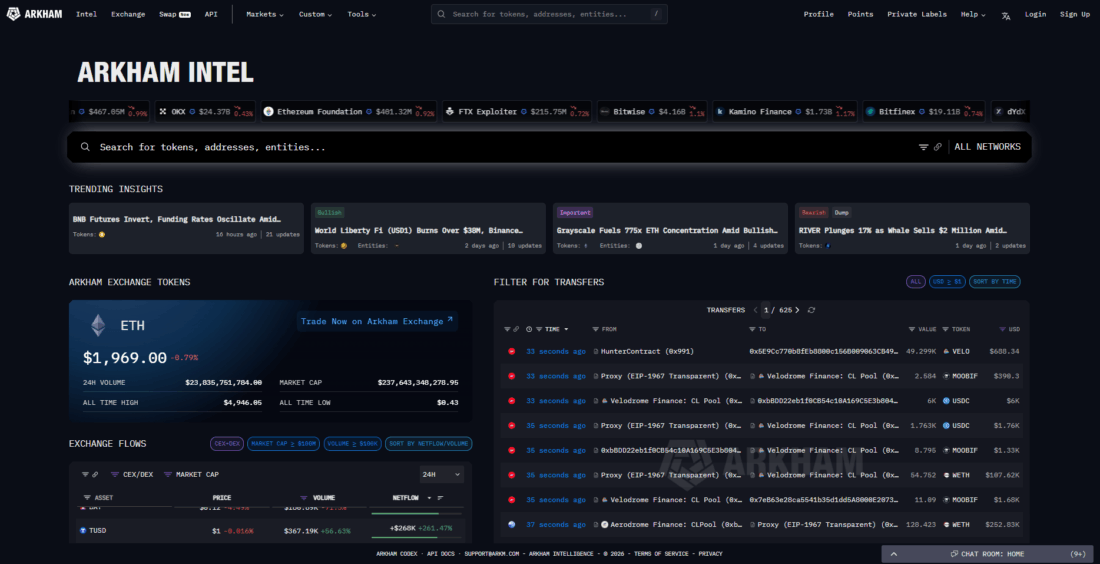
- Top bar: Markets, Custom Tools, Alerts, Tracer.
- Central section: Top wallets by AUM (Assets Under Management) - BlackRock ($58+ billion), Binance ($149+ billion), Satoshi Nakamoto ($74+ billion), etc., with 24-hour changes.
- Trending Insights: "World Liberty Fi burned $38 million," "Large inflow into ETH," and so on.
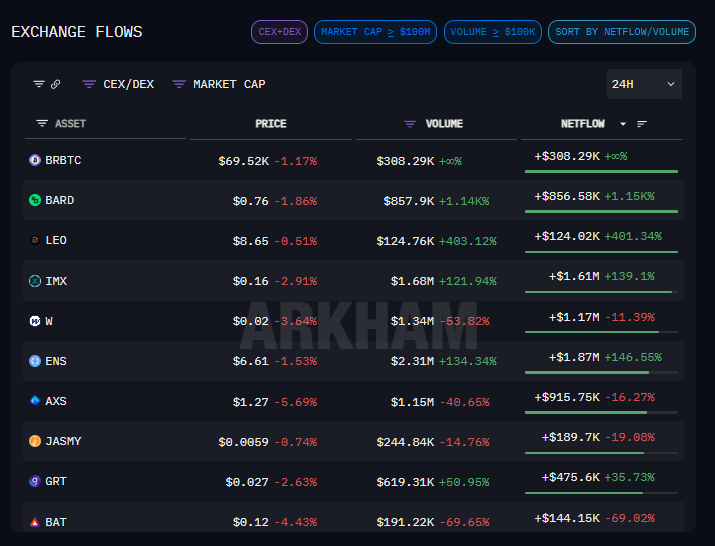
- Exchange Flows: net inflow/outflow on CEX/DEX for top tokens.
Search and Profiler. You need to enter an address, an ENS name, an address / name on X, or a name (for example, "Jump Trading," "Binance," "Vitalik Buterin").
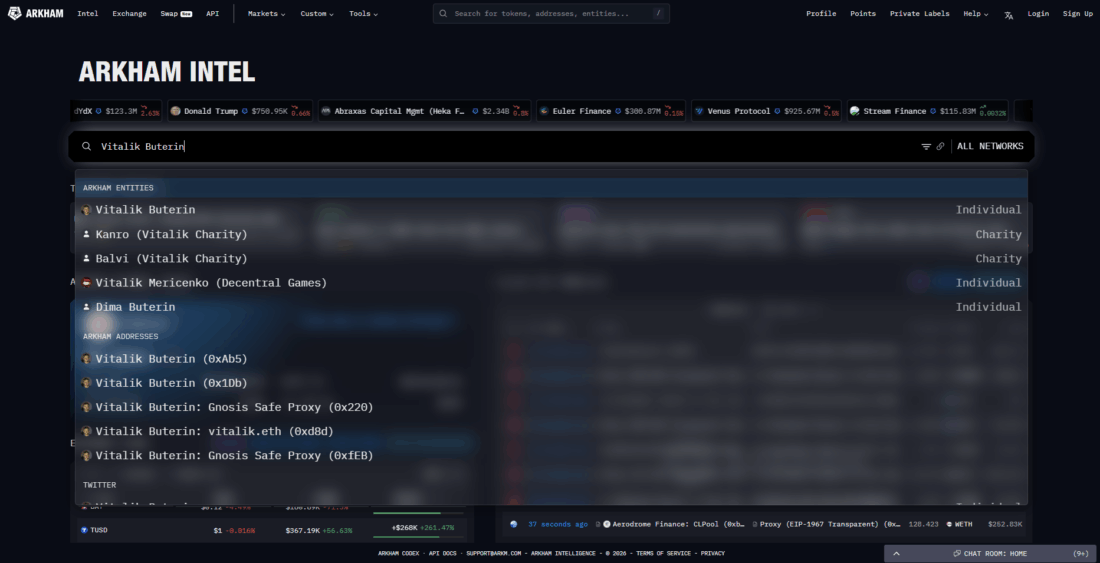
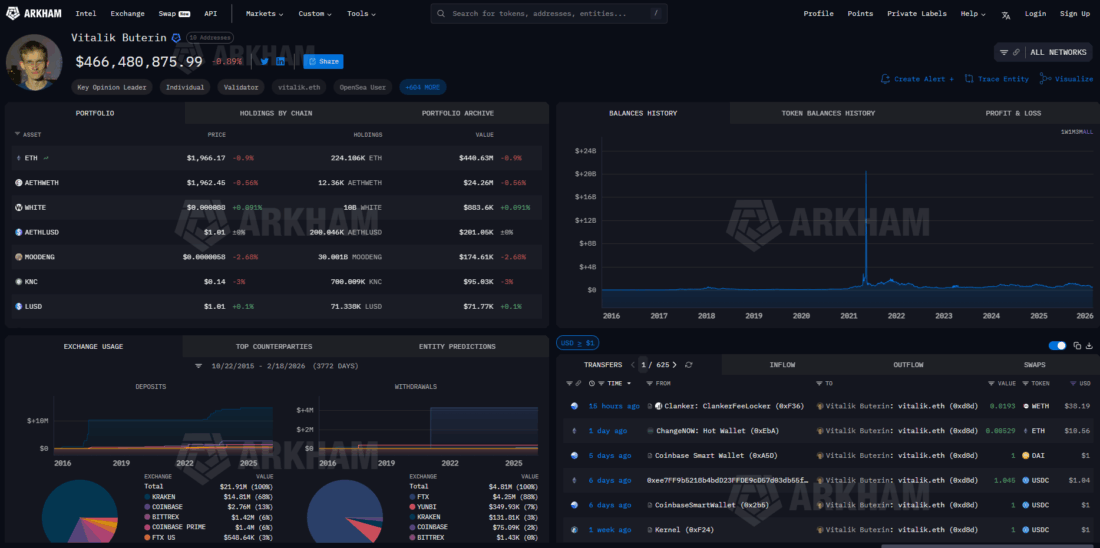
The search result shows:
- Current portfolio by chain (holdings by chain)
- Balance and P&L chart (profit/loss)
- Recent transactions (with filters by amount)
- Swap history
- Counterparties (who they trade with)
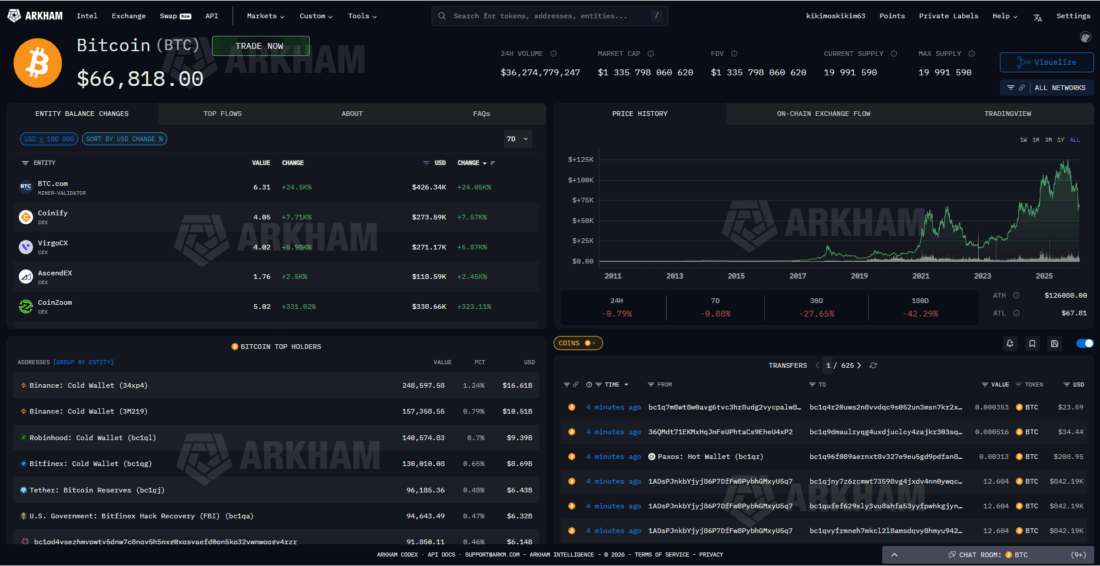
You can search not only for a profile, but also for a coin. For any token (BTC, ETH, SOL), the interface displays top holders, concentration, inflows/outflows, and large transactions.
Below is the BTC page:
Alerts (notifications). The most powerful tool for beginners.
The filter setup is quite flexible, and you can save a filter for future use.
Filtering parameters: network, time, transfer sender/recipient, number of coins (value), token, volume in USD.
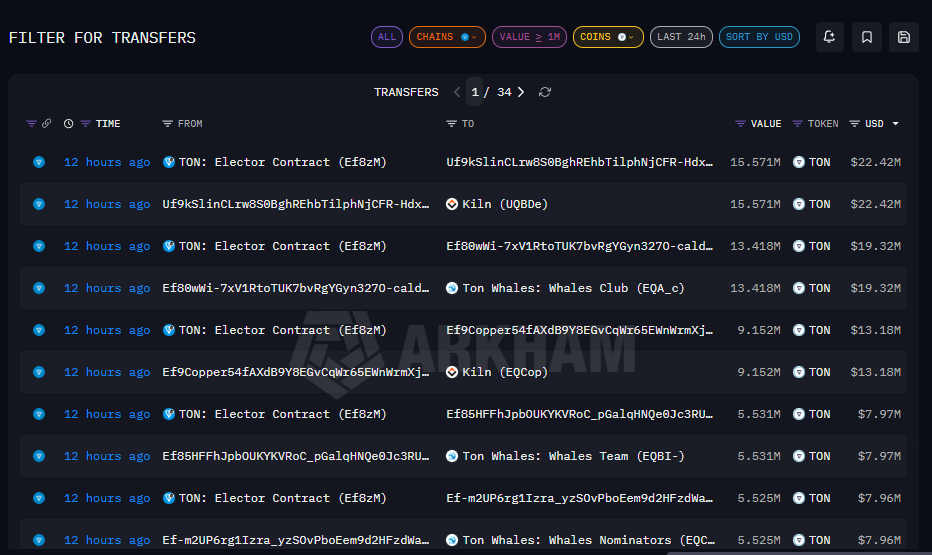
In the image above, the TON network / TON coin is selected, with transactions over the last 24 hours starting from a volume of 1000000 coins.
Markets and Exchange Flows. A real-time overview of capital movement between centralized and decentralized exchanges with customization options.
Tracer Page (flow tracer)
Visualizes the path of funds: where they came from, where they went, and which bridges they passed through. Ideal for understanding whether money is being laundered or a fund is accumulating coins.
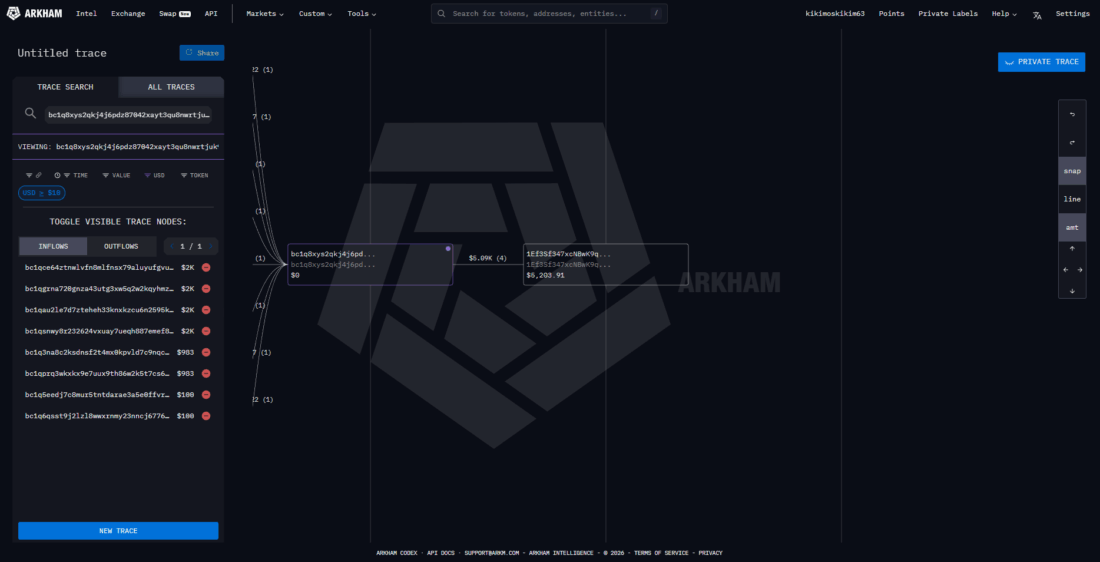
To work with it, you need to enter the address of interest into the search bar and analyze the data received.
Custom Dashboards Page
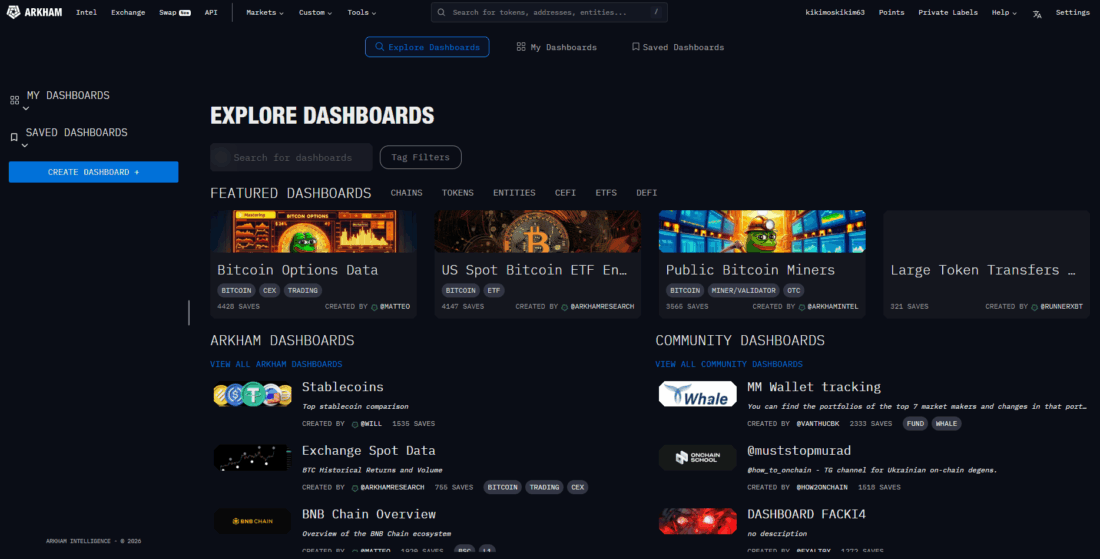
On this page, you can use popular and recommended dashboards or create your own. There is an option to add widgets: a specific fund's portfolio + a BTC chart + inflows statistics. You can make separate ones for "Institutionals," "Memes," "Hackers," and so on.
As an example, I will show what the Bitcoin Options Data dashboard looks like.
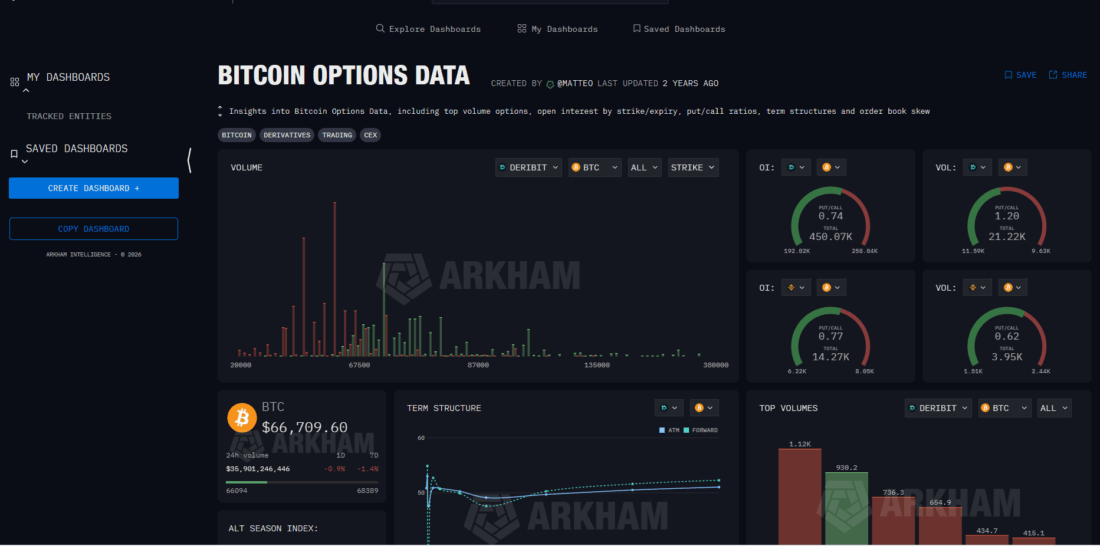
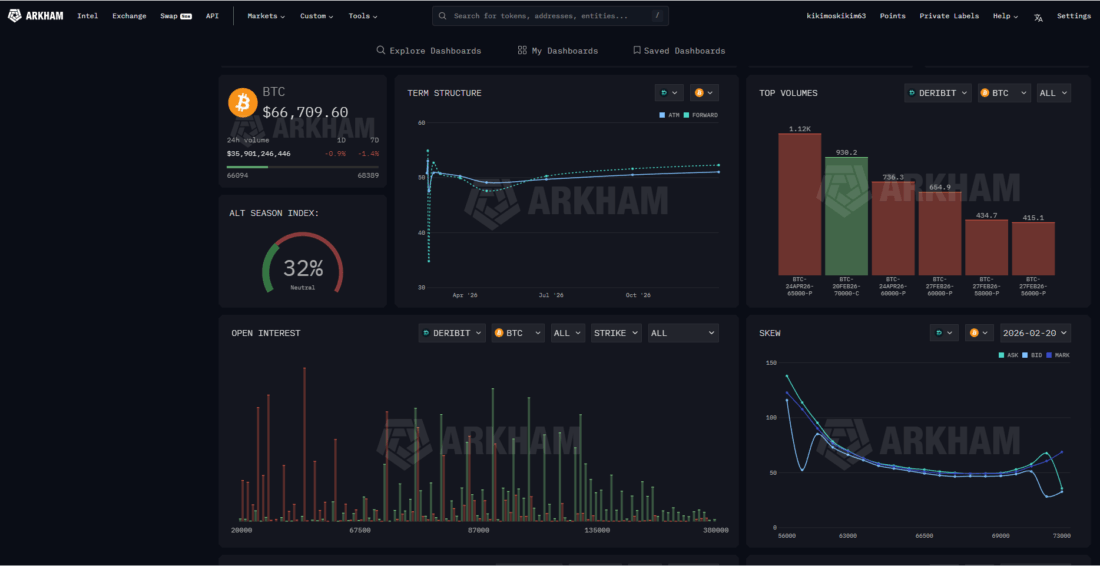
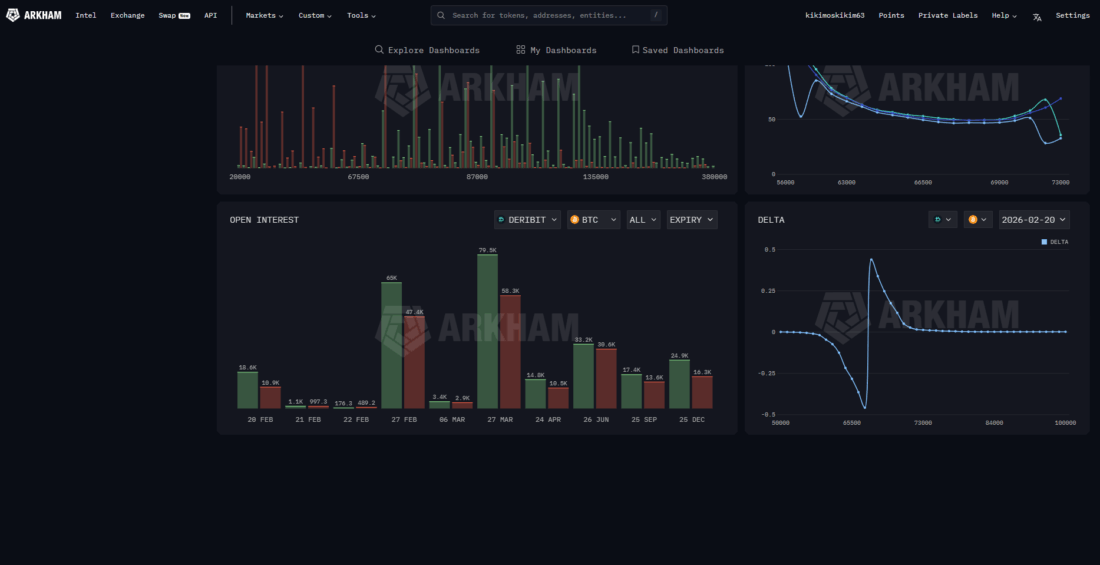
The information on this dashboard repeats the options information provided by the Deribit and Coinglass platforms.
Another dashboard is Public Bitcoin Miners:
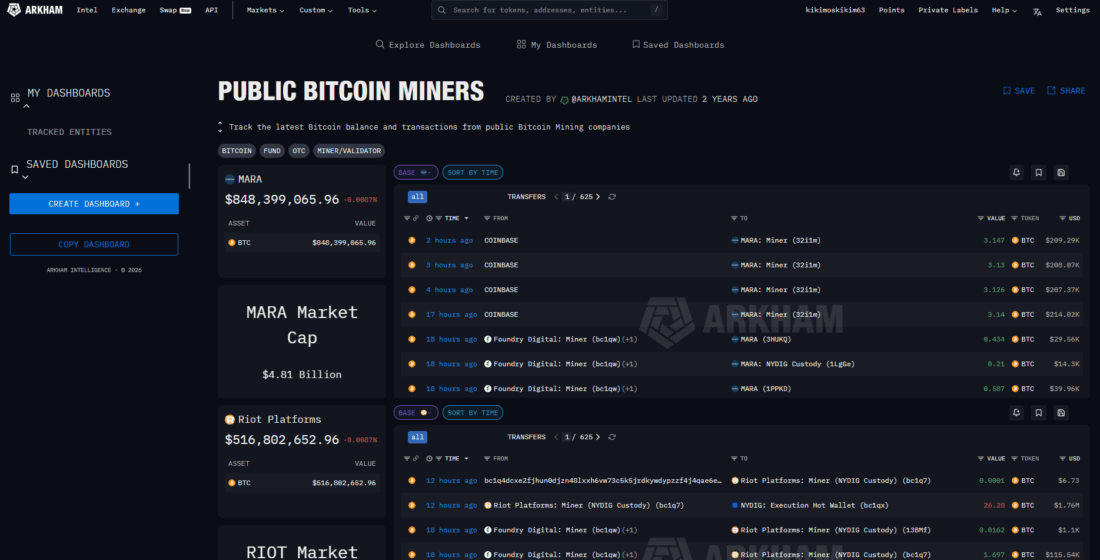
This dashboard lets you track the latest bitcoin balance, transactions, and market capitalization of bitcoin miners. Simple and useful. You can view detailed data for each miner by following the link to its profile.
Let's Summarize
Arkham Intelligence is a true intelligence center that levels the playing field for retail traders against funds. A beginner who learns to read on-chain signals will make decisions more confidently in 3–6 months than 90% of market participants.
What you need to do to start using Arkham in analysis and trading:
- Keep a journal to understand which signal produces the necessary price reaction.
- Do not blindly copy every whale's actions; they may manipulate.
- Do not trust every label without exception (AI makes mistakes).
- Do not trade your entire bankroll on a single signal.
- Remember that past movement does not guarantee the future.
- Combine the signals you receive with fundamental and technical analysis.
Practical Examples of Use in Trading
- Institutional footprint. A large BTC inflow is going to ETF wallets (BlackRock, Fidelity) - likely price growth in the coming days.
- Whale dump. A large holder (like Arthur Hayes or ZachXBT) transfers millions to an exchange - a correction is possible.
- Exchange flows. A mass outflow of USDT from Binance to wallets is a potential bullish signal (people are withdrawing to hold).
- Historical cases. In 2024, Germany sold confiscated BTC - Arkham showed the movements in real time, and many managed to exit before the dump.
- Memecoins and airdrops. Monitoring VC wallets that enter new tokens at an early stage.
- Risk management. If major sales from the top-10 holders are happening in an altcoin - it is time to lock in profits.