
Is There a New Year Rally in Forex?

Hello, fellow traders!
Probably each of us has heard the expression "Christmas" or "New Year" rally. The term refers to the US stock market, describing a seasonal powerful trend of stock indices at the end or at the beginning of the year.
National currencies and the dollar also do not stay aside, reacting to the global rise of the stock market. How the rally happens in forex, which instruments react most clearly to New Year trends, statistics of past years - all this is in our material today.
Reasons for the Rise of the Stock Market Before Christmas and New Year

Shares of 30 American companies in the oldest Dow Jones index have been showing a similar upward movement for two centuries in a row with a probability of 80%. Other stock indices repeat such movements in 65-75% of cases, being under the influence of various internal economic, commodity, national, and political factors.
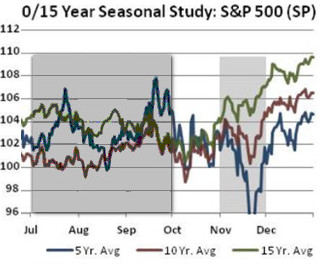
The rise in stocks, which can conventionally be divided into two pre-New Year stages, is based on subjective reasons. Christmas sales lift economic indicators of consumer demand and accelerate inflation. Speculators try to form positions in advance in order to lock in profit on the impulse growth in early December upon the release of economic statistics.
If the indicators significantly exceed analysts' expectations, and at the same time the reports of large companies for the previous three quarters showed profit growth, then the stock indices will go into a second wave of growth. Investors will buy shares in expectation of positive annual reports, which will be released immediately after the long New Year holidays.
The Forex Currency Market at Christmas and New Year

As was already said above, American exchanges have the highest probability of showing a Christmas rally. The stock market is directly connected with the national currency, and the growth of investors' appetite for risk and, as a consequence, for buying shares in the USA leads to the strengthening of the dollar in all currency pairs.
This means that with a high degree of probability at the end of November and throughout December we will observe either a decline in the rates of the other currencies, or a flat, if the local stock market grows more than the American indices.
The strength of the dollar trend in each specific pair will be determined by:
In our seasonality tool, one can observe averaged exchange-rate fluctuations of currencies broken down by months of the year. Pay attention to how they began to change over the 5- and 10-year periods relative to the longer 15-year segment. The reason for this is the pumping of national economies with "cheap loans" in recent years.
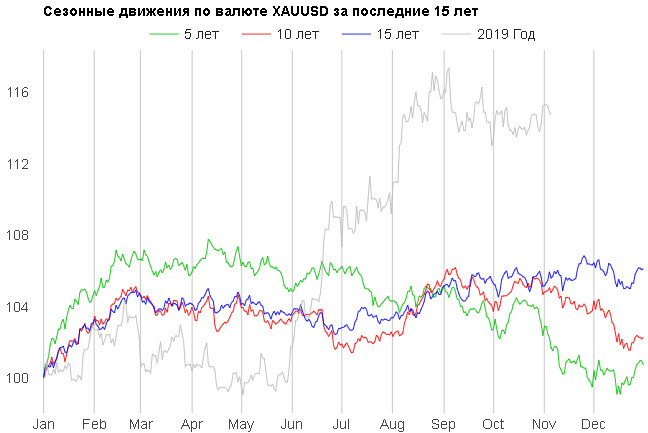
The problem is well illustrated by gold: the XAUUSD pair traditionally rose in November and was sold in December, while the freed-up investments went into buying stocks. Over the last five years gold has been losing to the dollar, just like the other currencies. With low or even zero inflation, investors prefer to buy Treasuries rather than precious metal.
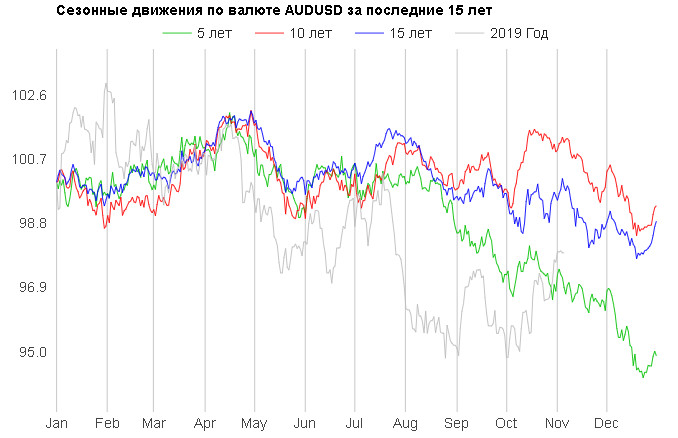
Such demand specifics hit the AUDUSD pair. The currency, dependent on gold mining, changed its 15-year seasonal downtrend to a steep dive in the last five years. Perhaps, by Thanksgiving, traders should look for an entry point into sales and try to hold the position through all of December.
Lovers of currency arbitrage may be interested in the possibility of hedging the sale of AUDUSD with a long position in NZDUSD (or buying the cross). If the Australian currency falls because of the depreciation of gold, then the economy and currency of New Zealand depend more on supplies of dairy and agricultural products.
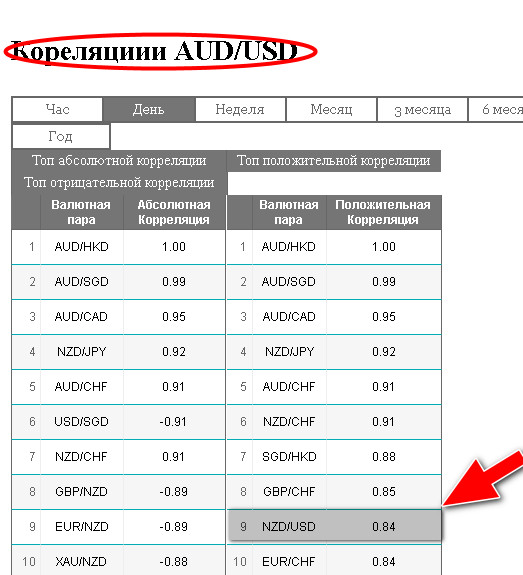
What New Year goes without a feast? In fact, retailers will stock up on goods in order to "survive the long holidays." The regional currencies AUD and NZD are linked by correlation, the indicator shows the relationship of quotes at 84%. If the AUD short starts to "go negative," the losses may be covered by the New Zealand currency.
The zero rate of the European Central Bank, economic problems, and Brexit led to growing uncertainty in the euro trend over the 10- and 5-year segments. The seasonal chart shows that medium-term traders can get caught in a "flat saw," which can lead to losses because of the absence of a clear trend together with high pre-New Year volatility.
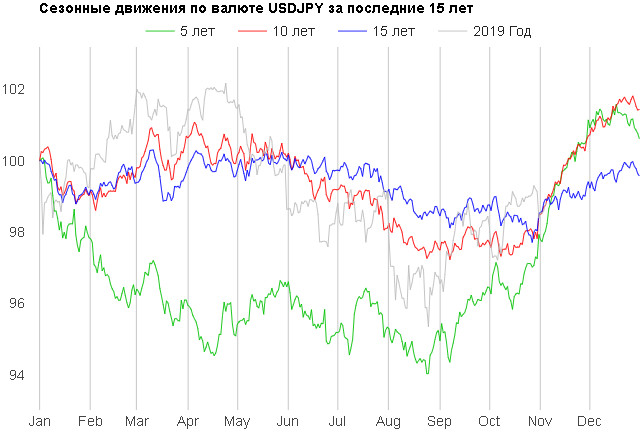
In Japan, a negative rate has existed for a long time, which has led to frequent growth of the USDJPY pair in November and December. Traders can use a reverse pyramid or grid tactics, which may justify themselves over two months.
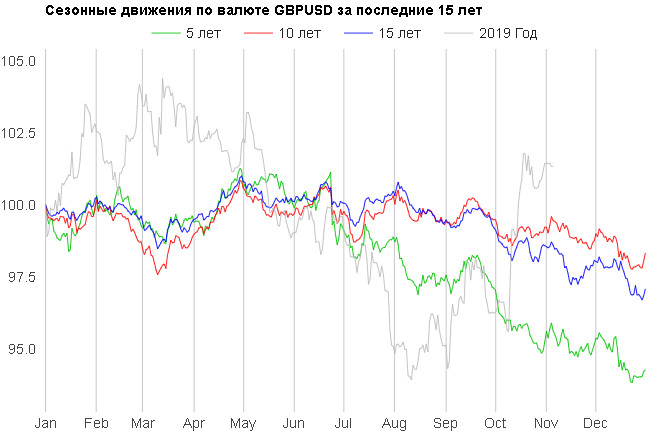
GBPUSD plays out the rally in November, when the currency is under the influence of the national stock market. The schedule of Central Bank meetings is another factor of the Christmas rally of the pound sterling. The Bank of England meets in November, when the Fed does not hold a meeting.
This year the seasonality factor may defeat Brexit; the four-year divorce from the European Union is approaching its finale, which may affect the rate and exchange rate of the currency in an unpredictable way.
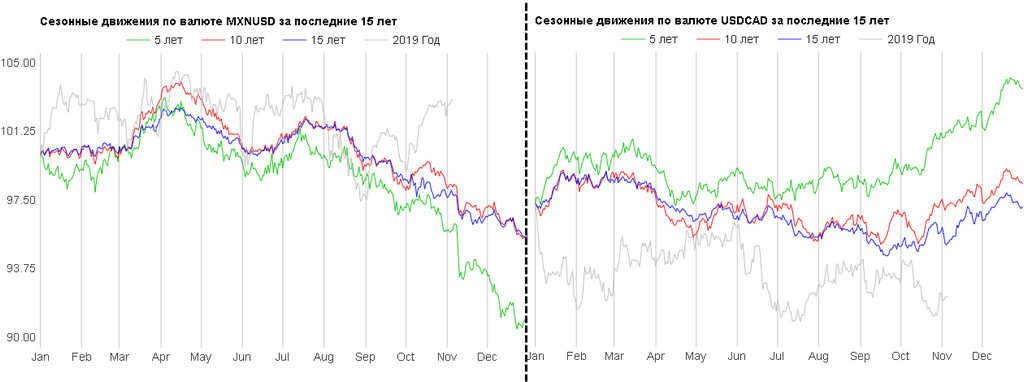
A more attractive idea may be to sell regional currencies close to the USA - the Mexican peso (USDMXN) and the Canadian dollar (USDCAD), which are under a strong negative influence of the Christmas stock rally.
The ruble also often loses ground before the New Year, but in the current situation the Russian currency may go against the usual trend, since a new round of OPEC+ oil production cuts is expected at the December meeting of the participants in the expanded agreement with the cartel.
Rublealso often loses ground on New Year's Eve, but in relation to the current situation, the Russian currency may go against the usual trend, as a new round of production cuts is expectedoilOPEC+ at the December meeting of participants in the expanded agreement with the cartel.
How often does the pattern of the winter rally in the Forex market work out?

The figure below marks the November-January intervals from 1999 to 2018 for the S&P 500 stock index. Over 20 years, the rally failed 5 times, and if one takes into account entry in an unambiguously crisis year - 6 times, which puts the strategy among average trading tactics.
If one applies a similar simple method of checking the effectiveness of rally entries to the USDCAD pair, the result will be worse: over 15 years, in 50% of cases the trend did not justify the expectations of traders.
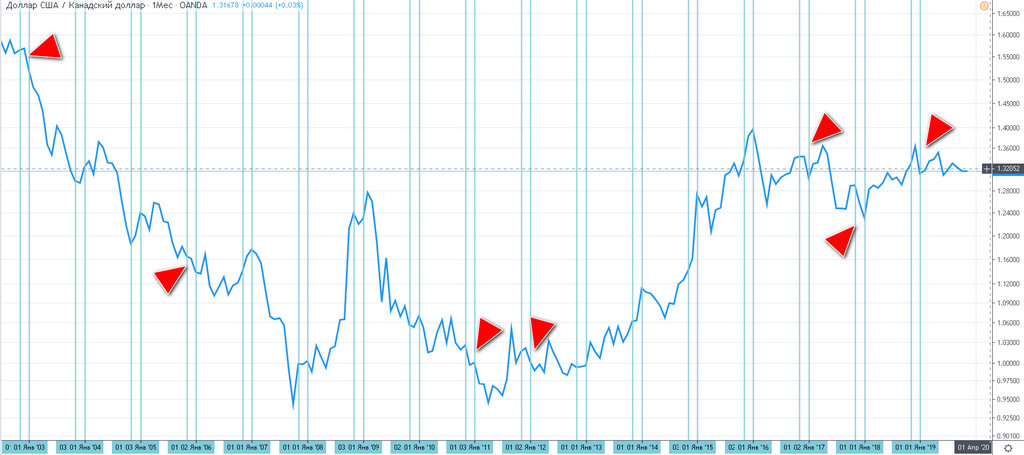
If we apply a similar simple method of testing the effectiveness of rally entries to the USDCAD pair, the result will be worse: over the course of 15 years, the trend did not meet expectations in 50% of casestraders.
Instead of conclusion: “No Silver Bullet”

Of course, knowledge of this phenomenon in itself can play its role in decision-making for entry. For example, trades into a countertrend in the presence of strong resistance or support will force one to search more carefully for signs of their false breakout. Everyone can decide for themselves how to use the information received as a seasonal additional filter for an already existing trading system.
Respectfully, Ivan Petrov
Tlap.io
Best regards, Ivan Petrov
Tlap.io
