
All About Quantitative Strategies on Forex

Which trading method is the most profitable? Manual trading or trading with robots? Technical analysis or fundamental analysis?
Neither one nor the other. The most profitable way to trade is quantitative, as James Simons, the founder of the most successful hedge fund in history, proves in practice.
Quantitative trading - what exactly is it? Today we will try to understand how strategies of this type work, who uses them, and what we should pay attention to when developing our own systems.
Quants or an Alternative Method of Indicator-Free Trading

As is well known, the main task of trading is predicting the trend or reversal points of quotes. It remains the same for any type of instrument and strategies, except in cases of arbitrage. A trader determines future price changes using fundamental or technical analysis.
In the case of algorithmic trading, fundamental indicators are excluded, and robots are tested on a large span of history without excluding unexpected political events or economic crises. Loss or profit resulting from such force majeure is counted in the overall mass of the strategy's performance metrics.
However, there is a third method of trading on the Forex market that does not use fundamental or technical analysis; trends are a secondary matter for it. At the same time, the creators of such strategies are far from markets and the topic of trading, the names of the heads of central banks mean nothing to them, and currency pairs serve only as symbols for loading quote history.
This method was named quantitative trading, replacing the task of forecasting the trend with the search for the optimal Sharpe ratio - a set of currency pairs and strategies that together will bring stable profit.
The phrase "steady profit" sounds like a search for the grail to many of us who have lost more than one deposit on the Forex market and have read a lot of literature on trading. In fact, however, the advantage of quantitative trading is a long-proven fact. Investment hedge funds have been creating quantitative algorithmic strategies for more than half a century.
Some prominent representatives are known to everyone, as are the results of their algorithms, which worked profitably for decades. In particular, George Soros's fund, Soros Fund Management, founded in 1969, used only mathematical strategies from its earliest days.
The fund's average stable return is 20% annually over 50 years of operation, while the financier, unlike funds trading in the constantly rising stock market, such as W. Buffett's Berkshire Hathaway, works with all kinds of instruments, even cryptocurrencies (since April 2018).
Soros became one of the first traders to prove the fallacy of fundamental and technical analysis and to profit from major miscalculations in the monetary policy of central banks and from the advantage of the logic of numbers and mathematical models.
At the end of the 20th century, investment funds and banks began actively hiring programmers and mathematicians after the development of the options market and open recognition of the achievements of Fischer Black and Myron Scholes. The Nobel Committee awarded a prize for the discovery of a trading mechanism that makes it possible to profit from market volatility regardless of the direction of the trend.
The Black-Scholes options pricing model radically changed trading strategies and hedging principles, proving the advantage of mathematical analysis approaches and making 80% of the positions of market makers and investment banks profitable.
At the beginning of the 21st century, the first major funds began to appear where the founders and staff were not connected by education or previous professions with trading or economics. In their everyday work, such companies do not use charts or economic forecasts - only a "live" stream of asset prices processed simultaneously by several thousand algorithms.
Examples of such fully algorithmic funds, where billions of dollars are traded using quantitative strategies without human involvement, include: Two Sigma Investments ($60 billion), DE Shaw & Co ($60 billion), Renaissance Technologies LLC ($110 billion). The companies offer universal algorithms, while the investor independently chooses the markets - stocks, bonds, commodities or Forex.
How Are Quantitative Trading Strategies Created and How Do They Work in the Forex Market?

The creation of quantitative trading strategies is based on a complex mathematical apparatus, which implies the use of special applied software to automate the search for models. If at this stage a company uses standard products such as MATLAB, EViews, etc., then after historical testing the discovered strategies are checked for compatibility with those already existing in a specially programmed environment.
The trading system is built on the principle of "the more strategies, the better," and the same applies to the number of instruments. The purpose of such expansion is to provide higher returns with less risk compared with some benchmark.
To achieve optimal profit, the following tactic is used: a time interval is chosen in which the values of price quotes are recorded (for example, only closes or all tick trades). The obtained values can be analyzed:
Another area of econometric analysis is the search for microeconomic samples: the global trading history is broken down into minimal specified segments with predefined pattern parts inside them.
The task of this strategy is to find, in the current move, a suitable segment in the past that most closely matches part of the pattern. The system then forecasts the future move based on copying the price dynamics from the past micro-segment of history.
The found set of trading systems in the three directions listed above is combined into one strategy, constantly traded and optimized according to money management criteria. Additionally, a trader can include forecasting of economic indicator data by inserting models that show the relationship between the reaction of quotes and those studied on historical data, but this is rare.
When researching many open algorithms (which have already outlived themselves), models with built-in macroeconomic analysis are encountered very rarely; in most cases only Price Action is used.
Mandatory conditions for the operation of quantitative strategies:
Prerequisites for quantitative strategies to work:
Examples of strategy algorithms for quantitative trading

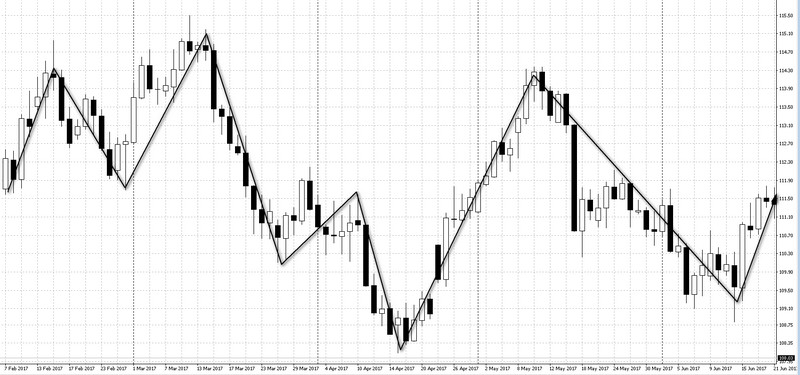
The chart in the figure resembles the broken line of the ZigZag indicator, only unlike it the quote values are forecast using coefficients calculated on history and a previously known periodically changing seasonality constant.
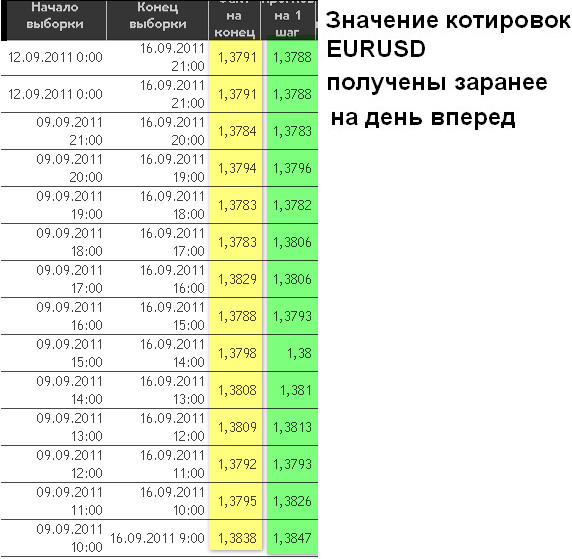
As soon as the equation is obtained, the work of the trader comes down to filling in a table with the quotes of the last day and hour in order to obtain the future value (day, hour, etc.). At the same time, the forecast results are later automatically compared with the actual value, which makes it possible to continuously optimize the equation.
The results are compiled into a constantly updated table of this kind:
Despite the fact that future closing prices of daily candles do not match tick for tick, they make it possible with high accuracy to determine the trend direction in advance in order to build an intraday trading strategy.
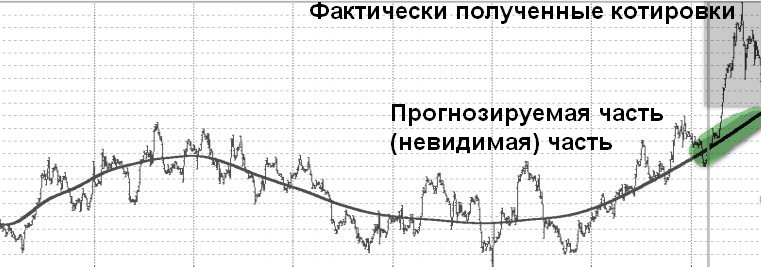
The nonparametric Singular Spectrum Analysis (SSA) method, like the linear approach to time-series analysis discussed above, also determines the future direction of trends. If the forecast is projected onto a chart, it looks as follows:
A major advantage of this method is the independence of calculations and forecasts from the factor of seasonality, volatility, changes in periods of cycles and trends with a sufficiently large data-window sample. On this segment, a trajectory matrix is determined, which is singularly decomposed into a sum of elementary parts.
Solving the equation makes it possible to represent the time series as trend and noise, which will later allow the resulting equation to determine medium-term and long-term trends despite changes in volatility or force-majeure chart moves.
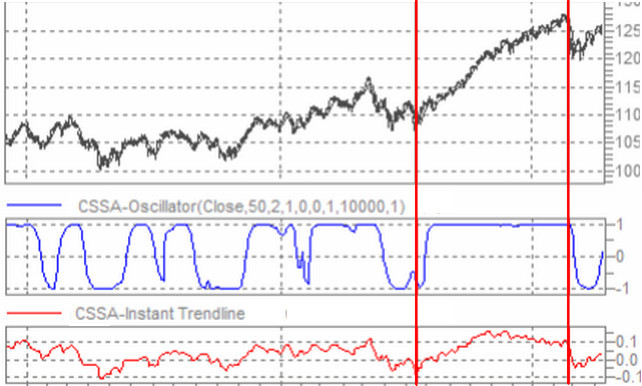
Today, traders are spared the need to perform their own highly complex calculations and build Singular Spectrum Analysis vector matrices; indicators are provided in the form of ready-made adapted templates.
SSA curves are shown as oscillators or trend lines, by combining whose signals one can determine the beginning and end of a trend using periods of 2000 or more candles of history. The only inconvenience is the large number of parameters in the settings, and skills in working with SSA vector analysis algorithms are desirable.
Today, traders are freed from the need to carry out their own complex calculations and construct Singular Spectrum Analysis vector matrices,indicatorsare provided in the form of ready-made adapted templates.
If we break a complex quantitative trading algorithm into its component parts, we observe the ordinary skeleton of a trading system in which three different strategies have been combined, usually used separately from each other.
Quantitative trading - a repetition of traditional trading systems?

The search for the ideal did not succeed, and now the artificial intelligence of Jurik Research is engaged in it.
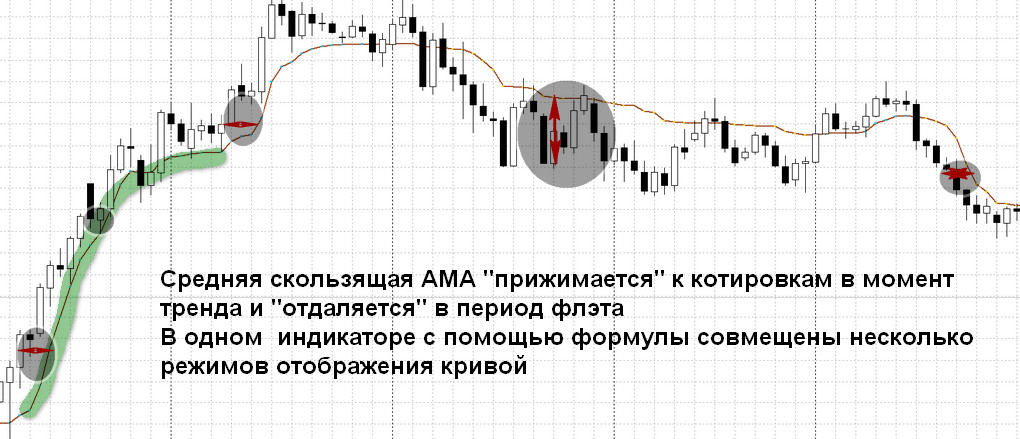
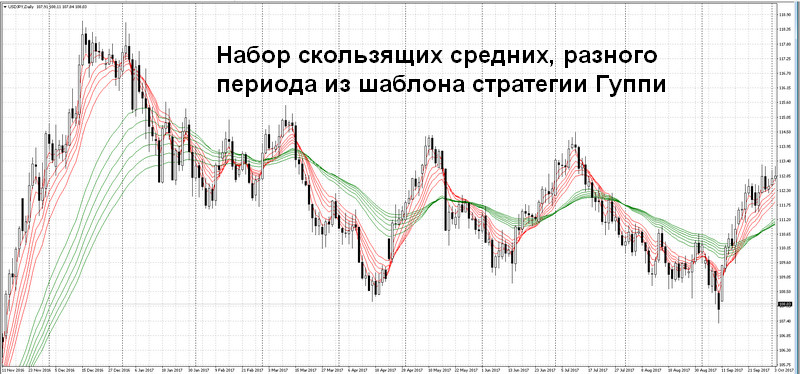
As an example of a quantitative approach in moving averages, one can take the Guppy strategy, where the Australian trader uses several MA at once with different periods. This resembles the parallel work of many mathematical algorithms of trend strategies.
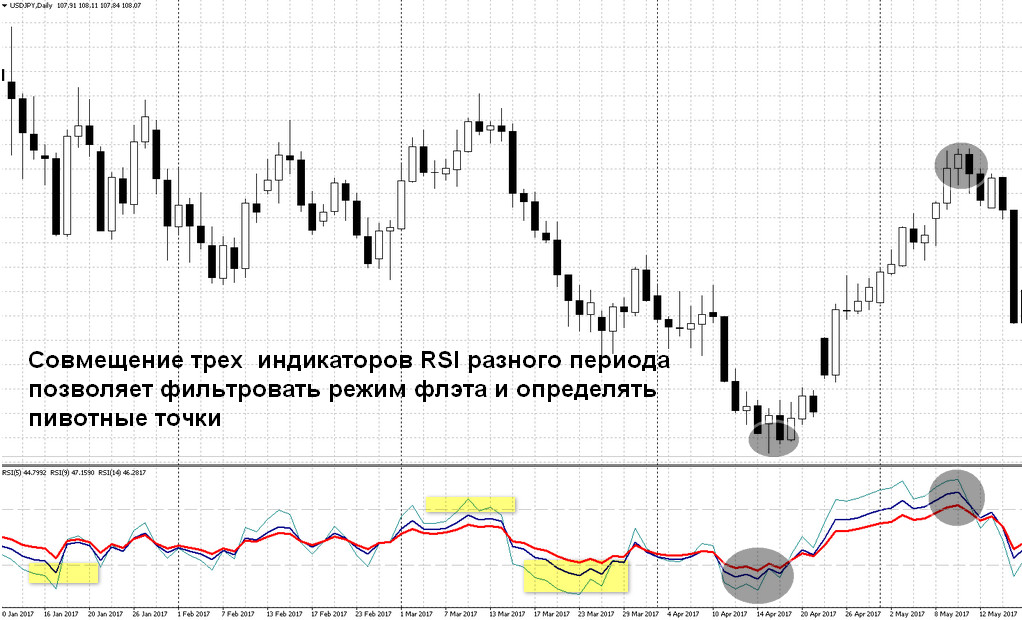
Pivot points can be searched by the same principle, using a set of RSI indicators with different periods, combined with each other on one timeframe. By combining this strategy and trend trading by MA, the trader will get countertrades that partially lock in profit and hedge open positions.
To forecast the future direction of a trend based on trading in the past, use patterns - they are described in books only because they periodically occur over the half-century history of market trading. By identifying a familiar figure, for example, Gartley or Wolfe waves, the trader will receive entry, stop-loss, and take-profit points in advance.
Pivot points can be searched using the same principle, using a set of indicatorsRSIwith different periods that are combined with each other on onetimeframe. By combining this strategy and trend trading using the MA, the trader will receive counter trades that partially fixprofitand hedging open positions.
Econometrics and mathematical analysis of economic parameters are a third-year university topic. Students create trading strategies and methods for forecasting exchange rates as course and diploma projects - these are the realities of the modern Forex market.
Conclusion

Respectfully, Alexey Vergunov
Tlap.io
Best regards, Alexey Vergunov
Tlap.io