
What You Need to Know About Stop Losses
 Hello, fellow forex traders!
In this lesson, we will talk about stop loss. Stop Loss is something of colossal importance, on which your success or failure in trading directly depends. Next, we will learn what stop loss is, where to place it and exactly how, which type of stop is better to use, compare short and long stop orders, and finally come to a conclusion about whether it is possible to trade without a stop and how sensible that idea is.
What Is Stop Loss?

Stop loss is an order that limits your losses by automatically closing your position when the price reaches a certain price level. Suppose you looked at the indicated candle and decided that its unusually long shadow most likely indicates an upcoming reversal. Thus, after the candle closes, you open a sell order.
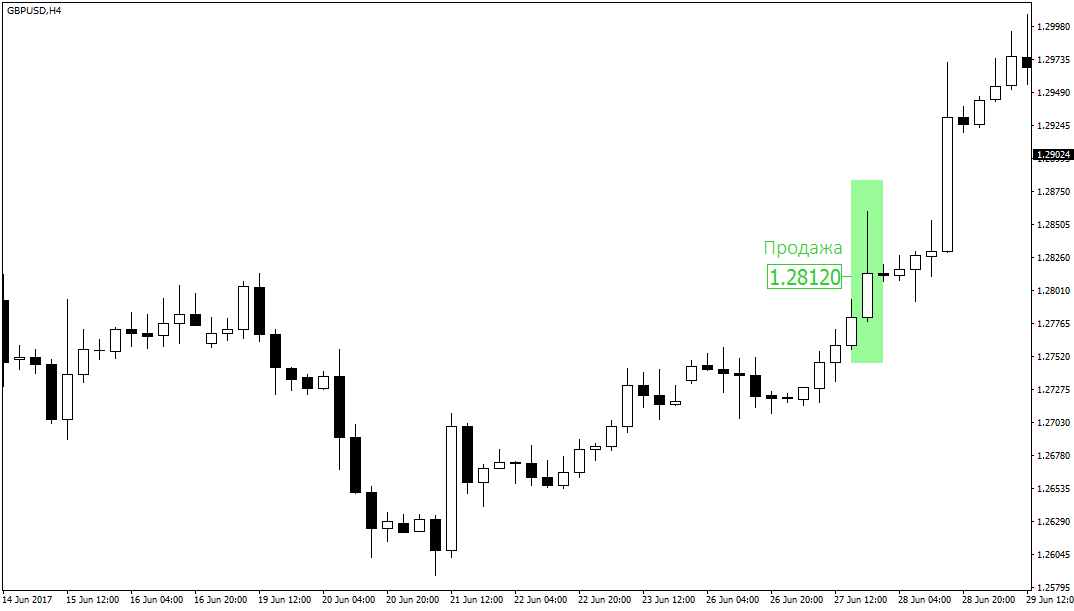 But after some time, the price goes up, meaning your assumption was wrong and the price is moving against your position. Of course, you can close the position manually at any moment, thereby locking in a loss, but, for example, you might simply not be near the monitor at that moment, or some emotional factor might kick in, a naive belief that the price will definitely reverse. Eventually, losses can even lead to the complete depletion of your account. That is, theoretically, if you do not have a stop loss, then the risk of the trade will equal your deposit.
In the case when we set a stop loss at some level in advance, we thereby limit the potential risk beforehand, knowing that in this particular trade we will not be able to lose more than a certain amount, or, more correctly, a certain percentage of the deposit.
A stop loss must be placed where it will be absolutely clear that we were wrong. That is, where the setup loses its meaning. In this case, it is obvious that our assumption will lose its force if the price goes beyond the extreme point of the tail. Accordingly, we place the stop loss slightly above the candle high. In case of any technical spikes, we always add a couple of points.
How to Set Stop Loss in MT4/MT5

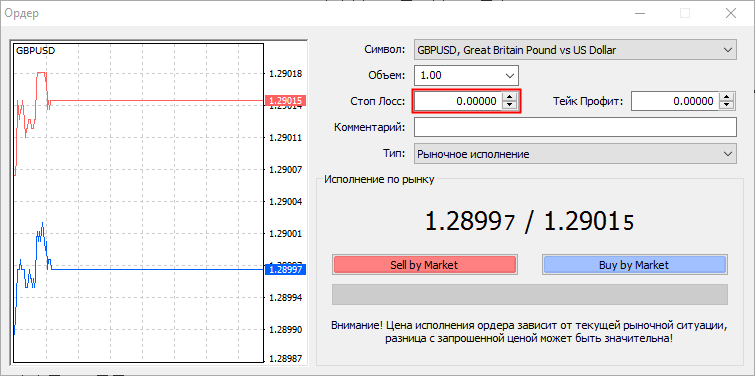
The standard order opening window is almost the same in the MetaTrader 4 and MetaTarder 5 terminals. In addition to the buy/sell buttons, there are fields here for setting take profit and stop loss. Here you can choose a stop loss even before opening the trade, which is recommended if the market is calm enough. In the case of a sale, the stop is placed above the opening price; in the case of a purchase, below.
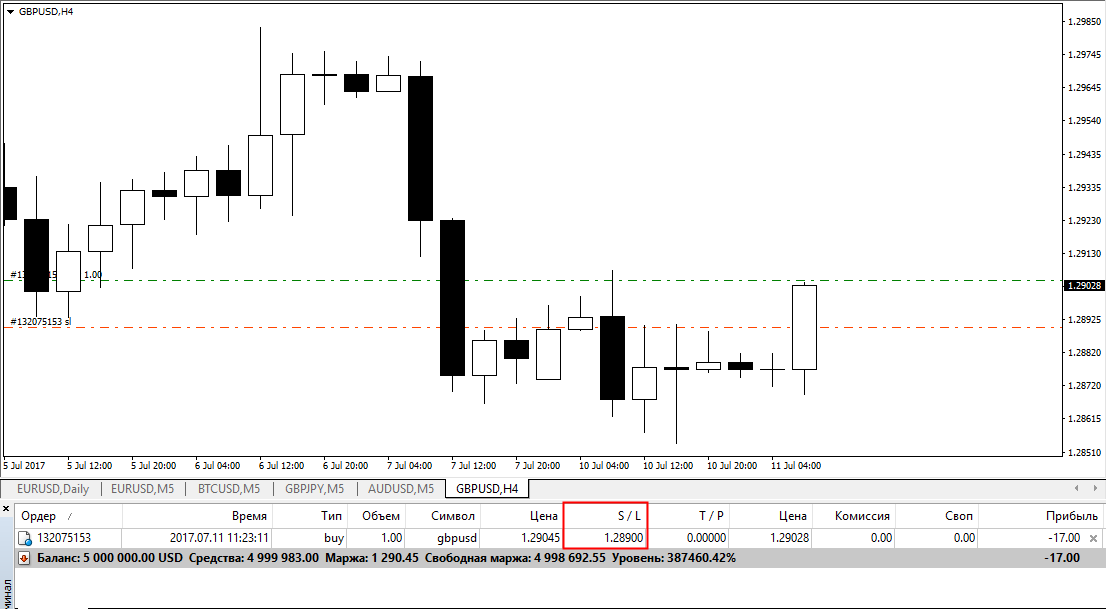
 If we open a position, the stop loss will be displayed on the chart as a dash-dotted line and also in the terminal window in the "S / L" column. To edit the order, double-click the corresponding line in the terminal.
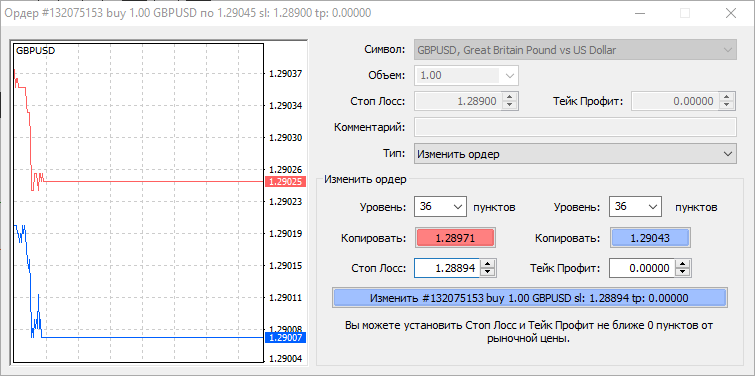
 Here you can change the stop loss in either direction. If you opened a trade without a stop loss, you can add it to the position this way. It is worth considering that on some account types you cannot set a stop loss at the same time as opening a trade, and this can only be done after opening the position.
Ways to Set a Stop Loss

Local extremum. Suppose that in this case we decided that the upward trend would continue and opened a buy trade at the current price. One of the most basic, classical methods of setting a stop loss is placing it below (for buys) or above (for sells) the previous extremum.
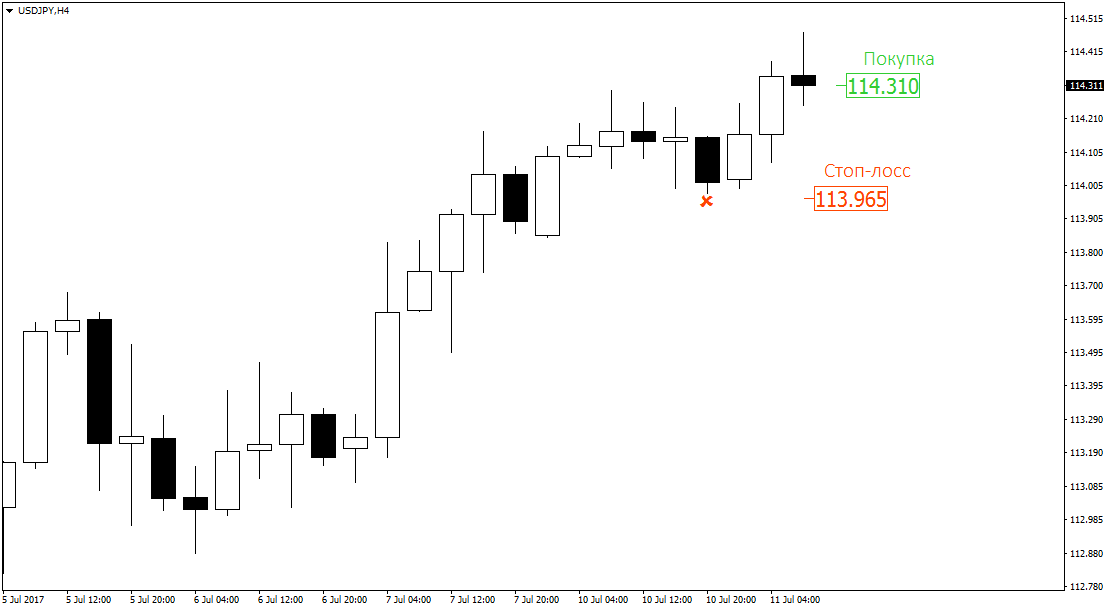
Please note that we never place a stop loss exactly at the price high or low point for point. It must be taken into account that small price spikes are always possible, and so that such a spike does not hit the stop purely by chance, we always place the stop loss slightly above or slightly below the reference point (the extremum).
Big candle. The next way to set a stop loss is under the extreme point or above the extreme point of a big candle. A candle about three times larger than the average candle on the visible chart fits the definition of a big candle.
Suppose you saw such a big candle and decided that this was a signal to buy. In the case of a buy, the stop loss can be placed below its extreme point, a few points below the low.
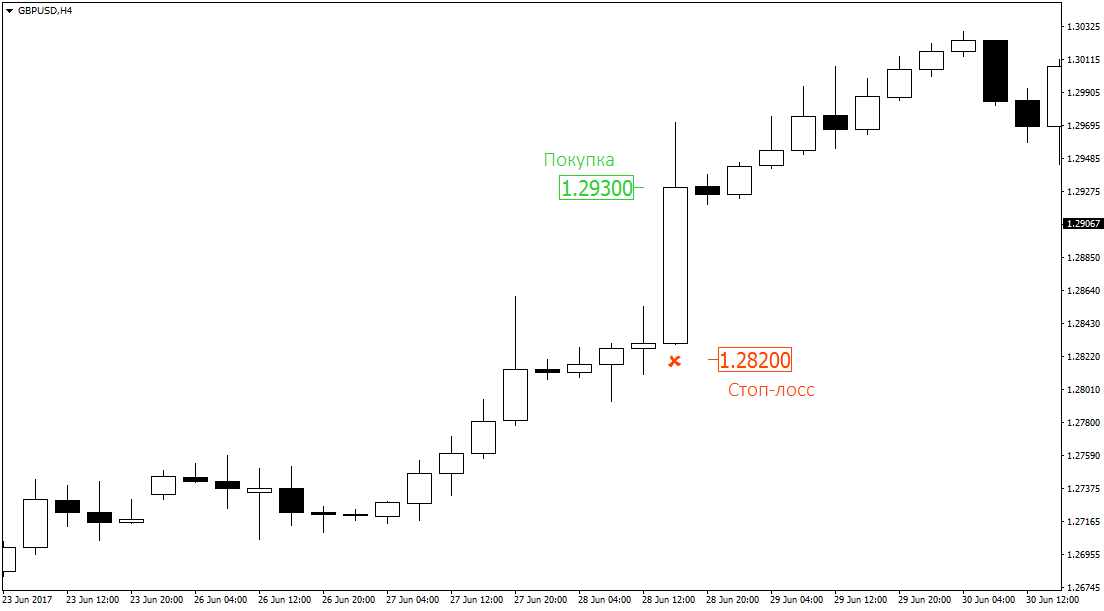
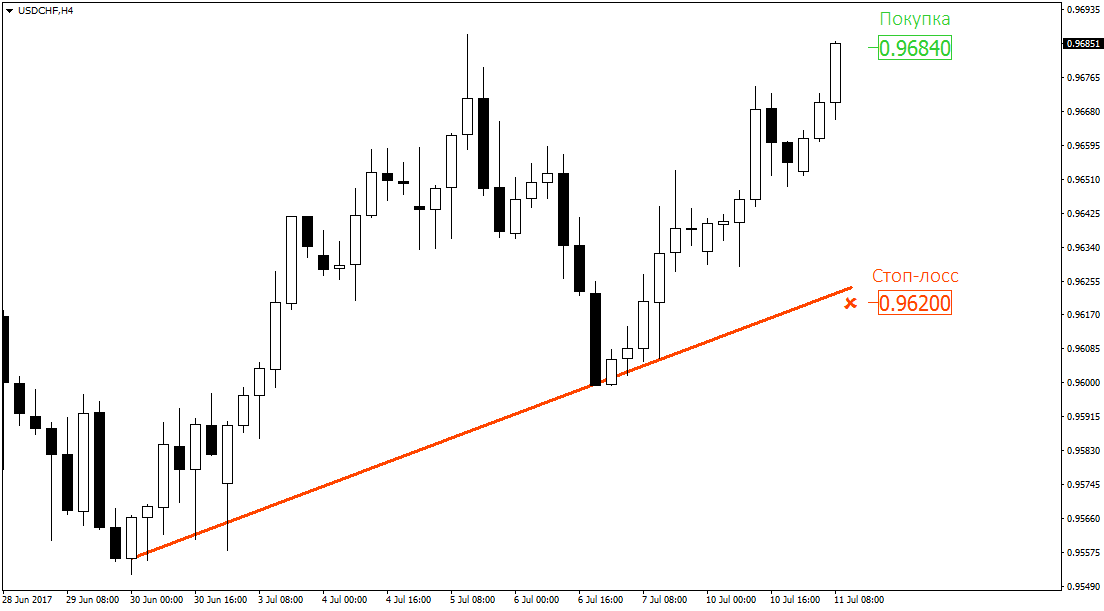
Trend line. A stop loss can also be placed below (in the case of buys) or above (for sells) the trend line. We have a separate video lesson on how to build a trend line, A logical question is that since the price and, accordingly, the trend line will change over time, is it worth moving the stop loss? In this case, the stop loss can indeed be moved along the trend line, for example, with each new candle.
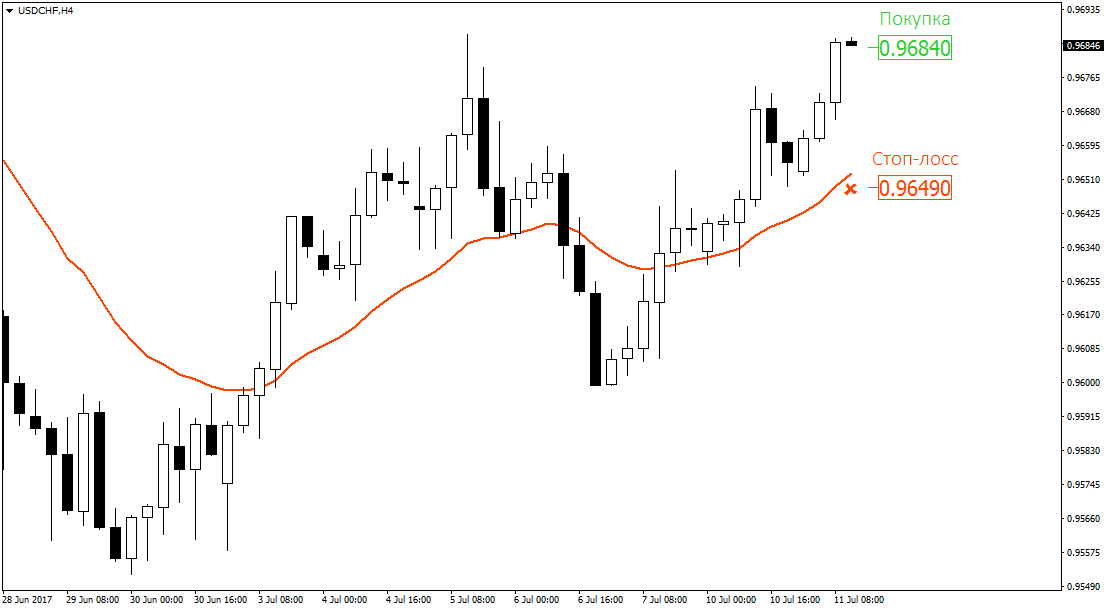
 Moving average. Another method is setting a stop loss by the moving average. In general, there is something in common here with the method of setting it by the trend line. Such a stop can also be moved following the average.
 By time. A stop can be set not only by price, but also by time. When opening a trade, we place the stop loss at a fairly large distance, in case of force majeure circumstances. But in reality, we exit the trade after some time has passed if there has been no movement toward profit. A well-known strategy is the 5-candle filter. That is, based on some signal we open a position, and if within 5 candles the price stands still, which means the signal had no effect on the market, then we simply exit the trade.
Key levels. A reliable way to set a stop loss is behind the nearest support/resistance level. In the case of sales, we place the stop slightly above the resistance level; in the case of purchases, slightly below the support level.
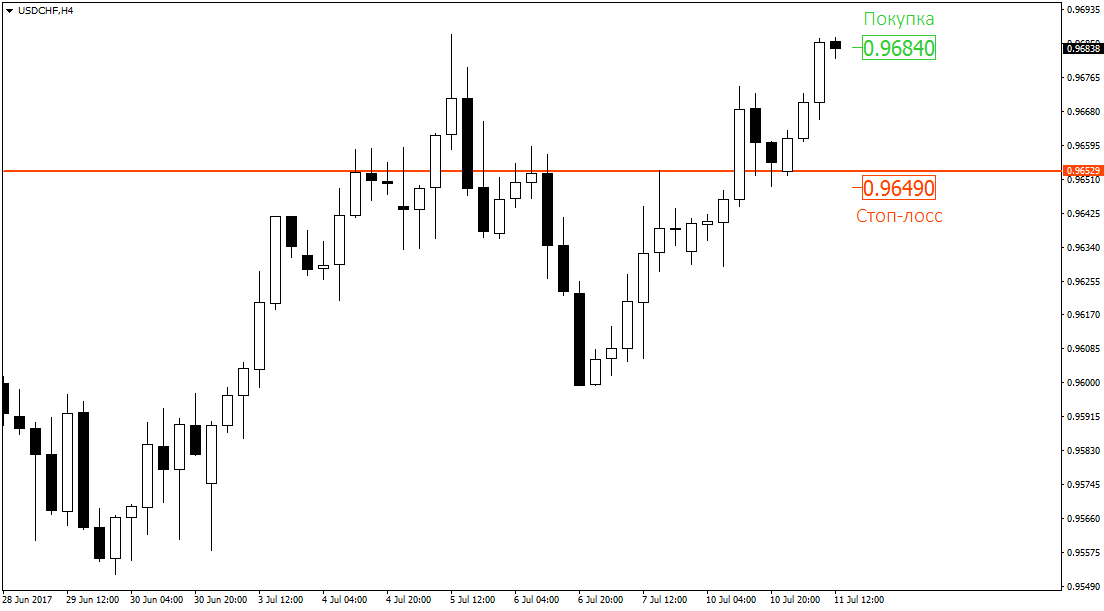 Volatility. A good guide for setting a stop loss is volatility. This method of setting a stop loss is suitable for intraday trading. Volatility data can be viewed here. In the list, find the pair you need and look at the average daily volatility. For example, for GBPUSD this value is slightly less than 100 points.
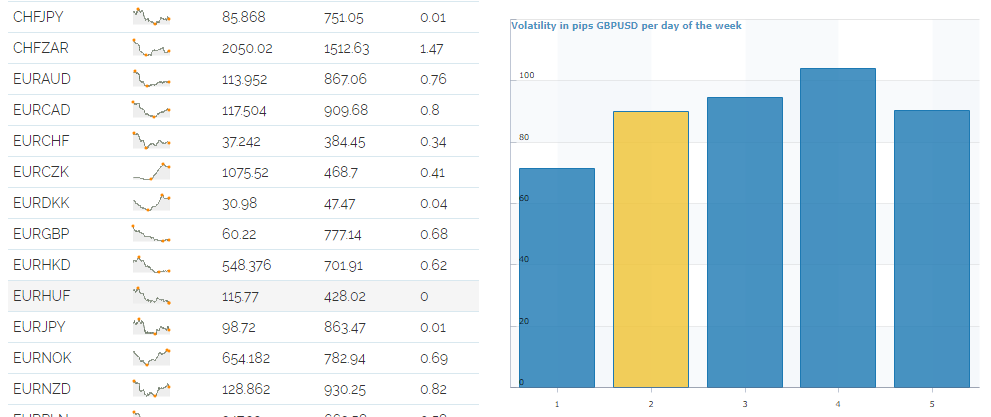 Next, we subtract from this value the distance the price has already traveled during the day. In this case, the price has already moved up 60 points. This means that, theoretically, the price can either move up another 40 points or move down 100 points. We set the stop loss according to these values.
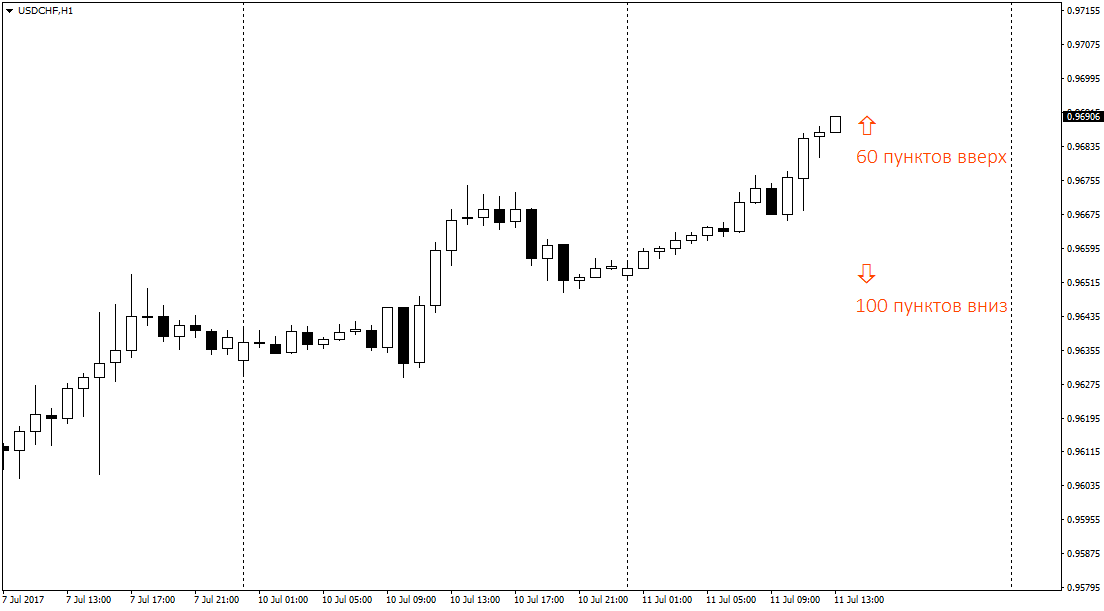 Overall, this method is very subjective and is more suitable for determining where the price may go, that is, how much more the price can squeeze out of the market. But, for example, if the price has already moved 120 points, you can set a very small stop loss in the area of 10-20 points on the assumption that the pair's average daily volatility has already been exhausted and the probability of further price movement in the same direction is low.
Parabolic SAR. Another classic method for calculating a stop is the Parabolic SAR indicator. Everything is simple here. When opening a trade, set the stop loss at some distance beyond the Parabolic's dots.
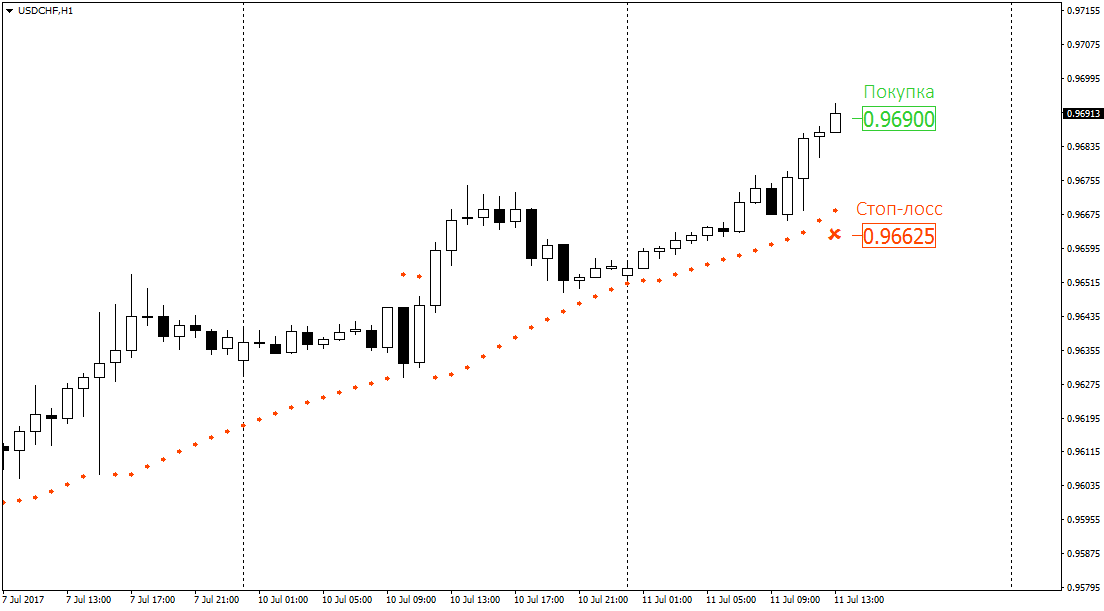 ATR Indicator. A method that I strongly recommend is setting a stop loss using the Average True Range indicator (or ATR). This indicator is a measure of market volatility. As a tool for setting stop losses, it is very, very good. The indicator's readings change together with market volatility and, accordingly, we always have a stop loss that matches the current market volatility.
To set a stop, look at the current ATR value. In this case, 12 points is the minimum possible stop loss for this instrument and timeframe. As a rule, ATR readings are multiplied by some factor, usually from 2 to 4. It depends on the strategy, your sensitivity to risk, and your view of the market.
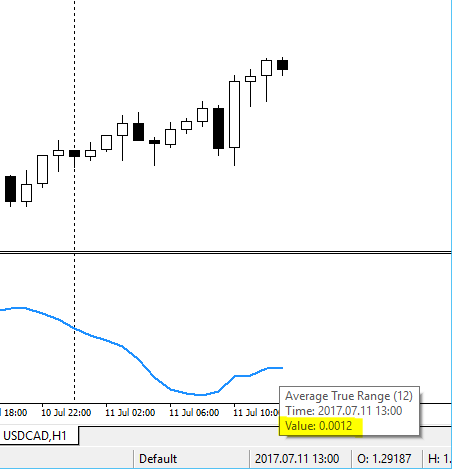 It is best to use a combined approach. That is, we take ATR readings as a reference point and, when setting the stop, adjust it relative to the nearest extreme or support/resistance level.
 Short stop loss or long? Here again, the camps are divided. You are free to choose your own option, whichever suits you more - more short stops or fewer stops, but longer ones. A lot here depends on the specific trader.
Can you trade without a stop loss? Theoretically you can, of course, but this imposes both trading and emotional risks. There are experienced traders who trade successfully without a stop loss, but they already have enormous experience behind them. If you are an inexperienced trader and have been trading in the market for less than a year, always set a stop loss.
A properly calculated stop loss can also be moved along with the price. However, never move the stop loss against the price. That is, the price is moving against you and you are trying to move the stop loss farther away - you definitely should not do that, since there are certain price levels to which the price does not return for a very long period of time.
Conclusion

That is all, friends. Be sure to study the ATR indicator if you are not yet familiar with it. Remember, technical analysis is not an exact science, but an art. Apply combined methods and do not forget to use stop losses.
With respect, Pavel Vlasov TradeLikeaPro.ru
