
What Is Altseason in Cryptocurrencies: How to Identify the Beginning and End
“Altseason will start soon” is the first thing crypto traders say when bulls pull Bitcoin north. Sometimes these words turn out to be close to reality, and sometimes they are completely wrong.
A beginner crypto trader should understand that altseason is not an official market stage and not a law of nature, but a market phenomenon observed in several cycles of cryptocurrency development.
Below we will examine what this term means, where it came from, and how far it can generally be used when analyzing the cryptocurrency market.
Altseason: Frequently Asked Questions (FAQ)
What is altseason in simple terms?
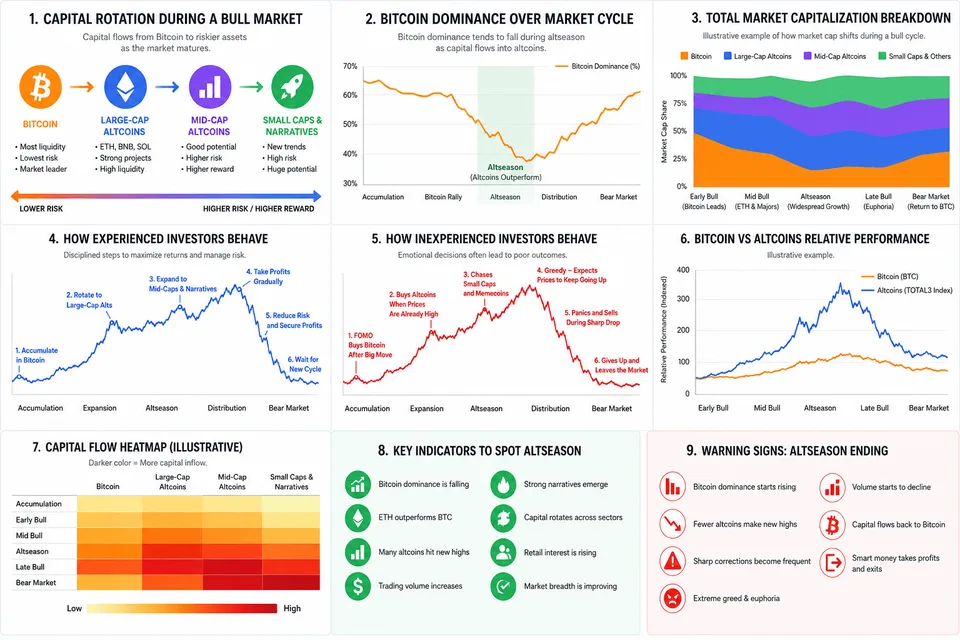
Altseason is a period in the cryptocurrency market when most altcoins (cryptocurrencies other than Bitcoin) begin to grow faster than Bitcoin itself. This usually happens because part of investors’ capital gradually moves from Bitcoin into alternative projects in search of higher potential returns.
When does altseason usually begin?
There is no exact date or universal rule.
Historically, altseasons more often appeared after strong Bitcoin growth, when its price moved into a stage of consolidation or slower growth. At that moment, investors began looking for new opportunities among large and then riskier altcoins.
However, every market cycle is different, so Bitcoin growth by itself does not guarantee the start of altseason.
What signs indicate the beginning of altseason?
The most common signs are considered to be:
most major altcoins begin to outperform Bitcoin in returns;
Bitcoin dominance declines;
market capitalization excluding Bitcoin grows;
altcoin trading volumes increase;
new projects begin to update historical or local highs.
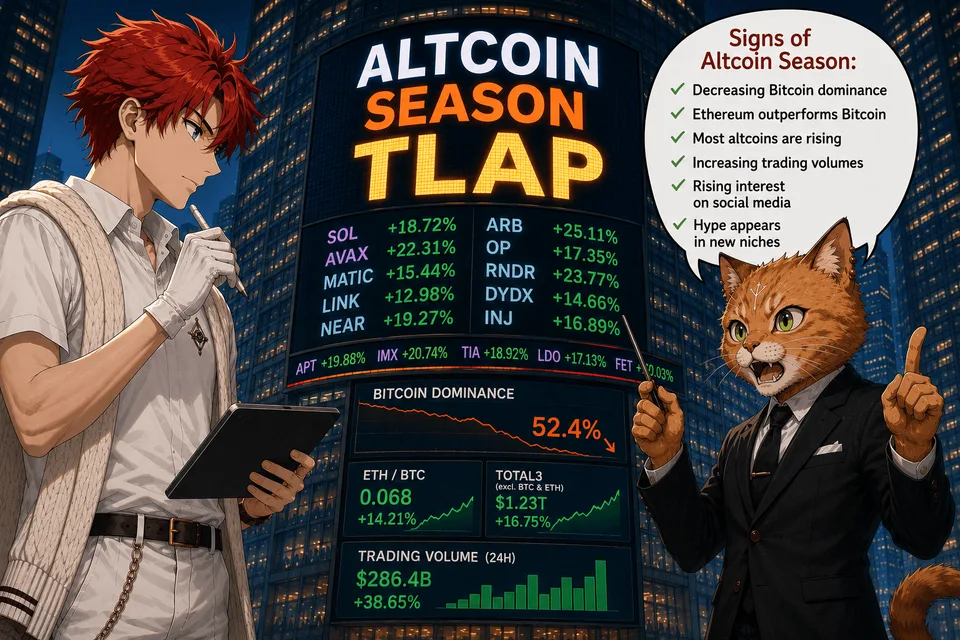
The more such signs are observed at the same time, the higher the probability that the market is really moving into a phase of active altcoin growth.
Does altseason always begin after Bitcoin rises?
No. This is one of the most common myths.
Sometimes Bitcoin continues to grow significantly faster than most altcoins. In other cases, capital remains concentrated mainly in Bitcoin or moves only into individual market sectors.
Therefore, it cannot be automatically assumed that altseason will necessarily come after every Bitcoin rally.
Which cryptocurrencies usually grow during altseason?
In different years, different projects became the leaders.
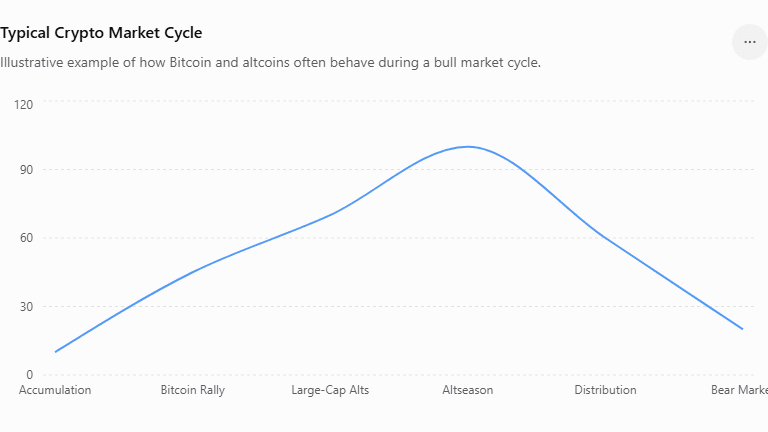
As a rule, the movement begins with the largest altcoins, such as Ethereum, after which capital gradually moves into mid-cap projects and individual promising areas.
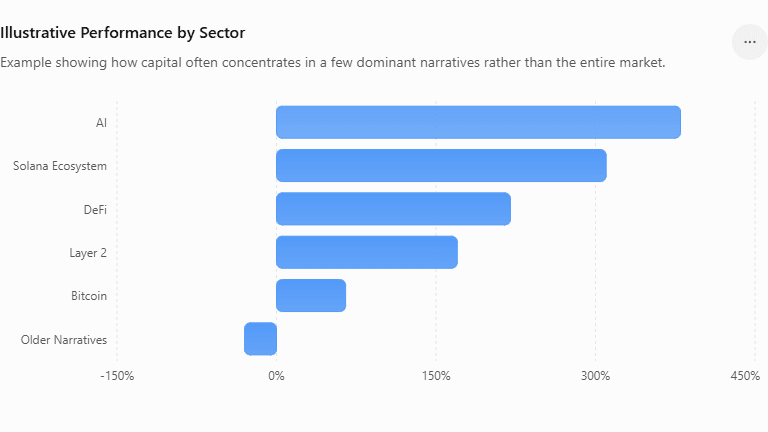
Each cycle has its own leading sectors. In different years, these included ICO projects, DeFi, NFT, Layer 1, artificial intelligence (AI), real-world assets (RWA), infrastructure solutions, and meme coins.
Do You Need to Buy All Altcoins During Altseason?
No. Even during the strongest altseasons, far from all projects grow.
Many coins remain without significant movement or even fall in price. Therefore, professional investors usually analyze liquidity, capitalization, fundamental indicators, developer activity, trading volume, and the project’s position within its ecosystem.
Can You Make Money During Altseason?
Yes, but high potential returns are always accompanied by increased risk.
During strong altseasons, some projects really did show severalfold growth. However, after the bull market ended, many of them lost 80–95% of their value.
Therefore, success depends not only on choosing a project, but also on competent risk management, portfolio diversification, and timely profit-taking.
How to Understand That Altseason Is Ending?
There is no exact signal that it is ending. The most common signs are:
fewer and fewer projects are showing growth;
trading volumes are declining;
sharp corrections are becoming more intense;
the market is becoming overly optimistic;
investors begin buying assets en masse after the growth has already happened;
capital gradually returns to Bitcoin or leaves the cryptocurrency market altogether.
Usually, the end of altseason is determined not by one event, but by a combination of several factors.
Can the Next Altseason Be Predicted?
No. No analyst or indicator can determine in advance the exact start date of a new altseason.
One can only assess the probability of its arrival by analyzing market structure, trading volumes, Bitcoin’s behavior, BTC dominance, the macroeconomic situation, and the inflow of new capital.
Which Indicators Are Most Often Used to Assess Altseason?
Investors usually pay attention to the following indicators:
Bitcoin dominance (BTC Dominance);
cryptocurrency market capitalization excluding Bitcoin (TOTAL2);
market capitalization excluding Bitcoin and Ethereum (TOTAL3);
the ETH/BTC ratio;
the Altcoin Season Index;
trading volumes;
the number of altcoins making new highs.
None of these indicators is an independent buy signal. The most reliable conclusions are made only through comprehensive analysis.
TLAP has developed its own unique altseason index.
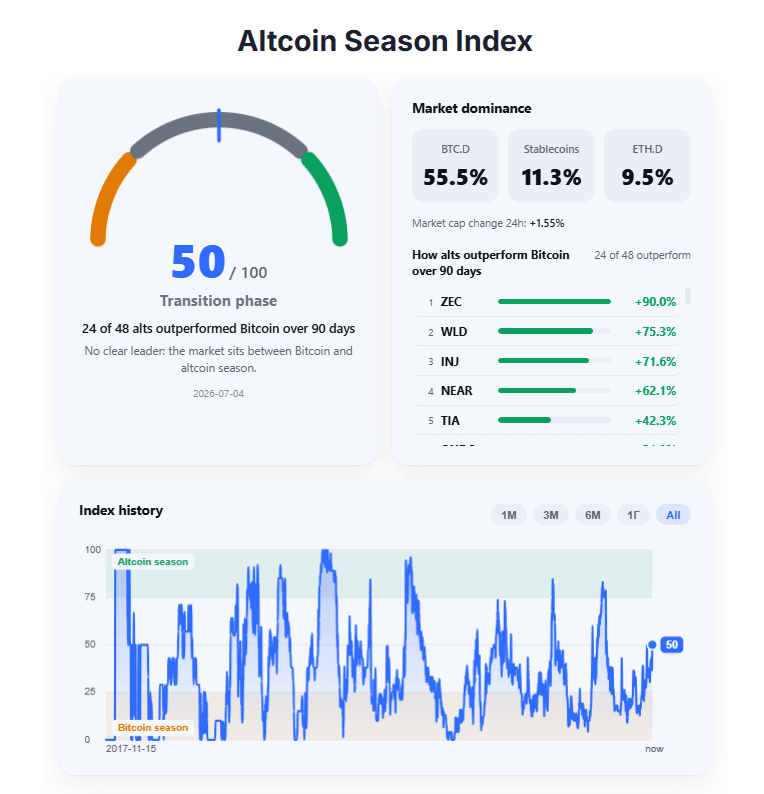
In the upper left corner there is a visual panel showing the current phase of altseason. The altseason phase is the share of altcoins that have outperformed Bitcoin over the past 90 days. A value above 75 means alt season, below 25 means Bitcoin season. The sample includes 47 alts in total.
On the right, the share of BTC, ETH, and stablecoins in the total capitalization of the cryptocurrency market is shown. Slightly below is a list of altcoins outperforming Bitcoin.
At the very bottom of the TLAP altseason index is a chart with the index history.
Should a beginner wait for altseason?
Waiting exclusively for altseason as a reason to invest is not the best strategy.
It is far more important to learn how to analyze the market, understand the reasons for capital movement, assess project quality, and follow risk management rules.
If altseason really does arrive, a prepared investor will be able to use its opportunities much more effectively than someone who starts studying the market at the height of general excitement.
Why most beginners lose money during altseason
The reason is usually one thing: they enter too late.
When social networks are already filled with stories about hundreds of percent in profits, a significant part of the move may already be behind.
Beginners start buying assets after a sharp rise, counting on it to continue. But exactly at this moment, major market participants may gradually be taking profits.
Historical examples of altseasons: 2017, 2021, and the 2024-2025 cycle
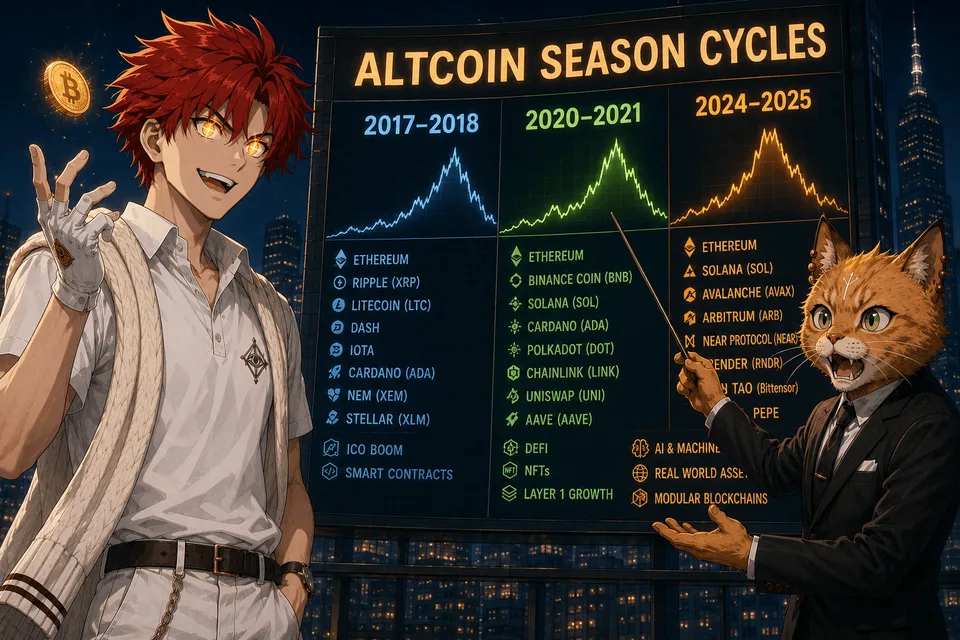
To understand how much the concept of altseason matches reality, it is useful to look at the history of the cryptocurrency market. In recent years, investors have usually identified three major market cycles. However, each of them differed significantly in the reasons for growth, the composition of leaders, and the distribution of capital.
The 2017-2018 cycle: the first real altseason
It was during this period that the very concept of “altseason” took shape.
Before 2017, the cryptocurrency market was almost entirely associated with Bitcoin. There were few alternative projects, and their capitalization was relatively small.
The situation changed after the emergence of Ethereum and the rapid development of the ICO (Initial Coin Offering) market. Thanks to smart contracts, thousands of new projects were able to attract investment by issuing their own tokens.
At first, capital traditionally flowed into Bitcoin. Its price rose from about 1,000 dollars at the beginning of 2017 to almost 20,000 dollars by December. After that, a significant share of investors began looking for more profitable assets.
A large-scale flow of capital into altcoins began.
Over several months:
Ethereum rose from about 8 to more than 1,400 dollars;
Ripple (XRP) grew by dozens of times;
Litecoin, NEO, EOS, Cardano, and many other projects reached new all-time highs;
hundreds of small ICO tokens rose by hundreds and even thousands of percent.
At the same time, Bitcoin's share of the total crypto market capitalization fell sharply: while at the beginning of 2017 it exceeded 85%, by the beginning of 2018 it had dropped to about 38%. This became one of the clearest examples of a classic altseason.
However, this growth also had a downside. A significant share of projects had no finished product and existed only as an idea and a White Paper. After the bull market ended, most ICOs lost more than 90% of their value, and many teams ceased to exist.
The main lesson of the 2017 cycle is this: even during a strong altseason, far from every project survives the subsequent bear market.
The 2020-2021 cycle: the era of DeFi, NFT, and Layer 1
The next major altseason turned out to be completely different.
After the 2020 crisis, global financial markets received a huge amount of liquidity thanks to the soft monetary policy of central banks. Part of this capital also came to the cryptocurrency market.
As in the previous cycle, Bitcoin was the first to start growing, updating its all-time high by rising above 60,000 dollars.
Then investors' attention gradually shifted to other areas.
The main drivers were:
decentralized finance (DeFi);
NFT;
new first-level blockchains (Layer 1);
metaverses;
gaming projects (GameFi).
It was during this period that projects such as Solana, Avalanche, Terra, Polygon, Fantom, and many others became widely known.
The distinctive feature of the cycle was that money was no longer distributed among all coins indiscriminately, but among separate fast-growing sectors. Investors increasingly analyzed ecosystems, the number of users, the total value locked (TVL), and developer activity.
Bitcoin's share of market capitalization again declined noticeably, from about 70% at the start of 2021 to around 40% by the end of the year, which was accompanied by strong growth in many altcoins.
However, this cycle also ended painfully.
In 2022, the market faced a series of serious shocks:
the collapse of the Terra ecosystem;
the bankruptcy of a number of major crypto companies;
the collapse of the FTX exchange;
the tightening of monetary policy around the world.
Many altcoins lost from 80 to 95% of their value.
The main lesson of the 2021 cycle is this: even strong fundamental projects can experience deep multi-year corrections.
The 2024-2025 Cycle: Has the Nature of Altseason Changed?
The third cycle turned out to be the most unusual.
After the launch of spot Bitcoin ETFs in the United States, a significant part of new capital flowed specifically into Bitcoin, rather than being distributed across the entire market. This led to Bitcoin dominance remaining high for most of 2024, while many altcoins noticeably lagged in returns.
Unlike previous cycles, the market no longer showed simultaneous growth of most coins.
Instead of a single large-scale altseason, sectoral rotation of capital was observed.
In different periods, investors showed increased interest in:
artificial intelligence tokens (AI);
infrastructure projects;
the Solana ecosystem;
meme coins;
real-world asset tokens (RWA).
Some categories could show severalfold growth, while many old projects barely changed in price.
By the end of 2024 and during certain periods of 2025, separate analytical indexes recorded signs of a local altseason, when a significant share of the largest altcoins temporarily began to outperform Bitcoin. However, this process was far less uniform than in 2017 or 2021.
For this reason, many analysts believe that the modern market is gradually moving from a “everything is growing” model to a model in which capital moves sequentially between separate sectors. At the same time, the very concept of altseason has not disappeared, but it has become less universal and requires more careful analysis of the market structure.
What the Three Altseasons Show
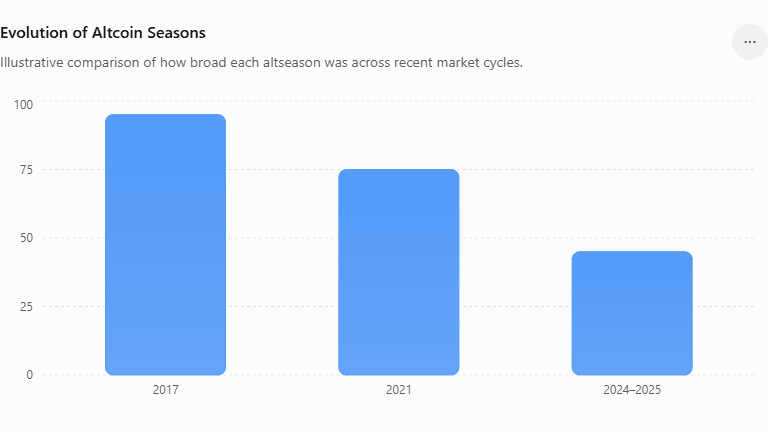
If we compare all three periods, an important pattern can be noticed.
2017 — almost the entire market grew thanks to the ICO boom.
2021 — capital was concentrated in technological areas: DeFi, NFT, Layer 1, and metaverses.
2024–2025 — growth became more selective. Instead of one large-scale altseason, capital rotation between individual themes and ecosystems was observed more often.
That is precisely why simply waiting for the “start of altseason” is no longer enough for today’s investor. It is far more important to understand which market sector new capital is flowing into, which projects are becoming leaders of the current cycle, and whether the growth is confirmed by real indicators of activity, liquidity, and demand.