
What Are Token Unlocking and Vesting

Cryptocurrency prices can soar and crash within hours, and the hype around new projects often overshadows the real economics.
To invest in cryptocurrencies consciously, you need to understand two key mechanisms: token unlocking and vesting.
These concepts directly affect the price, liquidity, and long-term success of any project. To a beginner they seem like complicated jargon, but in reality they are like "golden handcuffs" for the team and investors, a tool that turns speculation into a marathon.
In this article, we will break down the basic definitions, give real-life analogies, and look at real examples of price impact, tracking tools, and practical advice.
The Basics of Understanding Unlocking and Vesting

Every token has tokenomics, its own economic model. It specifies:
- Total Supply / Max Supply — the maximum number of tokens that will ever be issued.
- Circulating Supply — the number of tokens in free circulation (can be bought/sold on exchanges).
- Allocation — how the tokens are distributed (team, investors, community, ecosystem, etc.).
- FDV (Fully Diluted Valuation) — the "full" capitalization assuming all tokens are unlocked (price × Total Supply). Often FDV is 5-20 times higher than the current market capitalization.
Imagine a huge pie. Circulating Supply is the slices that have already been cut and laid out on the table. The rest is in the freezer and will be thawed gradually according to a schedule. If you suddenly put half of the frozen pie on the table, the price per slice will fall sharply due to excess supply.
Without control mechanisms, early participants (founders, VC investors) could immediately sell everything and crash the price. That is exactly why vesting and unlocking appeared.
What Is Vesting
Vesting is the process of gradually granting ownership rights to tokens. The tokens are allocated but sit in a smart contract and become available only according to a schedule.
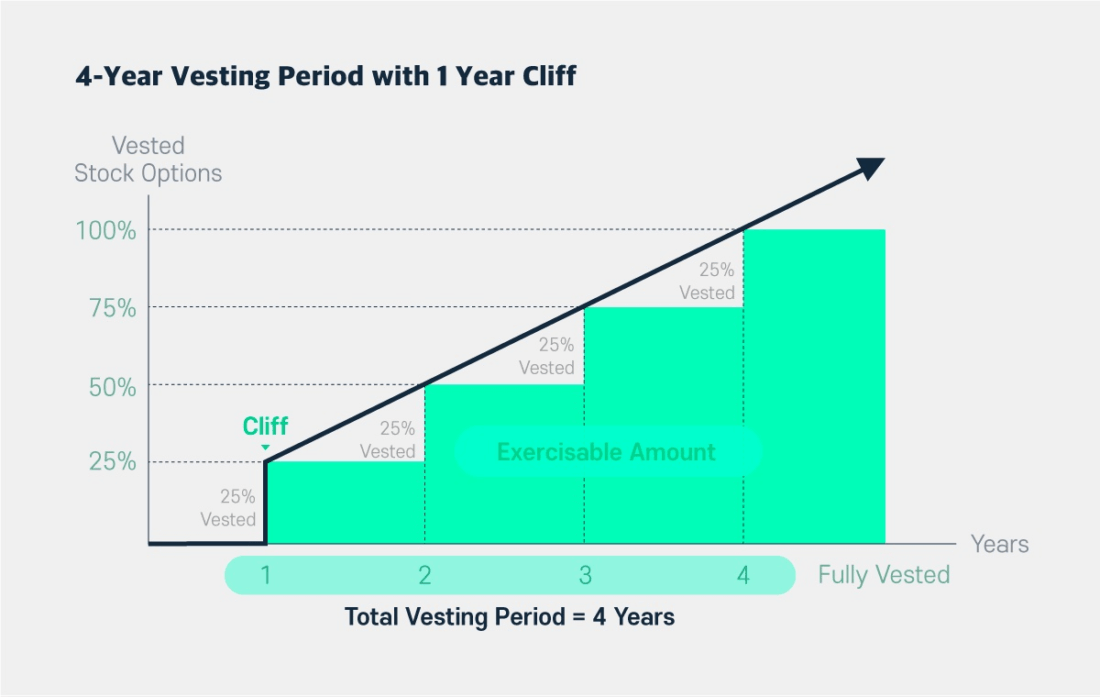
A simple real-life analogy: you joined a startup and were given stock options (the right to buy at a low price). But you cannot sell them right away, there is a 4-year vesting schedule with a 1-year lockup period. This motivates you not to quit after a month, but to keep working at the company. The scheme in crypto is the same, only implemented through a smart contract.
Thus, vesting protects the project from the quick exit of creators and investors and therefore increases the trust of ordinary traders.
Key components of a vesting schedule:
- Cliff (cliff / "drop-off") — the initial period of full lockup (usually 6-12 months after TGE — Token Generation Event, the moment of launch and listing). Zero tokens.
- Vesting Period — the total term (2-5 years for the team).
- Release frequency — the periodicity of unlocking: linear (monthly), stepwise, or continuous (streaming).
Here is a classic schedule with 4-year vesting and a 1-year cliff (25% immediately after the cliff, then linearly):
Types of vesting schedules:
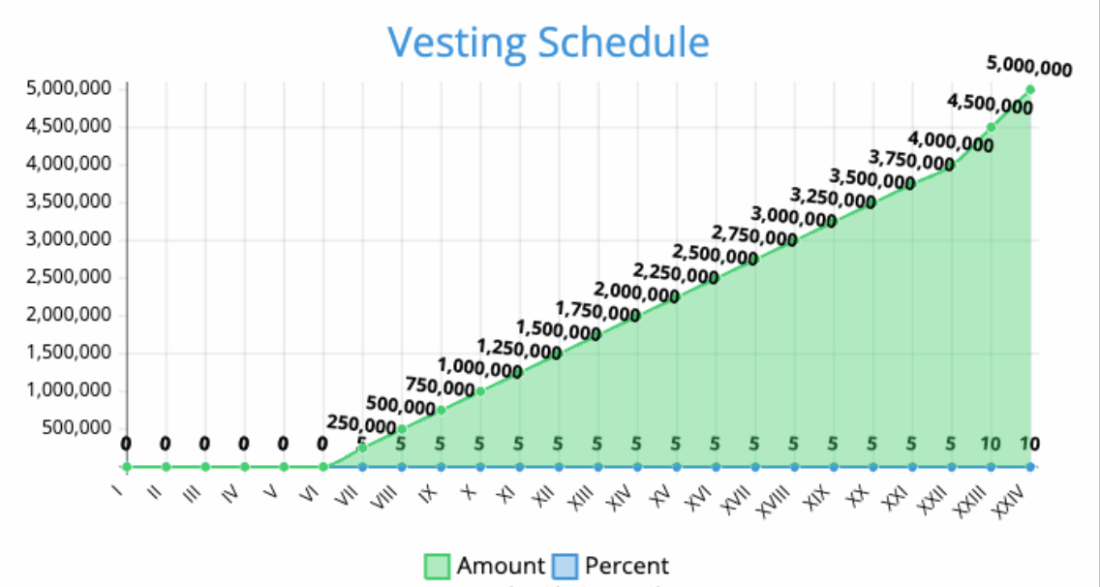
- Linear — evenly every day/month. The most predictable and fair. Example: 1/36 each month after the cliff.
- Cliff + Linear — the most popular in crypto projects.
- Step / Stepwise — large volumes once per quarter/year.
- Exponential / Back-loaded — little at the beginning, a lot at the end (motivates staying until the finish).
- Milestone-based — according to project achievements (rare, but ideal).
An example calculation for a beginner: a team member was given 120 000 tokens. The schedule is a 1-year cliff + 3 years linear (36 months). After 12 months → 30 000 tokens immediately (25%). Then each month ≈ 2 500 tokens (90 000 / 36).
Here is an example of a linear vesting schedule:
What Is Token Unlocking
Unlocking is the event when tokens from vesting become available for transfer and sale. They move from locked status into circulating supply (the amount of cryptocurrency freely available for trading on the market).
Unlocking is the execution of vesting. It can be daily/monthly (linear), a large one-time release after a cliff, or tied to events (TGE, mainnet, etc.).
After the unlock, the holder can sell the token (creating selling pressure), send it to staking, provide liquidity or use it in DeFi, or simply hold the coin.
Technically, everything is controlled by a smart contract, and it is impossible to “trick” it without a hack.
Who usually receives vested tokens, and how many?
A typical healthy allocation in a solid project (2025-2026) looks like this:
The team and founders receive 10-20% (4+ years of vesting), early investors (Seed/Private/VC) get 15-30% (1-3 years). Advisors usually receive 1-5% (1-2 years). The ecosystem / Treasury / Community get 20-40% (partly linearly for airdrops, grants, staking rewards). The liquidity pool and public sales get 5-15% (often without a long lock or with a short one).
It is important to watch out for a team holding >25% without vesting, investors without a lockup, or a huge treasury with no transparency.
How does unlocking affect a token's price?
Unlocking is one of the main volatility factors for altcoins. An increase in circulating supply with constant demand lowers the price, creating pressure (supply & demand).
In the same context, the psychological factor is also worth considering. For example, before an unlock, social media explodes with phrases like “unlock tomorrow, dump it!”.
The statistics (an analysis of thousands of events in 2024-2025) for unlocks look like this:
- 70-90% of large unlocks cause a short-term drop of 5-30%.
- The effect begins 7-30 days before the event.
- Developer and investor unlocks are the most dangerous.
- Liquidity unlocks from large holders are less painful.
Examples
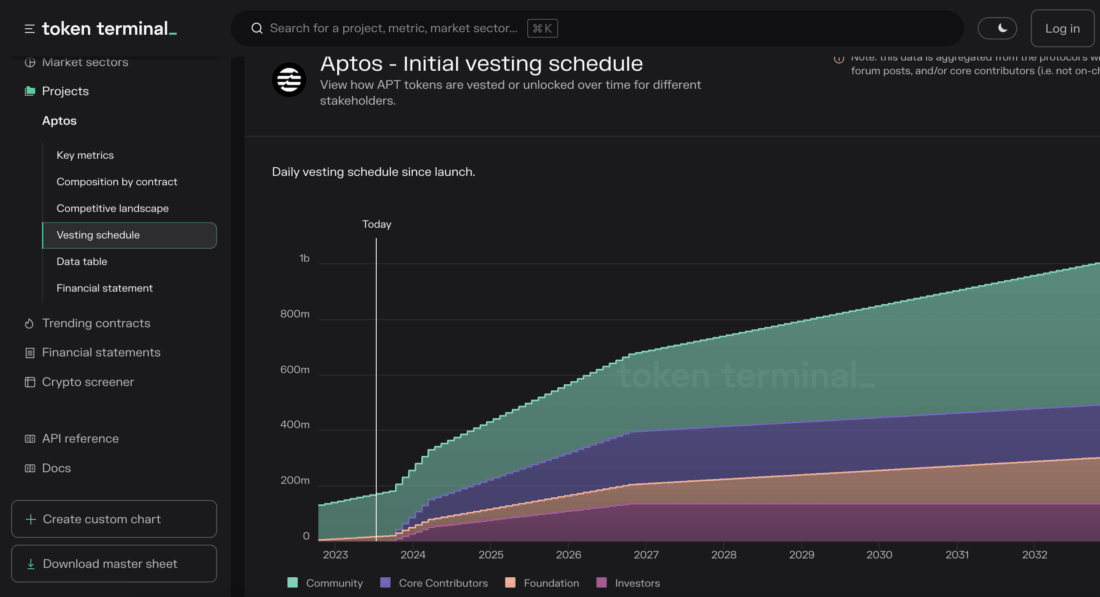
Aptos (APT): regular monthly unlocks of ~11 million tokens (≈1% of the supply). The vesting schedule looks like this (core contributors, investors, foundation shown in different colors):
Solana (SOL): linear unlocks for early investors helped it survive the crisis after the FTX collapse, as the market gradually absorbed the coins.
Sui, Arbitrum, Optimism, Celestia saw waves of unlocks in 2024-2025 worth billions of dollars. In a bear market they fell harder, while in a bull market the dips were easily bought up. In 2025-2026, more than $15 billion in total unlocks was expected (according to RBC Crypto).
It is important to remember that not everyone sells. Many reinvest into staking or hold the coins. If the project is growing (TVL, users, revenue), an unlock can pass almost unnoticed.
Tools for tracking unlocks and vesting
Top services (relevant as of 2026):
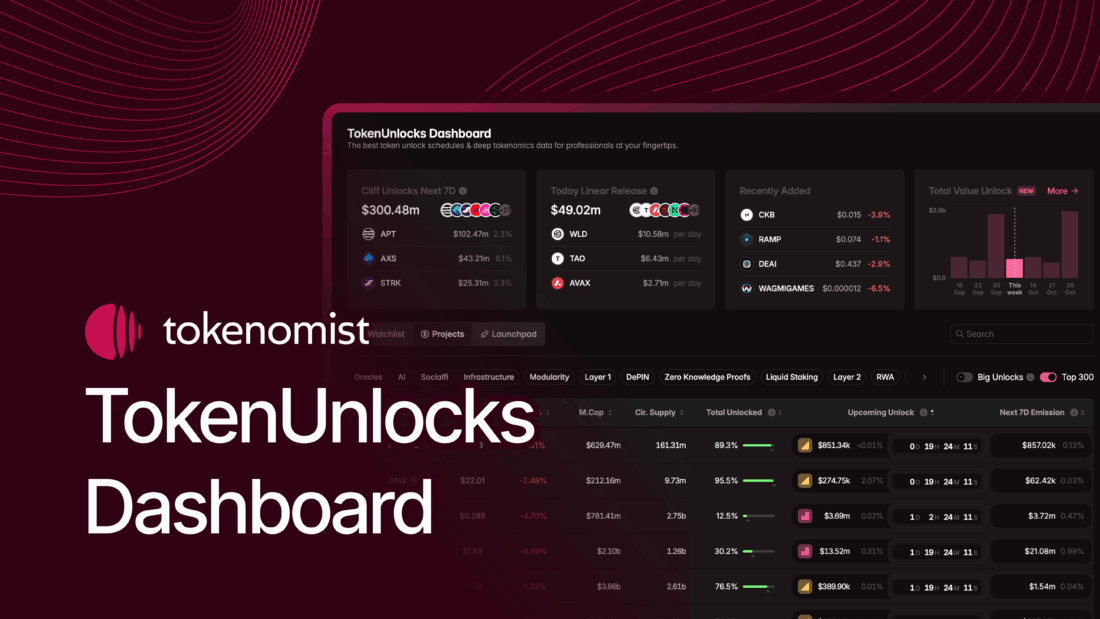
Tokenomist.ai (formerly token.unlocks.app) is No. 1. Beautiful dashboard, filters by unlock size, % of market cap, who receives tokens, charts. This is what a typical dashboard looks like:
CryptoRank.io/token-unlock is a convenient calendar plus vesting charts.
CoinGecko and DropsTab have an “Upcoming Token Unlocks” section.
Official project docs + Dune Analytics (for on-chain).
Advice for a beginner investor: if a large unlock (>3-5% of circulating supply) is expected in the next 30 days, think twice before buying the coin.
Practical Tips for Beginners
- Always look at asset distribution and the vesting schedule before buying.
- Avoid buying 1-2 weeks before a major token unlock belonging to developers or key investors.
- High FDV (Fully diluted valuation, fully diluted value) + low circulating supply + nearby unlocks = high dilution risk.
- In a bull market, unlocks are absorbed more easily. In a bear market, worse.
- Look for projects with long team vesting (>3 years) - this is indirect confirmation of the project's viability.
- After an unlock, there is sometimes a bullish move if there turned out to be few sellers.
- Watch on-chain (Arkham, Nansen, Etherscan/Solscan) to know where the unlocked tokens went.
- Diversify and think 1-3 years ahead.
FAQ - Answers to Frequent Beginner Questions
- Can you buy a token before full vesting? Yes, but the future increase in the total supply of the cryptocurrency (dilution) is already priced in.
- Do they always sell after an unlock? No - they often stake or hold.
- Can a project change the schedule? Yes, through a vote or a unilateral decision, but it is a blow to reputation.
- Is vesting only for the team? No - for all insiders and often to increase community loyalty.
- How do you calculate the "real" price? Look at Market Cap on circulating supply, not FDV.
- Is there vesting in memecoins? Rarely - that is why they are so volatile.
Conclusion
Vesting and token unlocks are among the most powerful protective mechanisms of the crypto ecosystem against mass manipulation. Thanks to them, "fast money" becomes long-term obligations, as in the stock market.