
Two Sides of Trading: Gambling Addiction and Strict Discipline
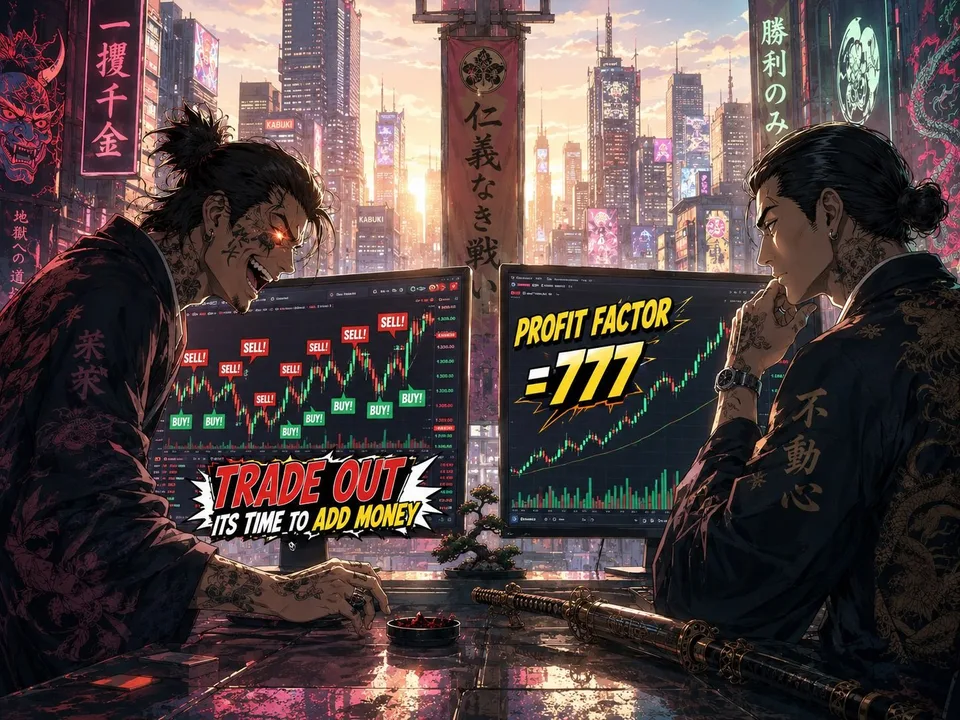
Trading is not just working with charts and numbers. It is a mirror in which the deepest traits of personality are reflected: attitude toward uncertainty, the ability to withstand pressure, a tendency toward self-deception. But there is a boundary dividing all market participants into two fundamentally different camps. It is not the size of the deposit, not a trading strategy, and not experience. It is the presence or absence of conscious management of the risk of ruin.
Risk of ruin is the mathematical probability of losing all capital under given trading parameters. A trader who does not take it into account, and a trader who builds all their activity around controlling this risk, are two opposite universes. They think, feel, act differently and, ultimately, arrive at diametrically opposite results. This article proposes comparing their psychological profiles, trading styles, and degree of reasonableness of behavior.
In this article, we will examine two psychological trading strategies and show the advantages of the one that allows you to earn money compared with the one that leads to constantly draining the deposit. In addition, we will explain how to determine your type of trading: for this, you will need to fill out a questionnaire and use the Risk of Ruin calculator.
Psychological Profile of a Gambler-Trader
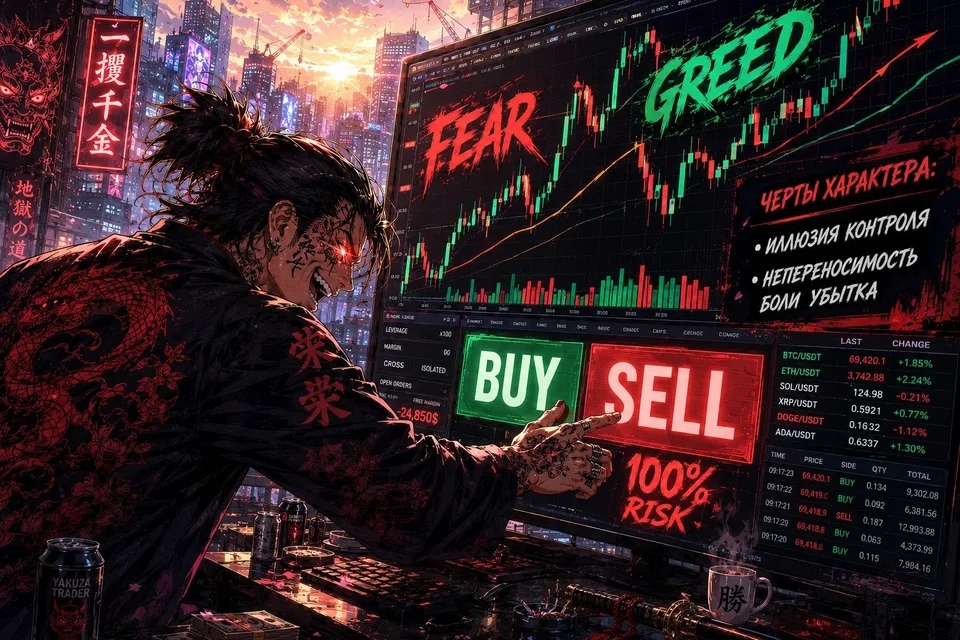
The inner world of a trader who endlessly drains the deposit is very simple. The main characteristic of such a trader is that reality has been replaced by a vivid fantasy. Such a trader comes to the market not for stable income, but for an emotional explosion, the feeling of omnipotence that random large wins give. Their consciousness resembles a roller coaster, from euphoria to deep despair in one trading day.
The dominant trait of such a psychological profile is the illusion of control.
The gambler-trader thinks that they understand the market, that their intuition, special indicator, or secret strategy lets them foresee price movement. They sincerely believe that big profits are the result of their genius, while losses are an annoying accident or the machinations of “puppet masters.” This belief is so strong that it blocks any danger signals. When price goes against them, they do not see real risk; they see only a temporary misunderstanding that is about to resolve in their favor.
The second key characteristic is intolerance of the pain of loss.
A gambler-trader who ignores the risk of ruin perceives every losing trade not as a statistical inevitability, but as a blow to self-esteem. Taking a loss is equivalent for them to admitting their own worthlessness. Therefore they are ready to do anything just to avoid this pain: average down, sit through losses, add volume, hoping for a miracle. They would rather put all capital at risk than accept a small but inevitable loss. Their psyche represses the very word “stop-loss,” perceiving it as an enemy.
The mind of such a trader is captured by the thirst for profit and revenge. After a series of wins, they feel euphoria, their confidence soars to the sky, and they sharply increase position size, precisely at the moment when the probability of a losing streak rises as much as possible. After a painful loss, they fall into a state of gambling frenzy, striving to win it back immediately. In this state of tilt trading, they enter trades without a plan, violate every possible rule, and increase risks like a player putting their last chips on red. The brain switches off rational thinking, and the amygdala and dopamine loop take over.
The emotional background of such a trader can be described as constant swings. The state of joyful excitement during moments of profit is quickly replaced by anxiety, irritation, anger at the market and at themselves when the profit evaporates.
Calmness and neutrality are unfamiliar to them; they live in a mode of constant combat readiness, which exhausts the nervous system. This is exactly why their sleep is disturbed, decisions are impulsive, and life outside the terminal fades compared with the bright flashes of market adrenaline. This is the psychology of a gambler, not a capital manager.
Trading Style Without Risk Management
Spontaneity is the exact definition of this approach. The trading style of a trader who does not take the risk of ruin into account is characterized by a lack of system and a hypertrophied appetite for returns. The goal is not a planned increase in the equity curve, but the fastest possible multiplication of the account, most often expressed in fantastic percentages per month.
Position size. The trader determines position volume not by the share of risk in the trade, but by the desire to earn a specific amount. They often use the maximum possible leverage. Risk on one trade may be 20%, 50%, or even the entire deposit in the hope of a “sure thing.” The concept of a fixed risk percentage is absent.
Loss management. The trader fundamentally does not place protective orders. They either hope for manual closing “when it pulls back a little,” or use “mental stops,” which are constantly moved. A common technique is martingale: doubling the position when price moves against the forecast. This creates the illusion of an imminent break-even exit, but in practice exponentially brings the moment of total collapse closer.
Decision-making. The basis for entry is emotions, unverified signals, advice from social networks, or “gut feel.” There is no system as such, but there is a kaleidoscope of indicators thrown onto the chart and chaotic switching between timeframes. The trader often opens trades under the influence of fear of missing out on a move (FOMO): the trader jumps onto an already moving train at the peak of excitement.
The time horizon of such a trader is extremely short: they crave an immediate result. Holding even a profitable position for a long time is painful for them, so profit is taken prematurely, while losses, on the contrary, accumulate and are held for weeks in the hope of a reversal. Such an asymmetric profile of profits and losses by itself makes positive mathematical expectation unattainable.
Reasonableness of the Gambler-Trader’s Behavior
From the point of view of probability theory and rational choice, the behavior of such a trader is a model of unreasonableness. Reasonableness in trading is the ability to act in a way that maximizes long-term utility while preserving the ability to continue the game. Here, every behavioral model leads to guaranteed ruin.
The main criterion of unreasonableness is ignoring the system’s mathematical expectation.
The trader does not calculate the risk/reward ratio, does not collect statistics, and does not analyze win frequency. They are focused exclusively on the outcome of the current trade, which is classic “narrow framing.” Even if they get lucky several times in a row, the method itself guarantees that sooner or later an event called a “black swan” will occur (for example, Trump introducing tariffs in April 2025), or simply a prolonged losing streak that will lead to a rapid draining of the account. And all because the trader violates the main law of survival under uncertainty: they stake more than they can afford to lose.
Constant use of strategies with negative expectancy, averaging losses, and martingale with limited capital mathematically predetermine ruin. It is not a question of “if,” but a question of “when.” Reasonableness is replaced by cognitive distortions: the sunk cost trap (holding a losing position because “too much has already been lost”), confirmation bias (searching for arguments in favor of one’s forecast), and the illusion of pattern in random events.
Psychological Profile of a Successful Trader
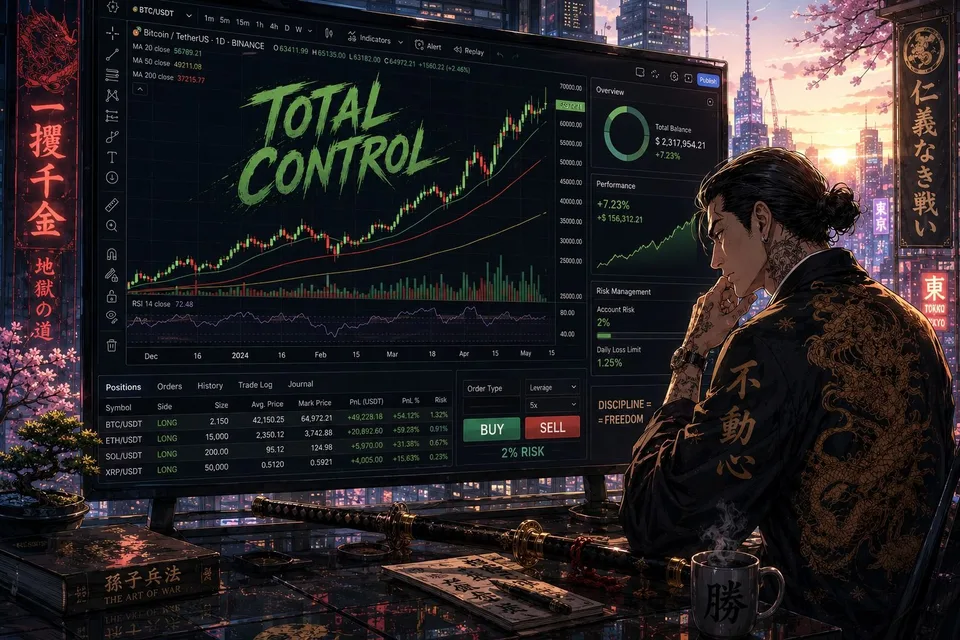
Such a trader has an entirely different personality structure. Instead of emotional swings, there is an even, almost stoic acceptance of reality. Such a trader has long learned the market's main paradox: to earn money, one must first learn to lose, i.e. protect capital. His psychology is based on humility before uncertainty and absolute inner discipline.
The psychological core is accepting losses as part of the business. For him, a loss is not a tragedy or a verdict on his intelligence, but an operating expense, just like server rent or an internet bill. Such a trader knows in advance how much he will lose if the trade does not go according to plan, and that amount is acceptable to him. Therefore, he sets a stop-loss with a cool head and feels no desire to move it.
A successful trader's self-esteem is not tied to the outcome of a single trade; it is based on the awareness that the trader strictly follows his methodology. The trader feels satisfaction from work done well, even if it produced the planned loss. This is the mindset of a professional, not a gambler.
The second most important element is managing fear and greed through formal rules. A disciplined trader does not fight emotions with willpower; he uses algorithmization of behavior.
His trading plan clearly specifies the maximum daily limit of losses, risk per trade (usually 1-2%), and conditions for increasing volume. When the loss threshold is reached, the terminal shuts down automatically; this is a rule that is not up for discussion. In this way, such a trader prevents a gambling breakdown.
A successful trader possesses probabilistic thinking. He understands that over the long run, any series of three or even ten consecutive losses is a normal phenomenon for a profitable system with a 50% win probability.
Such a trader does not look for a Grail that gives 100% accurate signals. His calm is based on knowledge of the law of large numbers. From this comes patience: he may avoid making trades for days and weeks if market conditions do not meet the criteria of his system, without feeling FOMO. His motto: "Missed profit is better than an incurred loss."
Emotionally, the trader is not charged toward getting thrills, but toward mastery in executing routine: daily analysis, a journal, and work on mistakes. His pleasure is the calm, long-term, and steady rise of the yield curve.
Trading Style with Risk Management
The style of a successful trader is a methodology elevated to the rank of a business process. Everything is algorithmized and stripped of spontaneity. The scheme of success is very simple.
Position calculation. The lot size is calculated based on two unchanging values: the size of capital and the distance to the stop-loss in points. The formula is simple: risk in currency / (stop in points x point value) = volume. This mathematical ritual is performed before every entry and does not depend on the degree of confidence in the trade.
Capital protection. Hard stop-losses are set immediately when a position is opened. The trader respects the "two percent rule", the maximum permissible risk per trade. In addition, daily and weekly loss-limit rules are often applied. Diversification is used to smooth equity, even if only one instrument is traded: strategies or timeframes are diversified.
Decision-making. Trading is conducted strictly according to a system, whether mechanical or discretionary, but with clearly formalized criteria for entry, position management, and exit. Every trade is necessarily recorded in a journal. This journal becomes a feedback tool: the trader analyzes statistics, identifies weak points, and evaluates the ratio of profit factor, expected value, and average drawdown. Decisions to modify the system are made only on the basis of a significant sample, not emotions after a couple of losses.
Goals. The strategy's focus shifts from absolute return to risk management. The ideal result is a smooth equity curve with minimal drawdown and predictable volatility. Even a conservative return of 3-5% per month, when reinvested, gives impressive compound interest, and the trader clearly understands this. Speed does not matter; longevity matters.
Rationality of the Behavior of a Risk-Managing Trader
The behavior of a successful trader fully meets the criteria of a rational economic agent acting under conditions of uncertainty. His approach is pragmatic and mathematically calibrated.
The key criterion of rationality is optimization of long-term capital growth. The trader consciously applies a strategy that maximizes geometric growth, not arithmetic growth. He understands the fundamental law: negative mathematical expectation with any capital management will lead to loss, while positive expectation without risk control will lead to ruin due to inevitable drawdowns.
A successful trader views trading through the lens of probability theory and statistics. Rationality is shown in the fact that he evaluates any trade not by its outcome, but by the quality of execution of the signal prescribed by a system with a proven statistical edge.
This removes cognitive dissonance: a losing trade can and should be "good," while a winning one can be "bad" if it was made in violation of the rules. This view completely eradicates the influence of the result on future decisions.
Observing strict risk limits and rejecting martingale ensure fulfillment of the survival condition. The trader makes a series of dozens of consecutive losses noncritical for the trading account, which mathematically allows him to wait for a favorable streak and realize positive mathematical expectation. This is not just discipline; it is a manifestation of high intelligence capable of modeling long-term consequences.
Finally, a successful trader accounts for the psychological aspect as a risk factor and formalizes it through restrictions, understanding that a person is weak and prone to tilt. Thus, his rationality lies in creating a system that protects capital first and foremost from his own irrational impulses.
Determine Your Trader Type

Determining your type of trading is extremely important for successful trading. To determine your type, it is worth conducting a small psychological study and analyzing your trades in the risk of ruin calculator.
Below is a self-diagnosis questionnaire built on the contrast between two psychological profiles. By answering the questions honestly, you can understand which type you gravitate toward and receive targeted recommendations.
Table for Determining a Trader's Psychological Type
No. | Question | Gambler | Real Trader |
|---|---|---|---|
1 | How do you determine position size? | I want to earn $1000, so I will enter with maximum volume | I calculate the risk percentage of the deposit and the distance to the stop-loss. Volume is always subordinate to risk. |
2 | Where is your stop-loss? | Most often in my head. I believe I can exit manually when I "understand that I was wrong." Or I do not set one at all. | Physically set in the terminal immediately upon entry. Its place is determined by market structure, not by my pain. |
3 | How do you react to 3 losing trades in a row? | Anger and a desire to win it back immediately. I increase volume in the next trade to quickly return everything. | I check against statistics. Three losses are normal for my system. I take a pause, check the daily loss limit. |
4 | What do you feel when the price comes right up to the stop-loss? | Panic and hope. I start looking for reasons to move the stop or average down, just to avoid taking a loss. | Nothing except slight curiosity. The risk has already been accounted for, and I will calmly accept the outcome. The work is done. |
5 | How do you perceive a profitable trade? | As confirmation of my talent and "instinct." Euphoria, I immediately look for the next entry to consolidate success. | As the result of the system's work. I analyze whether I did everything according to plan. A good trade is not a reason for euphoria. |
6 | Do you have a trading plan for the day/week? | A plan is boring. I trade according to the situation, relying on intuition and news. The plan constantly changes. | Yes, a clear plan. Entry criteria, risks, and action scenarios are written out. Deviations are an emergency, not the norm. |
7 | How long can you not trade? | It is very hard to sit without a position. If the market is moving and I am not, I feel that I am missing money (FOMO). | I calmly wait for my formations. A week without trades when there are no signals is an excellent week. Capital is preserved. |
8 | How do you feel about a 20% drawdown from the deposit? | This is a working moment; it happens. It means I need to increase risk in the next trade to get back into profit faster. | This is a catastrophe and a reason to immediately stop trading and review the system. Such a drawdown should not happen. |
9 | What is more important to you in trading? | Thrills, excitement, quick money, proving to myself and others that I am smarter than the market. | Stability, peaceful sleep, long-term capital growth, predictability of results. |
10 | Do you keep a trade journal? | No, I remember everything in my head. A journal is a waste of time that can be spent searching for new entries. | Yes, it is the main tool. I record screenshots, emotions, and reasons for entry. I regularly analyze mistakes. |
Interpretation of Results
If you have 8-10 "A" answers: Your psychological profile is "Player." You trade for emotions, ignoring mathematics. The risk of ruin is extremely high.
If you have 5-7 "A" answers: Unstable type. You understand the importance of rules, but emotions often take over. You are in the turbulence zone.
If you have 8-10 "B" answers: The "Risk Manager" profile. Your approach is rational, and your chances of long-term success are high.
Short Recommendations for Correcting Behavior
If you have found in yourself a tendency toward type "A," you are not condemned. This can be corrected by forming new neural connections through routine.
Turn capital management into a physical ritual.
The most destructive habit is setting a stop "by eye" or not setting one at all. Start with the "five steps" technique: 1) Defined the entry point; 2) Defined where the scenario is canceled (your stop); 3) Measured the distance in points; 4) Calculated the volume to lose no more than 1% of the deposit; 5) Entered and immediately placed the order. Only this way, without exceptions. The brain calms down when an action turns into an algorithm.
Introduce a "money stop valve."
If you have a constant desire to win it back, set a technical loss limit for the day (for example, 3% of the account). As soon as it is reached, you are obliged to close the terminal until the next day. This rule must be as immutable as the law of universal gravitation. It breaks the "anger-winback-blowup" loop.
Keep an "emotion journal," not only a trade journal.
Before each entry, write down your state in one word: "calm," "anxiety," "euphoria after a win," "I want revenge on the market." If you see the words "euphoria" or "revenge," entry is forbidden. This will teach you to distinguish the voice of the system from the voice of a distorted psyche.
Work with self-esteem outside the market.
Often excitement and unwillingness to admit a loss are connected with the fact that trading has become the only source of self-affirmation. Loss = "I am stupid." Shift the focus: regular sports, a hobby with measurable progress, skills unrelated to money. A self-confident person calmly accepts a small planned minus, because his "self" does not collapse from it.
Instead of a Conclusion
Comparing two types of traders, we see not just different trading styles, but two diametrically opposite worldviews.
One lives in a world of illusions, where luck masquerades as mastery, and every drawdown is a step toward a financial and emotional abyss. This is the psychology of a short-timer, for whom the market is a casino with a bright sign. The other builds his path on the foundation of mathematics, discipline, and deep self-understanding. His psychology is the psychology of a manager, a creator who turns the chaos of market quotes into a structured business.
The true boundary between the two types does not run through the size of capital, but through a simple question: "What maximum loss am I ready to accept in the next trade?" The first trader does not know the answer and is afraid to hear it. The second knows it down to the cent, because this answer is the basis of his calm and future prosperity.
To understand with precision what the true nature of a trader is, it is worth using the Risk of Ruin calculator. It will show the trader's risk of ruin: the more a trader's psychological profile resembles that of a gambler, the higher the risk of ruin.
The market rewards rationality with flawless cruelty and methodically punishes self-confident ignorance. Everyone makes the choice between destructive excitement and creative discipline for themselves, and this choice determines everything.