The Strategy of the Trader Who Moved the Nikkei 225 Single-Handedly

I would like to touch on the topic of pair trading, popular on Forex among beginners. Many of them notice the synchronous (identical) movement of currency pairs, quickly realizing the possibility of making money on divergences in such movements.
In this case, profit is brought by the tactic of shorting one asset and simultaneously taking a long position in another instrument with positive correlation or same-direction trades with negative correlation. That is why the strategy was named pair trading, although in the case of currencies two trades can be replaced with one by trading cross pairs.
Many resources describe the danger of pair trading or quasi-arbitrage, but there are always exceptions to every rule. In the Forex currency market there is a person who trades this strategy with proven profit. Without possessing or striving to learn the subtleties of the science of trading, he gained hundreds of thousands of followers, made it into the business press, and received an article on Wikipedia.
Let us see how the famous trader CIS from Japan trades, and analyze his strategy for USDJPY and the Nikkei 225 index.

The simple rules of searching for divergences and waiting for convergence are attractive because they do not require extensive knowledge of theory, complex trading systems, fundamental and technical analysis. Visual observation of charts and determining a certain divergence threshold for trades is enough.
Experienced traders know that the dynamics of exchange rates can diverge by up to a thousand points, bringing a double loss on each open position, and never converge. Ultimately, all lovers of pair trading in currencies may well face a blowup.
Such a development is predetermined in advance: it is enough to look at the correlation coefficient, which indicates the ability of the quotes of one instrument to repeat the movement of the quotes of another. It is defined in values from 0 to 1, that is, 100% interconnection, where 70% already "foretells a potential blowup" in pair trading.
How Trading on Forex Without Experience and Knowledge Brought a Trader from Japan Millions of Dollars

In 2015, a Bloomberg journalist went to Japan to meet the owner of the Twitter account @cissan_9984. The well-known business publication had been watching him since 2013, noting the constant growth in the number of trader followers, which by that time had reached several tens of thousands, and a stream of grateful reviews for public trades.
By that time, the 36-year-old young man hiding behind the pseudonym CIS had gained wide fame on national trading resources through provocative posts, flaunting an almost complete lack of knowledge while successfully conducting intraday and medium-term speculation in futures on the JPY and EUR currencies and the Nikkei 225 and S&P500 indices, while forecasting the market better than many analysts.
Thanks to CIS's active, almost around-the-clock communication on social media, one could see that the trader's day was mainly occupied by video games and cards, in between which he traded on Forex and the stock market.
The trader achieved worldwide fame in 2015, when during the market crash he managed to earn tens of millions of dollars in a period of just over a week. Profit was brought by trades in both directions: in mid-August CIS sold Nikkei 225 futures, after August 21 he opened a reverse position, actively accumulating longs, managing to earn on the panic sell-off, buy at the bottom, and earn on the rebound.
A Bloomberg journalist wrote an article about this, which spread in millions of reposts around the world, and CIS presented as proof of success broker statements for $186 million earned in trading.

The trader embodied the dream of many people who come to the Forex market for easy money, without spending a single day on learning trading and increasing the amount of the trading account every year. Starting with a balance of 1 million yen (almost 600 thousand rubles), by the end of 2018 CIS had 23 billion in the national currency or 2.1 billion U.S. dollars.
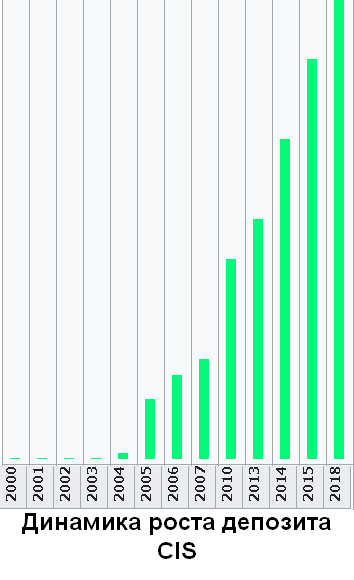
The article changed the young man's life: in 2015 he lived in a rented apartment, did not go farther than the nearest cafes and restaurants, and devoted more time to video games than to trading. After the Bloomberg publication and the growth of new followers on Twitter to hundreds of thousands, he began listening to the advice of the community, which urged him to think about the future.
In three years CIS became the owner of real estate, received rental income, turned into a rentier and bond holder, and wrote a book on investment philosophy.
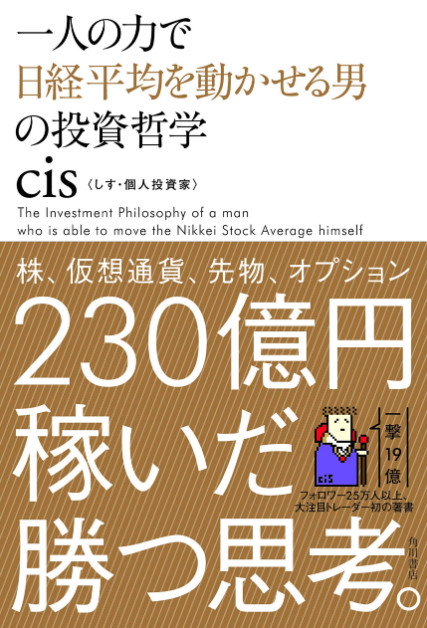
What remained unchanged was the approach to the strategy of earning on the Forex, securities, and, more recently, cryptocurrency markets. He builds absolutely all forecasts of future movements and trades on the basis of pair trading, correctly selecting instruments interconnected with each other.
The Philosophy of Pair Trading as Presented by CIS

According to the Japanese trader, the topic of currency and stock exchange speculation attracted him while he was still studying at Hosei University. Professional card playing taught CIS attentiveness and the search for patterns, and also helped with risk management by determining the size of investments in each trade, since stop losses were not provided for in the strategy.
While watching the stock market, the trader saw the possibility of forecasting the movement of small-cap stocks by observing blue chips. After a strong market rise, CIS looked for lagging securities in the first and second tiers that were part of the Nikkei index.
As a rule, the trader made purchases after a 3-5% gap (lag) in growth; in order not to place stops, the trader used hedging and diversification, selling flagship stocks or Nikkei futures for an amount equal to the purchases, while averaging into the buys by investing funds in other lagging first- or second-tier stocks.
The loss of 70% of the deposit forced CIS to expand the number of traded instruments for the sake of greater diversification and to improve the quality of forecasts. As a result, he went beyond the stock market after noticing the relationship between the national currency rate and the Nikkei, adding to this the inter-index arbitrage of the Japanese and U.S. markets. After such changes, the trader no longer lost more than 40% of the deposit.
The Strategy of Currency-Index Pair Trading
Platform: Metatrader 4
Trading instruments: a combination of national indices and currency (except EURUSD, American indices, and EU countries, excluding Great Britain)
Timeframe: from H1 to D1
Recommended brokers: Alpari, RoboForex, TickMill
Trader CIS uses one well-known feature to forecast the movement of a currency or index: "The national stock market falls together with the strengthening of the national currency and rises when it weakens
The yen is actively traded on the international Forex market, having the unofficial status of an Asian reserve currency. Currency speculators may react in advance to negative or positive events that the Nikkei stock index prices in with a delay.
At such moments, a divergence in the dynamics of the currency and the index arises, which attracts arbitrageurs or investors who reverse the rate, and this can be used as an indicator of pivot points.
The RSI indicator helps determine reversal zones by the overbought or oversold state of instruments. Let us look in more detail at the strategy of pair currency-index trading in the Nikkei 225 versus yen combination.
Trading Signals of the Pair Trading Strategy of the National Stock Index and Currency

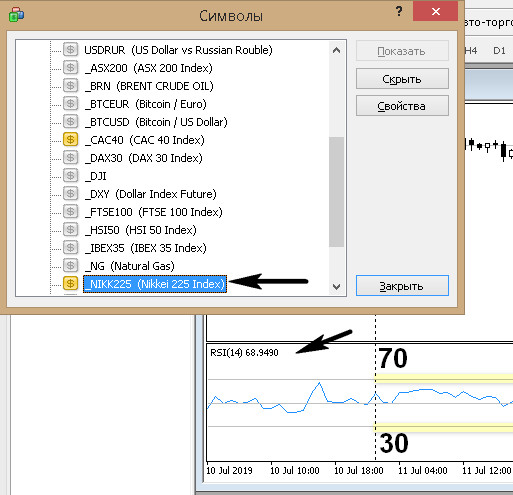
Let us combine both charts, selecting the H1 timeframe, and display on them the RSI oscillator with a period of 14 and levels 50, 70, and 30.
Considering the inverse quote of the USDJPY pair, a long signal is formed when:
In the latter option, the trader will need to take the nuances into account in advance:
In the latter option, the trader will first need to take into account the following nuances:
Let us perform similar actions with the USDJPY currency pair, placing its chart below the Nikkei chart and aligning the hourly candles.
Examples of using the Nikkei index as an indicator of transactions for the USDJPY pair

The figure above shows five examples of such signals on USDJPY. Comparing these overbought and oversold zones with the current RSI values on Nikkei, we will see that cases (1) and (2) will pass without trades, in the third case the pair should be sold, and in the fourth, bought. The fifth is a difficult case in which the conditions for a trade arise after the signal had already been rejected.
Let us consider each case in more detail.
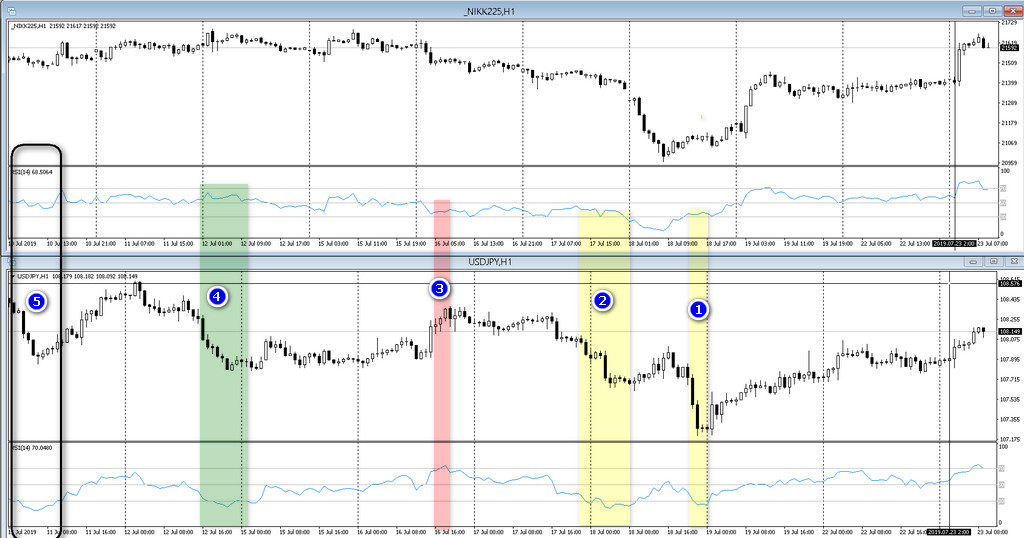
In the second half of July, the yen on the hourly chart strengthened to oversold conditions RSI<30. The rise in the value of the currency had a negative effect on the stock market, which at that moment had fallen and was in a state of flat.
The interconnection of the currency and the Nikkei led to both RSIs being <50 even at the moment when the indicator on the currency exited the oversold zone. According to the strategy rules (currency RSI <30, index RSI >55), in this case there are no conditions for a trade.
A similar situation developed several hours earlier: the currency and the stock market synchronously entered an oversold state. There is no divergence in the RSI dynamics of the two instruments, so we ignore the oversold condition of the currency.
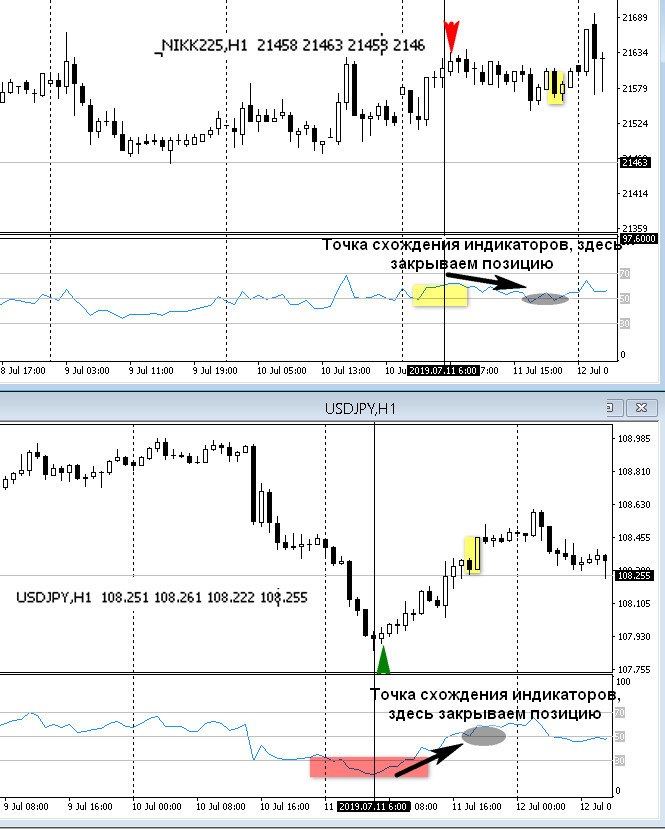
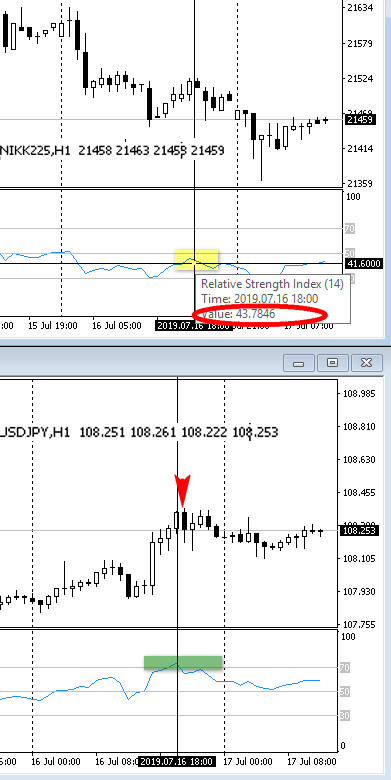
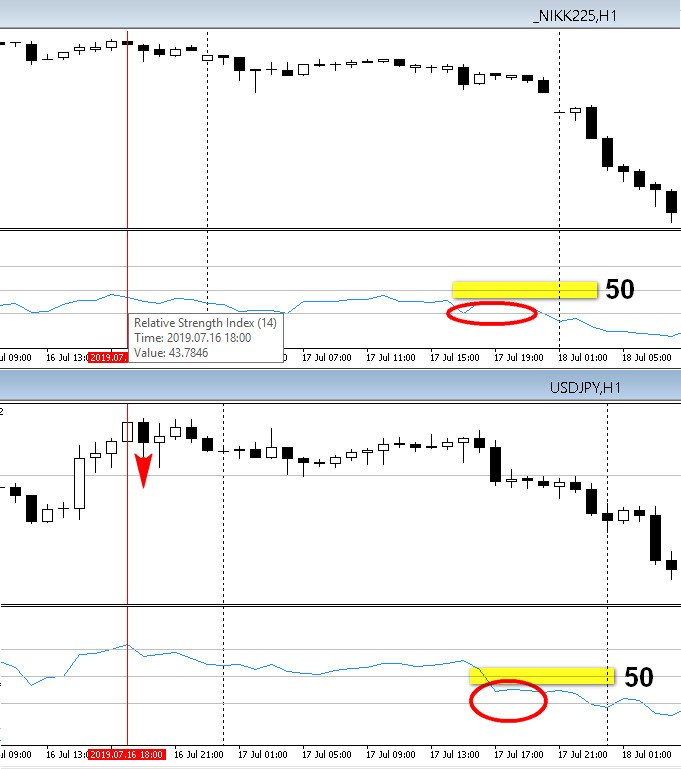
In the third example, the trends of yen weakening, expressed in the rise of the USDJPY pair, diverged from the dynamics of the stock market. As can be seen in the figure below, the currency RSI crossed 70, but the RSI of the Nikkei index at that moment was equal to 43. The entry conditions are met, so we sell the pair at the first return of the indicator below 70.
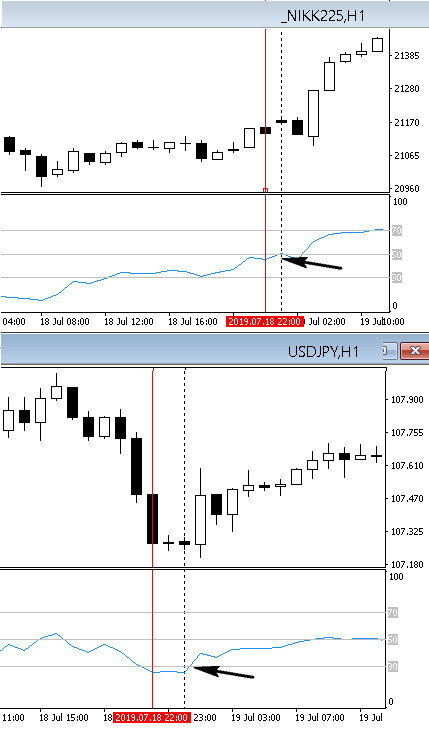
The position is held until the end of the next day; profit taking is determined by simultaneous observation of the position of the two indicators. As can be seen in the figure, the currency RSI moves below 50 as it falls. The RSI curve of the Nikkei index is there as well.
In this case, the divergence in the dynamics of the currency and the index that was the reason for the trade disappears, so it is better to lock in the profit.
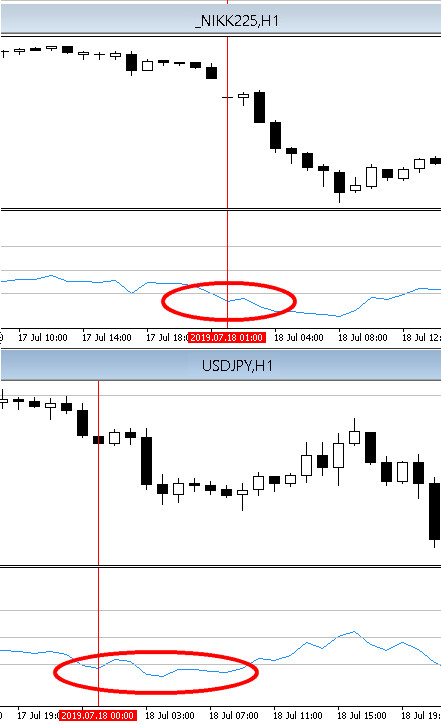
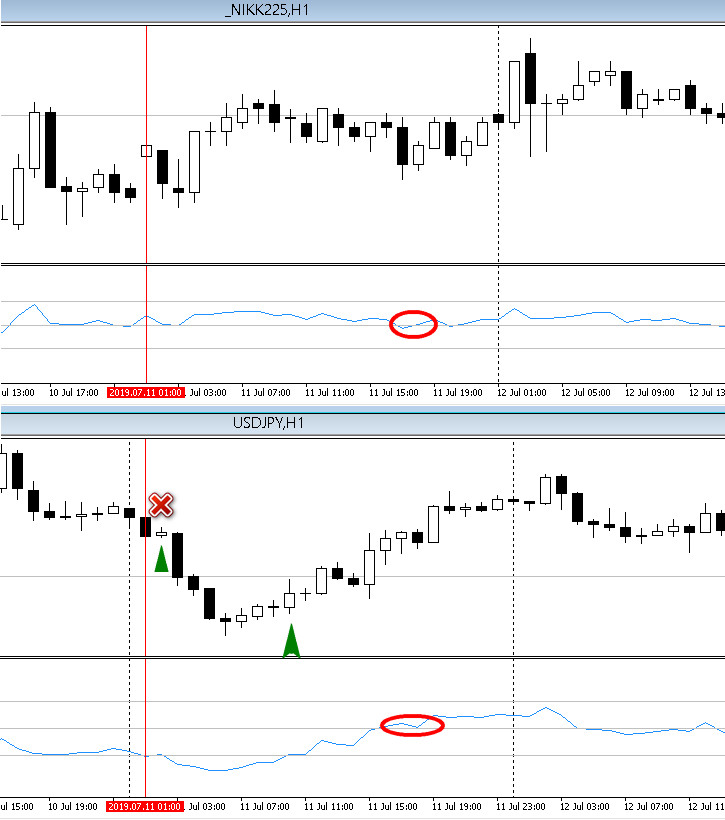
In the fourth example, the first buy signal turned out to be false; pay attention to the figure below: the RSI curve weakly breaks the 30 level at 1 a.m., while the RSI line of the indicator is above 55, but when USDJPY exits the oversold zone, the RSI signal of the index disappears, declining toward 50.
It appears again on the morning of another day when the RSI of the Nikkei chart exits the oversold zone above 55, which leads the trader to a trade. It is held until the curves level out; this time the decline of the stock market lets the RSI into the zone below 50.
The delayed trade discussed above is a frequent occurrence; the market can remain for a long time in extreme states above 70 and below 30 during a strong trend. During this time, the second signal indicator may reach the required values.
In the fourth example, the first buy signal turned out to be false, pay attention to the figure below: the RSI curve weakly breaks the level of 30 at 1 am, RSI lineindicatorat the same time, above 55, but when USDJPY exits the oversold zone, the RSI index signal disappears, decreasing to 50.
The connection between currencies and national indices is fundamental, since both instruments reflect the economic situation in the country and directly depend on the actions of the Central Bank. This reliably guarantees that in the end both parameters will get rid of short-term trend divergences thanks to the actions of arbitrageurs or under the influence of currency interventions by the Regulator.
The strategy is given in general terms, since its creator does not reveal tactical secrets or exact indicator settings and does not fully explain what other indicators he uses in trading. But even such a simple approach allowed trader CIS to take positions in the world's second most important stock market.
Conclusion

Best regards, Ivan Petrov
Tlap.io
The strategy is given in general terms, since its creator does not reveal tactical secrets and precise indicator settings and does not fully explain what other indicators he uses in trading. But even this simple approach allowed the CIS trader to take positions in the second most important stock market in the world.
In his own book, the author boasts that he can influence Nikkei trends with tweets, having unconditional authority among 400 thousand subscribers who are ready to copy the trader’s transactions. However, the strategy does not imply complexity of execution, raising only the issue of the frequency of transactions, but this can be solved by expanding the line of instruments.
Best regards, Ivan Petrov
Tlap.io